

There is no single federal rule that covers hot fueling, meaning fueling while an engine is running. The rules are split by industry and by state. The common thread is simple: shut the engine off before fueling, unless running it is necessary to do the fueling or the equipment is an emergency unit that has to stay online. Anything else is a hot fueling practice you should write a site procedure for, or stop.
This guide walks through the rules we can point to, where the exceptions sit, and how cold weather and night shifts change the risk. It is written for site superintendents, fleet managers and facilities teams who have to defend their fueling practices in an audit or after an incident.
TL;DR
- Federal motor carrier rules prohibit fueling a commercial motor vehicle with the engine running, except when the engine must run to fuel that vehicle.
- OSHA’s longshoring standard requires engines stopped and operators off the equipment during refueling. California goes further, with a narrow carve-out for emergency generators and pumps.
- Cold, dry weather raises static discharge risk. Bonding, grounding, slow filling and staying out of the cab until fueling ends are the core controls.
- Night fueling needs added lighting, signaling and traffic control, because night work surprises the public and crews alike.
- Write your exceptions down: which units may be fueled hot, who approves it, and what spill and fire equipment is staged.
Table of Contents
- What hot fueling means and why it is regulated
- The federal rules that apply
- State rules: California as the clearest example
- When an exception is legitimate
- Cold-weather fueling safety
- Night fueling safety and operations
- Building a hot, cold and night fueling procedure
- How Anytime Fuel Pros supports compliant fueling
- FAQ
- Sources
What hot fueling means and why it is regulated
Hot fueling is the transfer of fuel into a vehicle, generator or machine while its engine is running. It saves minutes on a cycle, and that is why it persists on busy yards, at rail and port operations, and wherever a generator cannot drop load.
The hazard is straightforward. A running engine means hot exhaust components, an electrical system that is live, and in many cases an operator sitting in the seat. Fuel vapors or a small spill meet an ignition source, and a fueling task becomes a fire. Static electricity adds a second path to ignition that has nothing to do with the engine itself.
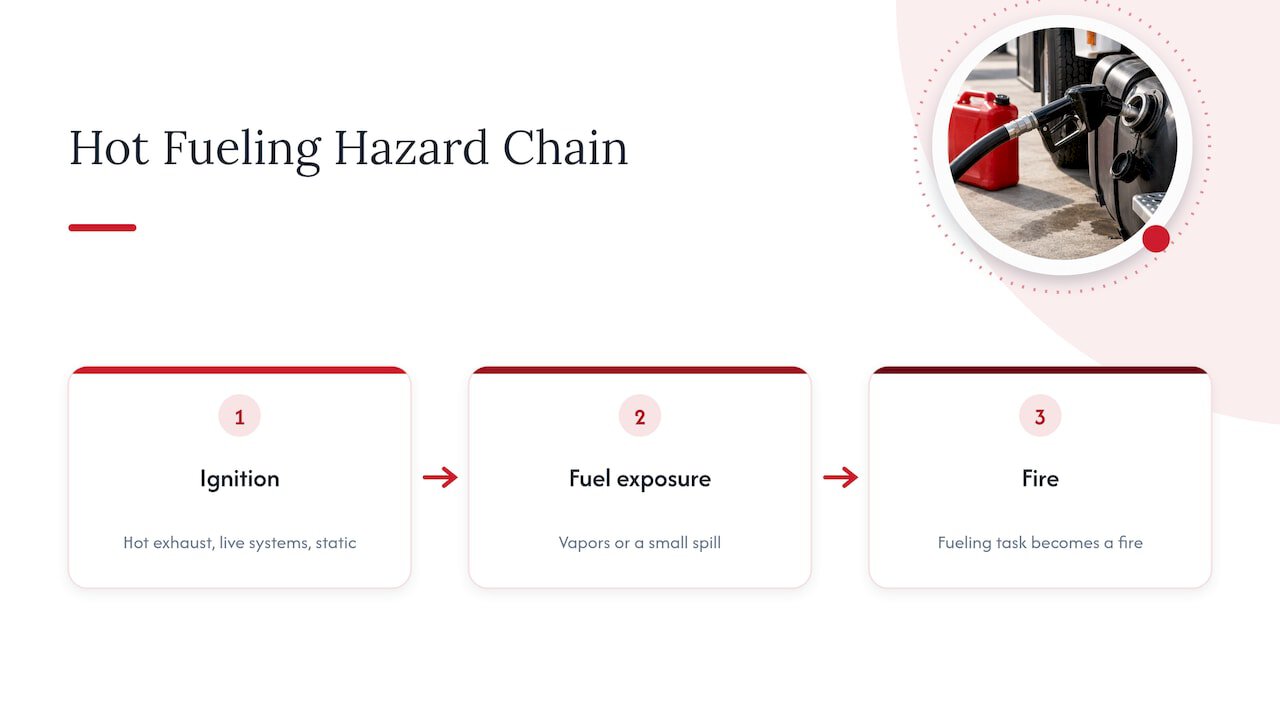
That is why most regulations frame the issue the same way: engine off, operator out, contact between nozzle and tank. The differences are in who the rule applies to and what exceptions it allows.
The federal rules that apply
Commercial motor vehicles: 49 CFR 392.50
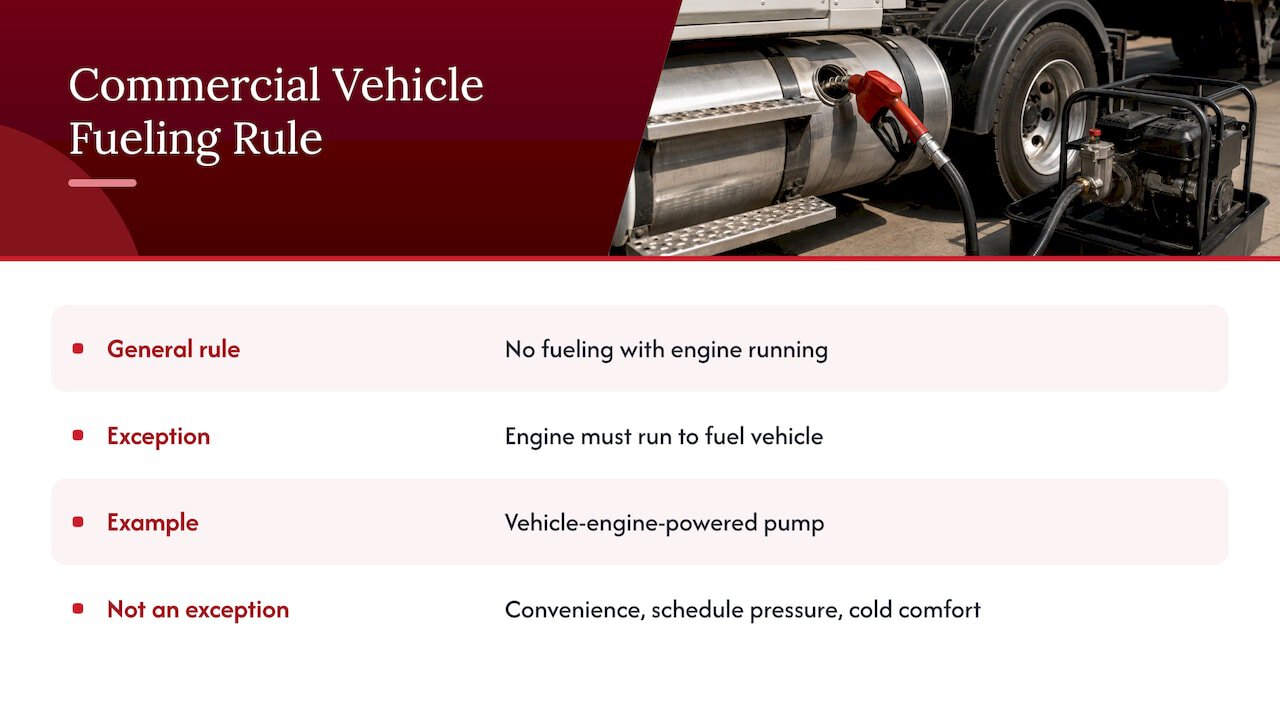
For trucks and other commercial motor vehicles, the controlling text is in the Fueling Precautions subpart of the motor carrier safety regulations. 49 CFR 392.50(a) prohibits fueling a commercial motor vehicle with its engine running, except when it is necessary to run the engine to fuel that vehicle.
The exception is narrow. It exists for situations such as a pump that is powered off the vehicle’s engine. It does not cover convenience, schedule pressure or cold-weather comfort. If your drivers leave tractors idling during fueling in winter, that is a practice to correct, not an exception to cite.
For fleets we fuel on-site, this is the rule that most often shapes a wet hosing routine. Drivers park, shut down, and leave the cab before the hose comes out. Our mobile fleet fueling service is built around that sequence so the yard schedule absorbs the shutdown time instead of the crew skipping it.
Longshoring and marine terminals: 29 CFR 1917.156
OSHA’s marine terminal standard is explicit. 29 CFR 1917.156(a)(3) requires engines to be stopped and operators to be off the equipment during refueling operations in longshoring activities. It applies to that sector, so it is not a blanket federal rule for every workplace. Still, it shows where OSHA’s thinking lands, and inspectors and insurers often treat it as a reference point for good practice on other sites.
If your operation is general industry or construction, do not assume this exact text covers you. Confirm which OSHA standard applies to your work, and check any state plan that may be stricter. Our audit-ready construction fueling plan lays out how to map those standards to a site.
State rules: California as the clearest example
State plans often spell out what federal text leaves general. California is a useful example because its rules are specific and name the exceptions.
- Title 8, Section 1936(g) prohibits fueling while engines are running. Exceptions are granted specifically for emergency generators and pumps where continued operation is deemed essential.
- Title 8, Section 1594 requires engines to be shut off during refueling and good metal-to-metal contact between the fuel supply tank or nozzle and the fuel tank.
Two lessons carry beyond California. First, the exception for emergency generators is tied to essential continued operation, not to preference. A data center generator carrying critical load qualifies for that kind of reasoning. A light tower at a laydown yard usually does not. Second, metal-to-metal contact is a rule in itself. It is the simplest static control there is, and it applies whether or not the engine is running.
If you operate in several states, you will see this pattern repeat with local variations. Fire marshals and local jurisdictions can add their own requirements for fueling at a site, particularly at events, in public right of way and near occupied buildings. Ask the authority having jurisdiction before the job, not after the truck arrives.
When an exception is legitimate
Most regulations that allow an exception do so for equipment that cannot be shut down without creating a worse problem. Three situations come up most often.
- Emergency and standby generators. Where continued operation is essential, as with life safety, hospitals or data halls, the unit may need to keep running. Many operators avoid the issue altogether by using a day tank and fueling it while the generator draws from the day tank. Our guide on diesel day tank refilling covers the methods and scheduling.
- Pumps and equipment that must run to move fuel. The federal truck rule recognizes engine operation when it is necessary to fuel that vehicle.
- Dewatering and bypass pumps. Where stopping a pump risks flooding or a process failure, a written hot fueling procedure may be the only practical option.
In each case, an exception is not permission to improvise. It is a reason to tighten the controls around it.
Controls to put around any hot fueling exception
- A written procedure naming the units that may be fueled running, and who authorizes it.
- A trained fueler who stays at the nozzle for the whole transfer, with the nozzle held open by hand and no latch-open device.
- Bonding between the delivery equipment and the receiving tank or unit. Our page on bonding and grounding for fueling explains the rules that prevent ignition.
- A fire extinguisher at hand, drip pans and spill kits staged before the transfer starts.
- No smoking, no open flames, and no hot work within the fueling area.
- A clear stop-work call that any crew member can make.
Our generator refueling safety protocol goes through these steps for operators who cannot avoid fueling a live unit.
Cold-weather fueling safety
Winter changes fueling in ways that crews underestimate. The risks are static, spills, slips, and equipment behavior.
Static is a bigger issue in cold, dry air
The Maryland Department of the Environment notes that cool or cold, dry weather conditions may be related to static buildup and discharge during refueling. It also says that reentering a vehicle can build static that could, rarely, ignite gasoline vapors. The same guidance recommends avoiding reentry into the vehicle, keeping the nozzle in contact with an approved container placed on the ground when filling a container, and filling slowly.
That guidance is written for gasoline and for the public, but the practice translates directly to crews. Operators should leave the seat, stay out until fueling is done, and touch bare metal before handling the nozzle. For transfers on a commercial scale, bonding and grounding are the control that matters, because static cannot be assumed away. Military petroleum doctrine treats static as present in every transfer and relies on bonding and grounding to equalize electrical potential. That is a sound way for any site to think about it.
A cold-weather fueling checklist
- Footing first. Clear and treat the fueling pad before the truck arrives. Ice around the hose reel and the tank fill is where falls and dropped nozzles happen.
- Slow fills. Cold, thick fuel and a frosted vent can cause surging and overflow. Keep the flow low and watch the tank.
- Check fill caps and vents. Frozen caps and iced vents lead to forced openings and spills.
- Drip pans and absorbents. Stage them before the fill. A winter spill on frozen ground spreads in unexpected directions. See our diesel spill response actions for what to do in the first minutes.
- Engine off, even when it is cold. The comfort of an idling cab is not an exception under the federal truck rule. Plan a warm-up break after fueling instead.
- Gloves that grip. Bulky gloves reduce nozzle control. Use insulated gloves rated for handling fuel equipment.
Cold also affects the fuel itself. Diesel supplied in winter is often blended for cold operation, and tanks that sit for long periods can collect water and contaminants. If a standby generator tank has sat through a cold season, fuel quality is worth checking, and fuel polishing can address it. Ask us about it through our emergency fuel delivery page.
Night fueling safety and operations
Night fueling is common on construction, mining, events and logistics yards, because the fleet works days and fills overnight. It is also where visibility, fatigue and traffic create most of the added risk.
Why night work needs extra controls
Transportation engineers have long noted the problem. The Idaho Transportation Department’s operations manual advises that night operations are inherently dangerous because they surprise the public, and it calls for extra warning measures and consultation with local traffic engineers. On a fueling job that touches a public road, a shoulder or an event perimeter, that advice applies directly.
What to put in place after dark
- Lighting at the work point. Light the nozzle, the tank gauge, the fill port and the walking path. A headlamp is not a substitute for area lighting at a fill station.
- High-visibility clothing. Reflective vests and clear markings for every person near moving equipment.
- Marked fueling zone. Cones, barriers and proper signs to keep other vehicles out. Good construction site signage helps drivers and crews see where the fueling zone starts and stops.
- A signal plan. Agree on hand signals, radio channels or light signals before the first truck moves. Everyone should know who directs traffic and who stops the fueling.
- Staged emergency gear. Extinguisher, drip pans and spill kit within reach, not in a truck cab down the yard.
- Fatigue awareness. Rotate fuelers on long overnight shifts, and keep a second person nearby who can see the whole operation.
- A reliable after-hours contact. If a pump will not start or access is blocked at 2 a.m., somebody needs to answer. Our guide to after-hours fueling procedures covers checking pump and gate access first.
Public road and event considerations
When night fueling touches a roadway, parking area or event footprint, local traffic control rules and the fire marshal may apply. Get the site plan approved ahead of time. For festivals, film production and outdoor venues, generators often run through the night, and a fueling plan should assign windows when foot traffic is lowest.
Building a hot, cold and night fueling procedure
A good procedure is short enough that crews read it and specific enough that an auditor can check it. A practical outline:
| Element | What to define |
|---|---|
| Scope | Which equipment is fueled, and which units, if any, may be fueled running |
| Authority | Who approves an exception and how it is recorded |
| Pre-fueling checks | Engine off, ignition sources removed, bonding connected, spill gear staged |
| During fueling | Fueler at the nozzle, no latch-open devices, operator out of the cab |
| Weather triggers | Ice treatment, slow-fill rules, wind and lightning stop points |
| Night triggers | Lighting, signals, marked zone, traffic control |
| Emergency controls | Extinguisher, spill response steps, who to call |
| Records | Delivery confirmation, quantity, time, and who was present |
Training matters as much as the paper. Everyone near a fueling operation should know the procedure and the signals, and know where the fire and spill equipment is.
For a broader view of how we run deliveries, see our on-site fuel delivery safety protocols.
How Anytime Fuel Pros supports compliant fueling
We deliver diesel (dyed and clear), gasoline and DEF directly to job sites, fleets, generators, data centers, mining operations and events. Our service is designed around scheduled and on-demand deliveries, with 24/7 emergency response and itemized invoicing, so crews are not sent to retail stations and fueling can be planned around shutdown and safety steps.
Our primary markets are San Antonio, Austin, Dallas-Fort Worth and Salt Lake City, and our partner network extends service across the continental United States. If your site needs a fueling plan that fits your engine-off rules, your generator exceptions and your night shifts, we can build a delivery schedule around them.
See our fuel services or place an order to set up a delivery.
FAQ
Is hot fueling illegal?
Not everywhere and not in every form, but the default is engine off. The federal motor carrier rule prohibits fueling a commercial motor vehicle with its engine running, except when the engine must run to fuel it. States such as California prohibit fueling running engines, with an exception for emergency generators and pumps where continued operation is essential.
Can I fuel a standby generator while it is running?
Some rules allow it where continued operation is essential, as California’s does for emergency generators and pumps. Check your state and local requirements first. Many facilities avoid the question by refilling a day tank, so the generator never needs to be fueled running.
Why is static more of a concern in winter?
Cool or cold, dry conditions may be related to static buildup and discharge during refueling, according to the Maryland Department of the Environment. Stay out of the vehicle during fueling, touch metal before handling the nozzle, and fill slowly. On commercial transfers, use bonding and grounding.
What extra steps does night fueling need?
Add area lighting, high-visibility clothing, a marked fueling zone, a clear signal plan and staged emergency gear. If the work touches a public road, consult local traffic engineers, since night operations can surprise other drivers.
Do I need a written procedure for fueling?
It is the practical way to show your exceptions, approvals and controls were deliberate. Write down which equipment may be fueled running, who approves it, and the weather and night rules. Confirm which OSHA or state standard governs your work.
Sources
- eCFR, 49 CFR Part 392 Subpart F, Fueling Precautions
- OSHA, 29 CFR 1917.156, Fuel handling and storage
- California Code of Regulations, Title 8, Section 1936
- California Code of Regulations, Title 8, Section 1594
- Maryland Department of the Environment, Gasoline Safety
- Idaho Transportation Department, Operations Manual
- FM 10-67-1, Chapter 2, bonding and grounding
Recent Comments