

Biodiesel works well in generators that run often and consume fuel fast, and poorly in standby units that sit idle for months. The main risks are oxidation in storage, warranty gaps, and cold-weather gelling. Before you order a drop, verify your OEM’s blend limit and get a certificate of analysis. If your generator sits idle most of the year, ask about renewable diesel instead.
TL;DR:
- Biodiesel is suitable for prime power generators running frequently but is risky for standby units where fuel remains idle for months due to oxidation issues.
- Standards like ASTM D6751, D7467, and D8274 must be verified, and suppliers should provide a production date and analysis certificates to ensure proper fuel quality.
- Using biodiesel in standby applications typically requires B5 or lower blends, with many OEMs recommending against more than 5% biodiesel to avoid warranty issues.
- Biodiesel degrades faster in storage, with recommended consumption within three months for blends up to B20, and tanks should be cleaned and monitored to prevent contamination.
- Maintenance should include early filter changes, regular microbial checks, and fuel testing, as biodiesel’s solvent action can loosen tank deposits and cause performance issues.
Table of Contents
- Which Generator Applications Work Best With Biodiesel?
- What Fuel Standards and Tests Should You Require From Suppliers?
- Does Your Generator’s Warranty Cover Biodiesel Use?
- How Long Does Biodiesel Last in Storage?
- What Maintenance Changes Does Biodiesel Require?
- How Does Biodiesel Affect Generator Performance and Emissions?
- Biodiesel or HVO: How Do You Decide?
- What’s a Practical Biodiesel Adoption Checklist for Facilities Managers?
- How Anytime Fuel Pros Supports Biodiesel-Ready Operations
- Sources
Which Generator Applications Work Best With Biodiesel?
Not every genset benefits from biodiesel the same way, and the deciding factor is almost always run time, not horsepower. Prime power units, running continuously or near-continuously to serve a site’s baseline load, burn through fuel fast enough that biodiesel rarely sits long enough to degrade. Standby units, the backup gensets that wait for a grid outage, are the opposite case: fuel can sit untouched for six months or a year, and that idle time is exactly what breaks biodiesel down. Peak-shaving generators fall in between, cycling on during high-demand periods often enough to keep fuel turning over.
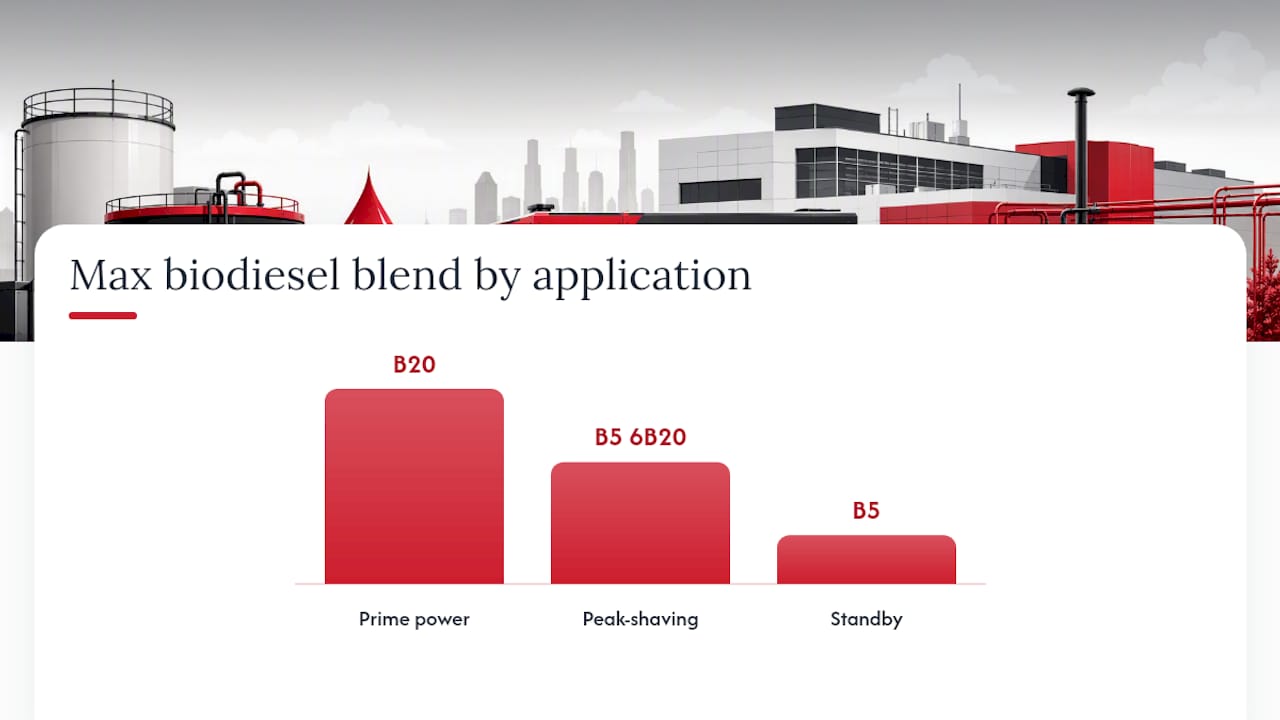
Cummins explicitly advises against biodiesel for standby genset applications, citing oxidation and storage stability concerns, and Cat’s guidance draws the same line, recommending very low biodiesel content for standby gensets due to oxidation stability.
Rule-of-thumb blend ceilings by application:
- Prime power (daily run cycles): B20 is generally workable with disciplined fuel testing.
- Peak-shaving (weekly to monthly cycles): B5 to B20, depending on how quickly the tank turns over.
- Standby (rare or emergency use): B5 at most, and many OEMs recommend B0 or a switch to HVO entirely.
What Fuel Standards and Tests Should You Require From Suppliers?
Biodiesel and renewable diesel are not the same fuel, and mixing up the terminology leads to bad procurement decisions. FAME biodiesel (labeled Bxx, where the number is the biodiesel percentage) is made through a chemical process called transesterification and carries the storage limitations discussed throughout this piece. HVO, or hydrotreated vegetable oil, is a drop-in renewable diesel processed to behave chemically almost identically to petroleum diesel, with a far longer shelf life.
Before accepting a delivery, require these three standards from your supplier:
- ASTM D6751 covers pure biodiesel (B100) intended for blending, setting limits on oxidation stability, water content, and acid number.
- ASTM D7467 governs finished B6 to B20 blends, the range most generator operators actually use.
- ASTM D8274 (often written ASTM 8274) verifies the actual biodiesel content in a blend, which matters because suppliers sometimes mislabel percentage.
Ask every supplier for a certificate of analysis, documented oxidation stability results, and the production date. A delivery without a production date on the paperwork is a delivery you can’t schedule a consumption window around.
Does Your Generator’s Warranty Cover Biodiesel Use?
Manufacturer guidance on biodiesel varies enough that skipping this step can cost you a warranty claim later. Cummins, Cat, and Perkins all publish position statements, and none of them treat biodiesel as a blanket approval across every model and blend level.
Cummins generally steers standby genset owners away from biodiesel altogether, recommending straight ASTM D975 #2 diesel or HVO instead, and requires ASTM D8274 testing if biodiesel is used at all. Cat draws a similar line, recommending against more than 5% biodiesel in standby EP generator sets while treating HVO as a lower-risk drop-in. Perkins’ own testing found HVO performs as a near match to conventional diesel, which is why it shows up so often as the OEM-preferred renewable option.
Before you commit to a biodiesel program, work through this sequence:
- Pull your generator model’s specific fuel guidance from the dealer or OEM technical documents, not a general industry brochure.
- Request written approval for your intended blend level, and keep that document on file alongside your maintenance records.
- Run a small volume of representative fuel through the unit and log performance before scaling to a full tank changeover.
- Ask your dealer whether any service bulletins address biodiesel use for your specific model year.
Skipping written documentation is the single most common mistake facilities make, because a verbal “should be fine” from a service tech won’t help you if a fuel-related failure ends up disputed.
How Long Does Biodiesel Last in Storage?
Storage is where biodiesel programs succeed or quietly fall apart. Biodiesel’s chemistry makes it more prone to oxidation than petroleum diesel, and oxidized fuel forms gums and sediments that clog filters and injectors long before anyone notices a performance drop.
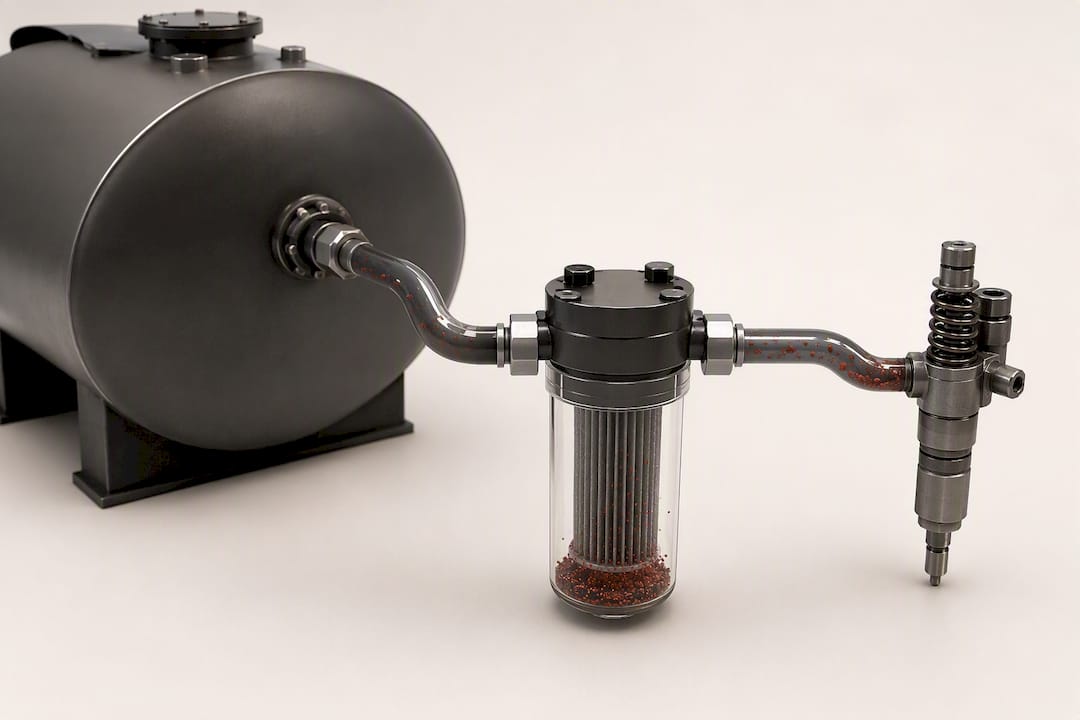
Cummins recommends consuming biodiesel-blended fuel within about three months, or testing it monthly if it sits longer than that. The DOE’s AFDC handling guide backs a similar window, generally 90 days for B5 to B20 blends, with higher blends needing tighter turnover. Compare that to HVO, which Cat notes can sit for more than 12 months without the same degradation profile.
Before transitioning any tank to biodiesel:
- Clean the tank first. Old diesel sludge and water at the bottom will react with biodiesel’s solvent properties and get stirred loose.
- Minimize headspace in the tank to cut down on the condensation that feeds water contamination.
- Install a water separator and consider a fuel polishing system if the tank won’t turn over quickly.
Pro Tip: Test a fresh sample the day fuel arrives, then again at 30 days, even if your consumption window looks safe on paper. A single early data point tells you almost nothing about how that specific batch will age.
If a tank isn’t going to turn over inside that consumption window, a program built around biodiesel probably isn’t the right fit for that site. That’s usually the moment to look at HVO or a smaller blend percentage instead.
For guidance on how long conventional diesel itself can be stored safely across tiers, see our diesel shelf-life breakdown.
What Maintenance Changes Does Biodiesel Require?
Biodiesel’s solvent action is the part most operators underestimate. It doesn’t just burn differently, it actively cleans years of accumulated tank deposits loose from the walls of an older storage system, and those particles have to go somewhere.
- Change filters aggressively in the first 50 to 100 hours after transition. Loosened tank deposits commonly cause a short-term spike in filter plugging, and budgeting for two or three early filter swaps beats an unplanned shutdown.
- Add fuel dilution checks to your regular oil analysis. Biodiesel that leaks past rings shows up in oil chemistry before it shows up as a performance problem.
- Sample for microbial growth on a set schedule, not just when something looks off. Biodiesel’s biodegradability, which is part of its environmental appeal, also makes it a better food source for the bacteria that cause tank sludge.
- Keep a biocide and fuel polishing option on hand for any tank that shows early contamination signs, rather than waiting for a full changeover.
A structured generator fuel maintenance program that already tracks oil analysis and filter intervals makes it far easier to layer these biodiesel-specific checks on top, instead of building a parallel tracking system from scratch.
How Does Biodiesel Affect Generator Performance and Emissions?
Biodiesel carries slightly less energy per gallon than ULSD, which typically shows up as a small increase in fuel consumption for the same load, though most operators don’t notice a meaningful difference in output at B20 or below. HVO, by contrast, performs close enough to ULSD that Perkins’ own testing found no meaningful power or consumption penalty worth flagging.
Emissions shift, they don’t uniformly improve. EPA testing on biodiesel blends has generally found reductions in particulate matter, hydrocarbons, and carbon monoxide, but some studies show a modest NOx increase at higher blend levels, so the tradeoff isn’t universally clean across every pollutant.
On the lifecycle side, Cummins cites greenhouse gas reductions in the range of roughly 40% to 86% versus fossil diesel, depending heavily on feedstock and how the fuel was processed. That range matters for anyone chasing sustainability reporting targets, but it also means one supplier’s “biodiesel” isn’t automatically another supplier’s carbon reduction.
Biodiesel or HVO: How Do You Decide?
The choice usually comes down to how often your generator runs and how much fuel-management discipline your team can sustain.
- Choose HVO if your generator is standby, sits idle for long stretches, or you want a drop-in fuel with minimal added maintenance burden. Perkins’ comparison testing backs this as the lower-risk renewable path for most standby fleets.
- Choose biodiesel if your site runs prime or peak-shaving cycles with steady consumption, and you’re willing to enforce supplier testing and short turnover windows.
- Weigh cold-weather exposure and supply access too. Biodiesel gels at higher temperatures than ULSD, so sites in cold climates without winter-blend access or fuel heaters face extra risk regardless of run profile.
For a broader look at how diesel fuel grades stack up against each other, our guide to diesel fuel types for commercial operations covers the full spectrum.
What’s a Practical Biodiesel Adoption Checklist for Facilities Managers?
Turning everything above into a repeatable process is what actually protects uptime. Here’s the sequence that keeps a biodiesel program from becoming a liability:
- Procurement: Require a certificate of analysis, production date, and documented oxidation stability numbers before accepting any delivery. Build your consumption schedule around the fuel’s age, not the delivery date on the invoice.
- On delivery: Inspect the tank for water or sediment, pull a fuel sample, and change filters early. Log the delivery, the test results, and the batch documentation together.
- Ongoing: Exercise the generator on a set schedule to keep fuel turning over, sample monthly if any fuel sits longer than planned, and have an emergency ULSD or HVO fallback ready if a test result comes back out of spec.
Pro Tip: Keep your fallback fuel supplier’s number saved somewhere your on-call team can find it fast. A failed oxidation stability test at 2 a.m. is not the time to be searching for a backup vendor.
How Anytime Fuel Pros Supports Biodiesel-Ready Operations
Running a compliant biodiesel program means juggling delivery timing, test coordination, and a fallback plan, and that’s exactly where a lot of internal teams get stretched thin. A fuel delivery service can handle the delivery and documentation side so your team isn’t tracking down certificates of analysis between other jobs, coordinating scheduled top-offs that match your actual consumption window instead of a generic delivery calendar.

For sites transitioning to biodiesel or keeping a fallback ULSD supply on hand, some fuel delivery providers offer on-site delivery to data centers, municipal fleets, construction sites, and multi-location operations, with 24/7 emergency response if a fuel test comes back out of spec and a clean tank is needed quickly. Bulk delivery and tank services can reduce the need to manage multiple supplier relationships on top of other operational responsibilities. If your facility is weighing a biodiesel program or just wants a reliable fallback plan, start with our diesel fuel delivery services page to see coverage and scheduling options for your site.
Sources
- Biodiesel Usage in Cummins Engines: Standby Power Genset Applications
- Biodiesel | HVO | Renewable Liquid Fuels For Generators | Cat
- Biodiesel Handling and Use Guide (AFDC/DOE)
- Generator sets powered by an alternative fuel (Power Engineering)
- Comparison of HVO and diesel (Perkins)
Recent Comments