
Bulk diesel delivery costs work off one formula: the terminal rack price on the day of delivery, plus the supplier’s delivery margin, plus applicable taxes and fees, equals your delivered per-gallon price. Most commercial buyers in the U.S. pay a delivery margin and taxes that add a variable amount over the rack price, which depends on factors like volume, region, and delivery conditions, though remote sites and emergency orders push higher. Volume, region, fuel type, and delivery urgency all move that number, so the fastest way to control cost is to request a fully itemized quote and to compare each line against a public rack reference before you sign.
TL;DR:
- Larger volume orders benefit from lower delivery margins due to economies of scale, especially when surcharges are spread across more gallons.
- Suppliers should itemize and separate rack price, delivery margin, and taxes on invoices to enable proper verification and prevent hidden markups.
- State excise taxes and fuel exemptions significantly impact the final cost, with dyed diesel usually cheaper but risking legal penalties if misused.
- Remote sites, smaller orders, and emergency deliveries tend to cost more per gallon because of higher fixed costs and premium charges.
- Building predictable, scheduled deliveries and consolidating routes can minimize costs and reduce price volatility for bulk diesel procurement.
Table of Contents
- What You Actually Pay Per Gallon: Rack, Margin, And Invoice Line Items
- How Order Size Changes The Per-Gallon Math
- Clear Diesel, Dyed Diesel, And DEF: Why Pricing Differs By Fuel Type
- What Drives Delivered Diesel Prices Up Or Down
- How To Budget, Contract, And Negotiate Better Diesel Pricing
- Three Delivery Scenarios And The Math Behind Each
- Where To Track Diesel Prices And Compliance Rules
- Anytime Fuel Pros: Built To Cut The Cost And Hassle Of Bulk Diesel Procurement
- Sources
- FAQ
What You Actually Pay Per Gallon: Rack, Margin, And Invoice Line Items
Every diesel invoice starts with the terminal rack price, the wholesale rate refiners and terminal operators charge suppliers loading fuel that day. Rack prices move daily and vary by terminal, which is why two suppliers quoting from different racks in the same city can hand you noticeably different numbers. Services like OPIS track these rack values in real time, and it’s worth asking your supplier which terminal and rack source they’re pricing from so you can sanity check the number yourself.
On top of rack price sits the delivery margin, the part suppliers actually compete on. That margin covers fuel sourcing, driver labor, truck maintenance and insurance, fuel loss allowances, and profit. A supplier running a tight regional route with full trucks can usually afford a thinner margin than one dispatching a half-empty tanker across three counties.
Beyond rack and margin, most invoices carry a handful of fixed charges:
- A flat delivery fee, sometimes waived above a minimum order size
- A minimum-delivery surcharge for orders under a supplier’s threshold, often several hundred gallons
- Tank rental fees if you don’t own on-site storage
- Environmental or spill-prevention compliance fees tied to state UST regulations
Pro Tip: Ask suppliers to break delivery margin out as its own line item rather than folding it into a single “per gallon” price. A supplier unwilling to separate rack from margin is usually hiding a wider spread than the market supports.
Taxes add another layer entirely. Federal fuel excise tax applies to on-road (clear) diesel, and most states layer their own excise tax on top, with rates that vary widely by state. Dyed off-road diesel is generally exempt from the federal road tax, which is one reason it costs less, but misapplying that exemption on a mixed-use fleet invoice is a compliance risk procurement should catch before payment, not after an audit.
How Order Size Changes The Per-Gallon Math
Delivery margin shrinks as volume grows because a supplier’s fixed costs, truck dispatch, driver time, insurance overhead, spread across more gallons. This is basic economies of scale at work: larger deliveries reduce per-gallon delivery margin due to economies of scale, since dispatch effort does not increase proportionally with volume.
Most suppliers price in rough tiers, though exact breakpoints vary by region and provider:
Delivery margins typically decrease as order size grows, with the smallest orders facing the highest per-gallon margin and often minimum surcharges, while larger and consolidated multi-site orders benefit from tighter margins due to dispatch efficiencies.
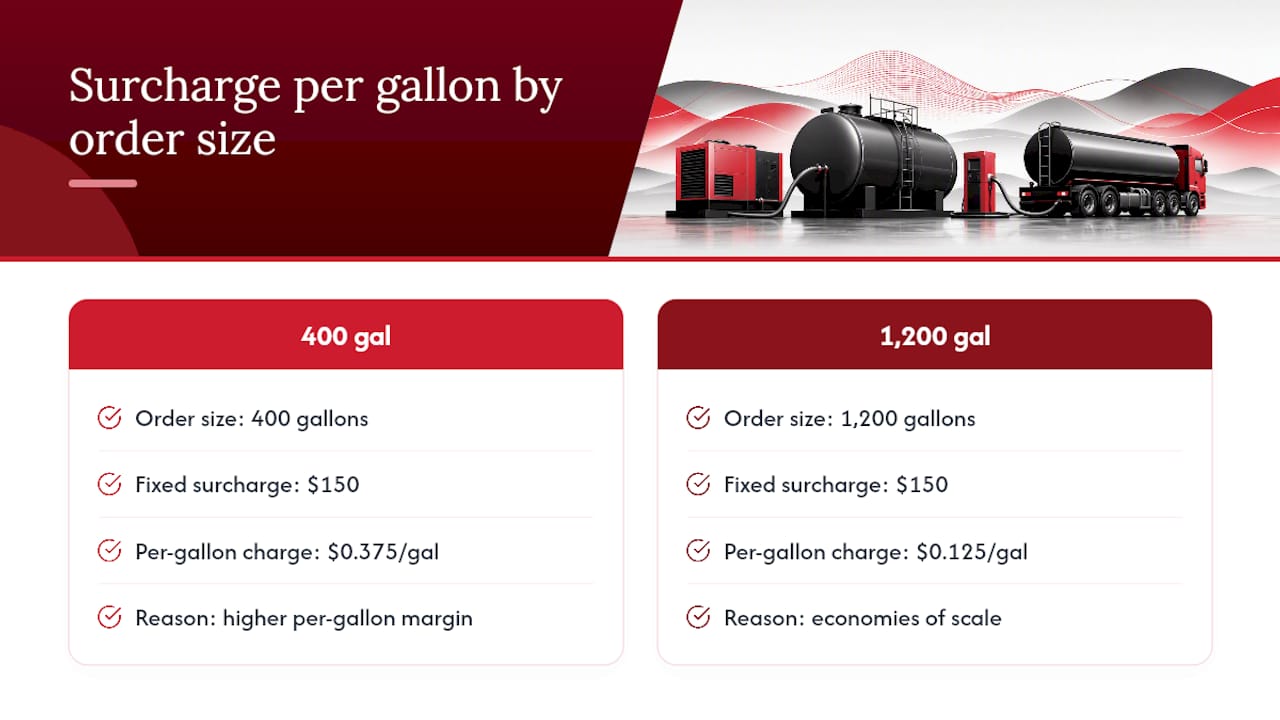
Run the math yourself before assuming bigger is always cheaper. If a minimum-delivery surcharge is $150 and you order 400 gallons, that’s an extra $0.375 per gallon hidden in the invoice. Order 1,200 gallons instead and the same fee drops to $0.125 per gallon, a difference that adds up fast across a fleet running dozens of deliveries a year.
Storage capacity sometimes forces smaller, more frequent orders regardless of the math. If your site can’t hold a full bulk delivery, ask your supplier about a scheduled recurring cadence instead of a la carte ordering. A fixed weekly or biweekly delivery locked into a route tends to price better than the same volume ordered reactively, because it removes dispatch uncertainty for the supplier. Guidance on siting and sizing on-site storage is covered in more detail in Anytime Fuel Pros’ setup guide for operations managers.
Clear Diesel, Dyed Diesel, And DEF: Why Pricing Differs By Fuel Type
Clear (on-road) diesel and dyed (off-road, red) diesel are chemically similar but taxed differently, and that difference shows up directly on your invoice. Clear diesel carries the federal road excise tax plus applicable state fuel tax because it’s legal for use in vehicles that travel public roads. Dyed diesel is marked red specifically so inspectors can identify it as tax-exempt fuel restricted to off-road equipment, generators, and other non-highway uses.
That tax exemption is exactly why dyed diesel usually runs cheaper per gallon than clear diesel from the same rack. But cheaper isn’t free of risk:
- Using dyed diesel in an on-road vehicle is a federal and state violation that carries substantial penalties, not a gray area
- Mixed fleets running both on-road trucks and off-road equipment need separate tanks and airtight recordkeeping to avoid cross-contamination
- Some states impose their own dye requirements or additional off-road fuel reporting on top of federal rules
DEF (diesel exhaust fluid) is priced and delivered as a completely separate product from diesel fuel itself, even though most fleets order both from the same supplier. It’s a urea solution, not a fuel, and its cost doesn’t track diesel rack prices at all, which means a supplier bundling DEF and diesel into one blended number is making it harder for you to see either cost clearly. Request DEF pricing as its own invoice line, and check that dyed diesel charges never carry a road tax line, a mistake that shows up more often than most procurement teams expect. Anytime Fuel Pros’ DEF delivery page outlines how that service is typically structured separately from diesel orders.
What Drives Delivered Diesel Prices Up Or Down
Distance from the supplying terminal is one of the biggest levers procurement can actually influence. A site 15 miles from a rack terminal costs less to serve than one 90 miles out, and deadhead, the empty return trip after delivery, gets baked into every quote whether it’s itemized or not.
Regional rack differences compound that effect. The U.S. Energy Information Administration’s diesel price data shows retail and wholesale diesel prices can differ by a wide margin from one region to another in the same week, driven by refinery proximity, pipeline access, and local demand.
Diesel prices don’t always move in lockstep with crude oil, either. Refinery utilization rates, distillate inventory levels, and shipping or insurance premiums can push delivered diesel higher even when crude is flat or falling. Argus Media’s coverage of 2026 to 2027 diesel forecasts points to exactly this kind of decoupling, and freight or war-risk insurance spikes tied to shipping disruptions have shown up as real cost pressure for remote and mining operations in past supply shocks.
Other drivers worth tracking on a recurring basis:
- Seasonal demand spikes, particularly winter heating season competition for distillate supply
- Same-day or after-hours emergency delivery premiums, which can run well above standard scheduled pricing
- Site access constraints (locked gates, narrow roads, limited delivery windows) that slow a driver down and add cost
- Consolidated routing across multiple sites, which lowers effective delivery cost per stop
Pro Tip: Build a standing delivery window into your contract, even a four-hour block twice a week, rather than calling in orders reactively. Predictable access lets suppliers route you efficiently, and that efficiency shows up as a lower margin on your invoice.
How To Budget, Contract, And Negotiate Better Diesel Pricing
Contract structure determines how much price volatility you absorb versus your supplier. Three structures cover most commercial arrangements:
- Rack plus fixed margin. You pay whatever the terminal rack is on delivery day plus a locked margin the supplier agrees to hold. This is the most transparent structure because you can verify the rack component against public data and know exactly what you’re paying for delivery itself.
- Fixed price per gallon. The supplier locks in one number regardless of rack movement. This protects you if prices spike but usually means paying a premium built in to cover the supplier’s own risk.
- Capped pricing. You pay rack plus margin up to a ceiling, after which the price stops climbing. This split-the-difference approach suits buyers who want upside protection without paying a flat-rate premium every month.
For most multi-site operations running recurring volume, rack plus fixed margin gives the clearest line of sight into what you’re actually paying for. Index-linked pricing tied to a public rack reference also makes supplier benchmarking dramatically easier than comparing opaque flat quotes.
Invoice verification is where procurement teams either catch overcharges or miss them for years. Every delivery invoice should list the terminal name, the rack price source and date, the exact gallons delivered, and delivery margin broken out as its own figure, backed by a signed proof of delivery. If a supplier can’t produce that level of detail on request, treat it as a red flag rather than standard practice.
Risk management means planning for the emergency call you hope never comes. Procurement teams routinely underprice reactive refueling in their budgets, then get blindsided by premium invoices during a storm or equipment failure. Building a modest emergency-fuel line item into your annual budget, and pre-qualifying a supplier with 24/7 dispatch capability, closes that gap before it costs you downtime. Anytime Fuel Pros structures its emergency response around rapid dispatch in covered markets specifically for this scenario, and its nationwide partner network lets multi-site operators run one contract across states instead of managing a separate regional vendor at every location. Details on that dispatch model are covered on Anytime Fuel Pros’ emergency fuel delivery page. Efficiency measures on the equipment side, covered in the Alternative Fuels Data Center’s fleet conservation resources and in Premier Fleet Repair’s fuel efficiency guidance, can reduce total gallons needed in the first place, which compounds any pricing gains from better contracting.
Three Delivery Scenarios And The Math Behind Each
The formula stays constant across every scenario: rack price + delivery margin + taxes/fees = delivered price per gallon. How each variable moves is where the real cost difference shows up.
- Scenario A, scheduled bulk delivery: A 5,000-gallon recurring order at a rack price of $2.80, plus a $0.20 negotiated margin and $0.35 in combined state and federal tax, lands at $3.35 per gallon delivered, no minimum surcharge applies at this volume.
- Scenario B, small frequent orders: A 400-gallon order against the same $2.80 rack and $0.35 tax picks up a $0.45 margin plus a $150 minimum-delivery surcharge, an effective $0.375 per gallon, pushing the delivered price to roughly $3.98.
- Scenario C, emergency same-day delivery: The same 400-gallon order called in after hours adds an emergency premium on top of the standard margin, frequently pushing total delivered cost well above both scheduled scenarios.
Build a simple spreadsheet with four columns, rack price, margin, surcharge divided by gallons, and tax, then sum them per scenario before you commit to an order size or schedule.
Where To Track Diesel Prices And Compliance Rules
Procurement teams tracking diesel spend over time should bookmark a short list of primary sources rather than relying on supplier quotes alone. OPIS supplies the terminal rack data suppliers themselves reference. The EIA’s gasoline and diesel fuel pages publish weekly national and regional price and inventory series free of charge. The EPA’s underground storage tank guidance governs compliance requirements for anyone storing diesel on site, which factors directly into tank rental versus ownership decisions. State fuel tax authorities remain the authoritative source for state-specific excise rates and dyed-diesel enforcement rules, since these vary considerably by state and change periodically.
Anytime Fuel Pros: Built To Cut The Cost And Hassle Of Bulk Diesel Procurement
Everything above points to the same conclusion: the buyers who pay the least per gallon are the ones who schedule ahead, consolidate routes, and demand transparent invoicing. That’s the exact model Anytimefuelpros runs on.
A commercial fuel delivery company delivers scheduled bulk diesel, DEF, and both clear and dyed fuel directly to job sites, equipment yards, data centers, and mining operations across Texas, Utah, and nationwide through a partner network. Scheduled recurring delivery and consolidated multi-site routing are exactly the levers this guide walks through to shrink per-gallon margin, and Anytimefuelpros builds them into every contract rather than treating them as an upsell. Invoices itemize rack reference, gallons delivered, and delivery margin separately, so procurement teams can verify pricing the same way this article recommends checking any supplier’s quote. For sites that can’t risk a fuel gap, 24/7 emergency response supports the scheduled side of the business without requiring a separate vendor relationship.
If you’re ready to see how your current fuel spend compares, request an itemized quote through Anytime Fuel Pros’ bulk fuel delivery page and ask specifically for a multi-site pricing evaluation if you’re managing more than one location.
Sources
- U.S. Energy Information Administration — Gasoline and diesel fuel updates
- U.S. EPA — Underground storage tanks
- OPIS (Oil Price Information Service)
- Argus Media — EIA sharply raises 2026-2027 diesel price forecast
FAQ
Is Bulk Fuel Delivery Cheaper Than Retail Fueling?
Yes, in most cases. Bulk delivery avoids retail station markups and driver labor lost to fuel runs, and per-gallon delivery margin drops further as order volume increases.
How Much Does It Cost To Have Diesel Delivered?
Delivered diesel prices run above the current terminal rack price once delivery margin and taxes are included, with small orders, remote sites, and emergency requests pushing that spread higher. Anytime Fuel Pros provides itemized quotes on request rather than a flat published rate, since rack prices shift daily.
How Many Gallons Of Diesel Can You Legally Transport?
Federal Department of Transportation rules generally treat containers or cargo tanks above certain volume thresholds as bulk packaging subject to hazardous materials regulations, so most commercial bulk shipments require a properly placarded tanker and a qualified driver rather than standard containers.
Where Can I Check Current U.S. Diesel Prices?
The EIA’s gasoline and diesel fuel updates publish weekly national and regional retail and wholesale price data, and terminal-level rack pricing is available through services like OPIS.
Recent Comments