
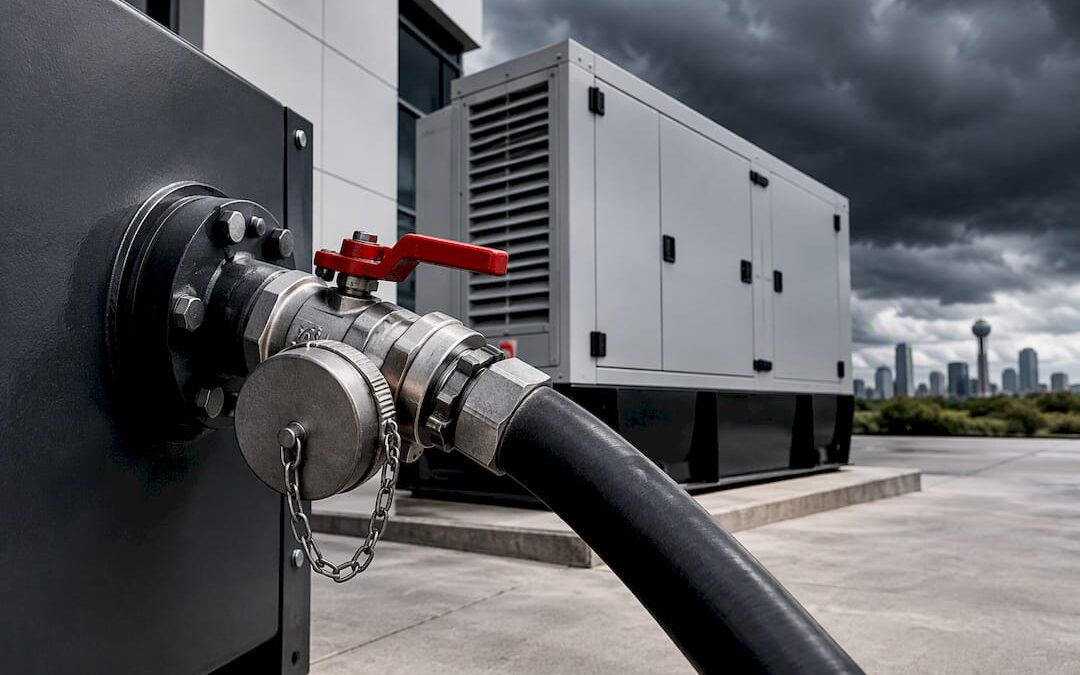
A reliable Dallas storm fuel planning strategy requires five locked-in elements before a storm ever forms: a contracted delivery provider with a documented SLA, a site fill map with pre-cleared access, a calculated fuel run-rate with reorder triggers, a written shutdown-and-restart procedure for generator refueling, and current tank documentation ready to hand a driver at the gate. This is a commercial operations plan, built for facilities, fleets, data centers, and event sites in Dallas, not a household preparedness list. Delivery contracts in Dallas–Fort Worth are structured around these five pillars.
TL;DR:
- Facilities should maintain a 24 to 48-hour fuel reserve based on actual generator fuel curves and conservative reorder triggers, especially during peak storm season.
- A complete storm-fuel plan must include current documentation such as TCEQ certificates, site maps, tank inventories, and verified access procedures to avoid delays.
- Fuel providers require active delivery certificates, proof of insurance, and proper tank labels well before storm season to ensure quick deployment during power outages.
- Generators must be shut down before refueling, and site procedures should explicitly specify authorization, safety checks, and restart processes to prevent safety violations.
- Conducting a formal storm-fuel drill at least once annually ensures readiness, and contracts should include scheduled rehearsals and verification of emergency response capabilities.
Table of Contents
- What Belongs on a Dallas Storm-Fuel Planning Checklist?
- How Much Fuel Does a Generator Actually Burn?
- What Documentation Do Texas Facilities Need Before a Storm?
- What’s the Safe Procedure for Emergency Generator Refueling?
- What Should a Storm-Fuel Drill and Contract Include?
- How Anytime Fuel Pros Supports Dallas Storm-Fuel Planning
- Sources
- FAQ
What Belongs on a Dallas Storm-Fuel Planning Checklist?
A storm-fuel plan is only as good as the details a driver can act on at 3 a.m. in the rain. Facilities managers who treat this as a paperwork exercise instead of an operations document are the ones who get bumped down the priority list when every generator in North Texas is calling for diesel at once.
Start with the identity layer, then work outward to logistics and paperwork. Here’s the sequence that actually holds up under pressure:
- Site identity and single point of contact. One name, one phone number, one person authorized to approve deliveries after hours. Committees don’t answer calls at 2 a.m.
- Fill point map and truck access diagram. Document the exact fill connection, hose route, and truck turning radius. PEI’s RP1400 recommended practice flags the fill connection and driver access as the most common points where a delivery agreement falls apart in practice, not on paper.
- Tank inventory. List every underground storage tank (UST), aboveground storage tank (AST), and day tank by capacity and fuel grade.
- Site documents ready for the driver. TCEQ delivery certificate or temporary authorization, tank tag numbers, and registration paperwork.
- Prioritized load list. Which generators keep the lights on for life-safety systems, which run HVAC, and which can wait.
- Authorized delivery windows. Gate codes, escort requirements, and any curfew or noise restriction that affects night deliveries.
- Ticketing and invoicing standard. Require a digital proof of delivery (POD) with a timestamped photo of the fill port and meter reading.
- Escalation contacts. A backup approver if the primary contact is unreachable, plus the fire marshal’s non-emergency line.
When a storm actually hits, that list becomes a decision flow: confirm generator run status, check fuel level against the reorder trigger, call the contracted provider, verify the delivery certificate is current, and clear the fill point before the truck arrives. Skipping a step here doesn’t just slow things down. It can stop the truck from delivering at all.
- Keep a laminated or digital copy of the fill map at the generator, not just in a manager’s inbox.
- Confirm insurance and DOT compliance documentation for any carrier before storm season, not during it.
- Assign a chain-of-custody log for every delivery so fuel quality disputes have a paper trail.
How Much Fuel Does a Generator Actually Burn?
Nameplate kilowatt ratings tell you almost nothing about real consumption. A facility running its 500 kW generator at 60% load burns diesel at a very different rate than one running it at 90%, and manufacturer fuel curves capture that variance far better than a flat formula. Use those curves, factor in the site’s actual load sequence, including UPS charging cycles and mechanical loads like chillers that spike demand, and treat any simplified formula as a sanity check rather than a final number.
FEMA’s planning guidance offers exactly that kind of check: daily diesel use runs roughly 0.07 times generator kW times 24 hours. It’s useful for a fast estimate, but it assumes a fairly steady load profile that most real facilities don’t have.
These figures are planning checks, not delivery orders. A data center running mixed critical and non-critical loads should build its own run-rate from actual fuel curves, then use FEMA’s number as a floor.
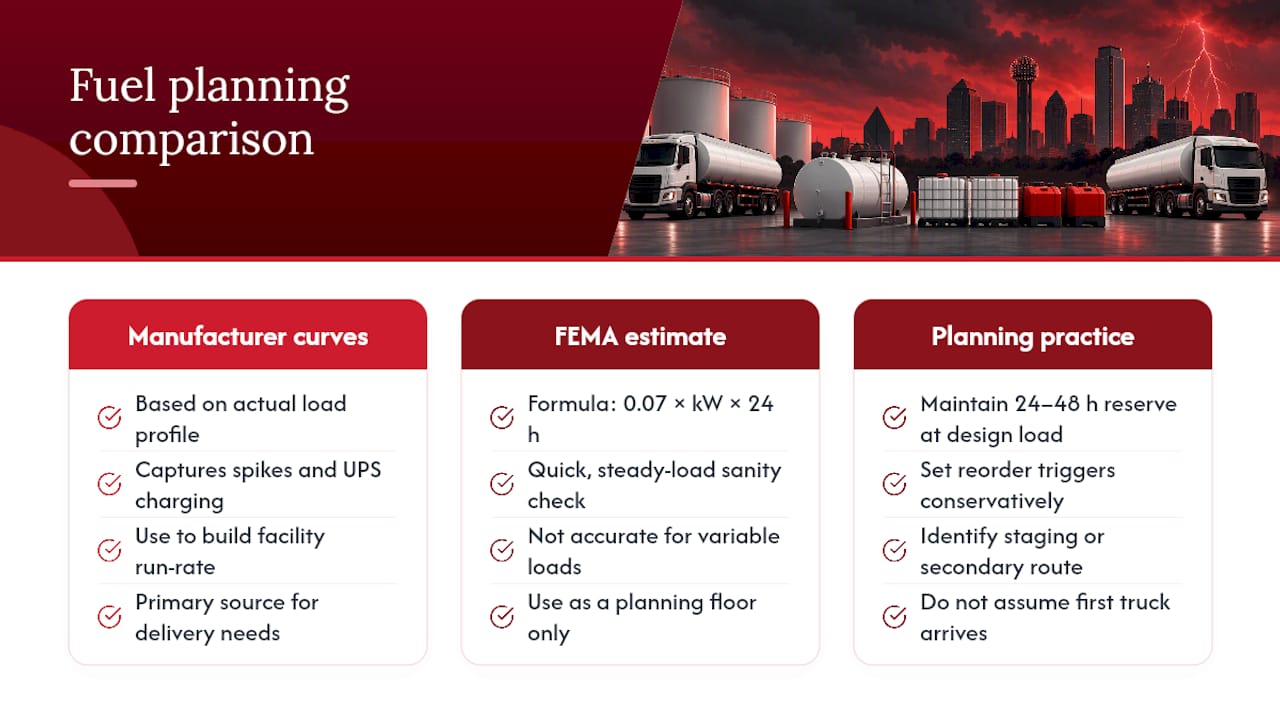
Set reorder triggers conservatively. Most Dallas facilities are safer planning deliveries to maintain a 24 to 48 hour reserve at design load rather than waiting until tanks approach empty. Interstate 35 and Interstate 30 both see delivery delays during major storm events, so facilities running multi-day outages should identify a staging site or secondary supply route in advance rather than assuming the first truck dispatched will be the one that arrives on schedule.
What Documentation Do Texas Facilities Need Before a Storm?
Missing paperwork is one of the most common reasons an emergency delivery gets delayed, and it’s entirely preventable. Texas regulates petroleum storage tanks through the Texas Commission on Environmental Quality, and TCEQ requires registration or self-certification along with an active delivery certificate for regulated USTs and ASTs. Carriers routinely ask to see that certificate before they’ll offload fuel, and a driver standing at a locked gate with no paperwork to check is not a problem you want to solve mid-storm.
Federal rules layer on top of the state requirement. EPA guidance on emergency-power-generator UST systems covers overfill prevention, spill buckets, release detection, and periodic inspections, all items an inspector or carrier may ask about during an emergency response. On the fuel-quality side, NFPA committee guidance calls for regular water checks, a documented fuel-quality baseline, and testing or polishing when contamination risk rises.
Before storm season starts:
- Contact the local fire marshal or authority having jurisdiction to confirm your site’s fill ports and tank IDs are clearly labeled and match their records; you can also explore contractor storage solutions that actually work for you to help with site staging and access during deliveries.
- Assemble a physical and digital emergency packet containing every certificate, tank chart, and inspection record, and give a copy to your fuel carrier in advance.
- Verify secondary containment and spill-prevention devices are inspected and functioning, not just installed.
Pro Tip: Don’t wait for delivery day to discover your delivery certificate expired last quarter. Build a recurring calendar reminder tied to your TCEQ renewal date, and confirm the carrier has the current version on file before hurricane season opens.
A delivery agreement is a promise on paper until documentation and access actually line up. Missing paperwork can legally block a delivery entirely, and that’s not a risk worth carrying into an active outage.
What’s the Safe Procedure for Emergency Generator Refueling?
Refueling a running generator is a hazard most storm-fuel plans underestimate until someone is standing next to a hot exhaust manifold with a diesel hose. FEMA’s generator refueling guidance is direct on this point: generators should be shut down before refueling, and the site plan must spell out who has authority to approve that shutdown and who manages the restart afterward.
A workable sequence looks like this during activation:
- Confirm the pre-delegated authorization contact and after-hours entry process before the truck arrives.
- Coordinate the shutdown with the generator contractor and confirm cold-start procedure in advance.
- Verify tank level, ground the truck, and route the hose according to the pre-documented fill map.
- Complete overfill prevention checks and monitor the fill continuously.
- Capture a timestamped photo of the fill port reading and obtain a signed digital proof of delivery.
- Verify tank level after delivery matches the ticketed volume.
- Notify the generator contractor for restart and confirm the unit returns to normal operation.
- Coordinate with site security or local authorities immediately if road closures or blocked access affect the delivery window.
FEMA’s guidance is unambiguous on one point: refueling a live generator is a safety violation waiting to happen, and the shutdown-before-refuel rule should be written into every site’s emergency procedure, not left to a driver’s judgment in the field.
What Should a Storm-Fuel Drill and Contract Include?
A plan that has never been tested is a guess dressed up as a procedure. Run a tabletop exercise at least once before storm season covering authorization, security entry, grounding, ticketing, and restart signoff, then follow it with a supervised live delivery drill where site conditions allow. FEMA’s training on refueling procedures recommends exactly this kind of rehearsal so the first real emergency delivery isn’t also the first time anyone has walked through the steps.
Your contract with a fuel provider should require:
- 24/7 emergency dispatch with a documented SLA response window, in writing.
- Proof of carrier insurance and DOT/HazMat compliance on file.
- Verification of your TCEQ delivery certificate before the carrier dispatches a truck.
- Digital invoicing and proof of delivery within 24 hours of every fill.
- Clearly assigned environmental and spill response responsibilities.
- A coordination clause naming your generator contractor and local fire authority as points of contact.
Pro Tip: Add an annual review clause with a documented drill schedule to the contract itself. A plan that only gets revisited when a storm is already forecast is a plan that’s already behind.
How Anytime Fuel Pros Supports Dallas Storm-Fuel Planning
You’ve seen what a real storm-fuel plan requires: contracted access, a working fill map, run-rate math that holds up, current paperwork, and a tested procedure. Contracts in Dallas–Fort Worth are built around every one of those pillars.
Scheduled top-offs keep tanks full before a storm even forms, which matters more than most facilities realize since partially empty tanks invite condensation and microbial contamination that can compromise fuel quality right when a generator needs it most. Anytime Fuel Pros handles generator top-offs, emergency and after-hours response, digital delivery tickets, DEF supply, and bulk fuel delivery for facilities that need extra volume staged on-site ahead of a multi-day outage. Coverage runs across Dallas–Fort Worth, and a national partner network means multi-site operators get one point of contact instead of juggling regional vendors state by state.
Getting a plan under contract starts with preparing your site packet: fill map, tank documentation, and load priorities. From there, SLA terms can be reviewed, certificate requirements confirmed, and a test delivery scheduled before storm season, not during it. Review the full lineup of fuel services or check emergency fuel delivery options to see where your facility’s plan has gaps worth closing now.
Sources
- FEMA operational generator fueling requirements
- EPA — Federal UST requirements for emergency-power generators (2022)
- NFPA committee statements on NFPA 110 fuel-quality guidance
- PEI RP1400 recommended practice (table of contents)
FAQ
How Much Diesel Reserve Should a Dallas Facility Keep On-Site?
Most facilities should plan to maintain a 24 to 48 hour reserve at design load, with reorder triggers set well before tanks run low. Use manufacturer fuel curves for your specific generator rather than relying solely on FEMA’s 0.07 x kW x 24 planning check.
Does a Generator Need to Be Shut Down Before Refueling?
Yes. FEMA’s refueling guidance states generators should be shut down before refueling, and every site plan should name who authorizes the shutdown and manages the restart.
What Paperwork Does a Fuel Carrier Need Before Delivering in Texas?
Carriers typically require an active TCEQ delivery certificate or temporary authorization along with tank tag numbers before offloading fuel. Keep both a physical and digital copy on-site and with your carrier ahead of storm season.
Does Anytime Fuel Pros Offer Emergency Storm-Fuel Delivery in Dallas?
Yes. Anytime Fuel Pros provides scheduled top-offs, generator fueling, and emergency fuel delivery across Dallas–Fort Worth, backed by a national partner network for multi-site operators. Current pricing details are available directly through the fuel services page.
How Often Should a Facility Run a Storm-Fuel Drill?
Run a tabletop exercise at least once before storm season, followed by a supervised live delivery test where site conditions safely allow. Contracts should include an annual review clause with a documented drill schedule so the procedure gets tested before it’s needed for real.
Recent Comments