
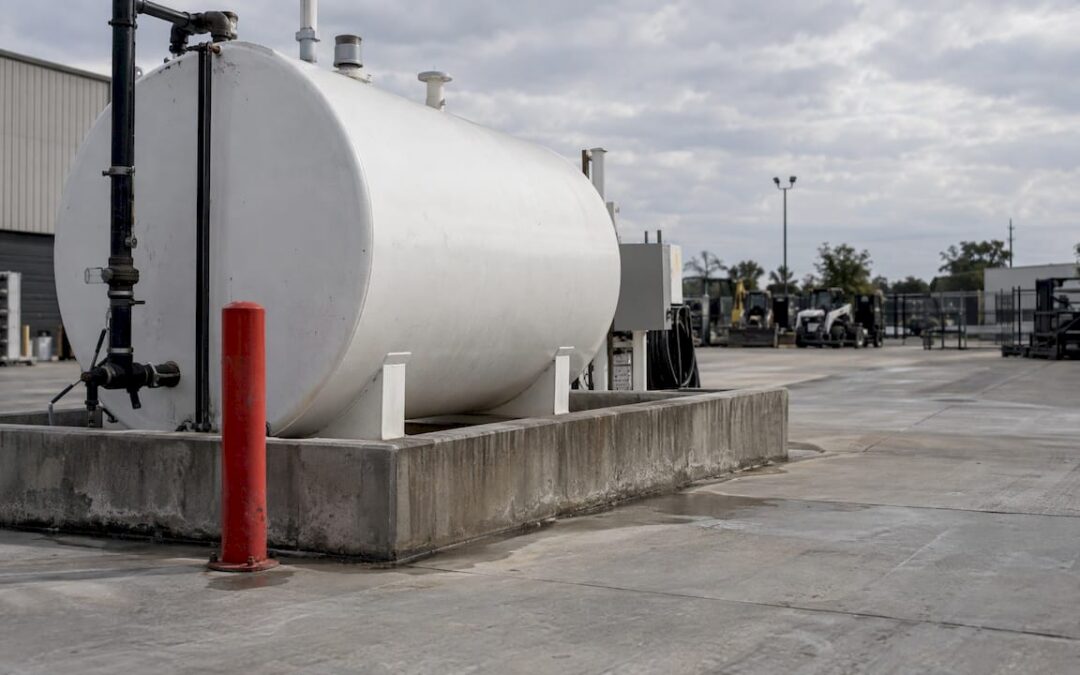
A diesel delivery risk assessment is a written review of what can go wrong when a tanker arrives at your site, who is responsible for each step, and which controls keep a routine drop from becoming a spill, a fire or a shutdown. The strongest assessments are built around the delivery itself: access, tank capacity, transfer, spill response and departure. They are also shared with the fuel supplier, because the driver and your site team each own part of the risk. We deliver on-site diesel to data centers, job sites, mines, events and fleets, and the sections below follow the order of a real drop.
TL;DR
- PHMSA recommends that facilities analyze loading and unloading operations, tailor the analysis to the process and materials, and use it to write or update operating procedures.
- Assess five zones: tanker access, receiving tank capacity, transfer, emergency response and departure.
- Federal rules fix several controls for you: an attended transfer, engine-off during unloading in most conditions, verified tank space and constant monitoring.
- Split every task between your team and the supplier in writing, and review the assessment after any incident, site change or new tank.
- The assessment is a living input to procedures, not a one-time form.
Table of Contents
- What the assessment is and who needs one
- Step 1: Map the hazards at your site
- Step 2: Prepare the access route and fill position
- Step 3: Verify the receiving tank before the transfer
- Step 4: Control the transfer
- Step 5: Plan the emergency response
- Step 6: Close out the delivery
- Who owns which risk
- How we fit into your assessment
- FAQ
- Sources
What the assessment is and who needs one
No single federal form is called a diesel delivery risk assessment. The idea comes from guidance: PHMSA, the U.S. Department of Transportation agency for hazardous materials, recommends that people involved in loading or unloading hazmat to or from cargo tank motor vehicles analyze the operations, or review earlier analyses, to assess hazards and current procedures. The analysis should be kept with your operating procedures and used to develop or update them.
That makes the document the input to your procedures. If the assessment sits in a binder while crews do something different at the tank, it has failed. If it changes how you mark the fill area, brief the driver or set up the day tank, it is working.
Who should own it depends on your operation:
- Data centers and hospitals: facilities managers, because generator day tanks and storage tanks are on the critical path for uptime.
- Construction, excavation and mining: site superintendents, because tankers move among haul roads, equipment and crews.
- Municipal and public agencies: procurement and safety officers, because the assessment belongs with the fuel contract.
- Events and film: production managers, because crowds, cables and temporary generators change the site every day.
A good rule is to assess every site once, then again when something changes: a new tank, a new access road, a new generator, a new supplier or an incident. The Dutch chemiebank best practice for dangerous-goods tankers makes the point that a risk assessment is worth doing whatever the quantity of substance, since it shows whether existing measures are enough. It also notes that non-routine work such as maintenance carries more fire and explosion potential than daily operations. Plan for the day the tank is being serviced, not only the normal Tuesday drop.
Step 1: Map the hazards at your site
Start with what diesel and the delivery can do. PHMSA recommends assessing the material’s characteristics and hazards, the safe-handling measures, and the conditions that affect safety, including access control, lighting, ignition sources and physical obstructions.
Turn that into a site walk with a simple table. For each zone, record the hazard, who could be harmed, the control and the owner.
| Zone | Typical hazard | Control to record | Usual owner |
|---|---|---|---|
| Gate and approach | Vehicle conflicts, pedestrians, tight turns | Marked route, spotter, speed limit | Site |
| Fill position | Ignition sources, poor lighting, obstructions | Cleared area, lighting, no-smoking rule | Site |
| Receiving tank | Overfill, wrong product | Verified space, readings, labeled fill ports | Site and driver |
| Transfer | Hose failure, leak, static | Attended transfer, bonding, shutoff | Driver |
| Spill or fire | Release to soil, drains, ignition | Spill kit, shutdown, reporting plan | Both |
| Departure | Open valves, loose fittings | Disconnect and secure checklist | Driver |
The hazards are not abstract. IChemE, the chemical engineering professional body, notes that the root cause of serious tanker loading and unloading incidents is usually human behavioral failure, and that consequences can include a flammable liquid release leading to fire or explosion. Good controls therefore cover both equipment (alarms, fail-safe valves) and people (attendance, escape routes).
Step 2: Prepare the access route and fill position
Most delivery problems begin before the hose comes out. A tanker that cannot turn, a fill port blocked by stacked material or a fill area with no lighting at 5 a.m. are site problems, and your assessment should list them.
Check these points:
- Can the truck enter, position and leave without reversing across foot traffic?
- Is the fill position lit for early or after-hours drops?
- Are ignition sources, such as hot work, running heaters and smoking areas, kept away from the fill point?
- Are other vehicles, pallets or temporary structures clear of the hose path?
Separation distances matter too. OSHA’s flammable liquids standard requires tank vehicle loading and unloading facilities to be separated from aboveground tanks, warehouses or adjoining property by 25 feet for the more flammable liquid categories and 15 feet for others, measured from the nearest fill stem. Confirm with your safety officer which category and distance applies to your fuel and facility.
If your site changes by the day, as event grounds do, use a structured approach. This event transportation risk assessment guide shows how planners think about vehicle movement around crowds, and the same logic applies to a fuel truck crossing a venue.
We cover the practical layout in more detail in our guide on how to prepare your site for fuel truck access.
Step 3: Verify the receiving tank before the transfer
Overfills are among the most preventable delivery incidents, and the rules put the verification on the tank owner. Under the federal underground storage tank rules, owners and operators are responsible for ensuring that no spill or overfill occurs: the volume available in the tank must be verified as greater than the volume to be transferred, and the transfer monitored constantly.
EPA’s tank guidance says the same in plain terms: make sure the delivery will fit and record accurate product and water readings before filling.
A worked example shows why this step is the one to formalize. Say a 4,000-gallon tank reads 3,100 gallons and the order is 1,500. The tank has room for 900 gallons, so the drop would overfill by 600. Nobody planned for that. It happens when the last reading was taken days earlier and the order was placed from a schedule, not a measurement. The fix is a pre-delivery reading logged with the order.

PHMSA also recommends pre-transfer procedures that verify the receiving container’s identity, compatibility and capacity, and check hoses and connections. It suggests color-coding components or using couplings that fit only the intended material, which matters on sites with both clear and red-dye diesel, gasoline and DEF. Label every fill port.
For tanks with spill prevention equipment, EPA’s UST rules also require a visual check every 30 days, or before each delivery for infrequent deliveries. Our diesel delivery QA checklist lists what to confirm before, during and after the drop.
Step 4: Control the transfer
The transfer is the short, high-consequence part of the visit. Federal rules set several controls you can write straight into the assessment.
Attendance. Under 49 CFR Part 177, a cargo tank must be attended by a qualified person during loading and unloading. That person must generally be within 25 feet of the tank with an unobstructed view of the tank and delivery hose. Remote monitoring is allowed only with the specified safeguards, including remote shut-off, and operations must stop immediately if monitoring is lost. A “qualified” person is one made aware of the material’s nature, instructed on emergency procedures, and authorized and able to move the cargo tank.
Engine off. The same part requires the engine of the tank vehicle to be stopped during unloading of flammable liquids unless it powers a pump. A diesel engine may stay running only when the ambient temperature is at or below 10°F. Put it in your briefing: no idling at the fill point.
Your own watch. EPA advises that you watch the entire delivery and make sure the delivery person does too. Assign a named person from your team at the tank, not whoever is nearby.
Valves and static. OSHA requires self-closing final-control valves for filling tank vehicles, and bonding for static protection when loading through open domes. Those provisions concern loading the vehicle, but they show the standard of control expected around flammable liquid transfers. Ask for the supplier’s equipment standards when you write the assessment.
Why qualified operators matter is covered in our safety guide on trained fuel delivery operators. For job sites and fleets, our summary of OSHA fuel handling requirements explains the rules that sit beside the transfer.

Step 5: Plan the emergency response
The assessment should answer one question before anyone arrives: if the hose fails or the tank overfills, who does what in the first five minutes?
PHMSA’s guide recommends emergency procedures that include instrumentation to monitor leaks, equipment to isolate leaks and shut down, assigned shutdown responsibility, emergency communication and spill reporting, training for the response equipment and a safe restart after shutdown.
Build your plan from these pieces:
- Stop the flow. Name the person who can trigger the emergency shutdown, and make sure the driver knows where your own shutoffs are.
- Contain. Under 49 CFR 177.823, a leaking cargo tank is handled by using every available means to contain the leak, diverting it away from streams and sewers. Smoking and ignition sources near a leaking tank are prohibited. Keep spill kits and drain covers where the fill happens.
- Report. If you own an underground storage tank, a suspected release must be reported to the implementing agency within 24 hours and investigated and confirmed within 7 days. Post the agency contact beside the response plan. For fire, injury or a release that threatens people, call 911 first.
- Protect uptime. For a data center or hospital, note which generators and day tanks are affected and how you maintain supply while the area is closed.
An emergency definition is also useful. FMCSA’s Part 390 describes an emergency condition requiring immediate response as any condition that, if left unattended, is reasonably likely to cause immediate serious bodily harm, death or substantial property damage. Use that standard to decide when a spill stops being a cleanup and becomes a call to emergency services.
Our five diesel spill response actions work well as the one-page version for your crews. If your aboveground storage nears the federal oil pollution prevention threshold, read the SPCC checklist for facility managers too.
Step 6: Close out the delivery
Departure is the step people skip. PHMSA’s guide lists post-unloading steps: evacuating the transfer system, safely disconnecting equipment, and securing fittings, valves and closures.
On your side, record:
- the post-delivery tank reading and the gallons delivered;
- the product, including whether it was dyed or clear diesel;
- any leak, drip or odd behavior at the connection;
- the time the truck left the fill area.
Those records feed the next review. Itemized delivery confirmation also helps with the compliance and reporting that comes with dyed diesel and government contracts.
Who owns which risk
A delivery has two parties and the assessment should show the line between them. A simple split works as a starting point:
- Your site: access route, lighting, fill-area clearance, tank readings and capacity, labeled fill ports, spill kits, the named watcher and the emergency plan.
- The supplier: the truck and hose condition, driver qualification, attendance during the transfer, engine and valve practice, and disconnection.
- Shared: shutdown, spill reporting and communication.
PHMSA recommends marking which loading and unloading activities are the facility’s responsibility and which belong to the cargo tank operator, and the Dutch best practice reaches the same conclusion by requiring a site-specific assessment that covers how a liquid can be released, the consequences, ignition and mitigation. It also links the result to hazardous-area classification on a floor plan, so that ignition sources stay out of defined zones. If your site has several tanks and generators, that floor plan is worth drawing.
For a data center with generator day tanks, our data center refueling checklist ties six checks to OSHA, EPA and NFPA, and our day tank refilling guide covers methods and scheduling.
How we fit into your assessment
We deliver on-site diesel (dyed and clear), gasoline and DEF, bulk fills, generator fueling, fleet fueling and wet hosing, and emergency and after-hours response. Our emergency service is built around 24/7 availability and a 3-hour response in covered areas. We work from primary markets in San Antonio, Austin, Dallas-Fort Worth and Salt Lake City, and through our partner network across the continental United States, so multi-site operations can run one assessment format with a single point of contact. Our invoicing is itemized, which gives you delivery records to attach to each review.
If you are setting up a new site or rewriting an assessment, start with our on-site diesel delivery setup guide, and see our fuel services for the full range, including emergency fuel delivery.
To schedule a delivery or discuss a site-specific plan, place an order with Anytime Fuel Pros.
FAQ
Is a diesel delivery risk assessment legally required in the U.S.?
No federal rule uses that title. PHMSA recommends analyzing loading and unloading operations, while specific rules, such as 49 CFR Part 177 attendance and the EPA tank overfill requirements, apply to the transfer itself. Check state and local requirements, and your insurer’s, with your safety officer or counsel.
How often should we review it?
Review it whenever something changes: a new tank, generator, route, supplier or incident. Also set a regular review date. The assessment feeds your operating procedures, so it should stay current with how crews actually work.
Who should be at the tank during a delivery?
The driver, who must be a qualified person, stays within 25 feet with a clear view of the tank and hose, unless approved remote monitoring is in place. We also recommend a named person from your site, and EPA advises that you watch the entire delivery.
Can the truck engine stay running?
Generally not. The federal rule requires the engine stopped during unloading of flammable liquids unless it powers a pump, and a diesel engine may keep running only at or below 10°F.
Sources
- PHMSA Cargo Tank Motor Vehicle pocket guide
- eCFR, 49 CFR Part 177 Subpart B
- eCFR, 49 CFR Part 177 (March 23, 2026)
- eCFR, 49 CFR Part 390 (November 18, 2024)
- EPA, Musts for USTs (2015)
- EPA, Musts for USTs (2015), alternate copy
- 40 CFR Part 280 (2024)
- 49 CFR Part 177 (2024)
- OSHA 1910.106, Flammable liquids
- IChemE, Loading and unloading of road and rail tankers
- Chemiebank best practice, dangerous-goods tankers (2024)
- Event transportation risk assessment guide
Recent Comments