

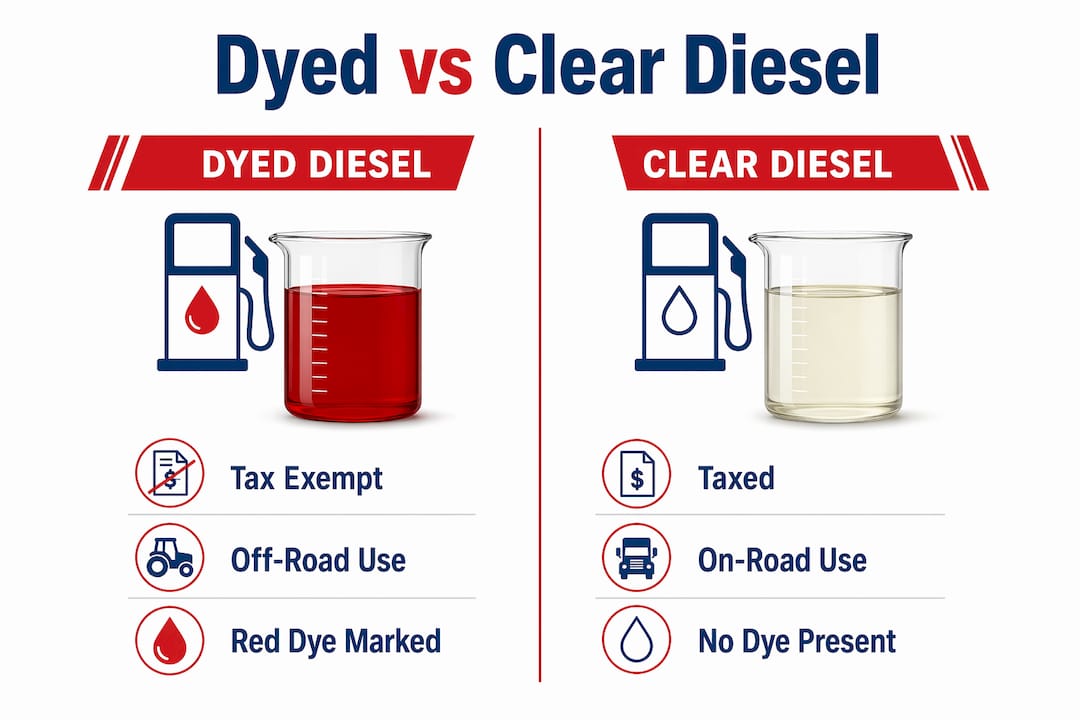
Dyed diesel is clear diesel that has been indelibly marked with a red dye to signify its tax-exempt status and restricted off-road use, while clear diesel is fully taxed and legal for on-road vehicles. Understanding dyed vs clear diesel explained in operational terms is not just a compliance exercise. For fleet managers, procurement officers, and site operators, getting this distinction wrong carries federal penalties, unexpected tax liabilities, and potential equipment downtime. The difference between these two fuel types comes down to regulation, not chemistry, and that distinction shapes every purchasing and storage decision your operation makes.
What is dyed diesel and how does the dye work?
Dyed diesel, also called off-road diesel or red diesel, is chemically identical to the clear diesel used in highway vehicles. The red color comes from Solvent Red 164, a synthetic dye injected mechanically at fuel terminals under federal mandate. Under 26 CFR §48.4082-1, the dye concentration must be spectrally equivalent to a defined mass per volume of fuel, meaning there is a minimum threshold that cannot be diluted away. This is not a voluntary industry practice. It is a legal requirement enforced by the IRS and the EPA.
The dye serves one purpose: to mark fuel as exempt from federal and state excise taxes. Clear diesel is taxed and legal for road use; dyed diesel is tax exempt and legal only for non-road equipment such as farming machinery, construction equipment, and stationary generators. The color makes enforcement straightforward. An IRS inspector can visually confirm a violation at roadside without laboratory testing.
What makes this especially consequential for fleet operators is the dye’s persistence. Dye residue remains detectable in fuel systems long after the tank has been refilled with clear diesel. The IRS treats visible or chemically detected dye as “reason to know” that dyed fuel was used, regardless of intent. A single misfueling event can leave a compliance trail that outlasts the fuel itself.

Pro Tip: Label every storage tank with the fuel type it contains and the equipment it serves. A simple color-coded tag system prevents misfueling at busy job sites where multiple fuel types are stored side by side.
Key characteristics of dyed diesel include:
- Injected with Solvent Red 164 at licensed fuel terminals, not at the pump or delivery point
- Tax-exempt under federal and most state excise tax codes
- Restricted to off-road, non-highway equipment and applications
- Detectable by visual inspection or chemical analysis even in trace amounts
- Subject to IRS enforcement with no reasonable-cause exception for accidental use
How do legal use cases, taxes, and penalties differ?
The federal excise tax on highway diesel is 24.4 cents per gallon, collected at the terminal and passed through to the buyer. This tax funds road maintenance and infrastructure. Dyed diesel bypasses this tax entirely because it is designated for equipment that does not use public roads. The legal boundary is not about the engine type or the fuel chemistry. It is about where the vehicle or equipment operates.
Legal applications for dyed diesel include:
- Agricultural equipment such as tractors, combines, and irrigation pumps
- Construction machinery including excavators, bulldozers, and skid steers
- Mining equipment operating on private or permitted land
- Stationary generators and backup power systems
- Railroad locomotives operating on private track
- Marine vessels in certain non-commercial applications
Clear diesel covers every vehicle that operates on public roads, including semi-trucks, delivery vans, and municipal fleet vehicles. If a piece of equipment crosses a public road under its own power, it legally requires clear diesel.
The penalty structure for misuse is severe and non-negotiable. Minimum penalties start at $1,000 per violation, plus all unpaid taxes, and the IRS enforces this with no reasonable-cause exception. Accidental contamination does not exempt an operator from liability. Using dyed diesel in on-road vehicles violates federal law, and the financial exposure compounds quickly across a fleet. A contractor running 20 trucks on dyed diesel faces not just the per-gallon tax recovery but per-vehicle penalties that can reach tens of thousands of dollars in a single audit.
State-level rules add another layer of complexity. Most states mirror the federal structure, but tax rates and refund claim processes vary. Operators using clear diesel exclusively in off-road equipment can often claim a state tax refund, but the documentation requirements are strict. Procurement officers managing mixed fleets should maintain separate purchase records by fuel type and equipment assignment to support any refund claims.
One regulatory exception worth knowing: the EPA and IRS may waive dyed diesel restrictions temporarily during declared disasters, allowing emergency vehicles to use dyed fuel without penalty. These waivers are geographically and temporally limited, but they matter for disaster response operators and emergency management coordinators who need flexibility during supply disruptions.
Are there real performance differences between dyed and clear diesel?
The short answer is no, with one important qualification. Off-road diesel meets the same EPA ULSD standard as on-road diesel, capped at no more than 15 parts per million sulfur. Performance, combustion efficiency, and engine wear are nearly identical across both fuel types. The diesel fuel color differences you see in the tank have no bearing on what happens inside the engine.
The qualification involves sulfur content history and lubricity. When the EPA mandated ultra-low sulfur diesel (ULSD) for all fuel types, it reduced the natural lubricity of diesel. ULSD can cause minor operational concerns including filter clogging and slightly increased fuel consumption in older equipment designed for higher-sulfur fuel. This applies equally to dyed and clear diesel. Operators running older generators or legacy construction equipment should consider fuel additives that restore lubricity, regardless of which fuel type they use.
| Factor | Dyed diesel | Clear diesel |
|---|---|---|
| Chemical composition | Identical to clear diesel | Identical to dyed diesel |
| Sulfur content | 15 ppm max (ULSD standard) | 15 ppm max (ULSD standard) |
| Engine performance | No measurable difference | No measurable difference |
| Tax status | Exempt from federal excise tax | Subject to 24.4 cents/gallon federal tax |
| Legal road use | Prohibited on public highways | Fully legal for on-road use |
| Dye additive | Solvent Red 164 required | No dye added |
Storage and handling practices matter more than fuel chemistry when it comes to operational risk. Mixing dyed and clear diesel causes no mechanical harm because the fuels are chemically similar. From a legal standpoint, however, mixing creates a compliance problem. Dye residue in a clear diesel tank can trigger an IRS violation even when the operator intended to use only taxed fuel. For fleets managing bulk fuel delivery and storage across multiple job sites, dedicated tanks for each fuel type are not optional. They are a compliance requirement.
Pro Tip: For generators and backup power systems running ULSD, schedule quarterly fuel quality checks to monitor for microbial growth and water contamination. These issues accelerate in low-turnover tanks and are far more common causes of generator failure than fuel type selection.
Cost implications and procurement strategy for fleet operators
The tax exemption on dyed diesel translates directly to a lower cost per gallon at the point of purchase. With the federal excise tax alone at 24.4 cents per gallon, plus applicable state taxes, the savings on dyed diesel can reach 40 to 60 cents per gallon in many markets. Across a high-volume operation running heavy equipment, that differential adds up to meaningful budget impact over a contract year.
Dyed diesel’s cost advantage is real, but it comes with procurement controls that must be built into your purchasing process. The savings disappear instantly if a compliance violation triggers IRS penalties. Procurement officers should treat dyed diesel as a restricted commodity, not just a cheaper fuel option.
Practical procurement controls for mixed-fuel fleets include:
- Maintain separate purchase orders and delivery records for dyed and clear diesel by equipment type and site location
- Require supplier documentation confirming dye compliance and terminal injection certification for every dyed diesel delivery
- Assign specific storage tanks to specific fuel types and enforce a no-cross-fill policy with physical labeling and driver training
- Track fuel consumption by equipment unit to identify any anomalies that could indicate misfueling or theft
- Review state tax refund eligibility annually for clear diesel used in qualifying off-road applications
Availability is another procurement variable. Dyed diesel is sold only to qualifying buyers for qualifying uses. Not every fuel supplier carries it, and not every delivery service handles both fuel types with the documentation controls your compliance program requires. For multi-site operations across Texas, Utah, or nationwide, working with a single supplier who delivers both fuel types with proper segregation and documentation reduces administrative burden and compliance risk simultaneously. Anytimefuelpros provides on-site red dye diesel delivery with full compliance documentation, keeping your procurement records clean and your operation protected.
How Anytimefuelpros supports compliant fuel delivery
Anytimefuelpros delivers both dyed and clear diesel directly to job sites, equipment yards, data centers, and fleet operations across Texas, Utah, and the continental United States. Every delivery is documented by fuel type, volume, and equipment assignment, giving procurement officers the paper trail they need for IRS compliance and state tax refund claims.

For fleets managing mixed fuel requirements, Anytimefuelpros maintains strict separation between dyed and clear diesel throughout the delivery process, eliminating the cross-contamination risk that creates unintentional violations. Whether you need scheduled top-offs for a construction fleet in Dallas, backup generator fueling for a data center in Salt Lake City, or emergency diesel during a weather event, Anytimefuelpros responds with the right fuel, properly documented. Explore the fuel delivery benefits that keep your operation compliant and running without interruption, or request on-demand diesel delivery for your site today.
FAQ
What is the difference between dyed and clear diesel?
Dyed diesel is off-road diesel marked with Solvent Red 164 to indicate tax-exempt status, legal only for non-highway equipment. Clear diesel is fully taxed and legal for on-road vehicles operating on public roads.
Can you mix dyed and clear diesel in the same tank?
Mixing causes no engine damage because both fuels are chemically similar, but dye residue in a clear diesel tank can trigger an IRS violation. Dedicated tanks for each fuel type are the only reliable way to avoid this compliance risk.
What are the penalties for using dyed diesel on the road?
The minimum federal penalty is $1,000 per violation plus all unpaid excise taxes, with no reasonable-cause exception for accidental use. Penalties multiply across vehicles, making fleet-wide misfueling an extremely costly compliance failure.
Does dyed diesel perform differently than clear diesel in engines?
No. Both fuels meet the EPA’s ULSD standard of 15 ppm sulfur maximum, and engine performance, combustion efficiency, and wear rates are nearly identical. Any operational differences relate to storage age or additive packages, not the dye itself.
Who is legally allowed to purchase dyed diesel?
Dyed diesel is available to operators of qualifying off-road equipment including farms, construction sites, mining operations, and facilities running stationary generators. Road vehicles and any equipment that crosses public highways under its own power must use clear, taxed diesel.
Key takeaways
Dyed and clear diesel are chemically identical fuels separated by a federal tax designation, and using the wrong type in the wrong application carries IRS penalties starting at $1,000 per violation with no exceptions for accidental misuse.
| Point | Details |
|---|---|
| Tax status drives the difference | Dyed diesel is exempt from the 24.4 cents/gallon federal excise tax; clear diesel is not. |
| Dye is legally persistent | Solvent Red 164 residue remains detectable after refueling, creating compliance risk from a single misfueling event. |
| Performance is equal | Both fuel types meet the EPA ULSD standard of 15 ppm sulfur and deliver identical engine performance. |
| Procurement controls are non-negotiable | Separate tanks, labeled storage, and supplier documentation are required to protect compliance across mixed-fuel fleets. |
| Disaster waivers exist but are limited | EPA and IRS may temporarily lift dyed diesel restrictions during declared disasters, but only within defined zones and timeframes. |
Recent Comments