
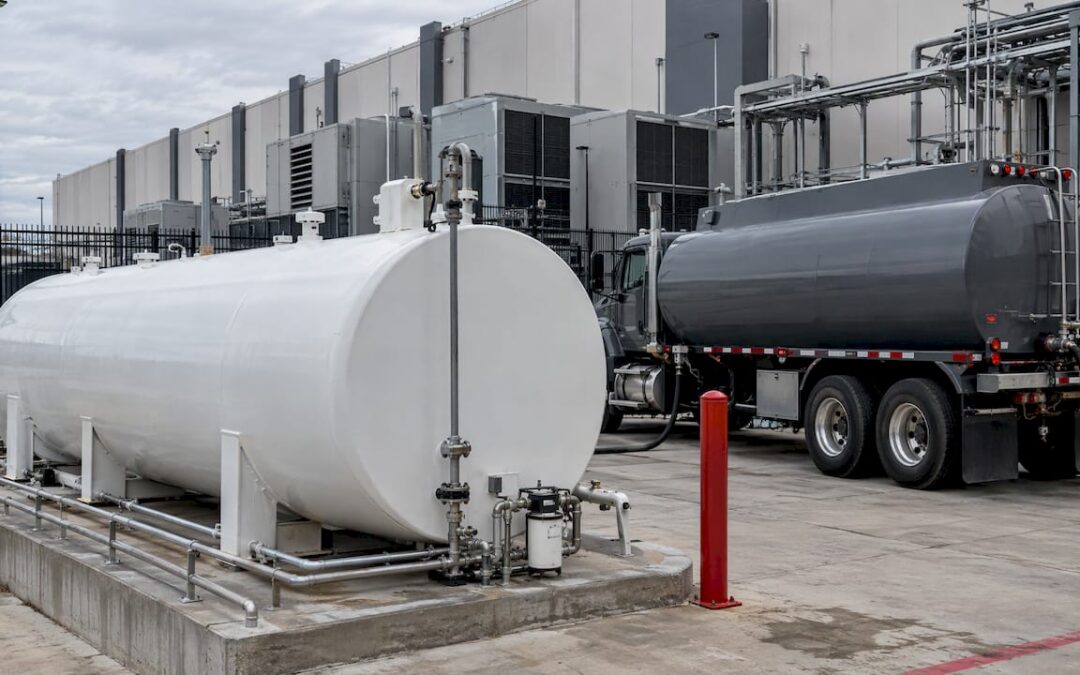
Emergency fuel staging means placing fuel, and the means to dispense it, at the locations where you will need it before supply fails. A workable plan answers five questions: who needs fuel, how much, for how long, where it sits, and who refills it when your tanks run low. The strongest plans do not rely on on-site storage alone. They pair a right-sized reserve with a contracted supplier that can deliver to the site, so the reserve is a bridge and not the whole plan. That is the model we build at Anytime Fuel Pros, and the rest of this guide shows how to get there.
TL;DR
- Size the reserve from load, not guesswork: a common rule of thumb is 7 gallons per hour per 100 kW of generator rating, multiplied by your target runtime (72 to 96 hours for most critical sites).
- Set a reorder threshold well above empty, and have a contracted supplier ready to deliver once the threshold is reached.
- Stage fuel in more than one location, protect it from flood, fire and wind, and plan access routes and security.
- Keep fueling schedules, receipts and usage logs from day one. Auditors, insurers and public agencies ask for them.
- Review supply contracts for emergency language before the storm or outage, not during it.
Table of Contents
- What emergency fuel staging actually involves
- Step 1: Decide what you are protecting
- Step 2: Size the reserve and set the reorder point
- Step 3: Choose where to stage it
- Step 4: Line up the supplier before the emergency
- Step 5: Handle the rules
- Step 6: Monitor, document and restock
- A staging checklist you can copy
- Where we fit in your plan
- FAQ
- Sources
What emergency fuel staging actually involves
Staging is the step between planning and response. Planning says you will need fuel. Staging puts it, along with tanks, trucks, hoses, pumps, people and paperwork, in position to be used.
Government plans show how this works at scale. South Carolina’s emergency refuel plan considers activation when an event threatens fuel supply, when a request signals that emergency-operations fuel will run out within 36 hours, or when fuel-conservation recommendations are issued. Refueling support begins once standard sources are exhausted or unavailable, and it draws on state yards, mobile tankers and contracted providers to supply response vehicles and generators at critical facilities.
A data center, a hospital, a county road department or a mine site is smaller than a state, but the logic is the same. You define a trigger, you hold a reserve, and you have a second source that takes over when the reserve is shrinking.
The U.S. Department of Energy frames this as energy assurance. Its guidance for local leaders says to understand where your energy comes from, identify vulnerabilities and key assets, build relationships with energy providers, and review existing supply contracts for emergency language before a disaster strikes.
Who needs a staging plan
- Data centers and other uptime-critical sites that run backup generators through multi-day outages.
- Construction, excavation and mining operations where a dry equipment fleet stops a whole crew and every subcontractor behind it.
- Municipal and public agencies that must keep fleets, pump stations and shelters running.
- Event and film productions that run on temporary generators in places with no grid and no nearby fuel station.
- Multi-site enterprises that cannot manage a different emergency fuel arrangement in every state.
Step 1: Decide what you are protecting
List every consumer of fuel that must keep running, in priority order. The Pennsylvania Department of Environmental Protection’s healthcare fuel shortage guidebook tells facilities to assess total needs across backup generation, heating and vehicle fleets. Many teams count only the generators and forget the rest.
A useful list has four columns: the asset, the fuel type, the hourly burn at expected load, and the consequence of it stopping. Include:
- Generators and their day tanks
- Heavy equipment and fleet vehicles that support recovery work
- Light towers, pumps and heaters
- Vehicles outside the building. HHS ASPR TRACIE points out that facilities should identify fuel needs for ambulances and helicopters beyond the structure itself.
Note the fuel type for each. On-road vehicles take clear diesel. Off-road equipment can run on dyed (red) diesel, which carries different tax treatment and record requirements. Diesel exhaust fluid (DEF) belongs on the list for modern diesel engines with emissions systems. Dual-fuel or multi-fuel generators are worth considering, since ASPR TRACIE notes they reduce the risk of a shortage in one fuel type.
Step 2: Size the reserve and set the reorder point
This is where most plans are wrong, usually too small. Three sources give you a defensible method.
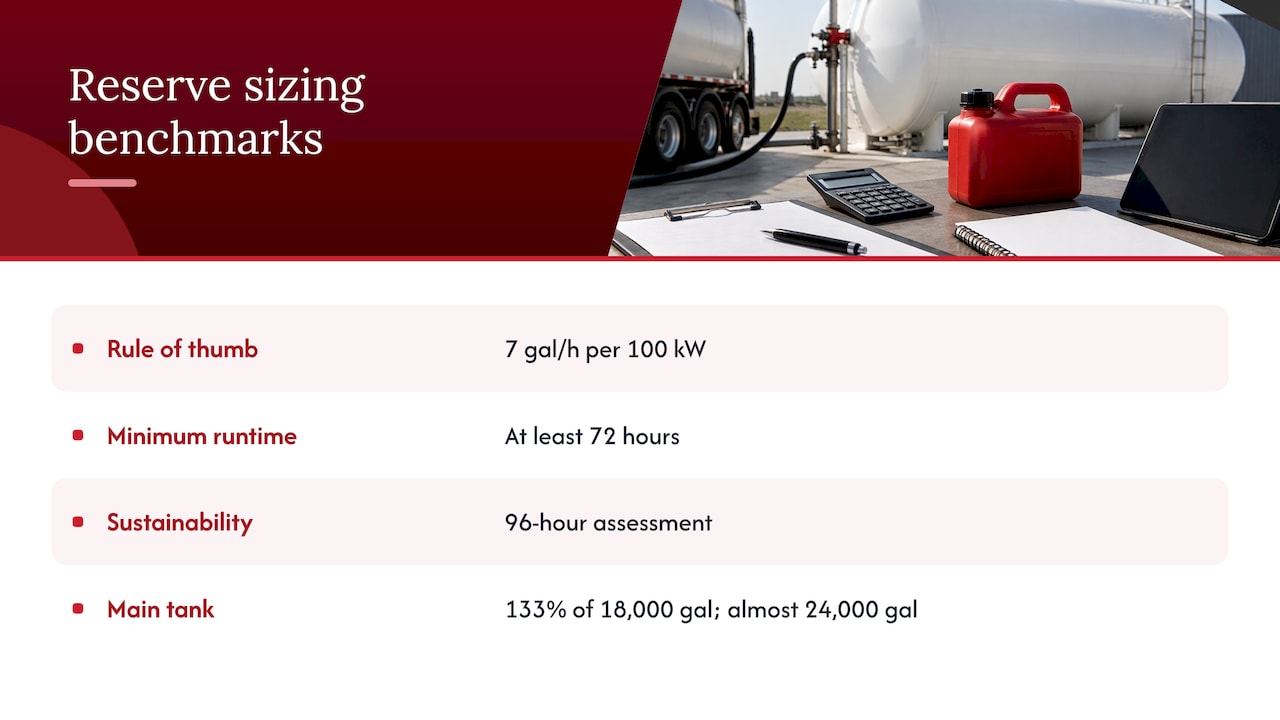
The rule of thumb. Consulting-Specifying Engineer gives a rough figure of 7 gallons per hour of diesel per 100 kW of generator rating, with a typical storage goal of three days. By that rule a 200 kW generator burns about 14 gallons an hour, and a 2 MW installation needs around 10,000 gallons for three days.
The runtime target. DOE guidance tells local officials to make sure backup generators have enough fuel for at least 72 hours. ASPR TRACIE advises aligning fuel plans with 96-hour sustainability assessments and setting reordering thresholds before supply is exhausted.
The code minimum. A Kohler whitepaper on NFPA 110 (the standard for emergency and standby power systems) works through an example: a system needing 18,000 gallons for 96 hours requires a main tank of at least 133% of that, almost 24,000 gallons. It also suggests oversizing tanks in rural areas, where deliveries take longer.
A worked example
A 500 kW generator at the rule-of-thumb rate burns about 35 gallons per hour (5 × 7).
- 72 hours: 35 × 72 = 2,520 gallons
- 96 hours: 35 × 96 = 3,360 gallons
That is the fuel the generator consumes at the assumed load. Real load varies, so use your own load data where you have it, and treat the formula as a starting estimate. Now add the other consumers from Step 1: a fleet of ten trucks, a light-tower set, a heating system.
The Pennsylvania guidebook offers a duration check: divide available storage capacity by emergency demand, then multiply by 24 to get hours of runtime. If the answer is lower than your target, you have a gap that either more storage or a faster resupply must close.
Set the reorder threshold
The reorder point is the fuel level at which you call for delivery. Set it by working backward: your supplier’s realistic delivery time during an emergency, plus a margin for road closures and queueing, times your hourly burn. If delivery could take 24 hours in a regional event and you burn 35 gallons an hour, your threshold should sit above 840 gallons, and probably well above, because every other customer is calling at the same time.
Consulting-Specifying Engineer also advises matching storage to criticality. A site providing functions nobody else duplicates should store more, and the business case should set the cost of storage and maintenance against the cost of downtime, including lost revenue and lost customers.
Step 3: Choose where to stage it
DOE guidance notes that bulk storage will likely be needed at multiple locations, and that fuel should be kept fresh through continual use and turnover. Stored diesel ages, so a reserve nobody rotates becomes a liability just when you need it.
Plan staging sites around these questions:
- Hazards. ASPR TRACIE recommends locating tanks in areas safe from flooding, wildfire, tornadoes and seismic hazards.
- Access. South Carolina’s plan requires pre-planned routes into and out of fuel yards and identification of impediments to clearing them quickly. A tanker that cannot reach your tank is no reserve.
- Security. The same plan calls for 24-hour security at yards and refueling points where required. Fuel theft rises when supplies are tight.
- Redundancy. South Carolina’s plan falls back on neighboring jurisdictions’ yards if local ones are damaged. Your equivalent is a second tank location or a second delivery route.
For a construction or mining site, staging usually means a bulk tank near the work area plus mobile fueling to the equipment. Our guide to bulk fuel delivery and storage on job sites walks through that layout. For events and temporary sites, see what temporary site fueling involves.
Mobile staging: bringing the fuel point to the work
Government responders stage fuel on wheels. Georgia’s logistics procedures describe Temporary Re-fueling Points set up along evacuation routes or at field facilities, typically one or more fuel trucks with diesel or gasoline, each with a primary and an assistant driver or operator. A private operator can apply the same idea to a yard or a recovery site. Park a delivery truck as a fueling point, rotate equipment through it, and keep the schedule written down. We cover the vehicle options in types of emergency fuel deployment vehicles.
Step 4: Line up the supplier before the emergency
On-site storage buys time. A supplier buys continuity. The two work together, and the supplier side is where most organizations are exposed.
A contract made during a crisis is made at the worst moment. DOE’s guidance says jurisdictions should arrange supplier contracts and procedures for emergency purchase authorizations and priority end-user allocations in advance. That applies to a private operator too: you want your name already in the supplier’s system, with delivery locations, contacts, tank sizes, fuel grades and access instructions on file.
A contract-ready checklist covers:
- Fuel grades and dye status, including DEF
- Emergency and after-hours response commitments and what they cover
- Delivery locations and site access requirements
- How pricing is set and how invoices are itemized
- Who can authorize an order at 2 a.m., and how fast
- Delivery confirmation and reporting
Our emergency fuel contracts checklist goes line by line, and the emergency fuel plan guide covers the procurement side. Teams preparing for supply disruptions in other industries follow the same principle: secure suppliers, contracts and storage capacity before demand spikes.
Cal OES’s staging-area procedures make a practical point for the equipment side: vendor-provided fueling and maintenance equipment can be easier to manage than owned equipment, because the vendor can remove and replace anything that malfunctions.
What Anytime Fuel Pros does at this step
We deliver diesel (dyed and clear), gasoline, DEF and bulk fuel to job sites, equipment yards, generators and data centers, with emergency and after-hours response and scheduled recurring deliveries. Our emergency response target is three hours in covered areas, and we are available around the clock. Our primary markets are San Antonio, Austin, Dallas-Fort Worth and Salt Lake City, and our national partner network extends service across the continental United States under a single point of contact, which matters when you run sites in several states and do not want a different vendor relationship in each.
Step 5: Handle the rules
Emergency fuel is regulated, and emergencies do not suspend the rules automatically. Illinois’s fuel plan, for example, states that during disruptions the state can maintain, take possession of, procure, restrict or ration fuel, that designated fueling sites must be secured, accessible and operable, and that waivers and exemptions are required for transport, receipt, storage and dispensing. States differ, so check your own state’s emergency fuel plan.
For your own tanks, three checks keep you compliant:
- Spill prevention. The EPA’s Spill Prevention, Control, and Countermeasure rule applies to facilities above certain aboveground and underground oil storage thresholds. Confirm with your environmental compliance officer whether your total tank capacity triggers a written plan, containment and inspections.
- Generator standards. If your generator falls under NFPA 110, your fuel capacity minimum comes from the class of system you run. Work with your generator manufacturer and engineer on the storage and maintenance plan.
- Cold weather. ASPR TRACIE notes that diesel can gel in cold weather and may need additives, a real concern for our Utah customers and for any winter event in the north.
For dyed diesel on government contracts, keep delivery tickets that show the fuel type and the equipment it went into. Our safety overview of mobile fuel delivery explains how deliveries are handled on your site.
Step 6: Monitor, document and restock
The emergency is not over when the power returns. Restocking and records come next.
Public plans treat documentation as a core function. South Carolina’s plan requires consolidated fuel-usage reports and situation report inputs. Cal OES’s staging-area procedures require fueling and maintenance schedules for generators and light towers, with all receipts for service and fuel collected and filed by date. Florida’s emergency plan tasks its fuels function with keeping accurate logs and records of response activities and their costs, which matters later when you seek reimbursement or file an insurance claim.
A simple monitoring routine:
- Read tank levels at set intervals and log them with the time.
- Record every delivery: gallons, grade, time, driver, ticket number.
- Track usage per asset so you can compare burn rate to your estimate.
- Refill to your target level as soon as supply normalizes.
- Review what happened: was the reserve long enough, was the threshold early enough, did the access route hold?
Fuel that sits unused degrades, so build a rotation or testing habit into your normal maintenance. Our generator fuel maintenance program page covers that, and our generator fuel delivery service covers refills. We provide transparent, itemized invoicing, so the cost record for an event is ready when finance asks for it.
A staging checklist you can copy
| Item | What to define | Review |
|---|---|---|
| Critical loads | Assets, fuel type, hourly burn | Yearly |
| Target runtime | 72 or 96 hours, per your risk assessment | Yearly |
| Reserve volume | Burn × runtime, plus other consumers | After any equipment change |
| Reorder threshold | Delivery time × burn, plus margin | Yearly |
| Staging locations | Hazard-safe, accessible, secured | Yearly |
| Supplier contract | Emergency terms, contacts, site details | Before each season |
| Compliance | Spill rules, generator standard, state plan | When capacity changes |
| Records | Level logs, delivery tickets, usage per asset | During and after every event |
Where we fit in your plan
Staged fuel on site gives you hours or days. A scheduled and on-demand delivery partner gives you the days that follow. We can cover the full chain: emergency fuel delivery when the reserve runs down, bulk fuel delivery to fill tanks, mobile fleet fueling to refuel equipment where it stands, and fuel tank rentals for temporary storage. If you manage a larger response, see our disaster response services.
Tell us your sites, your generators and your target runtime, and we will help you set up the delivery side of your plan before you need it. You can start at our order page or review our fuel services.
FAQ
How much fuel should I stage for a backup generator?
Start with about 7 gallons per hour per 100 kW of rated output, then multiply by 72 to 96 hours. A 500 kW unit works out to roughly 2,520 to 3,360 gallons. If NFPA 110 applies, your main tank must also meet its minimum percentage of the required fuel.
How is emergency fuel staging different from regular fuel storage?
Regular storage supports day-to-day operations. Staging adds a defined trigger, a target runtime, a reorder point, protected locations, a supplier ready to deliver and documentation. It is a plan, with tanks as only one part.
How early should I call for a refill?
Call when your level reaches the reorder threshold, which should be your hourly burn multiplied by the realistic delivery time during an emergency, plus a margin. In a regional event, delivery times grow, so set the threshold higher than your normal routine suggests.
Can one supplier cover several states?
Yes, if the supplier has the network for it. Our national partner network lets us serve sites across the continental United States, with one point of contact for multi-site and multi-state needs.
Sources
- South Carolina Emergency Refuel Plan, Appendix 9
- U.S. Department of Energy, Local Leaders: Prepare for an Energy Emergency
- Pennsylvania DEP Healthcare Fuel Shortage Guidebook
- HHS ASPR TRACIE, Utility Failures in Health Care Tip Sheet: Natural Gas/Fuel
- Consulting-Specifying Engineer, Keeping genset fuel flowing during disasters
- Kohler, Understanding NFPA 110
- Georgia Logistics Management and Resource Support SOG
- Illinois Emergency Operations Plan, Fuel Management Appendix
- Florida CEMP, ESF-19 Fuels
Recent Comments