

An emergency refueling procedure is a written routine that answers four questions before the tank runs low: who declares the emergency, how much fuel you need, who delivers it, and how you receive and verify it safely. The sites that stay online treat it as a plan with a signed supplier behind it, not a phone call made at 2 a.m. We built our emergency delivery service around that sequence: 24/7 dispatch, a 3-hour emergency response target in covered areas, and itemized invoicing that documents every gallon.
This guide is for facilities managers, fleet and site leads, municipal planners and event producers who run diesel generators, heavy equipment or vehicle fleets. It covers the routine in the order you will actually use it.
TL;DR
- Emergency refueling starts when your normal fuel sources are exhausted or unavailable. Your plan should name that trigger in advance.
- Know your burn rate. Emergency demand is burn rate times 24 hours, and reserve hours are storage divided by that demand, times 24.
- Sign delivery agreements before an event, and read how each supplier prioritizes deliveries during emergencies.
- At the fuel point: clear truck access, bond and ground, kill ignition sources, keep an extinguisher and spill kit at hand, and check the delivery ticket against your order.
- After the event, log actual burn rates, sample the fuel and update the plan.
Table of Contents
- What counts as an emergency refueling situation
- Before the emergency: know your numbers
- Step-by-step emergency refueling procedure
- Safety equipment at the fuel point
- Rules that shape emergency fuel deliveries
- Choosing a supplier for the emergency plan
- Where Anytime Fuel Pros fits
- FAQ
- Sources
What counts as an emergency refueling situation
A low gauge is not automatically an emergency. The South Carolina Emergency Refuel Plan sets a useful definition: emergency refueling is activated when all fuel sources used in normal operations have been exhausted or are unavailable. The plan notes that this can come from a lack of fuel, damaged or inaccessible fueling stations, or loss of power at the pumps. That last cause matters to private operators too: a retail station without power cannot sell you diesel, however much it has in the ground.
For a commercial site, write your own trigger in plain terms. Examples:
- Stored fuel falls below a set number of run-time hours.
- Your regular supplier cannot deliver within the window you need.
- Roads or retail stations in your area are closed, or the grid is down and generators are carrying the load.
- A planned event, such as a storm forecast, will cut access before the next scheduled delivery.
The point of a written trigger is speed. Nobody should have to debate whether it is time to call.
Before the emergency: know your numbers
Every step later in the procedure depends on three figures: how fast you burn fuel, how much you can store, and how long that lasts.
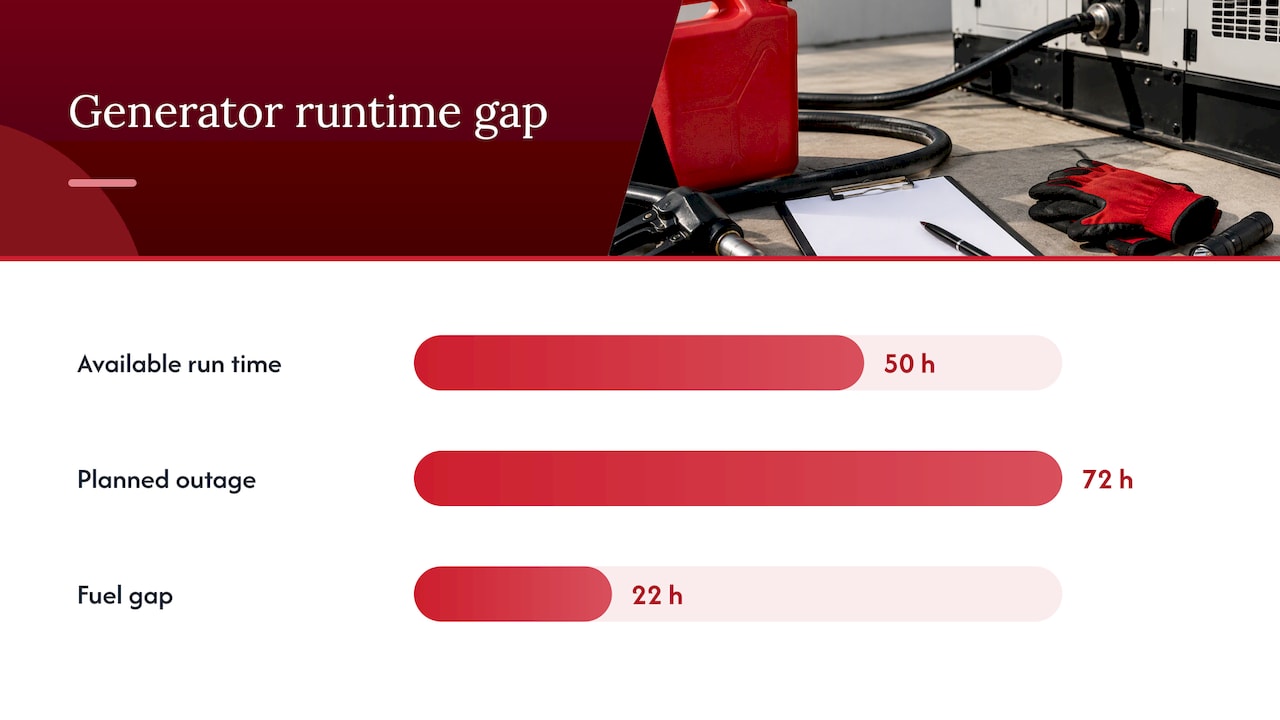
The Pennsylvania DEP’s Healthcare Fuel Shortage Guidebook gives the method. Multiply the generator burn rate by 24 hours to get emergency demand. Divide available storage by that demand, then multiply by 24 to get hours of run time. The guidebook is written for healthcare, but the arithmetic applies to any generator-backed site.
A worked example (illustrative numbers):
- A generator burns 40 gallons per hour at your typical emergency load.
- Emergency demand: 40 x 24 = 960 gallons per day.
- Your tank holds 2,000 gallons.
- Reserve: 2,000 / 960 x 24 = 50 hours of run time.
If your outage plan assumes 72 hours, you have a 22-hour gap, which is about 880 gallons. That is the volume your supplier must be able to deliver before hour 50, not after. Use your real load figures, since burn rates change with load.
The EPA’s Public Safety Power Shutoff SOP template adds the record-keeping side: keep a fuel log with points of contact, run-time needs, inventory and burn rates for each location. It also tells teams to reserve fuel for staff transport, so the people who run the site can reach it.
Two more checks belong here:
- Tank sizing. FEMA’s generator training course says facilities should know the operating period their generator’s fuel tank was sized for and adjust the refueling schedule to match.
- Fuel condition. A tank that has sat for months can hold water or sediment. A Rhode Island emergency power playbook advises having the vendor test stored fuel at the bottom, middle and top of the tank, since a top-only sample can miss problems below. Our fuel polishing service is listed on our emergency fuel delivery page for exactly this kind of stored-fuel work.
Step-by-step emergency refueling procedure
Use this as the backbone of your site SOP. Adjust the names and thresholds to your operation.
Step 1: Declare the emergency and assign roles
Name one person who declares it, one who talks to the supplier, one who meets the truck, and one who keeps the log. On a small site these may be two people. On a multi-site enterprise, the same roles should exist at each location, with one escalation contact at the top.
Washington State’s local fuel planning guidance breaks a fuel incident response into nine actions, from notification and situational awareness through fuel conservation, allocation and recovery, and notes that not every action applies to every incident. Take the same approach: build the full list, then activate only what the event requires.
Step 2: Assess what you have and what you need
Read the gauge, record the time, and calculate remaining run hours from your burn rate. List every fuel consumer: generators, light towers, loaders, haul trucks, reefer units. The EPA template directs teams to assess which locations need fuel, the demand and availability at each, and the generator load.
If your outage is still developing, top off storage now. During an active outage the EPA template says to monitor burn rate, keep storage full and contact the supplier to recheck availability.
Step 3: Call the supplier with a complete request
A vague call costs time. The South Carolina plan shows what a complete emergency fuel request contains, and the same list works for a private order:
- The type of operations supported
- The number of vehicles or pieces of equipment fueled in 24 hours
- The delivery location, with access instructions
- Security arrangements if a truck or tank stays on site
- Gallons and fuel type, including gallons of DEF if needed
Add one detail: whether you need on-road clear diesel or off-road dyed diesel, because that decides the tax and compliance paperwork. We deliver both, plus gasoline and DEF, and our dispatch runs around the clock. Our target in covered areas is a 3-hour emergency response. You can place the call through our emergency fuel delivery service or the order page.
Step 4: Prepare the site for the truck
The EPA recommends a generator refueling plan with a map of fuel-truck access routes, backup power for any stationary-tank transfer pump, and staff trained in fuel-handling safety, including spill kits, PPE and fire extinguishers. Before the truck arrives:
- Clear the route and the fill location of vehicles, debris and standing water.
- Brief the person meeting the driver.
- Place the spill kit and extinguisher at the fill point.
- Confirm where the fill port is. Portland’s generator tank reference sheet, citing NFPA 30, places fill connections outside buildings and at least 5 feet from building openings, and calls for overfill protection that alarms at 90% capacity and shuts off delivery at 95%.
Step 5: Control ignition sources and power state
Equipment that can be shut down for fueling should be. Cal/OSHA’s fueling rule, Section 1936, bans smoking and open flames in fueling areas and requires engines to be off during fueling, with an exception where continued operation is essential for emergency generators and pumps. Section 1936 is a California rule, so check your own state’s version, but the practice is sound everywhere.
For generators, FEMA’s training states that the unit must be shut off for refueling, which may require electrical system cold-start procedures. Plan that restart before you shut down, not while the building is dark. A hospital or data hall needs to know which loads transfer where while the generator is off.
OSHA has also addressed running diesel equipment. A 1996 standard interpretation treats refueling a running diesel engine outdoors or in a well-ventilated open structure as a de minimis condition when a dry-break connection and automatic fuel shutoff system are used. That applies to diesel only. Do not assume it covers your setup without confirming that equipment is in place.
Step 6: Bond, ground and fuel
Bonding and grounding keep static electricity from igniting vapors. One safety consultancy’s guidance on diesel refueling describes attaching a bonding cable from the nozzle or hose to the equipment’s tank or chassis with clean bare-metal contact, grounding the fueling source to earth, and making this part of the site SOP for all fuel transfers.
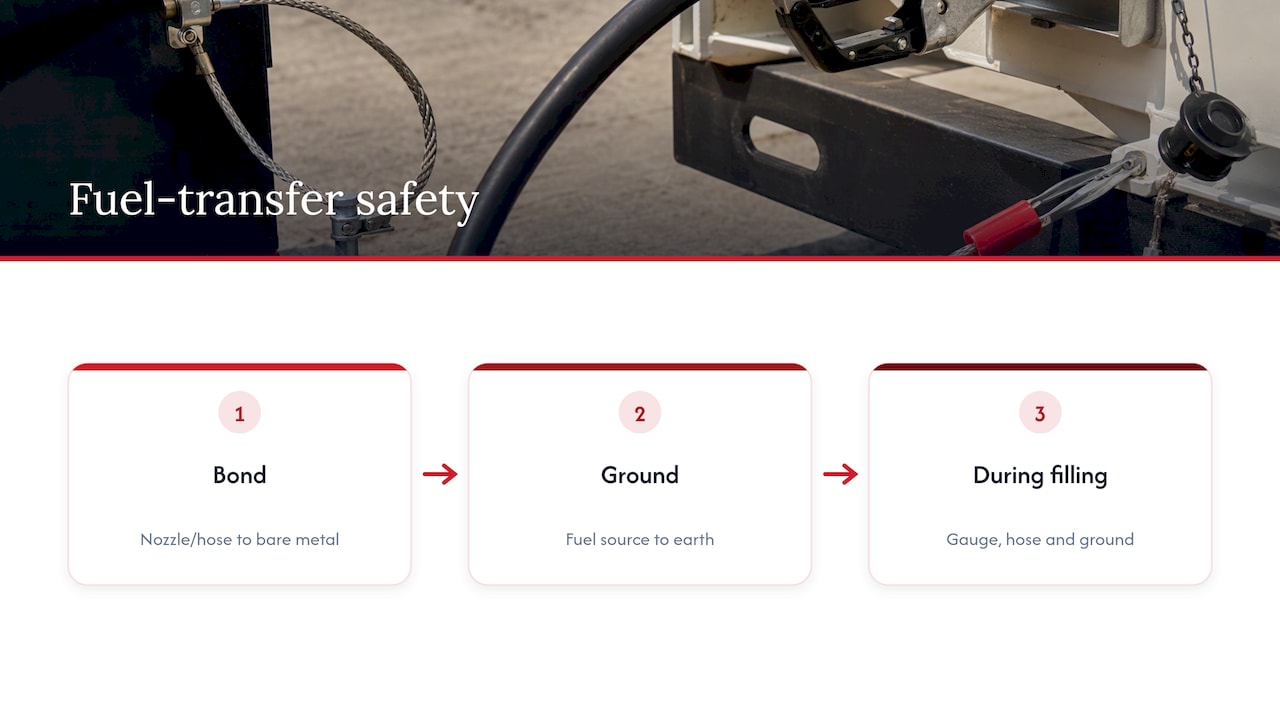
During the fill, keep the person who met the truck at the fill point for the whole transfer. Watch the gauge, the hose and the ground for leaks. Delivery trucks typically pump at up to 65 gallons per minute at 80 to 100 PSI working pressure, per the Portland sheet, so a loose connection becomes a spill quickly. If one happens, follow your spill plan; our diesel spill response guide lists the first actions.
Step 7: Verify and document the delivery
Do not sign until the ticket matches your order. Check:
- Fuel type (dyed or clear diesel, gasoline, DEF)
- Gallons delivered against gallons requested
- Delivery location, date and time
- Supplier and recipient names and addresses
Oregon gives a clear benchmark for what the paperwork should contain. Its wildland fire rules require fuel tenders on public highways to carry fuel type, total gallons, consignor and consignee details and any shipping papers required under 49 CFR. That is a state firefighting contract, not a rule for your site, but those are the fields an auditor or a public-agency reviewer will want to see. Our invoices are itemized, and we explain why this record matters in our guide to fuel delivery documentation.
If you are filing for reimbursement under a government contract or an emergency declaration, delivery records are what you will be asked for.
Step 8: Return to normal and update the plan
The EPA template’s recovery checklist is a good close-out: polish remaining stored fuel, sample for quality, top off all generators, sign fuel contracts ahead of the next event, and reanalyze burn rates using actual records. It also notes that fuel suppliers are first come, first served, which is the strongest argument for signing agreements before you need them.
Update the log within a week while the details are fresh. Replace your estimated burn rate with the measured one.
Safety equipment at the fuel point
Keep this short list at every site where emergency fueling can happen:
- Extinguisher: Cal/OSHA requires at least a 20-B:C rated extinguisher within 75 feet of each pump, dispenser or underground fill opening.
- Emergency cutoff: The same section requires a clearly identified, accessible remote emergency power cutoff for dispensing devices.
- Signs: No-smoking signs at the fill point.
- Spill kit and PPE: Absorbents, gloves and eye protection, with staff who know where they are.
- Bonding cables: Clean clamps and cables in good condition, stored with the kit.
Our generator refueling safety protocol and OSHA fuel handling overview go deeper on site protocols.
Rules that shape emergency fuel deliveries
Three regulatory points are worth knowing, because they affect what suppliers can do for you.
Mobile fueling has limits. PHMSA’s August 2026 hazardous materials deregulatory package lets carriers keep emergency response information electronically if it is immediately available. It also allows on-vehicle discharge of some materials under special permits, but those permits exclude petroleum distillate fuels. Diesel and gasoline deliveries still need to follow the established rules for fuel transport and transfer.
Fuel standards can be waived. EPA’s fuel waivers page records a nationwide waiver renewal dated August 20, 2026, covering ethanol blending and gasoline volatility in response to extreme and unusual supply circumstances. Waivers like these are temporary and are renewed on EPA’s schedule, so check the page for the current status.
Driver hours can be relaxed. When a governor declares a state of emergency, fuel haulers can be exempted from federal hours-of-service limits. FMCSA’s record of South Dakota Executive Order 2025-09 shows how it works: the exemption covered transport of gasoline, diesel, fuel oil and other fuels in short supply, and it ended when the emergency did. Each state’s order is different, so supply and delivery windows depend on what your state has declared.
When public resources are stretched, you may not be first in line. The South Carolina plan says refueling support may not be available in every county and that priorities are set by its Executive Group when necessary. A private supply agreement is how an operator avoids waiting in that queue.
Choosing a supplier for the emergency plan
The EPA template tells teams to sign delivery agreements with one or more fuel companies and read each one to see how the company prioritizes deliveries in an emergency. It also recommends multiple vendors for redundancy. LA County’s emergency power playbook adds that facilities should contract a secondary fuel supplier and be able to pay it immediately during an outage.
When you review an agreement, ask:
- Is dispatch staffed around the clock, including holidays?
- What is the response target, and in which areas does it apply?
- Can it deliver dyed and clear diesel, gasoline and DEF on one account?
- Does it cover every state where you operate?
- Will invoices itemize gallons, fuel type and location?
Multi-site operators gain most from one point of contact. We serve San Antonio, Austin, Dallas-Fort Worth and Salt Lake City directly and reach the rest of the continental United States through our national partner network, so a company with sites in several states can manage emergency fueling through one vendor. For a full procurement-ready plan, see our emergency fuel plan guide, and for data hall operators, our page on emergency fuel services for data centers.
Where Anytime Fuel Pros fits
If your plan needs a supplier you can call at any hour, we deliver diesel (dyed and clear), gasoline and DEF to job sites, equipment yards, generators, data centers, mines and event venues. We handle emergency and after-hours calls, scheduled recurring deliveries, bulk fills, mobile fleet fueling and wet hosing, and we can rent you a fuel tank for extended outages. Setting up a scheduled account before an event means your site is already on file when the call comes in. Start with our fuel services or go straight to the order page.
For storm and outage response at municipal or agency scale, our disaster response services page describes the rapid-deployment side, and our guide to emergency fuel deployment vehicles explains which truck suits which job.
FAQ
What does “emergency fuel” mean?
It is fuel supplied once your normal sources are exhausted or unavailable, for example during a storm, an outage or a supply disruption. Government plans use it for generators supporting hospitals, communication towers and water systems, and the same idea applies to private sites with critical loads.
How long should my emergency fuel reserve last?
That depends on your risk and your supplier’s reach. Calculate your burn rate times 24 hours, then divide your storage by it to find your hours of run time. If the result is shorter than the outage you plan for, you need larger storage, scheduled top-offs or a supplier that can deliver inside that gap.
Can a generator keep running while it is refueled?
FEMA’s generator training says the unit must be shut off for refueling, which may require cold-start procedures. Cal/OSHA allows an exception for emergency generators in California where continued operation is essential. Check your state rules and your site’s electrical plan before deciding.
What should be on the delivery ticket?
Fuel type, gallons delivered, delivery location, date and time, and the names and addresses of supplier and recipient. Compare it against your order before you sign, and file it with your fuel log.
Who should I call first when fuel is running low?
Call your signed fuel supplier with a complete request: fuel type, gallons, location, access details and number of units to fuel. If you do not have an agreement yet, our emergency fuel delivery team takes calls around the clock.
Sources
- South Carolina Emergency Refuel Plan, Appendix 9 (SCEMD)
- EPA Public Safety Power Shutoff SOP template
- Pennsylvania DEP Healthcare Fuel Shortage Guidebook
- FEMA IS-815 emergency generator training
- Rhode Island Powered for Patients playbook
- Washington State local jurisdiction fuel planning
- City of Portland generator tank reference sheet
- California Code of Regulations, Title 8, Section 1936
- OSHA standard interpretation on fueling mobile equipment, 1996
- Shepherd Safety Consulting on bonding and grounding for diesel refueling
- Oregon ODF fuel tender resource duties
- PHMSA hazardous materials deregulatory package summary (Pennsylvania Petroleum Association)
- EPA fuel waivers
- FMCSA South Dakota Executive Order 2025-09
- LA County EMS Emergency Power Resilience Playbook
Recent Comments