
Diesel generators typically run $0.22 to $0.28 per kWh in fuel, natural gas units land closer to $0.10 to $0.18 per kWh, and propane and gasoline usually fall somewhere in between depending on delivered price. Your actual number depends on three things: the kW load your generator is actually carrying, its specific fuel consumption (SFC) at that load, and what you pay per gallon or therm locally. Once you know those three inputs, the formula below turns this range into a site specific number in about five minutes.
TL;DR:
- Generator fuel costs vary significantly by fuel type, load, and local prices, with natural gas units generally being the cheapest per kWh.
- Fuel consumption is load-dependent, and running generators below 70% load increases fuel burn and reduces efficiency, impacting overall costs.
- Proper budgeting requires calculating specific fuel consumption and usage duration, including contingency for engine performance and environmental factors.
- Scheduled fuel delivery with automatic replenishment reduces emergency refueling costs and prevents running on low tanks during outages.
- Using site-specific tools and maintaining fuel quality through regular testing and storage management optimizes operational costs and compliance.
Table of Contents
- How Do You Calculate Generator Refueling Cost?
- How Much Fuel Do Generators Use By Size and Load?
- What Do Real-World Refueling Scenarios Cost?
- What’s the Best Way To Manage Fuel Storage and Delivery?
- How Can You Reduce Generator Fuel Costs?
- What Does NFPA 110 Require for Fuel Testing?
- Which Tools Help You Build a Site-Specific Budget?
- Why a Scheduled Fuel Delivery Partner Cuts Your Refueling Risk
- Sources
- FAQ
How Do You Calculate Generator Refueling Cost?
The core formula is simple, but most facility teams skip a step that matters: fuel burn isn’t linear, so you can’t just multiply nameplate capacity by hours and call it done.
- Find your load fraction. A 100 kW generator running a 75 kW critical load is operating at 75% load, not 100%.
- Pull the SFC from the manufacturer chart. SFC is expressed in gallons per kWh (diesel) or cubic feet per kWh (natural gas), and it changes by load band.
- Multiply: Fuel per hour = kW output × SFC.
- Apply local price: Cost per hour = fuel per hour × price per gallon or per unit of gas.
- Add a 5% to 10% buffer for engine age, altitude, and ambient heat, since real-world burn almost always runs above the spec sheet.
Worked example: A 100 kW diesel unit at 75% load (75 kW output) has an SFC around 0.058 gallons per kWh, according to Solvebility’s efficiency-curve data. That’s 4.35 gallons per hour. At a national average diesel price in the range EIA tracks for on-highway diesel, that hour of runtime lands around $15 to $18. Run it 24 hours and you’re looking at roughly $360 to $430 a day before contingency.
How Much Fuel Do Generators Use By Size and Load?
Fuel burn per kWh isn’t flat across load bands, and that catches a lot of facility teams off guard when they budget off a single “average” number instead of a load-specific one.
- A 20 kW diesel unit at 50% load burns roughly 0.8 to 1.0 gallons per hour; at 75% load, closer to 1.2 to 1.4 gallons per hour.
- A 100 kW diesel unit burns approximately 4.3 to 4.5 gallons per hour at 75% load, per Solvebility’s SFC data, rising sharply if load drops below 40%.
- A 500 kW diesel unit at 75% load typically burns 25 to 30 gallons per hour, based on sample tables in the same consumption analysis.
- Natural gas units in similar size classes burn measured in cubic feet per hour rather than gallons, and cost comparisons need to run on a per-kWh basis, not per-unit-of-fuel.
Here’s the part that trips up budgeting: a cheaper fuel per gallon doesn’t guarantee a cheaper cost per kWh. Diesel carries more energy density than natural gas, so even when diesel costs more at the pump, it can still produce cheaper delivered power once you run both fuels through the SFC math. Efficiency at the actual load band, not the price tag on the fuel, is what decides your real cost per kilowatt-hour.
What Do Real-World Refueling Scenarios Cost?
Budgeting gets easier once you stop thinking in flat daily numbers and start thinking in runtime blocks. Here’s how three common generator sizes stack up across typical outage durations, using diesel at current EIA benchmark pricing and a 75% load assumption with a 10% contingency built in:
- 20 kW unit, 8 hours: roughly 10 to 12 gallons, $35 to $45 total.
- 100 kW unit, 24 hours: roughly 105 to 115 gallons, $370 to $420 total.
- 500 kW unit, 72 hours: roughly 1,900 to 2,100 gallons, $6,700 to $7,800 total.
That threshold gives you a buffer against delivery delays, weather, or a longer-than-expected outage. Emergency refueling, arranged after a tank runs low with no lead time, almost always costs more than a scheduled recurring delivery planned around your actual burn rate.
What’s the Best Way To Manage Fuel Storage and Delivery?
Facility teams generally choose between three models: on-site bulk storage with periodic fills, standing tank rentals refreshed on a schedule, and on-demand delivery triggered by monitored fuel levels. Each has a place depending on runtime requirements and site access.
- Check diesel shelf life. Standard diesel starts degrading within 6 to 12 months without a fuel stabilizer, so stored fuel needs periodic testing or polishing.
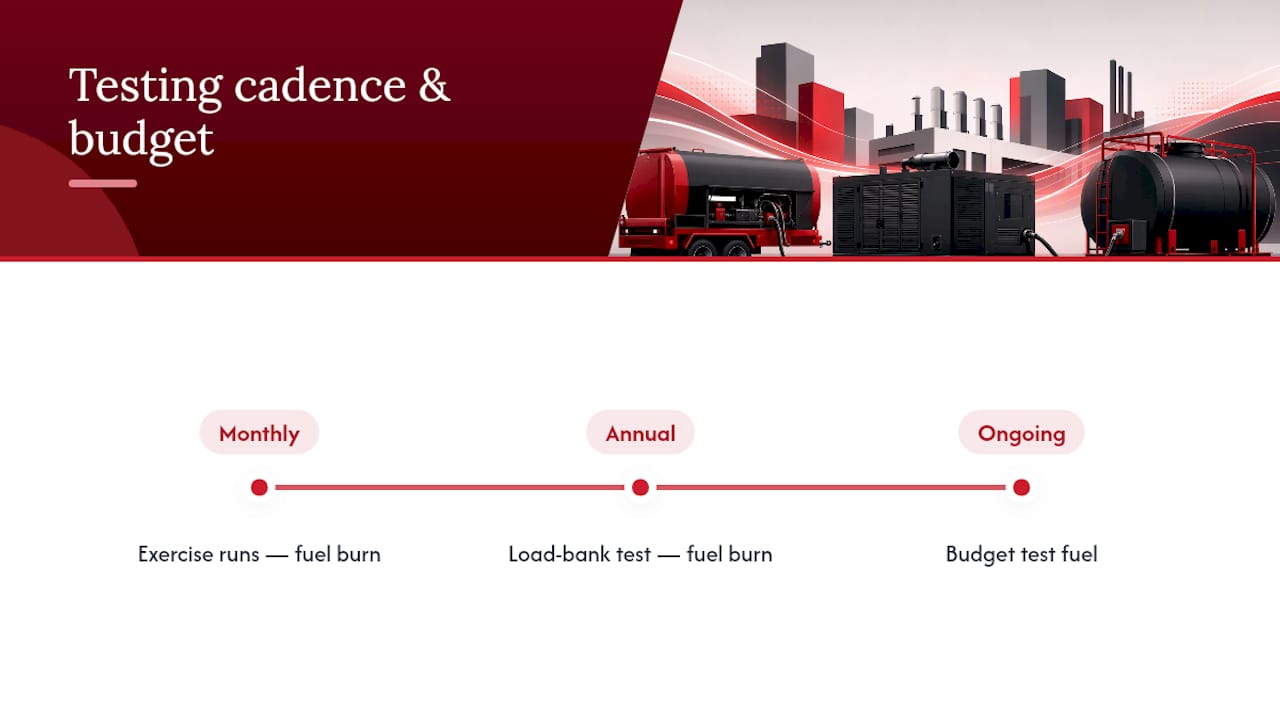
- Schedule monthly exercise runs and confirm fuel quality before annual load-bank testing.
- Set a minimum reserve threshold (commonly 25% to 30% of tank capacity) that triggers a reorder automatically rather than reactively.
- Vet delivery partners on response time, invoicing clarity, and dyed-diesel compliance if the generator runs on off-road fuel.
Pro Tip: Log every delivery against actual runtime hours, not calendar days. A generator that ran twice as long during a heat wave will burn through its reserve threshold faster than your regular schedule assumes, and that gap is exactly where emergency refueling costs creep in.
How Can You Reduce Generator Fuel Costs?
Cutting fuel spend without cutting reliability comes down to a handful of operational levers, and most facility teams are only using one or two of them.
- Right-size the load. Diesel units run most efficiently between 70% and 80% load; running well below 40% load increases fuel burn per kWh and raises wet-stacking risk.
- Stay current on preventive maintenance. Dirty air filters and worn injectors quietly push fuel consumption up over time.
- Install fuel-flow metering to catch consumption drift before it becomes a budget surprise.
- Evaluate a fuel-type switch where pipeline gas is available. Natural gas conversions can cut per-kWh fuel cost by 30% to 50% for high-hour installations, though payback typically takes 18 to 36 months.
- Add power factor correction on sites with heavy inductive loads to reduce apparent-power waste.
- Watch your load profile. Staging multiple smaller units to match demand beats running one oversized generator at partial load.
Pro Tip: Before spending on a fuel-type conversion, pull six months of load data first. A generator that spends most of its runtime below 40% load has a right-sizing problem that a fuel switch won’t fix.
What Does NFPA 110 Require for Fuel Testing?
NFPA 110 requires monthly exercise runs and annual load-bank testing for most emergency and standby generator installations, and both require actual fuel burn, not just a startup check. Bell Performance’s compliance guidance is direct on one point: test fuel should never get deferred just because prices are elevated. The cost of a missed compliance test is a fraction of what an unverified generator costs you during an actual outage. Build test fuel into your recurring budget line rather than treating it as a discretionary expense.
Which Tools Help You Build a Site-Specific Budget?
The formula in this article gets you close, but a few resources make the math faster and more accurate for your specific site.
- ASPR TRACIE’s generator fuel cost calculator runs hourly, daily, and monthly estimates using SFC and efficiency curves.
- EIA’s fuel price pages give current diesel and natural gas benchmarks to swap into your local calculation.
- Manufacturer consumption charts (usually in the generator’s spec sheet or available through Anytime Fuel Pros’ consumption resources) give you the actual SFC curve for your unit.
Swap in your local delivered price, your measured load profile, and your unit’s actual SFC, then save the 5% to 10% contingency in every scenario you export.
Why a Scheduled Fuel Delivery Partner Cuts Your Refueling Risk
Every scenario above assumes you know your fuel level and can act on it before you’re running on fumes during an outage. That’s the gap Anytimefuelpros closes. Rather than sending a crew off-site or scrambling for emergency delivery at premium rates, you get on-site diesel delivery scheduled around your actual burn rate, with recurring fills that keep tanks above your reserve threshold automatically.

For data centers and other critical facilities, that means fewer 2 a.m. dispatch calls and a predictable line item instead of a fuel emergency. Anytimefuelpros handles bulk fuel delivery and emergency after-hours response with transparent, itemized invoicing, so the numbers you calculated in this article show up on your budget the way you planned them, not with a surprise emergency markup attached. If your generator fleet runs on a testing schedule, a recurring event calendar, or an unpredictable outage risk, request a site assessment through Anytimefuelpros’ fuel services page and get a delivery schedule built around your actual consumption data instead of a guess.
Sources
- Generator Fuel Cost Calculator | Technical Resources | ASPR TRACIE
- EIA FAQs: How much does energy cost?
- Generator Fuel Cost Calculator: Complete Guide (Solvebility)
- Bell Performance — NFPA 110 generator fuel testing guidance
FAQ
How Long Will 5 Gallons of Fuel Last in a Generator?
It depends entirely on load. A small generator running light (around 1 gallon per hour) stretches 5 gallons to roughly 5 hours, while a larger unit at 75% load can burn through it in under an hour. Check your unit’s SFC chart against your actual load to get a real number rather than assuming a flat burn rate.
How Often Do Generators Need To Be Refueled?
Refueling frequency depends on tank size relative to runtime, not a fixed schedule. Most facility teams plan a top-off once the tank drops to 25% to 30% capacity, and critical sites often set up recurring scheduled deliveries so refueling never depends on someone noticing a low gauge.
How Much Gas Does a Generator Use in 24 Hours?
A 100 kW diesel generator running at 75% load for 24 hours burns roughly 105 to 115 gallons, based on standard SFC figures from Solvebility’s consumption data. Smaller 20 kW units use closer to 20 to 25 gallons over the same period at comparable load.
How Much Does Anytimefuelpros Charge for Generator Refueling?
Pricing depends on fuel type, volume, and delivery location, and current rates are available directly through Anytimefuelpros’ fuel services page. Facility teams typically get a quote based on tank size, delivery frequency, and site access rather than a flat published rate.
What Is 1,000 Cubic Feet of Natural Gas Worth for Generator Fuel?
Natural gas pricing varies by region and season, and industry price tracking shows meaningful swings between summer and winter rates. Converting that price into a per-kWh generator cost requires your unit’s specific fuel consumption in cubic feet per kWh at your actual operating load.
Recent Comments