
An on-site fueling policy is a written standard that says who may order, authorize, dispense and record fuel at your sites, how fueling is done safely, and what records prove it. The strongest policies cover eight areas: scope and roles, authorization controls, fueling area and spill rules, training, delivery documentation, dyed diesel handling, inventory and emergency planning, and scheduled review. This guide walks through each one, using public guidance from regulators and cities, so you can draft a policy that holds up in an audit and keeps equipment running.
TL;DR
- Assign named roles for approving, ordering, dispensing and recording fuel, and keep those roles with different people.
- Require a written spill and emergency plan, documented training, and a fueling area built to contain spills.
- Keep delivery tickets, meter readings and usage logs, and mark and document dyed diesel as off-road only.
- Plan inventory, scheduled deliveries and emergency refueling in advance so a low tank never stops a crew or a generator.
- Review the policy on a fixed schedule and after any change in equipment, sites, tank capacity or regulation.
Table of Contents
- Why a written fueling policy matters
- Define scope, roles and responsibility
- Assess your needs and choose a fueling arrangement
- Authorization and internal controls
- Permits and regulatory rules to check
- Fueling area design and spill prevention
- Training and fire prevention
- Spill response
- Records, delivery documentation and dyed diesel
- Plan inventory, scheduled deliveries and emergencies
- Keep the policy current
- How Anytime Fuel Pros supports your policy
- FAQ
- Sources
Why a written fueling policy matters
Fuel is one of the few operating costs that is easy to lose without noticing. It moves between tanks, trucks, cards and cans, and each handoff is a chance for theft, a spill or a billing error. Without a policy, every supervisor invents their own routine, and the first time anyone compares them is during an audit or after an incident.
A policy fixes that by setting expectations once. It also helps on the operations side. When ordering, delivery windows and tank levels follow a standard, crews stop waiting on fuel and managers stop paying rush rates for avoidable emergencies.
The same structure works for a data center with backup generators, a contractor with an equipment yard, a city fleet or an event production. The details change, but the building blocks are the same.
Define scope, roles and responsibility
Start with what the policy covers: which sites, which equipment, which fuels (gasoline, clear diesel, dyed diesel, DEF) and which delivery methods, such as bulk tank fills, wet hosing or mobile fleet fueling.
Then name the roles. Washington State Auditor guidance says agencies should adopt and enforce a fuel program policy describing expectations for employees who authorize or issue fueling devices, manage inventory, monitor usage or dispense fuel. It should also address internal controls and the reporting of excessive usage, losses or discrepancies. That list is a practical template for any organization, public or private.
A simple role table keeps it clear:
| Role | Responsibility | Should not also be |
|---|---|---|
| Fuel program owner | Maintains the policy, reviews reports, approves exceptions | The person who dispenses fuel |
| Approver | Authorizes access, cards, keys and tank assignments | The person who orders or issues cards or keys |
| Orderer | Places scheduled and on-demand delivery requests | The person who approves access |
| Dispensing operator | Fuels equipment, follows spill and safety procedures | The person who keeps the records |
| Records custodian | Reconciles tickets, logs and invoices | The person with custody of the fuel |
The separation in the last column comes straight from the Washington guidance. It says approvers should not be the same people who order, issue or record fuel cards or keys, and that those who maintain records should not be the same people who have custody of or dispense fuel.
Assess your needs and choose a fueling arrangement
Before you write procedures, size the demand. Pull twelve months of fuel purchases by site and equipment type, then note the peaks: harvest, a project phase, storm season, an event weekend. Group the equipment into three buckets:
- Mobile equipment that moves between locations, such as trucks and loaders. These fit mobile fleet fueling or wet hosing at a yard.
- Stationary equipment, such as generators, light towers and compressors. These fit scheduled tank fills.
- Standby assets, such as backup generators. These need level monitoring and an emergency delivery path.
Then choose the arrangement for each bucket. Common options are a rented or owned bulk tank on site, scheduled mobile deliveries straight into equipment, and on-demand orders for spikes. Many operations combine all three. Our On-Site Diesel Delivery Setup guide covers the practical steps, and bulk fuel delivery and storage on job sites explains how tanks fit into a site plan.
Write the choice into the policy, with the reasoning. Whoever inherits the program later will know why a tank sits where it does.
Authorization and internal controls
Control who can get fuel, how much and when. A workable policy requires:
- Manager approval before any person, vehicle or piece of equipment gets fueling access.
- Unique credentials per user or per asset, whether cards, keys or codes.
- A defined process to deactivate access when someone leaves or equipment is retired.
- Thresholds that trigger a review, such as fuel use per hour or per mile far above the norm for that asset.
- A reporting path for losses, discrepancies and excessive usage.
The Washington guidance lists manager approval for fueling access as a core authorization control, alongside the segregation of duties above.
Public fleets often add an eligibility rule on top. The City of Long Beach, for example, states that its fuel system serves only city fleet assets unless the City Council approves a fueling agreement, and that Fuel Services strictly controls distribution to avoid product theft. It also monitors fuel use and provides emergency fueling during contingencies through assigned mobile fuel trucks. A municipal fueling policy should answer the same three questions: who is eligible, how use is monitored, and who fuels the city during a disaster.
Permits and regulatory rules to check
A policy should list the permits and plans that apply, so no one has to guess. Requirements vary by city, county, state and fuel type, so confirm each with your local fire code official and environmental agency. Three examples show the range:
- Local fire permits. A Modesto, California permit application states that a permit is required to dispense liquid fuels from a fixed site into motor-vehicle tanks, and to use mobile tank vehicles to dispense fuel directly into motor-vehicle tanks.
- Spill Prevention, Control and Countermeasures (SPCC). Under 40 CFR 112, a facility with aboveground tank systems, including refueler trucks, and aggregate storage of 1,320 gallons or higher must prepare an SPCC Plan. The plan framework includes secondary containment, loading and unloading, inspections, training and spill response procedures.
- Site-level permits for fixed storage. One municipal airport standard requires a Fuel Storage System Permit before installation, with spill prevention features, containment and an approved SPCC plan.
If you rent a tank or take bulk deliveries, add the tank’s capacity to your SPCC math and record it in the policy. Telecom and utility operators face this often, and our telecom site fueling guide shows how SPCC, monitoring and run-out prevention fit together.
Fueling area design and spill prevention
The physical setup is where policy meets the ground. EPA’s municipal vehicle fueling guidance says staff should design fueling areas to prevent spills and stormwater contamination and include spill containment, because spills can still happen. Its specifics are useful as policy language:
- Impervious paving such as concrete, or sealed asphalt.
- A 2 to 4 percent slope to prevent ponding.
- A grade break or berm to keep stormwater away from the fueling area.
For mobile fueling, Tacoma’s stormwater manual gives numbers you can copy into a standard. The driver or operator must keep constant observation during fuel transfer. Fueling must take place at least 25 feet from the nearest stormwater inlet, or inside an impervious containment area holding at least 110 percent of the receiving tank volume, or with an impervious cover over the inlet. The same manual requires drip pans or liquid-tight absorbent pads, with 5-gallon capacity, under each fueling location before and during dispensing.
A Maple Grove, Minnesota mobile fueling permit guide adds an operating rule worth borrowing: it addresses leaving the vicinity of a vehicle while it is being filled, and treats the delivery hose on a tank vehicle as part of the fuel transfer system. In plain terms: nobody walks away during transfer.
For the day-to-day checklist on our side of the hose, see our on-site fuel delivery safety protocols and generator refueling safety protocol.
Training and fire prevention
A procedure nobody has been trained on is only a document. San Francisco’s mobile fueling submittal guidelines require a written safety and emergency response plan covering fire safety, spill prevention and control, and personnel training. They also require initial and refresher training records that identify each employee and training dates, available to the fire code official on request.
Your policy can mirror that with these requirements:
- Initial training before anyone fuels or supervises fueling.
- Refresher training on a set interval.
- A training record for every person, with names and dates.
- Fire prevention rules: no ignition sources, bonding and grounding where required, extinguishers within reach, and no fueling of running equipment unless the equipment procedure allows it.
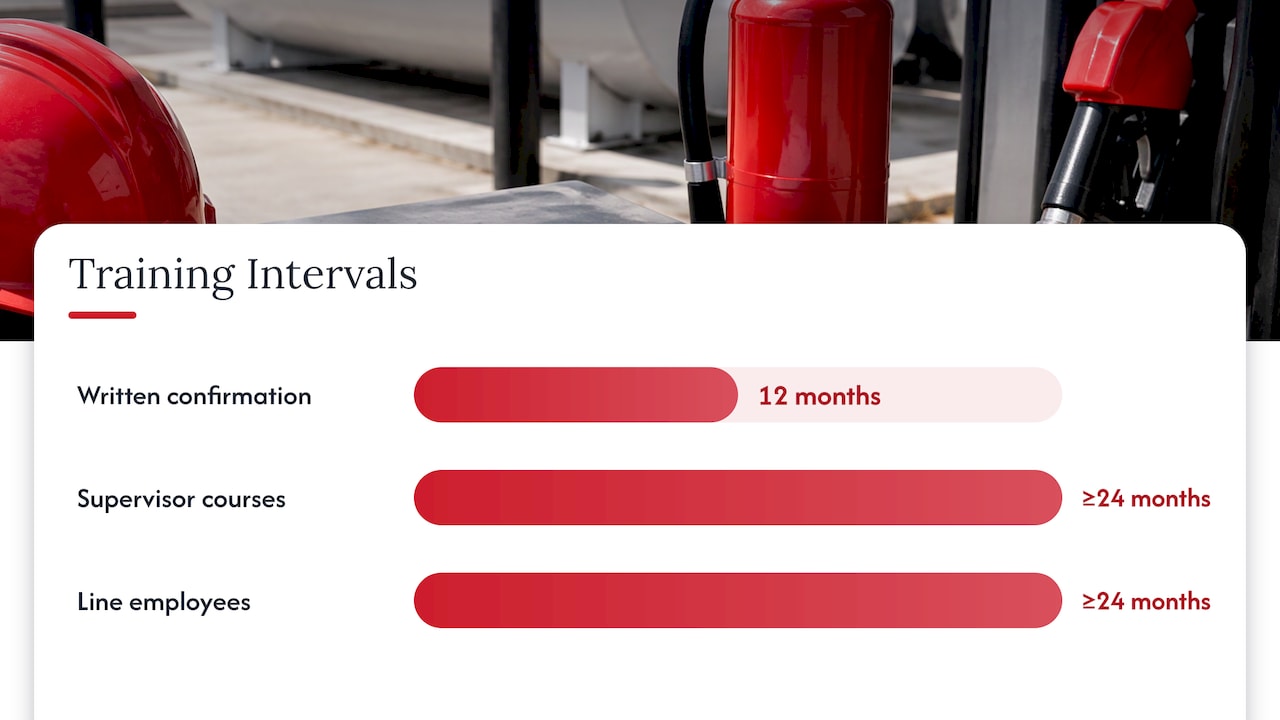
Aviation shows how specific intervals can get. One airport authority’s standard, built on FAA rules, calls for written confirmation of training every 12 months, supervisor fire-safety courses with recurrent instruction at least every 24 months, and hands-on recurrent training for line employees at least every 24 months. You do not need aviation intervals for a construction yard, but a fixed interval written down beats an informal one. Our article on why fuel delivery requires trained operators explains what to expect from a delivery crew.
Spill response
Put a site-specific spill plan in the policy, not a generic one. A Las Vegas airport tenant standard requires tenants to develop and implement a site-specific spill response plan covering control, response and cleanup of spills, leaks or discharges. The principle applies anywhere.
A useful plan answers five questions:
- Where is the spill kit at each site, and who checks it?
- Who stops the transfer and how?
- Who is called first, and who decides whether a release must be reported?
- Where are the nearest storm drains and waterways?
- How is the incident documented afterward?
Small spills caught in a drip pan are a different case from releases that reach soil or water. Tacoma’s manual notes that spilled fuel retained in the drip pan or pad need not be reported, but reporting thresholds differ by jurisdiction, so write yours with your environmental agency’s rules in hand. For response steps, see our diesel spill response actions.
Records, delivery documentation and dyed diesel
Good records answer three questions: what came in, what went out, and where it went. Require these for every site:
- Delivery tickets or bills of lading showing date, product, gallons and delivery location.
- Meter readings and tank levels at a consistent interval.
- Usage logs by asset, with hours or mileage.
- Reconciliation of tickets, logs and invoices by the records custodian.
Itemized invoicing makes the last step far easier. Our invoices are itemized, so each delivery can be matched to a site, product and volume.
Dyed diesel rules
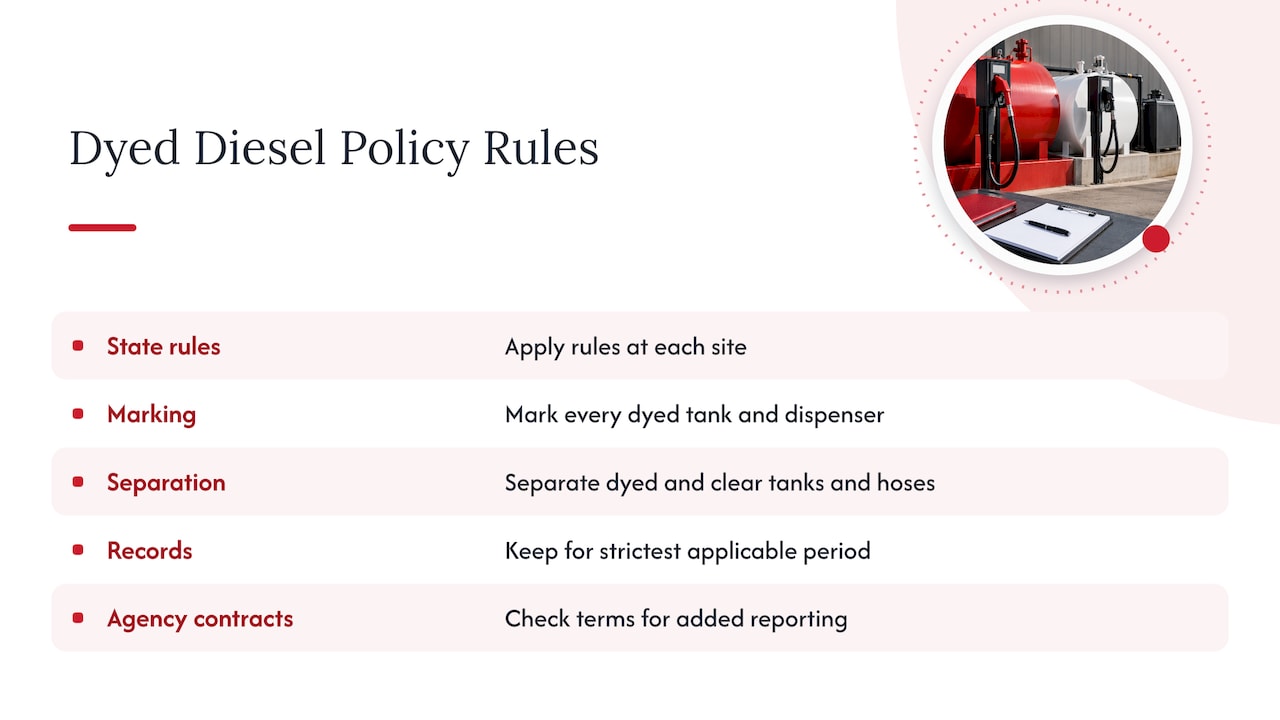
Dyed diesel is for off-road use, and the paperwork is where organizations get caught. North Carolina’s revenue department guidance is a clear example of what states expect. It says dyed diesel is for off-road use only, that storage tanks, fill caps or spill containment boxes and dispensing devices must carry a marking such as “Dyed Diesel, Non Taxable Use Only, Penalty for Taxable Use,” and that records must be kept for three years. The same page lists retailer records such as receipts, invoices or bills of lading, monthly totalizer readings and monthly beginning and ending inventories, and says shipping documents must be kept for 90 days.
Alabama’s regulation takes the user’s side. It says the diesel excise tax does not apply to dyed diesel used exclusively off the highway if the user shows that to the department, and it requires adequate records, including daily logs showing distance traveled and fuel used.
Those are two states, not a national rule. Your policy should say which state rules apply at each site, require marking on every dyed diesel tank and dispenser, keep dyed and clear diesel in separate tanks and hoses, and set a retention period at least as long as the strictest rule that applies. Public agencies should also check contract terms for added reporting.
Plan inventory, scheduled deliveries and emergencies
This is where policy prevents downtime. Set rules in advance for:
- Reorder points. Order when a tank hits a set level, not when the gauge looks low. A common approach is to base the level on lead time plus a buffer for a delayed delivery.
- Delivery schedules. Put predictable demand on recurring deliveries. Heavy equipment fleets benefit from fixed days tied to shift patterns, which our heavy equipment fueling schedule best practices article lays out. Standby generators need schedules too, as in generator fueling schedules explained.
- Emergency triggers. Define what counts as an emergency, who can call it, and who pays attention after hours. Critical facilities should read our mission-critical uptime fueling strategies.
- Fuel quality. Standby fuel that sits for months needs a maintenance plan. See our generator fuel maintenance program.
- Disaster mode. Pre-authorize priority sites, backup contacts and alternate delivery points for hurricanes, wildfires and outages. Our disaster response services page describes our approach.
A short worked example: a contractor runs six machines using about 300 gallons a day in total from a 2,000-gallon rented tank. With a two-day delivery lead time, the policy sets the reorder trigger well above 600 gallons, and adds a margin for a missed window. Your numbers will differ, but the method holds.
Keep the policy current
Set a review date in the policy itself. Annual reviews work for most operations, and the review should also be triggered by events rather than the calendar alone:
- New sites, tanks or a change in total storage capacity.
- New equipment types or fuels.
- A spill, near miss, theft or audit finding.
- A change in local fire code, state dyed diesel rules or contract terms.
- A change of fuel supplier or delivery method.
Some reviews are mandatory. Under the EPA SPCC rule, a plan must be reviewed at least every five years, and amended if the review finds it no longer matches facility conditions. Keep a revision log with the date, the change and the approver.
How Anytime Fuel Pros supports your policy
A policy only works if your fuel partner can deliver to it. We bring diesel (red and clear), gasoline and DEF directly to job sites, equipment yards, generators, data centers, mining operations and events, with scheduled recurring deliveries, bulk fills, fuel tank rentals, mobile fleet fueling and wet hosing. Our service is designed around 24/7 availability, a 3-hour emergency response in covered areas, itemized invoicing and technology-driven order and dispatch coordination.
We serve San Antonio, Austin, Dallas-Fort Worth and Salt Lake City directly, and the continental U.S. through our partner network, which gives multi-site operators one point of contact. Review our fuel services, see how mobile fleet fueling works, or place an order to set up a delivery schedule that matches your policy.
FAQ
What is an on-site fueling policy?
It is a written standard for how fuel is ordered, authorized, delivered, dispensed, recorded and protected at your sites. It names responsible roles, sets safety, spill and training rules, and defines the records you keep. It applies to tanks, mobile deliveries and equipment fueling alike.
Who should own the policy?
A named fuel program owner, usually in operations, fleet or facilities management, should maintain it and review reports. Authorization, ordering, dispensing and recordkeeping should sit with different people, a separation recommended in Washington State Auditor guidance.
What should a municipal fueling policy add?
Public agencies should add eligibility rules for who may use city fuel, usage monitoring, theft controls and an emergency fueling plan. Contract and reporting requirements for dyed diesel and government funding should be written in as well. The Long Beach regulation cited above shows how one city handles these items.
How long should fueling records be kept?
It depends on your state and fuel type. North Carolina, for example, says dyed diesel records must be kept for three years. Set your policy to the longest period that applies to any of your sites, and confirm it with your state revenue agency.
How often should the policy be reviewed?
Review it at least once a year and after any spill, audit finding, equipment change or rule change. If you have an SPCC plan, the EPA rule requires its own review every five years.
Sources
- Best practices for fueling government owned vehicles (Washington State Auditor)
- Flammable and Combustible Liquids Permit Application (City of Modesto)
- Airport Fuel Dispensing and Handling Standards (Boulder City)
- Spill Prevention Control and Countermeasures (SPCC) policy
- SPCC Plan Requirements: 40 CFR 112 guide
- Submittal Guidelines for On-Demand Mobile Fueling (San Francisco Fire Department)
- Stormwater Best Management Practice: Municipal Vehicle Fueling (EPA)
- BMP S123 Mobile Fueling of Vehicles and Heavy Equipment (City of Tacoma)
- Mobile fueling operations permit guide and application (Maple Grove, MN)
- Aviation Fuel Safety FAR 139.321 Standard Operating Procedures (Sarasota Manatee Airport Authority)
- Airport Tenant Fueling Standard (Las Vegas McCarran International Airport)
- Administrative Regulation 4-5, fleet refueling (City of Long Beach)
- Guide for Dyed Diesel Use (North Carolina Department of Revenue)
- Ala. Admin. Code r. 810-8-1-.17, Dyed Diesel Fuel (Cornell LII)
Recent Comments