

A public fuel bid asks you to prove three things: that you can deliver the right product on time, that you can price it in the agency’s exact format, and that you carry the insurance, licenses and paperwork the contract demands. Miss any mandatory item and the agency can reject the bid as nonresponsive, however low your price is. This guide walks through what fuel solicitations from cities, counties and states typically contain, using real 2026 solicitations as examples, so you can build a bid that gets scored.
TL;DR
- Most public fuel bids require completed bid and pricing forms, references, proof of terminal or supply access, an emergency response plan and insurance acknowledgment.
- Pricing is usually a fixed adder or differential on top of a published index such as an OPIS rack price, with no extra handling or surcharge lines allowed.
- Many agencies set standard delivery windows (for example 48 hours) and much shorter emergency windows (for example 12 hours), and they expect you to commit to both.
- An Invitation for Bids (IFB) usually goes to the lowest responsive and responsible bidder. An RFP weighs experience and other criteria too.
- Missing forms, an unacknowledged addendum, added conditions or a late upload are the most common ways to lose a bid. Always verify the controlling rules in the solicitation itself.
Table of Contents
- IFB, ITB or RFP: which document are you answering?
- What documents a fuel bid typically requires
- How agencies specify fuel, quantities and delivery
- How to quote fuel prices in a public bid
- Qualifications, licensing and insurance
- How to submit a responsive bid
- How agencies evaluate and award
- Requirements that vary by agency and state
- Where Anytime Fuel Pros fits
- FAQ
- Sources
IFB, ITB or RFP: which document are you answering?
The label on the solicitation tells you how you will be judged. Agencies use several names, and the differences matter.
- Invitation for Bids (IFB) or Invitation to Bid (ITB): The agency has already defined exactly what it wants. You quote a price, and the award goes to the lowest bidder that is both responsive (it followed the instructions) and responsible (it can perform). The Providence, Rhode Island fuel IFB, for example, awards on evaluated differential pricing to the lowest responsive and responsible bidder.
- Request for Proposals (RFP): Used when price is not the only factor. The State of Maine explains that when subjective criteria such as experience are a priority, agencies use an RFP rather than an IFB, which allows broader evaluation than low cost alone.
If you searched for a fuel delivery RFP, expect a written technical response (approach, staffing, equipment, safety record, emergency plan) in addition to a price sheet. If you are answering an IFB, the technical content shrinks to forms and certifications, and the price sheet decides the outcome. Either way, the instructions are binding.
What documents a fuel bid typically requires
The packet varies by agency, but the same building blocks appear again and again. The Providence IFB is a useful model. It asks for completed bid forms, a pricing form, vendor qualifications with references, terminal-access documentation, an emergency response plan and acknowledgment of insurance requirements.
Build a standing bid library so you are not starting from zero each time:
- Signed bid forms and certifications. Names, signatures, authorized-signer details and any affidavits or non-collusion statements the agency lists.
- Pricing form. Filled out exactly as laid out, with every line item the agency asks for and nothing it does not.
- Vendor qualifications. Years in business, comparable contracts, fleet size, and at least the number of references requested, with current contact details.
- Supply and terminal access. Evidence that you can actually obtain product. One June 2026 invitation asks bidders for written documentation of direct ownership, contractual access, exchange agreements or supply rights. Treat that as a signal to keep supply paperwork ready.
- Emergency response plan. Who answers the phone after hours, how trucks are dispatched, and what backup supply you can call on.
- Insurance certificates and acknowledgment. Covered below.
- Subcontractor disclosure. The Illinois Tollway’s bulk fuel IFB requires bidders to list subcontractor names and addresses when a bid includes them. If you rely on partner carriers or a partner network for some deliveries, plan to disclose it.
How agencies specify fuel, quantities and delivery
A well-written solicitation tells you what to price. Read this part before anything else, because it defines your cost.
Products and standards
Agencies specify fuel by product and grade, often with an ASTM standard attached. Providence’s IFB specifies fuels by product, including the applicable ASTM standards. Check whether the bid calls for clear (on-road) diesel, dyed off-road diesel, gasoline, DEF or a blend, and whether seasonal grades are required.
Locations and estimated volumes
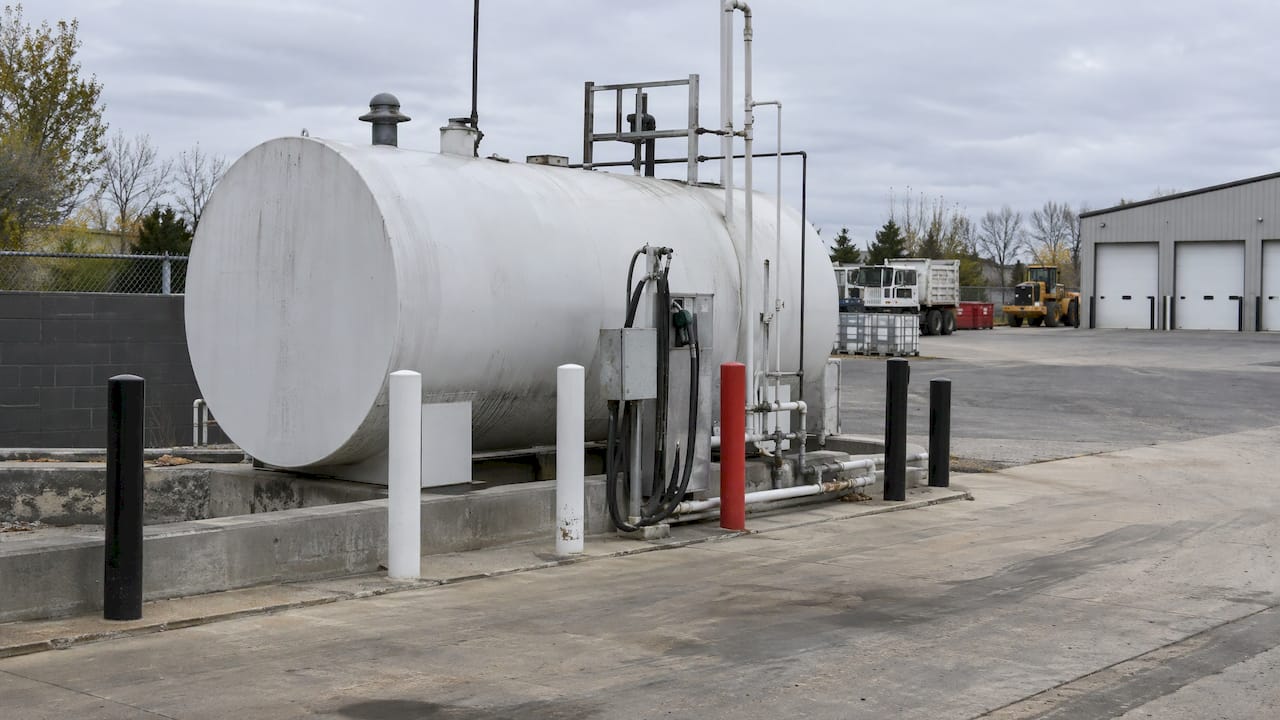
Expect a table of delivery sites with estimated annual usage. Those figures are estimates, not guarantees, so confirm in the terms whether the agency commits to a minimum. Providence’s IFB lists its locations and estimated annual usage, which is the pattern most agencies follow. Tank sizes, access restrictions and whether a site is a fixed tank, a generator tank or a mobile fueling stop all change your truck and labor cost.
Delivery windows and emergency response
Standard and emergency timelines are written into the bid as obligations. The Providence IFB sets standard delivery at 48 hours and emergency delivery within 12 hours. Only commit to windows your dispatch and supply can meet in every location listed, including holidays and storms. Agencies use these clauses for generators, snow operations and public safety fleets, so a missed emergency delivery is a contract problem, not just a service complaint.
If you are comparing what response times look like in practice, see our breakdown of emergency fuel response time targets.
How to quote fuel prices in a public bid
Pricing is where most bids are won, and where most are disqualified. Public buyers want a structure they can audit.
Index plus adder
Many agencies tie price to a published index and ask you to bid only the fixed portion. Morgan County, Colorado asks bidders to quote a fixed reseller’s price added to the average Denver OPIS rack price for the delivery date. In that structure, your bid is the adder: your margin, delivery cost and overhead, expressed in cents per gallon. The index does the rest.
Because the index you choose matters when contracts run for months, it helps to understand the difference between weekly and daily benchmarks. Our guide to EIA weekly diesel versus OPIS daily rack prices explains why the reference in the contract language can move your effective price.
Taxes, delivery and extra charges
Read the tax language carefully. Some agencies, such as Austin County, Texas in a recent fuel bid, want state taxes for gasoline and highway diesel stated separately, with prices quoted for fuel delivered into their tanks. Tax-exempt purchasers and dyed diesel have their own treatment, so follow the form rather than assuming.
Do not add surcharges the form does not provide for. The Vancouver, Washington ITB disallows additional charges, including handling charges, beyond the stated pricing. If your delivery fee, minimum-drop charge or fuel surcharge is real, fold it into the adder instead of listing it separately, unless the form has a line for it.
Fixed price versus floating
Some buyers also want fixed pricing for a set volume. Whether that wins depends on the market and the agency’s budget tolerance. We cover the trade-offs in when a fixed price wins for U.S. buyers.
Qualifications, licensing and insurance
Responsible-bidder checks screen out vendors who cannot perform. The Providence IFB looks for financial capability, experience, licensing, terminal access, fleet capacity and emergency-response capability, and requires insurance certificates before the contract is executed.
The coverage list in that same bid is long: it calls for general, auto, pollution, environmental, workers’ compensation, cyber, umbrella and cleanup or remediation coverage. Fuel delivery carries spill and pollution exposure, so agencies press hard here. Ask your broker well before the due date whether your current limits match the solicitation, because endorsements and additional-insured wording can take days to issue.
Other items that commonly sit alongside insurance:
- Business and fuel handling licenses required by the state or locality.
- Driver and vehicle compliance records.
- Spill prevention and response procedures. See our guide to diesel spill response actions and our on-site fuel delivery safety protocols for the kind of procedures reviewers like to see documented.
- Public-sector and government-contract reporting, including dyed diesel documentation for off-road use.
How to submit a responsive bid
Responsive means you did what the instructions said, in the way they said it. Evaluators often check this before they ever look at price.
Submission checklist
- Read the whole solicitation once for requirements, once for traps. Note the due time (with time zone), the delivery method and the question deadline.
- Submit every required form. The Vancouver ITB requires its listed forms by the deadline through one of the listed submission methods, and notes that a missing addenda acknowledgment or conditions added by the bidder can make a bid nonresponsive.
- Acknowledge every addendum. Agencies issue addenda to correct quantities, extend dates or change specs. Check the portal again the day before the deadline.
- Do not edit the agency’s terms. Qualifying language, exceptions and added conditions can disqualify you. Send questions during the Q&A window instead.
- Upload early. Illinois’ BidBuy instructions put responsibility for timely submission on the vendor and warn that leaving too little time for technical support or portal problems risks disqualification.
The consequence is stated plainly in the Providence IFB: failing to provide a mandatory item, such as required certifications or forms, may result in rejection as nonresponsive.
Common ways fuel bids fail
| Mistake | Why it hurts |
|---|---|
| Unsigned or missing forms | Mandatory items missing can mean rejection as nonresponsive |
| Unacknowledged addendum | Agencies treat it as not accepting the current terms |
| Extra fees or conditions | Many bids disallow charges beyond stated pricing |
| Wrong index or location basis | Your adder is measured against the wrong rack price |
| Last-minute portal upload | Technical problems are the bidder’s risk |
| Promising windows you cannot meet | Emergency delivery clauses can create contract exposure |
How agencies evaluate and award
On an IFB, the process is mechanical: confirm responsiveness, confirm responsibility, rank the price. The lowest qualified price wins, and for index-based bids that means the lowest adder or differential. Some agencies also award by location or product, so you may be able to bid on part of a package.
On an RFP, evaluation criteria and their weights are published in the document. Typical categories include experience, references, emergency capability, safety record and price. Write to the scoring sheet: answer each criterion under its own heading and give specifics such as fleet type, dispatch hours and comparable accounts.
Either way, a tight, complete package matters more than an elaborate one. Evaluators are working through a stack of submissions with a checklist.
Requirements that vary by agency and state
No single national rulebook governs every local fuel bid. Federal contracts, state contracts, cooperative purchasing programs and city or county solicitations each follow their own rules. Posting periods, bid bonds, local-preference rules, small or minority business participation, registration with a state vendor portal and bid opening procedures can all differ. Some agencies hold public openings, while others keep bids confidential until award.
So treat the solicitation as the controlling document:
- Read the instructions, terms and conditions and every addendum on the agency’s own procurement page or portal.
- Confirm the registration steps with the state or city vendor system before you need to bid.
- Use the contact named in the solicitation for questions, within the question deadline.
- Do not rely on a summary, including this one, for deadlines or legal requirements.
Because fuel bids repeat on annual or multi-year cycles, track each agency’s cycle and set reminders to check its portal. Do not rely on a date you saw once.
Where Anytime Fuel Pros fits
Anytime Fuel Pros provides on-site diesel (dyed and clear), gasoline, DEF, bulk deliveries, mobile fleet fueling, wet hosing, generator fueling and emergency delivery for businesses and public agencies, with primary markets in San Antonio, Austin, Dallas-Fort Worth and Salt Lake City and nationwide reach through our partner network. Our positioning is built around 24/7 service, a 3-hour emergency response in covered areas, itemized invoicing and coordinated dispatch.
If you are preparing a public fuel solicitation or pricing a delivery contract, explore our fuel delivery services, review our emergency fuel delivery and bulk fuel delivery offers, or place an order to talk through your sites and schedule.
FAQ
What is the difference between a fuel IFB and a fuel RFP?
An IFB asks you to price a fully defined requirement, and the lowest responsive, responsible bidder wins. An RFP is used when factors like experience matter, so evaluators score both your technical response and your price.
How is fuel usually priced in a public bid?
Many agencies ask for a fixed adder on top of an index. Morgan County, Colorado, for example, uses the average Denver OPIS rack price for the delivery date plus the bidder’s fixed price. Taxes and delivery charges must follow the agency’s pricing form.
What insurance do public fuel bids require?
It depends on the agency, but fuel solicitations often ask for general liability, auto, pollution and environmental, workers’ compensation, and umbrella coverage. Providence’s IFB also lists cyber and cleanup or remediation coverage. Check the insurance section and talk to your broker before the due date.
Can a fuel bid be rejected for a paperwork mistake?
Yes. Agencies can reject a bid as nonresponsive if a mandatory form or certification is missing, an addendum is not acknowledged, or the bidder adds conditions. Late submission is also a risk, especially on electronic portals.
Where do I find the rules that apply to a specific bid?
The solicitation document and its addenda on the agency’s procurement portal control. Check the instructions, terms and conditions, and the named contact for your questions.
Sources
- Providence, RI Invitation for Bids: heating oil, diesel and gasoline
- Morgan County, CO Invitation to Bid: fuel
- Vancouver, WA ITB #26-26: Fuel and Oil
- Illinois Tollway IFB vendor instructions and requirements: bulk fuel
- Doing Business With the State of Maine
Recent Comments