
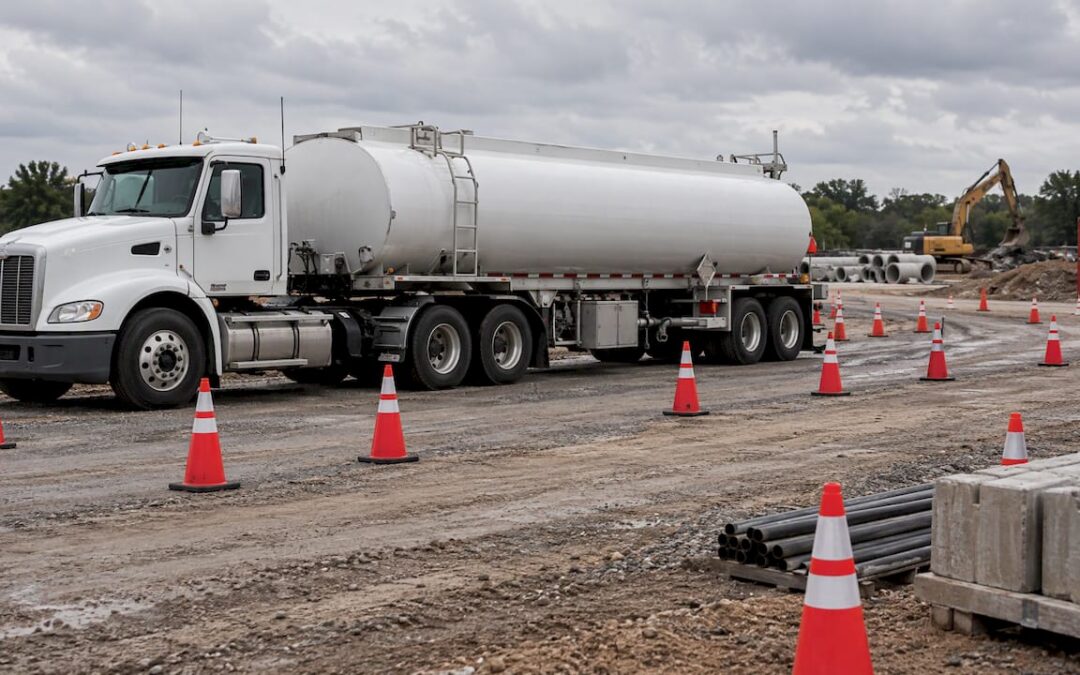
Traffic control for site fueling comes down to one written plan that gives the fuel truck its own route, keeps people on foot out of the paths and swing zones of moving equipment, and tells every crew who stops work when the truck arrives. Write that plan before the first delivery, brief everyone on it, and fuel on a schedule your site can predict. We deliver diesel, gasoline and DEF to job sites, yards, data centers, mines and events, so the sections below follow what a site manager has to settle before a truck pulls through the gate.
TL;DR
- Plot vehicle paths and pedestrian locations on your own site layout, then brief every driver and worker on that plan. OSHA’s field guide describes this as an internal traffic control plan.
- Keep worker-free zones around blind areas, equipment travel lanes and queues, swing radii and pinch points. The fueling lane and the staging spot should sit outside them.
- Use a spotter whenever backing happens near workers, and make sure people on foot are in high-visibility garments.
- Protect the tank or dispenser from collisions, keep extinguishers within reach, and agree in advance what happens if a spill or a traffic change interrupts fueling.
- Scheduled deliveries make all of this easier, because the route and the zone can be set up once and reused.
Table of Contents
- Why fueling needs its own traffic plan
- Step 1: Plan routes and pedestrian locations before delivery
- Step 2: Set worker-free zones around the fueling lane
- Step 3: Signs, cones, spotters and visibility
- Step 4: Control what happens during the fueling
- Step 5: Plan for changes, spills and emergencies
- Who handles what: site versus fuel provider
- A worked example
- Fuel delivery and the traffic plan
- Pre-delivery checklist
- Order fueling that fits your site plan
- FAQ
- Sources
Why fueling needs its own traffic plan
Fueling is a stop-and-go event in the middle of a working site. A tanker has to enter, position, connect, dispense and leave, often while excavators swing, haul trucks queue and crews walk between machines. Each of those movements can cross another one.
Most sites already have a general traffic plan for materials deliveries. Fuel deserves its own section in that plan for three reasons:
- The truck is large and slow to maneuver. It needs a defined approach, a place to stop and a way out that does not require backing through a work area.
- The cargo is flammable. A collision, a spill or an ignition source near the fueling point is a different class of incident from a fender bender.
- Fueling pulls people toward machines. Operators climb down, workers gather to watch gauges, and equipment queues up. That is exactly where pedestrians and moving vehicles meet.
The cost side matters too. When fueling is improvised, machines idle in a line, crews wait, and the schedule slips. A route that is planned and a window that is agreed keep both people and production moving.
Step 1: Plan routes and pedestrian locations before delivery
Start with the site layout, not the fuel truck. OSHA’s field guide on avoiding runovers and backovers says traffic routes should be planned in advance by plotting where pedestrians, equipment types and vehicle paths sit given your specific layout and activities. The same guide describes an internal traffic control plan as routes for vehicles entering, exiting and traveling through the work space, with workers on foot separated from moving equipment as far as possible.
For a fueling operation, that translates into five decisions:
- Entry and exit. Choose a gate and a path the tanker can use without crossing active work areas. A loop beats a dead end, because a dead end forces a reverse.
- Fueling position. Pick one primary spot, plus a fallback if the first is blocked. Mark it so a driver who has never visited the site can find it.
- Equipment queue. Decide where machines wait to be fueled and where they go afterward. A queue that spills into a haul road is the most common conflict point.
- Pedestrian locations. Mark walkways, break areas, parking and the places where crews congregate, then check that none of them sits beside the fueling lane.
- Communication. Name one person who knows the truck is coming and can pause nearby activity.
The guide says the plan has to be communicated to all site personnel and drivers. A plan that lives in the superintendent’s truck does not control anything. Put it in the pre-shift briefing, and give it to the fuel provider with the delivery order so the driver arrives knowing the route.
Step 2: Set worker-free zones around the fueling lane
A worker-free zone is an area where no one on foot is allowed while equipment moves. The same OSHA guide lists what should be included: blind areas around equipment, equipment travel lanes and queues, and the swing radii, pinch points and moving parts of machines.
On a fueling day, apply that list literally:
- The lane the tanker uses is a travel lane.
- The line of equipment waiting is a queue, and the space around each machine is a blind area.
- A loader or excavator positioned to refuel has a swing radius that extends beyond its tracks.
- The gap between the tanker and a fixed object such as a trailer or fence is a pinch point.
The guide also says parking, restroom and break areas should be staged away from principal traffic conflict points. If your break trailer sits beside the fueling spot, move either one. A crew taking a break next to a queue of idling machines is the scenario the plan is designed to prevent.
Keep the fueling area itself protected
Traffic control is also about protecting the fuel. OSHA’s interpretation on a 1,000 gallon diesel tank requires that fuel dispensing units be protected from collision damage. Where a tank sits in an area used only by vehicles approaching to refuel, a curb or another warning device such as flags or markers may be sufficient. The same interpretation treats the requirement as risk-based, so what protects a tank depends on the collision risk at that specific location. A tank beside a haul road needs more than a tank in a quiet corner of the yard.
The same letter says fire extinguishers for outdoor flammable liquid storage must be placed not less than 25 feet and not more than 75 feet from the storage area. Place them where a person can reach them without crossing the traffic lane.
Step 3: Signs, cones, spotters and visibility
Signs and cones show the route. Spotters and high-visibility clothing handle the moments when the route fails.
Mark the route and the zone
The plan should communicate vehicle paths and worker-free zones to everyone, according to the OSHA guide. In practice that means:
- Cones or barricades that define the lane and the stopping spot.
- A sign at the gate or the briefing board showing the fueling route.
- Clear marking of the zone around the tanker while it dispenses, so crews know where not to walk.
Keep markings simple and consistent from one delivery to the next. Drivers and crews learn a fixed layout quickly. A layout that changes weekly is one that people stop reading.
Use a spotter when backing is unavoidable
The best route needs no reversing. When it does, the OSHA guide says a spotter should be used where backing happens near workers. The spotter needs a clear line of sight to the driver, an agreed signal, and a position outside the vehicle’s path.
Make people on foot visible
The guide also calls for workers to be visible in high-visibility garments. For roadway construction, OSHA’s excavation standard requires at least an ANSI Class 2 vest. Apply that baseline to everyone who is near the fueling lane, including visitors and subcontractor crews who were not at the morning briefing.
Step 4: Control what happens during the fueling
Once the truck is in position, the job is to keep the area quiet and predictable.
- Hold pedestrian movement in the zone while fuel is dispensing.
- Stage machines in the queue with operators following a set order, rather than driving up to the tanker on their own.
- Keep ignition sources away. Where marine terminal rules apply, OSHA’s traffic safety guidance says employers must fuel vehicles in designated no-smoking areas a safe distance from possible ignition sources, and that smoking and open flames are prohibited in fueling and fuel storage areas. Most other sites adopt the same practice as a matter of policy.
- Shut equipment down. At marine terminals, OSHA’s fuel handling standard requires engines to be stopped and operators to be off the equipment during refueling. It is a sound rule for any site that fuels from a truck.
If your site has particular requirements for fueling, such as no fueling during a lift, a shift-change window or a permit for hot work nearby, give them to the provider when you book. Our guide to OSHA fuel handling requirements covers the broader rules for job sites and fleets.
Step 5: Plan for changes, spills and emergencies
The route you drew is the route you want, and the day will not always cooperate. A crane sets up in the lane, a concrete pour blocks the gate, or a machine breaks down in the queue. Decide in advance who can stop fueling, who can reroute the truck and how the driver is reached.
For spills and leaks, the plan should say what happens to traffic as well as to the fuel:
- Stop traffic through the area until the spill is controlled, and close the lane.
- Do not restart equipment on top of a spill. For powered industrial trucks, OSHA requires that spilled oil or fuel be carefully washed away or completely evaporated, and the fuel tank cap replaced, before the engine is restarted.
- Take leaking machines out of service. The same standard prohibits operating a powered industrial truck with a leak in the fuel system until the leak has been corrected.
- Keep the extinguishers reachable and keep the emergency access route clear of the queue.
For a fire, an injury or a large release, call 911 and follow your site emergency plan. That is a step for emergency responders, not for the fueling crew.
Who handles what: site versus fuel provider
The site owns the layout, the briefing and the people on foot. The fuel provider owns the truck and the delivery. Problems arise in the gap, so settle these points in writing before the first delivery:
| Item | Site manager | Fuel provider |
|---|---|---|
| Gate, route and fueling position | Decides and marks | Receives route with the order |
| Worker-free zone and pedestrian control | Sets and enforces | Works inside the zone |
| Delivery window | Agrees with the crew schedule | Schedules the truck |
| Spotter for backing | Supplies if backing is needed | Coordinates with site spotter |
| Collision protection for tanks | Provides for site tanks | Informs on rented tank placement |
| Delivery confirmation and invoice | Reviews | Provides itemized record |
A worked example
Take a 40-acre excavation site with a single main gate, a haul road along the north edge and a break trailer near the gate. This is an illustration, not a client case.
Before the plan, the tanker enters through the main gate, parks by the trailer and waits for machines to drive over. Operators cross the haul road, pedestrians cut between machines, and the tanker backs out when it is done.
After the plan, the site designates a fueling pad on the east side, set back from the haul road. A cone lane leads to it from a second gate, so the tanker enters and exits without reversing. The break trailer moves to the west side. The superintendent briefs crews at the start of the shift, and the foreman for each machine group sends operators in order. A designated person holds pedestrians out of the zone until the truck leaves.
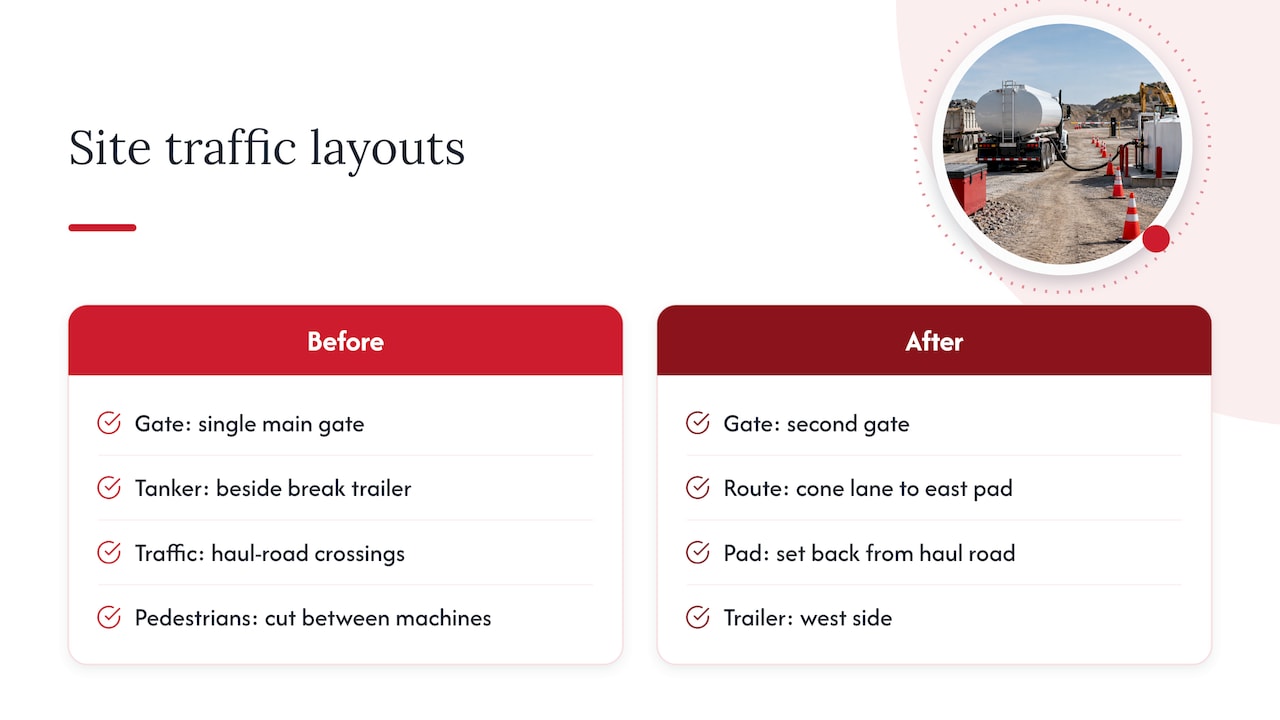
Nothing in that change is expensive. It costs a briefing, some cones and a decision about where things go. It also removes the three conflicts that created most of the exposure: pedestrians crossing a haul road, a truck reversing, and a break area beside a queue.
Fuel delivery and the traffic plan
The more predictable the delivery, the easier the plan. A recurring schedule lets you set up the lane and the zone for a known time, and brief the same crews on the same routine. On-demand fueling during production is harder to coordinate, because the truck arrives into whatever the site is doing at that moment.
We offer on-site diesel and gasoline delivery, mobile fleet fueling and bulk fuel delivery with scheduled and on-demand deliveries. Giving your fueling route to us when you place an order puts the plan in the driver’s hands before arrival. Our setup guide for operations managers walks through what to prepare, and our guide to fueling plans for construction sites covers the audit side. For yards with heavy truck movement, see our trucking yard fueling guide.
Pre-delivery checklist
Run this before each delivery, or before the first delivery of a recurring schedule:
- Fueling position and fallback marked on the site plan.
- Entry and exit route set, with no reversing through active work areas.
- Worker-free zone marked around the lane, the queue and equipment swing areas.
- Break, restroom and parking areas away from the fueling point.
- Spotter assigned if backing is required.
- High-visibility garments on everyone near the lane.
- Extinguishers 25 to 75 feet from outdoor flammable liquid storage and reachable.
- Tanks and dispensers protected from collision by curbs, markers or barriers suited to the risk.
- Spill and emergency contacts posted, and the person who can stop fueling named.
- Route and site rules sent to the fuel provider with the order.
Order fueling that fits your site plan
We supply red and clear diesel, gasoline and DEF to job sites, equipment yards, generators, data centers, mines and events. We cover San Antonio, Austin, Dallas-Fort Worth and Salt Lake City directly, and the continental U.S. through our partner network, with 24/7 service and itemized invoicing. In covered areas, our emergency response target is three hours.
To book a delivery and send your site route with the order, place an order with Anytime Fuel Pros, or see all our fuel services.
FAQ
Do I need a formal traffic control plan just for fueling?
You need the fueling route and zones to be part of your site traffic plan, written and briefed. OSHA’s field guide describes planning routes for vehicles entering, exiting and traveling through the work space and separating pedestrians from equipment. A short fueling section inside that plan is enough for most sites.
Where should the fuel truck stop?
Choose a position away from haul roads, blind areas, equipment queues and pedestrian areas, with an exit that avoids reversing. Mark it, and keep a fallback spot for days when it is blocked. Protect any fixed tank or dispenser from collision in proportion to the risk at that location.
When is a spotter needed?
Use a spotter whenever the truck or equipment has to back up near workers on foot. The spotter needs a clear view of the driver, an agreed signal and a position outside the vehicle’s path. A route that removes backing is better still.
What should we do if there is a spill during fueling?
Stop traffic through the area, close the lane and keep ignition sources away. Do not restart equipment until spilled fuel is washed away or has evaporated and the tank cap is back on, and keep leaking machines out of service until repaired. For fire, injury or a large release, call 911.
Sources
- OSHA field guide: Avoiding Runovers/Backovers
- OSHA interpretation: Clarification of requirements for 1000 gallon diesel tank
- 29 CFR 1926.651, Specific excavation requirements
- 29 CFR 1910.178, Powered industrial trucks
- OSHA 1917.156, Fuel handling and storage
- OSHA: Traffic Safety in Marine Terminals
Recent Comments