
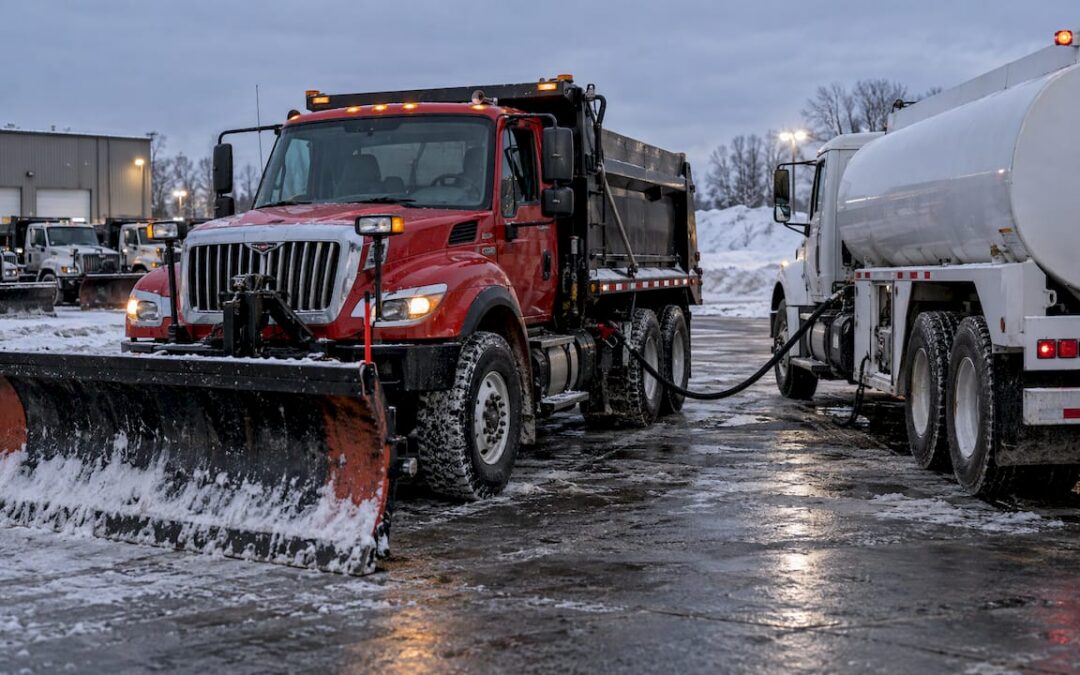
A snowplow fleet fueling plan answers four questions before the first storm: how many gallons you will burn, when each truck fills, where the fuel is stored, and who supplies more when a storm runs longer than forecast. The strongest version puts fuel on site, on a schedule, with a delivery partner who can respond around the clock. That keeps plow drivers on the route instead of in a station line. We deliver diesel, DEF and gasoline to commercial and public fleets, so this guide covers the routine as we would build it with an operations director.
TL;DR
- Size fuel by storm, not by season average: heavy-snow days run about 29% above dry days in MnDOT’s four-winter plow data.
- Cut idling first. It took nearly a quarter of active plow time in that study.
- Fill trucks on a fixed cycle tied to shift changes, and top off storage tanks before the forecast window, not during it.
- Write a documented backup plan with owners, triggers and timeframes, and review it every year.
- On-site delivery with scheduled drops and an emergency line keeps crews working and gives you itemized records.
Table of Contents
- Start with the fuel number
- Schedule fueling around the storm, not the fuel gauge
- Depot tank, on-site delivery or retail stops
- What the plan must say about storage and supply
- Records that control use and shortages
- Backup plan for storms that break the schedule
- Storage rules to check before you add tanks
- How we support a snowplow fueling plan
- A pre-season checklist
- FAQ
- Sources
Start with the fuel number
A plan built on last year’s invoice total fails on the first big storm. Fuel demand swings with storm count, storm size and how long trucks sit running.
MnDOT researchers analyzed 978 vehicles and more than 232,000 hours of data across the 2018 to 2022 winters. Fuel use rose 29% on average on days with four or more inches of snow compared with dry days. The same study logged nearly 280,000 idling events, adding up to more than 52,000 hours, and more than 50,000 of the 1.2 million gallons used went to idling (MnDOT research report, January 2023).
A simple storm-fuel worksheet
Use your own telematics or fuel logs for every input:
- Count the trucks that run in a full-response storm.
- Take each truck’s average gallons per operating hour from last winter.
- Multiply by the expected hours per truck for a major storm, including the hours spent idling at the yard or on the shoulder.
- Add the support equipment: loaders, salt spreaders, generators at the yard.
- Add a buffer for a storm that runs longer than forecast.
The arithmetic scales quickly. One 2026 winter-readiness analysis gives an example of five trucks burning 4 gallons an hour for 300 operating hours: 6,000 gallons, with a $0.75-per-gallon price swing moving the fuel bill by $4,500. Scale that to a 40-truck fleet and the price exposure is the reason to settle pricing and delivery terms before November, not during a storm.
For a seasonal budget, the Clear Roads Winter Cost Tool from the University of Vermont estimates added yearly cost of snow and ice control, including fuel, salt and driver and vehicle time. It scales with the number of plow dispatch events in a year, so it helps you test a light winter against a heavy one.
Why idling is the first lever
In the MnDOT data, idling was defined as three or more minutes motionless. The median idle event ran over six minutes, and more than 90,000 events exceeded nine minutes. Those gaps often come from waiting: a truck waiting for a loader, for a load of salt, for a fuel line. A fueling plan that brings fuel to the truck shortens those waits, so the same storm burns fewer gallons.
Schedule fueling around the storm, not the fuel gauge
A fleet that fuels when the gauge drops lets drivers make the decision at the worst moment. Build three fixed windows instead.
Pre-storm: full tanks and full trucks
When the forecast crosses your trigger, every truck fills to the top and every storage tank is topped off. Larger operations buy a forecasting service for this. The City of Decatur, Illinois, for example, contracts a 24/7 weather service that supplies alerts, meteorologist consultation, pavement temperature, precipitation type, arrival time, duration and accumulation rate (Decatur Snow and Ice Control Plan). Tie your tank-fill order to that same forecast so the delivery lands before the storm, not inside it.
Our bulk fuel tank fill scheduling guide walks through setting a fill cycle from consumption and tank capacity.
Shift change: fuel as part of handoff
Decatur’s plan runs full operations in 12-hour rotating shifts with a 30-minute supervisor overlap for briefing at each change. That overlap is the natural point to fuel: the outgoing driver fills the truck, logs it and hands off a ready unit. A truck that goes out with a quarter tank costs the next shift its first hour.
In-storm: bring the fuel to the plow
During a long event, trucks should not leave the route to find fuel. Mobile fueling at the yard or at a staging point lets a crew refuel in minutes while the supervisor briefs the next driver. This is the job of mobile fleet fueling, where a fuel truck comes to the vehicles. Wet hosing, fueling vehicles directly from a delivery truck, also fits overnight yard fills when the fleet is parked and crews are off.
Depot tank, on-site delivery or retail stops
Three approaches exist for getting fuel into plows, and they differ in labor, control and storm resilience.
| Approach | Labor cost | Storm resilience | Records |
|---|---|---|---|
| On-site delivery to yard tanks and trucks | Low: no drive time | High with scheduled drops and an emergency line | Itemized by delivery |
| Owned depot tank only | Moderate: staff handle pumping and ordering | Depends on tank size and resupply | Your own logs |
| Retail station stops | High: drivers leave the route | Low: lines, outages and road conditions | Card statements |
On-site delivery comes first for most fleets because it removes both the trip and the dependence on a station being open and reachable. If you keep a depot tank, delivery keeps it full. Our guide to setting up on-site diesel delivery covers the setup steps, and how on-site diesel delivery works explains the order-to-delivery flow.
If you do not own storage, tank rental is available from us, so a yard can hold a storm-sized supply without a capital project.
What the plan must say about storage and supply
Storage size and fuel grade
Size tanks for the storm plan, not for a normal week: multiply your worksheet number by the number of days you want to be self-sufficient. Our article on choosing the right fuel tank capacity works through that math.
Grade matters in cold. The City of Fargo’s bid instructions describe a winter diesel blend of #1 and #2 with a cold-weather additive, while biodiesel may be used in summer (Fargo fuel bid instructions). Whatever your region, specify the winter blend and cold-flow target in the delivery order. Our winter diesel delivery planning guide explains cold filter plugging point targets. If trucks have diesel exhaust fluid tanks, include DEF in the same drop; the DEF delivery scheduling guide covers timing.

Delivery access
Access is a plan item because plows block their own yard. Name the fill point, the lane the fuel truck uses, where plowed snow gets stacked, and who clears a path to the tank. Give the dispatcher a site contact who answers during storms.
Measuring what you have
Caltrans requests deliveries when manual tank dips or automated level sensors show fuel is needed, and suppliers invoice by gallons delivered. That makes accurate tank measurement critical, because fuel expansion, temperature, water in the tank or a misread dip can create discrepancies (Caltrans Bulk Fuel Management chapter). Itemized delivery invoices let you reconcile against your own readings. We provide transparent, itemized invoicing for that reason.
Records that control use and shortages
Driver procedures are how a plan survives contact with a 3 a.m. fill. Caltrans has operators at manual fuel sites record the date, equipment ID, gallons, odometer or hour reading, printed name and ending pump meter after every disbursement. Automated sites authorize fueling with fuel cards, site cards or vehicle transmitters (Caltrans).
Copy that discipline:
- One record per fill: unit, date, gallons, hours or miles, driver.
- Review gallons per operating hour weekly in winter. A truck far above the fleet average is idling, leaking or being drawn on.
- Track a few delivery measures such as on-time rate and gallons per drop. Our fuel delivery KPI tracking guide lists useful ones.
Backup plan for storms that break the schedule
PennDOT’s Publication 23 requires counties to write contingency plans with “what if” scenarios for major storms, resource changes and communication failures. Each states who is responsible, what action is taken and the timeframe. Plans are updated yearly, tested with tabletop and field exercises, and shared with internal and external partners (PennDOT Publication 23, Chapter 4). Private fleets can use the same format.
For fueling, write scenarios such as:
- Scheduled drop missed: who calls the supplier, and what is the threshold for an emergency order?
- Road closure blocks the yard: which alternate fill point do trucks use?
- Power outage at the yard: how do you fuel if electric pumps are down? Generator fuel belongs in the plan too.
- Storm doubles in length: what is the second-day fuel volume and who approves it?
The value of redundancy showed up in New York City’s 2012 petroleum shortage. The city’s fleet office reported sourcing 50 to 60% more biodiesel to fuel its own fleet and supply private fleets, supported by more than 400 independent fueling sites (NYC DCAS case study). Few fleets have that footprint, which is why a supplier with emergency capacity belongs on your contact sheet.
Storage rules to check before you add tanks
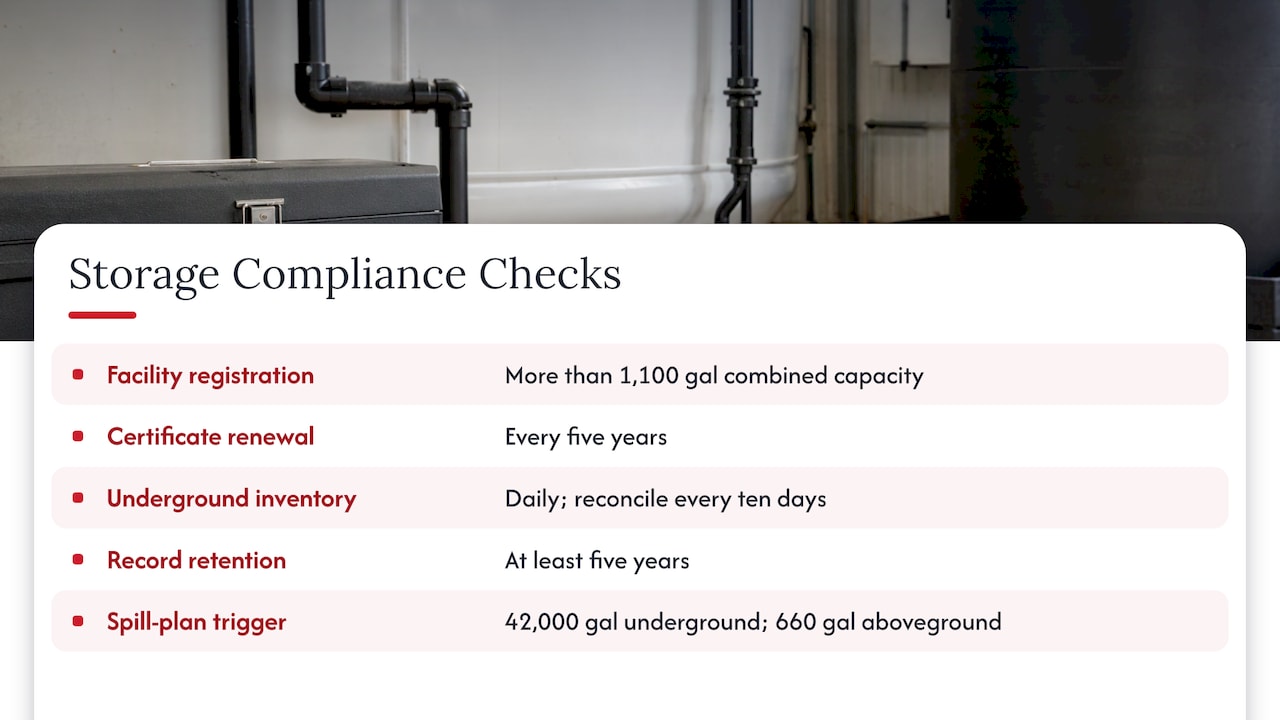
Onsite tanks bring regulatory duties. The New York State DOT handbook is a useful model of what states require. It calls for registering facilities with more than 1,100 gallons of combined tank capacity, posting registration certificates, renewing them every five years, and daily inventory monitoring with reconciliation every ten days for underground tanks. Records are kept at least five years, and a spill plan applies above 42,000 gallons of underground capacity or 660 gallons in a single aboveground tank (NYS DOT Environmental Handbook). That handbook dates to 2001, and requirements differ by state and change, so confirm current EPA underground tank rules, your state’s registration and spill-plan thresholds, and local emergency-planning reporting with your environmental compliance officer or state agency before installing storage.
Public agencies and contractors on government work also deal with dyed diesel. Off-road equipment such as loaders and yard machinery uses red-dye diesel, while plow trucks driven on public roads need clear diesel. Keep the two separated in storage and on invoices; we deliver both red dye diesel and diesel for on-road trucks.
How we support a snowplow fueling plan
Our on-site delivery covers diesel (dyed and clear), gasoline, DEF, bulk tank fills, fuel tank rentals, mobile fleet fueling and wet hosing, plus generator fueling. Service runs 24/7, with emergency response in as little as three hours in covered areas. Primary markets are San Antonio, Austin, Dallas-Fort Worth and Salt Lake City, and our partner network extends delivery across the continental United States, so a multi-state fleet can work with one point of contact.
If your plan needs scheduled storm-window drops and an emergency line behind them, start with our bulk fuel delivery page or review emergency fuel delivery. You can also place an order directly. For more on winter operations, see how on-site services keep businesses running in winter.
A pre-season checklist
- Fuel worksheet completed from last winter’s logs, with a major-storm case.
- Trigger set for pre-storm fills, tied to your forecast source.
- Fueling built into each shift handoff.
- Winter-grade diesel and DEF specified on every order.
- Storage sized, measured and reconciled against invoices.
- Backup scenarios written, assigned, and rehearsed at a tabletop exercise.
- Compliance requirements for tanks confirmed with your state agency.
FAQ
How much fuel does a snowplow fleet need for a storm?
Multiply the number of trucks by gallons per operating hour and expected storm hours, then add support equipment and a buffer. Use your own telematics for the inputs. Remember that heavy-snow days ran about 29% above dry days in MnDOT’s data.
When should plow trucks be fueled?
Fill every truck before the storm and again at each shift change, so no driver starts a shift low. During long events, bring fuel to the truck at the yard or a staging point instead of sending it to a station.
How do we reduce fuel use in plow operations?
Address idling first, since it took nearly a quarter of active plow time in the MnDOT study. Shorter waits for fuel, salt and loaders reduce idle hours. Reviewing gallons per hour by truck each week shows where the waste sits.
What should we do if a scheduled delivery is missed?
Your backup plan should name who calls, the threshold for an emergency order, and the alternate fill point. Our emergency line operates 24/7 for exactly that case.
Sources
- MnDOT: Using Advanced Data Analytics to Reduce Snowplow Fuel Use
- Clear Roads Winter Cost Tool
- Snowplow driver shortages: who pays for winter readiness?
- Caltrans Bulk Fuel Management chapter
- PennDOT Publication 23, Chapter 4
- NYC DCAS biodiesel case study
- City of Fargo fuel purchase bid instructions
- NYS DOT Environmental Handbook for Transportation Operations
Recent Comments