
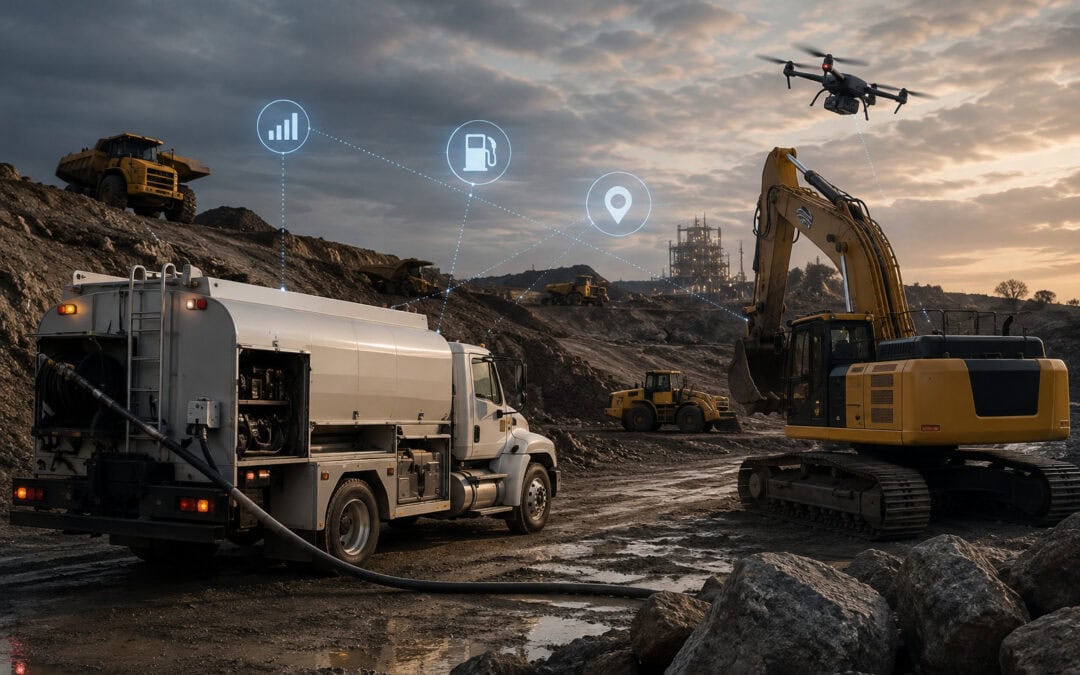
Construction sites are getting smarter. Equipment is becoming more connected. Machines are starting to operate with less direct human control. Telematics can already tell fleet managers where machines are, how long they idle, how much fuel they burn, when service is due, and whether an operator is using equipment efficiently.
The next step is already happening: autonomous and semi-autonomous equipment.
Caterpillar, John Deere, Komatsu, and other manufacturers are heavily investing in autonomous technology for construction, mining, agriculture, and industrial applications. Autonomous haul trucks already operate in mining environments today. Remote-operated equipment is becoming more common on large projects. AI-assisted machine control systems continue to improve every year.
That sounds futuristic. But there is one practical question that does not get enough attention:
Who Is Going to Keep All of This Equipment Fueled?
There is a common assumption that autonomous equipment automatically means electric equipment. Some machines will absolutely move toward electrification. Some will become hybrid systems. Some industries may eventually adopt hydrogen or alternative technologies.
But a large percentage of heavy-duty operations will continue relying on diesel for years to come.
Construction equipment, mining machinery, backup generators, large pumps, cranes, haul trucks, and remote-site equipment still demand long operating hours, fast refueling capability, and dependable performance in environments where charging infrastructure may not exist or may not be practical.
Diesel remains one of the most efficient ways to move massive amounts of energy into heavy equipment quickly.
In many ways, autonomous equipment may actually increase the importance of mobile fueling operations.
The Modern Job Site Is Becoming a Connected System
Traditional construction sites often depend heavily on human observation.
An operator notices a low fuel level. A superintendent sees equipment sitting idle. Someone realizes the generator needs to be topped off before an overnight concrete pour. A fuel call gets placed when the problem becomes urgent.
Autonomous and connected job sites work differently.
Modern equipment continuously produces data. Fuel burn rates, idle time, GPS location, operating hours, maintenance intervals, and machine utilization can all be tracked in real time. The entire job site begins functioning less like disconnected pieces of equipment and more like a coordinated operational system.
Fueling naturally becomes part of that system.
Instead of waiting for emergency fuel calls, deliveries can be scheduled based on actual machine consumption patterns. Instead of blindly topping off every piece of equipment, fueling can prioritize mission-critical assets first. Instead of losing hours of productivity because several machines unexpectedly run low at the same time, mobile fueling can become predictive and proactive.
The more advanced equipment becomes, the more expensive downtime becomes.
Fuel Logistics Will Become More Important, Not Less
Autonomous equipment is designed to maximize productivity.
Machines may operate longer shifts. Some may continue working after normal labor hours. Semi-autonomous equipment may reduce idle time caused by operator inconsistencies. AI-assisted route planning and machine coordination may improve overall production efficiency across entire sites.
But all of that efficiency creates a new challenge:
Interruptions become even more costly.
If a connected machine is capable of operating continuously within a carefully planned workflow, something as simple as delayed fuel delivery can suddenly create bottlenecks across multiple parts of the operation.
Fueling can no longer be treated as an afterthought.
It becomes part of operational planning.
Imagine a future construction site with:
- Autonomous compactors operating overnight
- Semi-autonomous excavators feeding material routes
- Connected haul trucks coordinating movement patterns
- Remote-monitored generators powering temporary infrastructure
- Telematics systems monitoring fuel levels across every asset
On a site like that, fuel is not just a consumable product.
It becomes a control point within the larger operational system.
The Future of Mobile Fueling Is Predictive
The future of mobile fueling is not simply a truck delivering diesel to a job site.
It is fuel delivery connected to data.
Advanced fuel operations will increasingly rely on telematics, tank monitoring, route optimization, and machine usage data to make fueling decisions more efficient.
Fuel providers may eventually integrate directly with customer fleet management systems. Equipment could automatically report low fuel conditions. Storage tanks may trigger refill requests before reaching critical levels. Dispatchers could build routes around real-world equipment usage instead of relying entirely on manual phone calls.
Mobile fueling evolves from a convenience service into an operational support system.
The companies that adapt to this shift will help customers reduce downtime, improve planning, and keep increasingly automated operations moving efficiently.
DEF Will Become Even More Critical
Another major piece of the equation is DEF.
Modern diesel equipment depends heavily on diesel exhaust fluid to maintain emissions compliance and proper engine operation. As contractors invest in newer Tier 4 equipment and more advanced engines, DEF availability becomes just as important as diesel availability itself.
Running low on DEF can trigger equipment derates, warning systems, and unexpected downtime. On a highly coordinated job site, that disruption can affect multiple connected workflows at once.
Reliable DEF delivery and inventory management will continue becoming more important as fleets modernize and automation increases.
The Future Is Not Just Electric. It Is Managed.
The future of heavy equipment will likely include a combination of diesel, electric, hybrid, and autonomous systems operating together.
Some environments will adopt electrification faster than others. Mining operations, controlled industrial sites, and large infrastructure projects may see autonomous technology become mainstream relatively quickly. Smaller or constantly changing job sites may adopt these technologies more gradually.
But across every environment, one thing remains true:
Energy management will become more important than ever.
That includes:
- Fuel availability
- DEF supply management
- Tank monitoring
- Delivery timing
- Emergency response capability
- Telematics integration
- Operational planning
The future is not simply about replacing operators with machines.
It is about building smarter operational ecosystems that minimize downtime and maximize productivity.
What Contractors Should Be Thinking About Today
Contractors do not need fully autonomous job sites to begin preparing for this shift.
The transition starts with visibility and planning today.
Questions companies should already be asking include:
- Do we know how much fuel our equipment uses by project?
- Are operators wasting time leaving the site for fuel?
- Do we rely too heavily on emergency fuel calls?
- Are machines sitting idle because fuel scheduling is inconsistent?
- Do we have a dependable DEF supply strategy?
- Can our fuel provider support after-hours or multi-site operations?
- Are our storage tanks sized correctly for actual consumption?
These questions matter today.
They will matter even more as equipment becomes increasingly connected, automated, and productivity-focused.
The Bottom Line
Autonomous equipment may eventually change who sits in the cab.
It will not eliminate the need to keep equipment running.
As construction, industrial, mining, and infrastructure operations adopt smarter technology, mobile fueling will become increasingly data-driven, predictive, and operationally integrated.
The fuel truck is not disappearing from the future job site.
It may become one of the most important support assets on it.
At Anytime Fuel Pros, we understand that fuel delivery is about more than simply delivering gallons. It is about uptime, planning, responsiveness, and helping real operations continue moving forward.
The equipment is getting smarter.
Fuel logistics need to get smarter with it.
Recent Comments