
When a job site runs on diesel, fuel supply becomes a logistics problem that never fully goes away. Equipment needs fueling on unpredictable schedules. Delivery windows don't always line up with peak demand. Running out is expensive — every hour of downtime on a stalled excavator or dead generator costs real money.
The obvious answer is to keep more fuel on hand. But bulk storage isn't just a matter of getting a big tank and filling it up. The right setup depends on your operation size, site duration, equipment mix, and how your delivery partner services the site. Get it right and you eliminate most fuel-related headaches. Get it wrong and you're managing a problem instead of solving one.
Why On-Site Storage Matters
Sending operators to fuel stations costs time and money. A driver who spends 45 minutes round-trip fueling a pickup truck twice a day is burning nearly eight hours a week in unproductive time — before you account for the additional vehicle wear and mileage.
For heavy equipment, the math is even starker. You can't drive an excavator to a fuel station. You either bring fuel to the machine or you delay the machine while a service truck does it. Either way, dedicated on-site storage with scheduled bulk fuel delivery eliminates that coordination problem entirely.
Tank Types: What's Actually Worth Using
Above-ground storage tanks (ASTs) are the standard for most job sites. They come in a range of sizes, are relatively easy to position, and can be paired with dispensing equipment that lets operators fuel without waiting for a service truck. For sites that run for more than a few weeks, an AST is almost always the right answer.
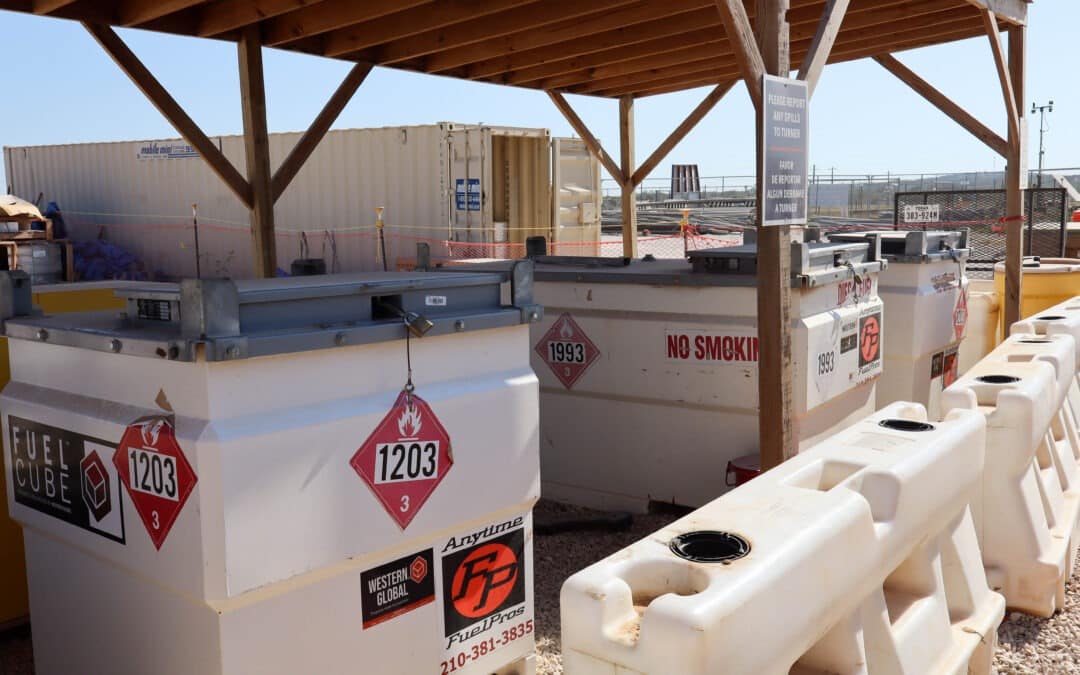
Fuel cubes and portable tanks are useful for shorter deployments or remote areas of a large site where bringing the main tank isn't practical. They're limited in capacity typically 250 to 500 gallons but they're fast to set up and easy to move. Many operations use a combination: a main AST for bulk storage and smaller portables positioned closer to active work areas.
Skid tanks offer a middle ground. They're larger than portables but designed to be moved with a forklift or skid steer as the site evolves. For sites where the center of activity shifts over time, skids provide flexibility without the permanence of a fixed tank.
Underground storage tanks (USTs) are rarely practical for construction or temporary sites. They require permitting, secondary containment compliance, and significant installation investment. Unless you're fueling a permanent facility, an AST is almost always the better path.
What You Don't Need
Oversized tanks are a common mistake. Operators assume that more storage capacity means fewer deliveries and less risk of running out. But large tanks that aren't regularly turned over create fuel quality problems diesel that sits for weeks in a hot Texas summer oxidizes, takes on water, and breeds microbial growth.
Multiple redundant tanks that aren't integrated into a clear delivery schedule create confusion about which tank is active, which needs testing, and which has older fuel that should be burned first. Simplicity in tank configuration paired with a reliable delivery schedule is more effective than excess capacity.
Delivery from multiple suppliers into the same tank is another problem to avoid. Different fuel quality standards, additive packages, and contamination risks compound when you mix sources. A single trusted delivery partner with consistent product quality is worth more than chasing the lowest per-gallon price across multiple vendors.
Sizing Your Storage Correctly
Right-sizing a job-site tank starts with understanding your daily consumption. Add up the average gallons burned per day across all diesel equipment excavators, generators, light towers, service vehicles and then build in a buffer for high-demand days and potential delivery delays.
A general rule of thumb: size your storage for 3–5 days of consumption at peak demand. That's enough buffer to absorb a missed delivery or a surge in equipment hours without running dry, but not so much that fuel sits long enough to degrade.
For a precise calculation based on your equipment mix, the tank sizing calculator at anytimefuelpros.com/bulk-diesel-delivery can help you work through the numbers. It accounts for equipment type, hours of operation, and delivery frequency to help you land on a tank size that actually fits your operation.
Placement & Compliance Basics
Tank placement affects both safety and delivery logistics. Tanks need to be accessible to a delivery truck typically requiring at least 12 feet of clearance for approach and safe hose reach. Positioning a tank in a hard-to-access corner of a site to keep it out of the way sounds practical until the delivery driver can't safely reach it.
Secondary containment is required for most AST installations. A properly constructed berm or containment structure around the tank is a regulatory requirement in most jurisdictions and protects the site from spill liability. Don't skip this step the cost of a containment structure is trivial compared to the cost of a spill cleanup or regulatory fine.
Keep tanks shaded where possible, especially in Texas and desert climates. Heat cycling degrades fuel and accelerates condensation. A tank in direct sun experiences more thermal stress and higher internal temperatures than a shaded one and that difference shows up in fuel quality over time.
Anytime Fuel Pros delivers efficiency, cost savings, and reliable service right to your job site.
📞 Call 877-481-3835 to schedule your first delivery or request a custom quote.
Recent Comments