
Keep the delivery ticket and supplier invoice together for every clear diesel delivery, and scan and tag them to the receiving site and vehicle or tank ID right away. That single habit, repeated at every delivery, becomes the backbone of audit-ready clear diesel recordkeeping. The sections below walk through what to collect, how to file it, and how to reconcile it against IFTA and federal excise reporting.
TL;DR:
- Collect and file the delivery ticket and invoice together, ensuring all required fields—date, seller, gallons, product type, and tax status—are clearly documented.
- Implement a structured digital filing system by site and vehicle, linking records to a spreadsheet that tracks purchase, cost center, and discrepancies for quick retrieval.
- Maintain tank inventory records with quarterly reconciliations, flagging and investigating any variances before submitting IFTA or excise reports.
- Reconcile fuel delivery to vehicle miles driven across jurisdictions monthly to support accurate IFTA and Form 2290 filings, not just purchase location.
- Keep records for at least four years, extending retention during disputes or audits, and verify vendor electronic ticketing and consolidated billing to streamline compliance.
Table of Contents
- 1. Checklist: required fields and documents for every delivery
- 2. Organize deliveries and invoices for fast retrieval
- 3. Bulk tanks and site inventory controls
- 4. Reconcile deliveries to vehicle miles, IFTA, and excise reporting
- 5. Retention schedules and audit readiness
- 6. Practical workflows and tools fleets use
- 7. Common red flags and a one-page audit checklist
- 8. How a compliant delivery partner reduces audit risk
- FAQ
- Sources
1. Checklist: required fields and documents for every delivery
Auditors reviewing clear diesel purchases expect a specific set of data points on every receipt, and gaps in that data are the first thing a reviewer flags. The IFTA Procedures Manual requires records sufficient for an auditor to verify fuel placed into qualified vehicles, which means the paperwork has to do more than confirm a delivery happened. It has to prove where the fuel went.
Collect these fields on every ticket and invoice:
- Delivery date and the seller’s name and address
- Quantity delivered in gallons, with the product clearly designated as clear diesel
- Invoice or ticket number, unique and sequential
- Receiving authorization (the name of the person who accepted delivery)
- Site address or location code
- Tax status, confirmed from the invoice itself, not assumed from the product name
That last point matters more than it looks. IRS Publication 510 explains that the federal diesel excise tax applies to clear diesel and that tax status should be verified directly on the supplier invoice rather than inferred. Dyed diesel carries different tax treatment and shipping papers for dyed fuel must carry a conspicuous dye notice, so an invoice without a clear statement of tax status is a paperwork gap waiting to become an audit finding.
Keep the delivery ticket and the invoice stapled or filed together. A ticket without a matching invoice, or an invoice with no corresponding ticket, reads to an auditor as a record that cannot be verified.
Pro Tip: Photograph illegible or handwritten tickets on-site before they fade or smear, and attach the photo to the digital file the same day.
2. Organize deliveries and invoices for fast retrieval
A filing system only works if the person retrieving a record six months from now can find it in under a minute. We recommend a folder structure that mirrors how an auditor thinks: by site, then by tank or vehicle, then by date and ticket number.
- Create a top-level folder for each receiving site or job location.
- Inside it, create a subfolder for each tank or vehicle ID that receives fuel.
- Name each scanned file with the date and ticket number, in the format YYYYMMDD_ticket-number, so files sort chronologically without extra sorting steps.
- Log the same information in a receiving spreadsheet that links the ticket number to the purchase order, cost center, and vehicle or tank ID.
That spreadsheet becomes the bridge between paper records and accounting codes, and it is usually faster to search than a shared drive full of PDFs. For contested deliveries, where a driver disputes gallons received or a seal looks tampered with, add a note field recording who received the fuel, the time, and any discrepancy observed, since that chain-of-custody note is often the only thing that resolves a disputed quantity later.
Pro Tip: Assign one person per site as the record custodian so there is never a question of who should have filed a ticket that went missing.
3. Bulk tanks and site inventory controls
Bulk storage tanks carry their own recordkeeping burden because fuel sits in inventory before it is withdrawn, and that gap between delivery and use is exactly where records tend to fall apart. The IFTA Procedures Manual specifies that bulk storage records must include delivery receipts, quarterly inventory reconciliations, tank capacity, and withdrawal records by location.
For each tank, keep:
- Tank capacity and location
- Every delivery receipt tied to that tank
- Date-stamped withdrawal logs that reference the vehicle or equipment ID that received the fuel
- A quarterly reconciliation: beginning inventory plus deliveries, minus withdrawals, should equal ending inventory
When the math does not balance, flag the tank and investigate before the next filing period rather than after. A persistent variance usually means withdrawals are not being logged consistently, or a delivery ticket was misfiled. Document whether the fuel in that tank was tax-paid at purchase or whether tax still needs to be credited or remitted to the jurisdiction, since mixing those two categories in one undocumented pool is one of the fastest ways to create an exposure an auditor will catch.
4. Reconcile deliveries to vehicle miles, IFTA, and excise reporting
Where fuel is purchased and where it is actually used are rarely the same place, and that gap is exactly what IFTA reporting is built to address. FHWA guidance on motor fuel reporting stresses that fleets must reconcile delivery tickets and invoices to vehicle mileage by jurisdiction, using the Form 551M and 556 reporting processes, rather than assuming purchase location equals taxable use location.
A workable reconciliation sequence looks like this:
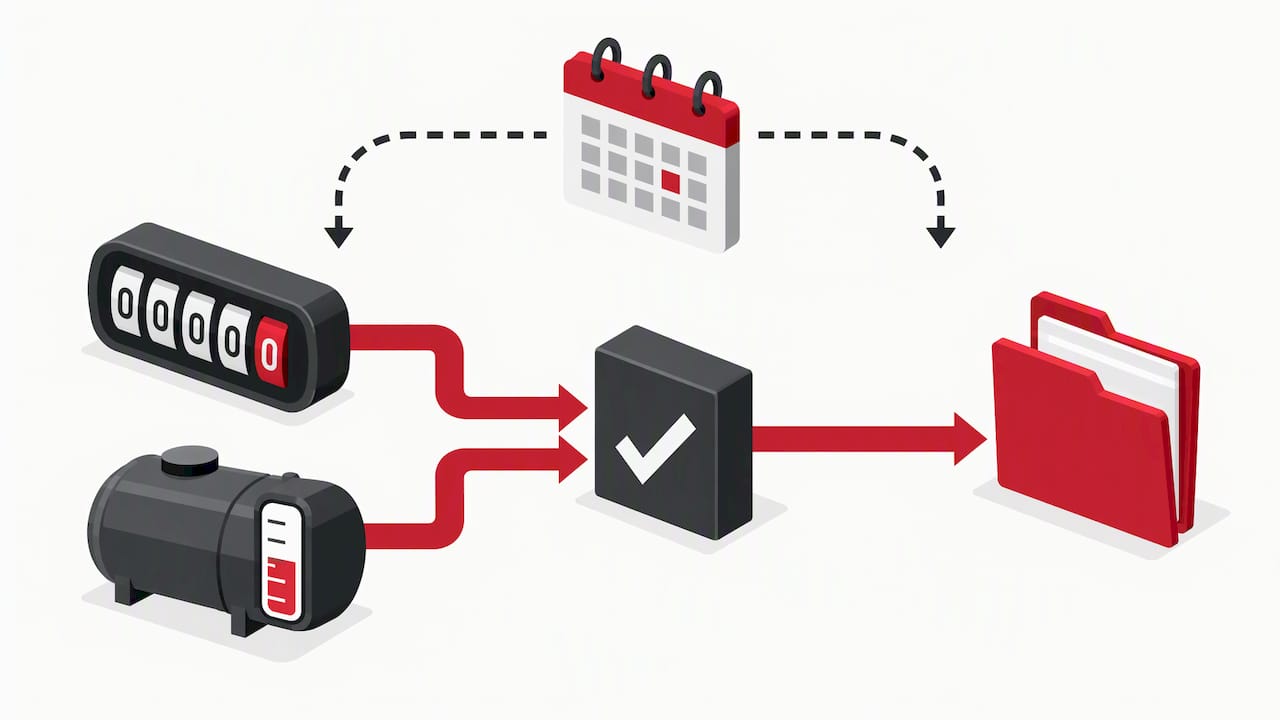
- Match each delivery ticket to the tank or vehicle that received the fuel.
- Link that fuel to vehicle fueling events recorded in your fleet log or telematics system.
- Attach mileage driven by jurisdiction for the same reporting period.
- Compute net taxable gallons for each state based on miles driven there, not gallons purchased there.
This sequence is what turns a stack of tickets into a supportable IFTA quarterly return. For federal excise purposes, the same vehicle-level records support Form 2290 filings, and the instructions for Form 2290 require electronic filing when a return reports tax on 25 or more vehicles.
Pro Tip: Run the mileage-to-gallons reconciliation monthly instead of waiting for quarter-end. Catching a mismatched ticket in week two is a five-minute fix; catching it during the audit is a liability.
5. Retention schedules and audit readiness
How long you keep a record depends on which form it supports, and the two federal floors rarely match, which is why a single retention policy that defaults to the longer period is simpler than tracking two clocks. The IFTA Procedures Manual sets a four-year minimum for fuel and distance records, while Form 2290 instructions require vehicle-level records to be kept at least three years.
- Default to four years for any record that supports both IFTA and excise reporting.
- Extend retention further when a refund claim, an excise tax dispute, or litigation is still open, since the clock does not start until the matter closes.
- Watch for state-specific rules that exceed the federal floor; some jurisdictions ask for longer.
- Keep a searchable digital archive, indexed by site, tank or vehicle, and quarter, so an auditor’s request for a specific period does not turn into a multi-day search.
- When an auditor requests records, confirm the format they want (PDF, CSV export, or original scans) before sending a batch that does not match their system.
6. Practical workflows and tools fleets use
Most of this comes down to a short checklist followed consistently at the point of delivery, and a spreadsheet with the right columns from day one. A receiving-day checklist should cover: confirm the ticket number, confirm gallons against the tank gauge or meter, confirm product designation, confirm tax status on the invoice, and sign off with the receiver’s name.
A minimal tracking spreadsheet needs these columns:
- Date and ticket number
- Gallons delivered
- Invoice number
- Tank or vehicle ID
- Purchaser or cost center
- Tax status (clear, tax-paid; or dyed, tax-exempt)
Pro Tip: Ask your fuel supplier whether they offer electronic tickets. A digital ticket preserves every required field automatically and removes the risk of a handwritten number becoming illegible six months later.
When evaluating a delivery partner, consider clear diesel delivery services that emphasize paperwork discipline: itemized invoicing, consolidated billing across multiple sites, and clear tax status on every ticket, because the fewer gaps in the paperwork, the less time your team spends reconstructing records later.
7. Common red flags and a one-page audit checklist
Auditors see the same gaps repeatedly: missing ticket numbers, altered or illegible receipts, no segregation between dyed and clear diesel in storage or accounting codes, and bulk withdrawals with no vehicle tie-back. Any one of these can turn a routine review into an extended assessment.
- Reconstruct missing receipts immediately using supplier records if your copy is lost or damaged.
- Add a receiving log wherever one does not already exist.
- Isolate any tank with a suspected dyed-fuel cross-contamination issue until it is tested and resolved.
| Check item | Pass condition |
|---|---|
| Ticket number present | Matches invoice number |
| Tax status stated | Clear or dyed noted on invoice |
| Receiving signature present | Name and date recorded |
| Vehicle or tank ID linked | Withdrawal log references ID |
| Quarterly reconciliation done | Beginning + deliveries − withdrawals = ending |
8. How a compliant delivery partner reduces audit risk
The paperwork burden described above gets lighter when your fuel supplier builds compliance into the delivery itself instead of leaving you to reconstruct it later. Clear diesel on-site delivery with itemized tickets, consolidated invoicing for multi-site accounts, and tax status clearly stated on every invoice can reduce paperwork burdens for your receiving team.

When you are vetting a delivery vendor, ask three questions: what fields appear on their standard ticket, whether they offer electronic ticketing, and how often they consolidate invoices for multi-site billing. Services worth confirming include:
- On-site clear diesel delivery with itemized, auditable tickets
- Consolidated invoicing across multiple job sites or tanks
- Reporting support that distinguishes dyed from clear diesel
For procurement teams ready to set up a compliant delivery account, visit our clear diesel delivery page to see coverage and request service.
FAQ
What documents are required for clear diesel recordkeeping?
At minimum, keep the delivery ticket and the supplier invoice for every delivery, with date, seller, gallons, product designation, and tax status all stated. The IFTA Procedures Manual requires these records to be detailed enough for an auditor to verify fuel placed into qualified vehicles.
How long should fleets keep diesel delivery records?
The IFTA floor is four years for fuel and distance records, while Form 2290 vehicle records carry a three-year minimum under the Form 2290 instructions. When a refund claim or dispute is open, keep records until that matter closes, even if it exceeds those floors.
How do I know if my clear diesel invoice shows the right tax status?
The invoice should state plainly whether excise tax was charged or whether the fuel is dyed and tax-exempt, rather than leaving you to assume based on the product name. IRS Publication 510 explains this distinction and why dyed fuel carries separate shipping-paper notices.
Why do delivery records need to connect to vehicle mileage for IFTA?
Fuel is purchased in one location but often used across several jurisdictions, so IFTA reporting requires allocating gallons to where the vehicle actually drove, not where it was fueled. FHWA guidance on motor fuel reporting outlines this reconciliation using the Form 551M and 556 processes.
What should I request from a diesel delivery vendor for easier recordkeeping?
Ask for electronic ticketing, itemized invoices with clear tax status, and consolidated billing if you manage multiple sites. Our clear diesel delivery service is built around these fields specifically to reduce audit prep time for fleet and procurement teams.
Recent Comments