
EIA publishes the U.S. government’s weekly retail pump benchmark, tax included, built for trend analysis and public reporting. OPIS is a commercial pricing service that tracks retail and wholesale (rack) diesel prices multiple times a day, built for contracts and daily fuel operations. The practical move is to pair them: use EIA to understand where prices are heading, and OPIS to execute purchases and index contracts.
TL;DR:
- EIA’s weekly diesel prices include taxes and are based on a Monday survey, making them suitable for trend analysis but less accurate for fast-moving markets.
- OPIS provides multiple intra-week snapshots at terminal-level granularity, tracking wholesale rack prices before taxes, ideal for daily procurement and invoicing reconciliation.
- The price discrepancy between EIA and OPIS arises mainly from one reporting on tax-included retail prices and the other on pre-tax wholesale prices, not from errors.
- To avoid mismatched figures, specify snapshot times, document laid-in components like taxes and freight, and verify terminal sources when comparing prices.
- Rely on EIA for long-term trends and OPIS for daily decisions, using both together with detailed reconciliation to obtain an accurate view of delivered fuel costs.
Table of Contents
- How the EIA tracks and publishes diesel prices
- How OPIS tracks and publishes diesel prices
- Why EIA and OPIS numbers rarely match
- When to use EIA vs OPIS for your fuel decisions
- What dataset confusion looks like on a real job site
- A delivery partner that keeps the numbers honest
- FAQ
- Sources
How the EIA tracks and publishes diesel prices
The EIA weekly diesel methodology relies on Forms EIA-888 and EIA-878, a statistical sample of retail outlets surveyed every Monday. Prices are collected as of 8:00 a.m. local time, then released the following day as volume-weighted national and regional averages, broken out by Petroleum Administration for Defense District (PADD).
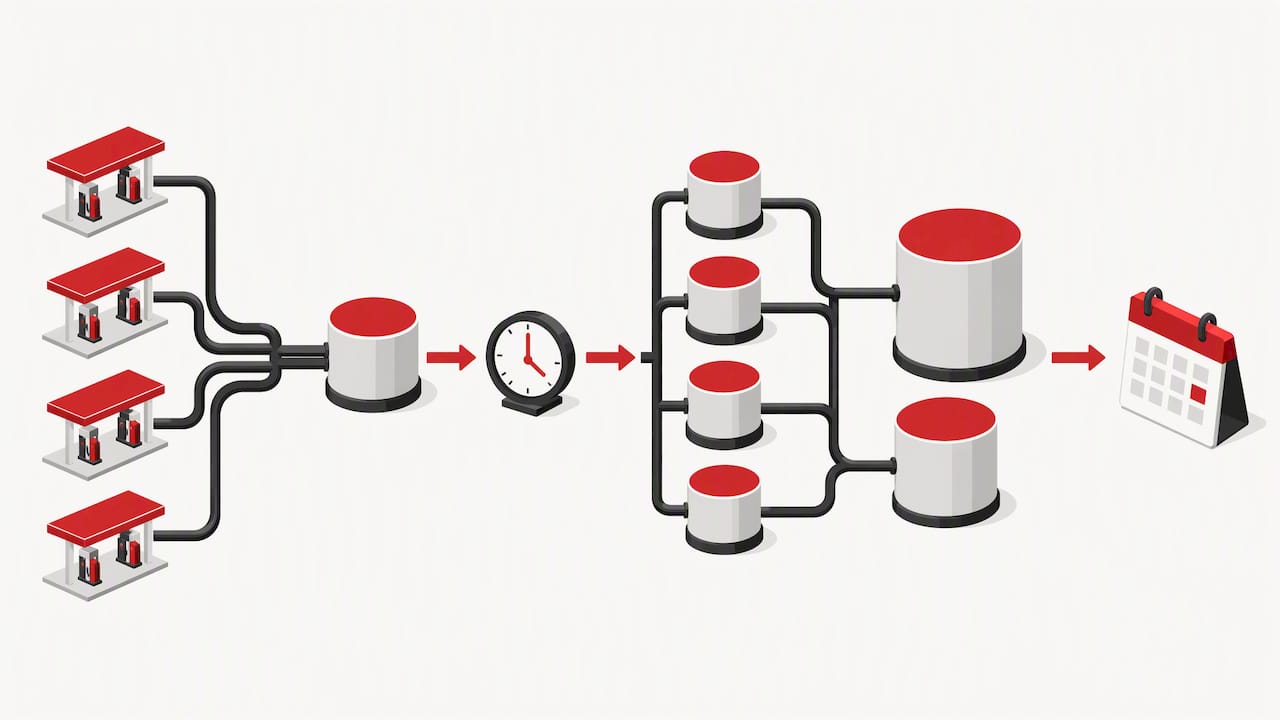
This number reflects the cash price a driver pays at the pump, taxes included, which is exactly why it works for trend monitoring and public reporting rather than for pricing a Tuesday afternoon delivery. EIA also revised its sampling methodology in 2018 and again in 2022, and those documented methodology updates can affect how cleanly you compare series across those dates.
A few things to keep in mind when you pull this data:
- The snapshot happens once a week, so a Wednesday price spike will not show up until the following Tuesday’s release.
- Averages are regional or national, not terminal-specific, so local supply shocks can get smoothed out.
- Figures include taxes, making them a poor stand-in for wholesale cost comparisons.
For a quiet market, that weekly cadence is more than adequate. For a market moving fast, it leaves a blind spot that commercial buyers cannot afford.
How OPIS tracks and publishes diesel prices
OPIS runs two parallel data operations: a retail survey and a wholesale rack feed, both built for buyers who need pricing more often than once a week. The OPIS diesel products overview describes a retail network covering more than 9,000 truck stops, fed by card-provider transaction data and direct chain inputs, alongside rack coverage spanning more than 1,500 terminals across roughly 400 U.S. rack locations.

The rack side is where wholesale buyers live. The OPIS wholesale rack methodology documents fixed daily snapshot times, often around 10:00 a.m. Eastern, with verification rules applied to supplier postings before they go out. On the retail side, the OPIS retail pricing methodology blends retail feeds with rack, tax, and freight inputs to build laid-in cost estimates, publishing retail files around 7:30 a.m. and cost-plus figures around 10:00 a.m.
What that structure delivers to a buyer:
- Multiple snapshots a day, not one, so intra-week moves show up before they become a surprise invoice.
- Terminal-level granularity, which matters when two suppliers thirty miles apart post different rack prices.
- Delivery through email, API, or the RackPro platform, built to plug straight into dispatch and contract systems.
Rack prices are quoted pre-tax. That single fact explains most of the confusion buyers run into when they try to match an OPIS number against a number pulled from EIA.
Why EIA and OPIS numbers rarely match
The gap between these two benchmarks is not a data error. It is baked into what each one measures, and understanding the mechanics keeps you from budgeting against the wrong number.
- Price base. EIA reports retail pump prices with taxes included. OPIS reports wholesale rack prices pre-tax, with retail estimates built separately from rack, tax, and freight inputs, per the OPIS retail methodology.
- Sampling and coverage. EIA draws from a statistical sample of retail stations. OPIS aggregates at a much larger scale, tracking tens of thousands of wholesale prices across its terminal network, according to the OPIS diesel products page.
- Timing. EIA takes one snapshot every Monday morning and releases it Tuesday. OPIS refreshes multiple times daily with fixed snapshot windows, so it reflects conditions EIA will not report for days.
- Granularity. EIA speaks in regional and national averages. OPIS prices individual terminals, which matters when your nearest rack is the one setting your actual cost.
Taxes, freight, and local station margins stack on top of the wholesale number to produce the retail number, and that stack is consistent enough to create a predictable gap rather than random noise. Treating EIA and OPIS as interchangeable is a common and costly misstep. A buyer who indexes a contract to EIA but takes delivery against rack-driven pricing is comparing a tax-included retail average to a pre-tax wholesale snapshot, and the mismatch shows up as margin that nobody planned for.
Pro Tip: Never quote an EIA figure in a rack-based contract negotiation; convert it to a laid-in estimate first, or you will be arguing about the wrong number.
When to use EIA vs OPIS for your fuel decisions
The right benchmark depends on what decision you are making, not which one is more “official.”
- Use EIA for long-term trend analysis, public reporting, board-level summaries, and historical year-over-year comparisons.
- Use OPIS for contract indexation, daily purchasing calls, invoice reconciliation, and terminal-level rate negotiations.
- Combine both in a budget cycle: validate the macro trend with EIA, then execute and reconcile against OPIS, adding laid-in costs like taxes, freight, and terminal fees for a real delivered price. Our diesel pricing indexes explainer walks through how that reconciliation works in practice.
Before you pick an index for a specific task, ask three questions: Are you reporting a trend or settling an invoice? Does your contract specify a snapshot time, and if not, whose clock applies? Have you accounted for taxes and freight, or are you comparing a pump price to a rack price without adjusting for either?
What dataset confusion looks like on a real job site
When a vendor invoice references an OPIS rack number but the delivered price looks nothing like what you saw in an EIA trend report, the gap is almost always the tax and freight layer, not a pricing error. Reconciling it means pulling the laid-in components, the rack price, applicable taxes, and the delivery surcharge, and checking them against the contract’s defined snapshot time.
A few contract terms prevent this fight before it starts:
- Specify the exact index snapshot time (OPIS 10:00 a.m. Eastern, for example) rather than leaving it ambiguous.
- Define every laid-in component (taxes, freight, terminal fees) in writing before signing.
- Build in a verification step, whether that is a second index source or a request for terminal-level backup.
Our own invoicing is itemized by design, so customers can see exactly which rack price, tax line, and delivery fee built their final number, which is the same discipline we recommend when you are reviewing any vendor’s fuel pricing. For more detail on how that delivered price stacks up against a rack quote, see our diesel delivery cost breakdown.
Pro Tip: Ask any vendor quoting OPIS rack pricing to show the terminal source and snapshot time in writing; a quote with no reference point is not a benchmark.
A delivery partner that keeps the numbers honest
Reading an index correctly only matters if the fuel actually shows up when you need it. We run on-site diesel delivery, both clear and dyed, DEF delivery, and bulk fills for job sites, fleets, generators, and remote operations across key markets, with nationwide coverage through our partner network including linehaul contracting and logistics solutions.

For customers who already index their contracts to OPIS or track trends through EIA, we built our operation around the part that index numbers never cover: getting fuel on-site reliably and showing you exactly what you paid for.
- Scheduled recurring deliveries keep tanks topped off without manual reorder tracking.
- Emergency and after-hours response covers the gaps a weekly or daily index cannot predict.
- Itemized invoicing shows the components behind your delivered price, the same transparency we recommend when you are checking any supplier’s rack-based quote.
If you are ready to move from benchmark-watching to a scheduled or on-demand delivery plan, visit our fuel services page for a quote.
FAQ
What is the price of oil per barrel in the international market?
Crude oil prices move daily on international markets and vary by benchmark, such as Brent or WTI, so there is no single fixed figure to quote. Readers tracking crude benchmarks should check a live market source rather than rely on a static number, since this article focuses on U.S. diesel pricing data rather than crude oil markets.
How much is 1 gallon of diesel in the US?
U.S. diesel prices change weekly and vary by region, which is exactly why the EIA publishes a weekly retail average rather than a single national figure. Check the current EIA release or an OPIS retail feed for the latest number in your area rather than relying on a fixed price.
When was oil $140 a barrel?
Crude oil approached and briefly exceeded that level during a past price spike driven by a combination of demand growth and supply concerns. This article does not track historical crude benchmarks in detail, so consult EIA’s historical crude data series for the exact dates and figures.
How much will gas be if oil is $200 a barrel?
There is no fixed formula that converts a crude oil price directly into a retail gas or diesel price, since refining costs, taxes, and local station margins all affect the final pump number. A sharp jump in crude would likely push both EIA retail averages and OPIS rack prices higher, but the exact pass-through varies by region and over time.
Why do EIA and OPIS diesel prices never match exactly?
EIA reports a tax-included retail average from a weekly snapshot, while OPIS reports pre-tax wholesale rack prices updated multiple times a day, so the two measure different points in the supply chain. Comparing them directly without adjusting for taxes, freight, and timing will almost always produce a mismatch.
Sources
- Methodology for EIA weekly on-highway diesel fuel price estimates
- OPIS diesel products and methodology overview
- OPIS Retail Pricing Methodology (2026)
Recent Comments