
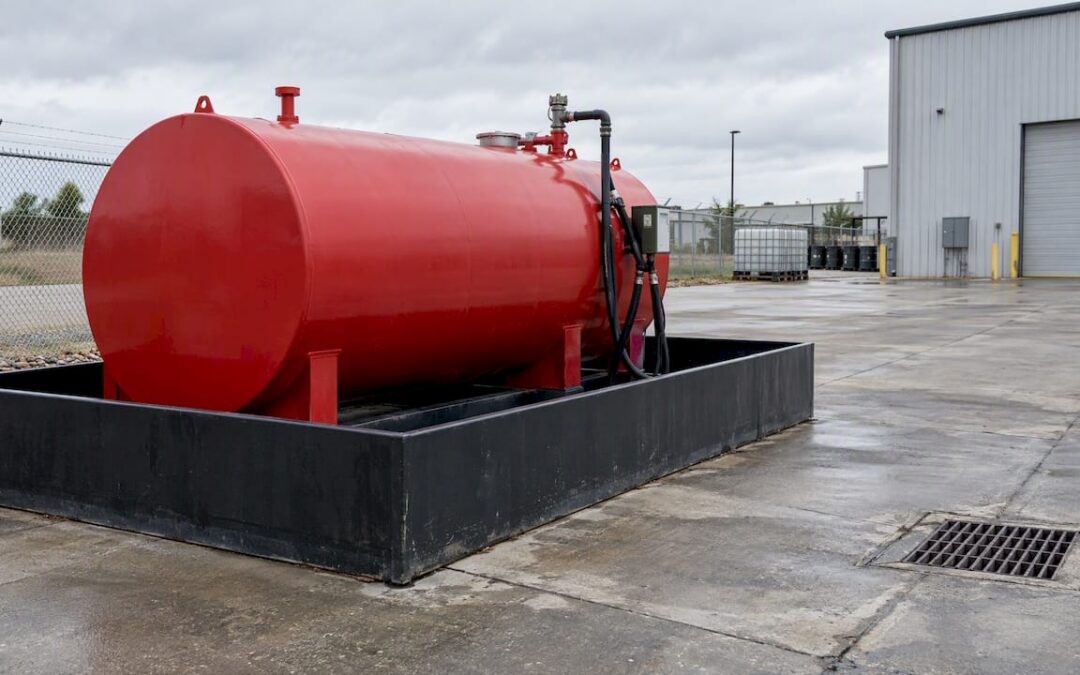
Yes, a rented fuel tank counts toward your site’s aggregate storage, and that single fact can trigger SPCC obligations and local fire permits you didn’t budget for. Before the rental truck shows up, calculate your total on-site capacity, call the local fire marshal, request the vendor’s tank cut sheets and UL listing, and schedule a pre-fill inspection. Skip any of these steps and you risk a delivery truck sitting idle while paperwork catches up.
TL;DR:
- Rented fuel tanks count toward your site’s total storage capacity, which can trigger SPCC regulations if the combined volume exceeds 1,320 gallons.
- Confirm tank capacity, UL listing, and safety features before signing contracts, as these are critical to compliance and local permitting.
- Federal SPCC rules apply if the total aboveground oil storage surpasses 1,320 gallons and discharges could reach navigable waters, regardless of temporary status.
- Local fire code requirements vary by jurisdiction, often requiring permits, inspections, and specific safety documentation for tanks of 100 gallons or more.
- Proper coordination of permit submission, inspection, and delivery timelines can prevent delays and avoid costly standbys or penalties.
Table of Contents
- Quick compliance checklist for temporary fuel tank rentals
- Federal rules that can apply: SPCC and when a PE is required
- Local permitting and fire-code requirements: what fire marshals expect
- Technical tank and containment requirements to specify in the rental contract
- Practical steps and timeline: permit submission, inspection, delivery, and removal
- Costs, typical fees, and penalties to budget for rental installations
- How Anytime Fuel Pros supports compliant fuel tank rentals and on-site deliveries
- Environmental and safety training requirements for personnel handling rental tanks
- Insurance requirements and liability considerations for rented fuel tanks
- Specific state-by-state variations or examples in fuel tank rental regulations
- How to get a permit-ready rental quote from Anytime Fuel Pros
- FAQ
- Sources
Quick compliance checklist for temporary fuel tank rentals
Temporary doesn’t mean unregulated. Most jurisdictions treat a rented tank exactly like a purchased one once it touches your property, so the compliance work starts before the delivery date, not after.
- Add the rental tank’s capacity to your existing storage and check it against the 1,320-gallon SPCC threshold, then confirm whether a Tier I template or a PE-certified plan applies.
- Secure a signed removal agreement if your local code requires one to classify the tank as temporary rather than permanent.
- Confirm the tank carries a UL rating, overfill prevention, emergency venting, and a defined secondary containment method.
- Schedule the fire department inspection early and coordinate it with the delivery window.
- Document your site plan, including setbacks, vehicle impact protection, and required signage, before the tank arrives.
Pro Tip: Request the vendor’s tank cut sheet and UL certificate before you sign the rental agreement, not after the tank is on-site, since fire marshals often ask for this paperwork at the permit counter.
Federal rules that can apply: SPCC and when a PE is required
The EPA’s Spill Prevention, Control, and Countermeasure rule applies once a facility’s aggregate aboveground oil storage exceeds 1,320 U.S. gallons, counting every container 55 gallons or larger, and the site could reasonably be expected to discharge oil to navigable waters or adjoining shorelines. A rented tank doesn’t get a pass just because it’s temporary: if it pushes your shell capacity over the regulated threshold, SPCC applies for as long as the tank remains on your property.
A facility with aggregate aboveground oil storage over 1,320 gallons and a reasonable discharge pathway to navigable waters must comply with SPCC requirements, which shapes nearly every other decision in this article, from tank selection to containment.
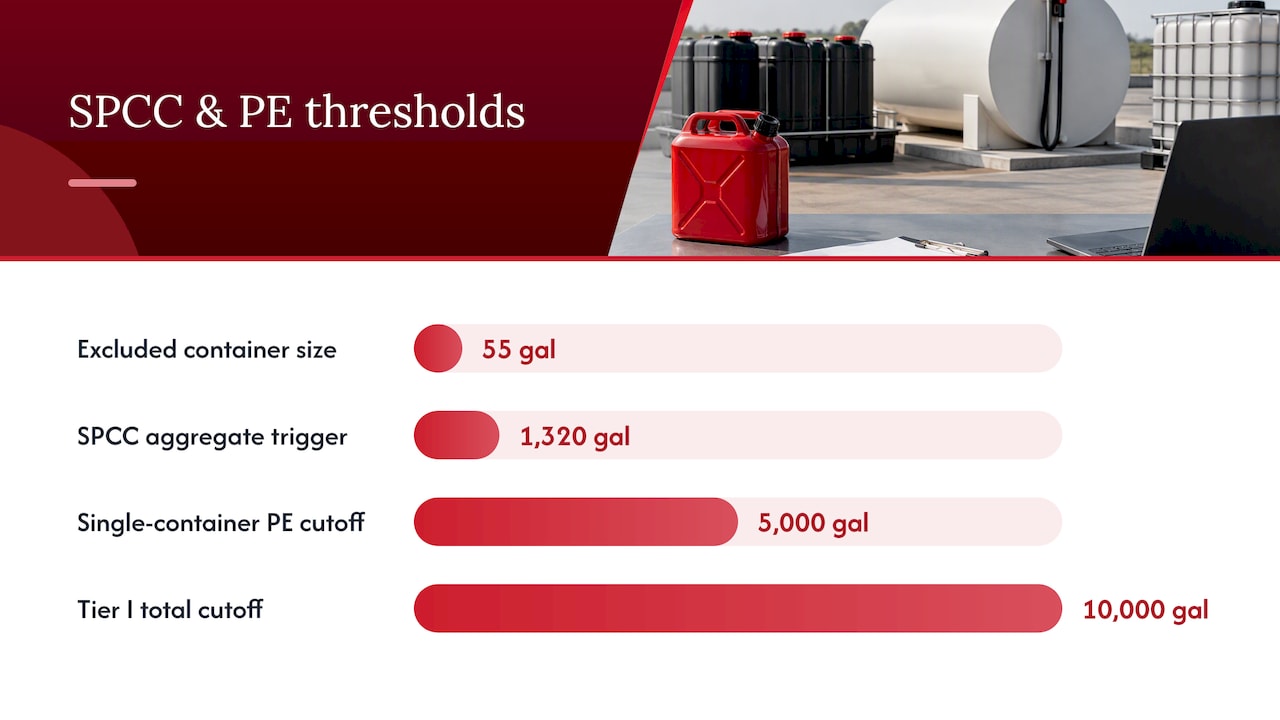
Counting rules matter here. Shell capacity, not the amount of fuel actually in the tank, determines whether you cross the threshold, and EPA guidance excludes containers under 55 gallons from the count. Drainage and proximity to a storm drain, creek, or ditch factor into whether a discharge “could reasonably be expected,” so a site that seems dry on paper can still qualify if runoff has a path to a waterway.
Whether you need a Professional Engineer’s signature depends on your facility’s profile:
- Facilities with total aboveground capacity of 10,000 gallons or less, with no single container exceeding 5,000 gallons, may qualify for the Tier I self-certification template.
- Facilities above that threshold, or that don’t meet other Tier I criteria, need a PE-certified SPCC plan.
- A rented tank that temporarily pushes you past 10,000 gallons or 5,000 gallons in a single container can bump you out of Tier I eligibility for the rental’s duration.
Check your facility’s status against the EPA’s SPCC resources before you finalize a rental size, since dropping to a smaller tank or splitting capacity across two locations sometimes keeps you inside the self-certification tier.
Local permitting and fire-code requirements: what fire marshals expect
SPCC is a federal floor, not the whole picture. Local fire codes layer on their own permit requirements, and they tend to focus on the physical safety of the installation rather than environmental discharge.
Submittal packages vary by jurisdiction, but most fire marshals ask for a consistent set of documents:
- Tank cut sheets showing UL listing, capacity, and construction type.
- A to-scale site plan showing setbacks, access routes, and nearby structures.
- A signed removal agreement, when the tank is being classified as temporary.
- Electrical and piping plans for pumps, dispensers, and any grounding or bonding systems.
Local treatment of “temporary” varies enough that it’s worth checking before you assume a rental qualifies. Bexar County’s fuel systems checklist requires permits for any tank of 100 gallons or more, caps temporary permits at 180 days, and conditions that classification on a signed removal agreement. Re-permitting past that window can force the installation to meet permanent-tank standards instead. Fort Worth’s guidance follows a similar pattern, adding specific inspection and signage requirements before a tank can be filled.
Inspections typically include witnessed tightness tests, sometimes called soap or air tests, on tank and piping connections, plus verification that overfill protection actually triggers at the stated levels. Many jurisdictions, including Fort Worth, expect the fuel delivery truck to be present during the inspection so the inspector can watch overfill alarms and shutoffs work in real time.
| Jurisdiction | Permit trigger | Typical temporary duration | Sample fee or penalty |
|---|---|---|---|
| Bexar County, Texas | Tanks ≥100 gallons | Up to 180 days, renewable once | $400 per tank; double fee if installed without a permit |
| Fort Worth, Texas | Aboveground fuel tanks for equipment or generators | Inspection required before filling | Witnessed tightness test required pre-fill |
Fees and penalties differ by county and city, so confirm the current fee schedule with your local fire marshal’s office before you commit to a rental date. An unpermitted install isn’t just a compliance gap: it’s often a guaranteed double fee once discovered.
Technical tank and containment requirements to specify in the rental contract
The tank itself is where most compliance failures start, because rental fleets vary widely in age, listing, and containment design. Specify requirements in the contract instead of assuming the vendor’s standard unit meets code.
- Confirm whether you need a UL 142 or UL 2085 tank: UL 2085 tanks are fire-resistant, insulated, and typically required for dispensing operations or larger capacities under many local codes.
- Ask whether the tank is double-walled with interstitial monitoring, since OSHA and NFPA 30 have accepted this design as an alternative to a separate dike under specified conditions.
- Confirm emergency venting is sized correctly and set to vent at least 12 feet above adjacent grade, per common municipal guidance.
- Require overfill alarms at 90% capacity and automatic shutoff at 95%, along with a level-monitoring method the delivery operator can check without opening the tank.
- Specify vehicle impact protection, such as bollards, if the tank sits anywhere near vehicle traffic.
At delivery, verify these specs against the actual tank rather than the spec sheet alone. A bunded or double-walled design can simplify secondary containment, but only if the interstitial space is intact and monitored, a detail worth confirming before the first fill.
Practical steps and timeline: permit submission, inspection, delivery, and removal
Treat a rental like a construction project with a hard delivery date, not a same-day order.
- Pre-rental: Calculate your facility’s new aggregate storage total, request tank spec sheets from the vendor, draft the removal agreement, and finalize your site layout with setbacks marked.
- Permit submission: Submit your application with enough lead time for the local fire marshal’s review, which can run from a few business days to several weeks depending on the jurisdiction. If a PE certification applies, build in time for engineering review before submission.
- Inspection and delivery coordination: Schedule the fire department’s witness test before the delivery truck leaves the yard, since many inspectors require the truck on-site to verify overfill protection during the test.
- Removal and closeout: Keep proof of removal on file for permit records, and update your SPCC plan if the rental changed your aggregate storage figure during the period it was on-site.
Pro Tip: Book the fire marshal’s inspection and the delivery truck for the same appointment window. A missed inspection often means the truck waits on standby, and standby time is rarely free.
Costs, typical fees, and penalties to budget for rental installations
Permit fees are the most predictable cost, but they’re rarely the only one. Bexar County’s published fee example runs $400 per tank, with a doubled fee for installations completed without a permit, a penalty structure that shows up in various forms across jurisdictions.
- Budget for PE certification and engineering drawings if your aggregate storage pushes past the Tier I threshold.
- Factor in impact protection, such as bollards, if your site plan doesn’t already have it.
- Include standby fees in your estimate: a delivery truck held up because an inspection wasn’t scheduled in advance often carries its own charge.
- Build in a contingency, since fee schedules change and some counties charge per tank rather than per site.
Confirm the current fee schedule with your local fire marshal before ordering, since a rental priced without permit costs in mind can run well past the original quote.
How Anytime Fuel Pros supports compliant fuel tank rentals and on-site deliveries
Fuel vendors may assist with paperwork alongside the fuel itself, such as providing tank cut sheets and UL documentation for permit applications, advising on site-plan placement and setbacks, supplying removal agreement templates where required, and coordinating inspection timing to avoid delivery delays.
- Fuel delivery scheduled after the tank is permitted and inspected.
- Emergency fuel delivery options for sites needing capacity while permitting is in progress.
- Coordination with partner networks may assist multi-site or multi-state operations managing rentals across jurisdictions.
For facilities managing data center backup power, construction equipment yards, or municipal fleets, having a single contact for both fuel and compliance documentation can streamline the rental process.
Environmental and safety training requirements for personnel handling rental tanks
Anyone handling fuel transfer, connecting hoses, or monitoring a rental tank needs training specific to flammable and combustible liquids, not general safety orientation. OSHA’s standard for flammable and combustible liquids, 1910.106, governs much of this, covering spill response basics, grounding and bonding procedures during transfer, and proper use of emergency shutoffs.
Personnel should know how to read the tank’s level gauge, recognize an overfill alarm, and shut down a transfer immediately if a leak or spill starts. Spill kit location and basic containment steps belong in site-specific training, along with who to call internally and externally if a release reaches soil or a storm drain.
Training doesn’t need to be elaborate, but it does need to be documented. Keep a record of who completed it and when, since fire marshals and EPA inspectors sometimes ask for this during a site visit. If your crew rotates between sites, refresh training when someone moves to a facility with a different tank type or containment setup, since a double-walled tank with interstitial monitoring is operated differently than one relying on a dike.
Coordinate with your fuel vendor on this too. A delivery driver should walk new site personnel through the specific tank’s shutoff and alarm locations at the first fill, rather than assuming everyone already knows where they are.
Insurance requirements and liability considerations for rented fuel tanks
Renting rather than owning a tank doesn’t shift environmental liability away from your facility. If a rented tank leaks on your property, your business is typically the responsible party for cleanup and regulatory reporting, regardless of who owns the equipment.
Check your general liability and pollution liability coverage before the tank arrives. Many standard commercial policies exclude pollution incidents entirely, which means a separate pollution liability policy or an endorsement may be necessary for the rental period. Ask the rental vendor directly whether their equipment is covered under their own liability policy for equipment failure, and get that answer in writing as part of the rental agreement.
Review the rental contract’s indemnification language closely. Some vendors push cleanup responsibility back onto the customer for anything that happens after delivery, even if the failure traces back to the tank itself. Your insurance broker can tell you whether your current pollution liability coverage, if you carry it, extends to rented equipment or whether it needs a rider.
Documentation matters here too. Keep the signed rental agreement, tank inspection records, and proof of insurance coverage together in one file for the duration of the rental, since a claim or a regulatory inquiry will ask for all three.
Specific state-by-state variations or examples in fuel tank rental regulations
Fire codes and permit processes are set locally in most states, which means two facilities a few counties apart can face different rules for the same tank. Texas counties illustrate this well: Bexar County’s fuel systems checklist caps temporary permits at 180 days and charges a flat per-tank fee, while Fort Worth’s fire department guidance emphasizes pre-fill inspection and specific venting heights without the same fixed fee structure.
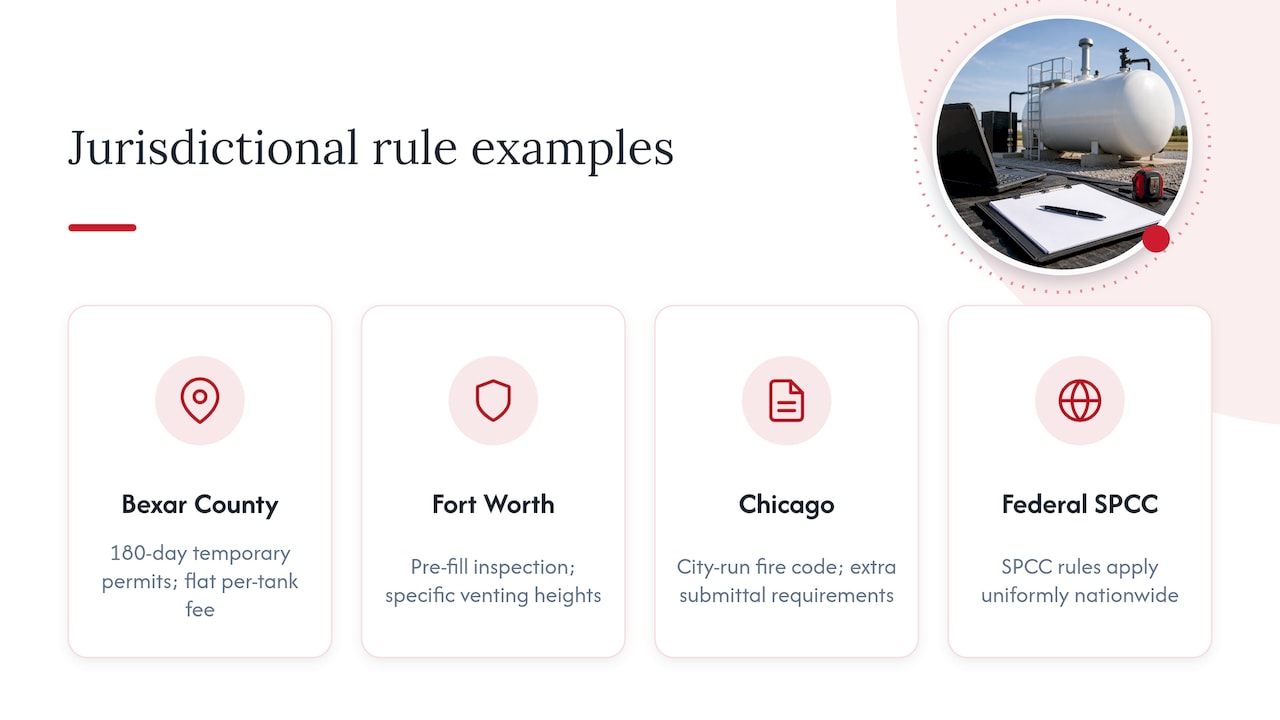
Illinois follows a similar local-first pattern, with Chicago’s fire code and permitting process run through the city rather than the state, adding its own submittal requirements on top of whatever Illinois state fire code specifies.
The practical takeaway: never assume a rule that applies in one Texas county, or one Illinois city, applies statewide or even in the next jurisdiction over. Always confirm requirements with the specific city or county fire marshal’s office where the tank will sit, since permit fees, temporary duration limits, and inspection requirements are set at that level far more often than at the state level. Federal SPCC rules apply uniformly regardless of state, but the local permit layer is where most of the variation lives.
How to get a permit-ready rental quote from Anytime Fuel Pros
Renting a fuel tank shouldn’t mean juggling a vendor, a fire marshal, and a delivery schedule on your own. Anytime Fuel Pros brings fuel tank rentals, bulk delivery, and pre-fill documentation together under one point of contact, so your permit paperwork and your fuel order move on the same timeline instead of two separate ones.
- Tank cut sheets and UL documentation provided ahead of your permit submission.
- Inspection scheduling coordinated with your delivery window to avoid standby charges.
- Nationwide partner network for sites managing rentals across multiple states.
| What you need | What AFP provides |
|---|---|
| Permit-ready documentation | Tank cut sheets and UL listing before delivery |
| Inspection coordination | Delivery scheduled around fire marshal witness tests |
| Multi-site consistency | Nationwide partner network for cross-state rentals |
Request a quote through our fuel services page or reach out directly for bulk fuel delivery paired with your rental, and we’ll work the documentation timeline around your permit deadline.
This article is general information, not a substitute for advice from a qualified lawyer. Consult a qualified legal professional about your own circumstances before acting on anything here.
FAQ
What are the OSHA regulations for fuel tanks?
OSHA’s standard 1910.106 governs flammable and combustible liquid storage, including emergency venting, pressure limits, and construction requirements for portable and stationary tanks. It also recognizes double-walled tanks with interstitial monitoring as an acceptable alternative to diking under specified conditions.
How full does the tank need to be when returning a rental car?
This question concerns passenger vehicle rentals, which is a different topic from commercial fuel tank rentals and isn’t covered by the compliance rules discussed in this article. For commercial fuel tank rentals, the relevant requirement is overfill protection, not a minimum fill level, with alarms typically set at 90% capacity and automatic shutoff at 95%.
How many gallons of fuel can you transport without hazmat?
Federal hazmat transport thresholds depend on the specific fuel type, container design, and mode of transport, and they fall under a different regulatory framework than the SPCC and fire-code rules covered here. Check with the Department of Transportation’s Pipeline and Hazardous Materials Safety Administration or a qualified transport compliance professional for the exact threshold that applies to your fuel type and vehicle.
What are the regulations for fuel tanks in Florida?
Florida fire codes and permitting for aboveground fuel tanks are administered locally, similar to the county and city-level processes seen in Texas. Confirm specific permit, setback, and inspection requirements with the local fire marshal’s office in the Florida county or city where the tank will be installed, since no single statewide fee or permit duration applies.
Do rented fuel tanks count toward SPCC storage limits?
Yes, a rented tank’s shell capacity counts the same as an owned tank toward your facility’s aggregate aboveground storage under SPCC rules. If the addition pushes your total past 1,320 gallons with a reasonable discharge pathway to navigable waters, SPCC requirements apply for as long as the tank remains on-site.
Sources
- Spill Prevention, Control, and Countermeasure (SPCC) for the Upstream (Oil Exploration and Production) Sector | US EPA
- Spill Prevention, Control and Countermeasure (SPCC) Regulation (EPA extract)
- Fuel systems checklist — Bexar County (temporary tank permit rules and fees)
- Above-ground fuel tanks for fuel-fired equipment / generators — Fort Worth Fire Department guide
- OSHA regulations for flammable and combustible liquids (1910.106)
Recent Comments