
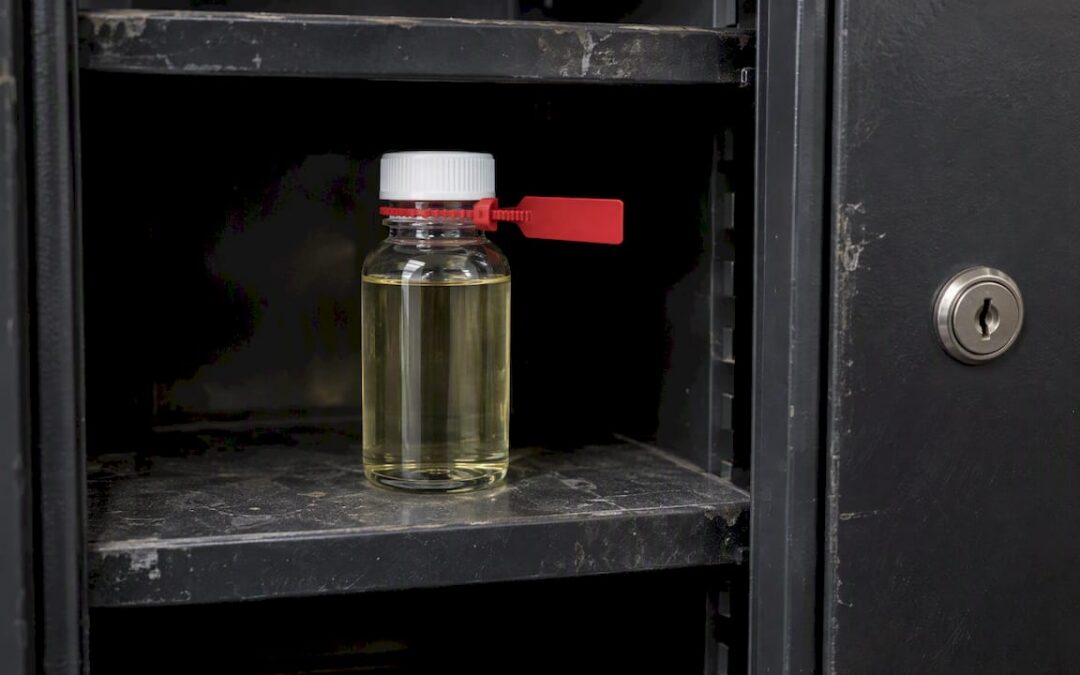
A fuel sample chain of custody is a written record of who collected a sample, where it went, who held it and what condition it was in, from the moment it leaves the tank until a laboratory logs it in. NIST Handbook 158 describes it as a record-keeping system for the collection, movement, storage and custody of a fuel sample. If you ever dispute a bad load, a warranty claim or a compliance finding, that record decides whether your lab result carries weight.
This guide is for facilities managers, fleet managers and site superintendents who take diesel samples. It covers what to write down, how to collect, label, seal and ship, which tests answer which questions, and how delivery tickets and bills of lading relate to all of it.
TL;DR
- Chain of custody tracks a sample, not a delivery: identifier, collector, date, time, every hand-off with signatures, and the analyses requested.
- Collect to a recognized practice (ASTM D4057 for manual tank and dispenser sampling), label in permanent ink, seal with a signed and dated custody seal, and keep the form with the sample.
- A bill of lading or delivery ticket records the transaction. It does not replace a chain-of-custody form.
- Sample at delivery, not after a problem shows up. Evidence gathered late is hard to defend.
- Keep the sample record, ticket, and lab report together in one file per delivery.
Table of Contents
- Why chain of custody matters for diesel
- When you need a formal chain of custody
- What the chain-of-custody record must contain
- How to collect, label, seal and ship a diesel sample
- How to test diesel quality once the sample is in hand
- Diesel contamination testing: what to check for water, sediment and microbes
- Bill of lading, delivery ticket and chain of custody: what each one does
- Special cases: dyed diesel, government work and remote sites
- A simple sampling routine you can adopt
- How Anytime Fuel Pros supports your fuel records
- FAQ
- Sources
Why chain of custody matters for diesel
Most diesel samples never go to court. They go to a lab because an engine is plugging filters, a generator failed a load test, or a tank has been sitting for a year. Even so, the way you handle the sample decides whether you can act on the result.
NIST states that a sample not collected under prescribed procedures, or with undocumented custody, has little chance of admission as evidence in legal proceedings. That matters if you plan to claim against a supplier, a carrier or an upstream terminal. If you cannot show the sample stayed sealed and under control, the other side will argue it was contaminated somewhere between your tank and the lab.
There is a second, practical reason. A documented trail forces discipline. When every transfer needs a time and two signatures, samples stop sitting in truck cabs for three days. ASTM International’s D4840 guide to sample chain-of-custody procedures calls custody procedures a fundamental element of data defensibility from collection through disposal. It also makes clear that custody paperwork alone is not enough. You still need sound sampling, a competent lab and a consistent method.
The cost of skipping this is real. Contaminated fuel rarely announces itself. As we explain in how fuel contamination wrecks equipment long before anyone notices, the first sign is often a clogged filter or a derated engine, and by then the question of where the problem started is already contested.
When you need a formal chain of custody
Not every sample needs the full form. Use this as a working rule:
| Situation | Formal chain of custody? | Why |
|---|---|---|
| Routine in-house check of your own storage tank | Usually a simple log is enough | No third party will contest the result |
| Suspected bad load, with a possible supplier claim | Yes | The result may be disputed |
| Regulatory or government contract testing | Yes, follow the agency’s form | The agency sets the format |
| Warranty claim on an engine or generator | Yes | The manufacturer may question sample handling |
| Data center generator fuel testing | Yes, as part of maintenance records | Auditors and insurers ask for the paper trail |
If you are unsure, treat it as formal. The extra five minutes cost far less than a result nobody will accept.
For generator sites, fuel quality is part of a wider testing program. Our guide on fuel for data center testing and what NFPA 110 requires covers how testing and fueling schedules fit together.
What the chain-of-custody record must contain
The NIST handbook is specific about the minimum. Each record should capture:
- Sample identifier, a unique ID that appears on the container and on the form.
- Date and time of collection.
- Collector’s name and the agency or company they represent.
- Intended analyses, so the lab knows which tests to run.
- Inspection notes answering who, what, when, where, why and how.
- Signature, title and signing date of the official or responsible person.
The Florida Department of Environmental Protection’s chain-of-custody instructions add details that apply well to fuel: the field ID tied to the sampling location, date and time, whether the sample is a grab or composite, the matrix, the number of containers, any preservatives, and the analyses requested. The form is written for environmental work, but the logic carries over to a diesel sample.
For a fuel sample, add what a lab will want and a dispute will turn on:
- Tank, truck compartment or dispenser sampled, and the exact sampling point (top, middle, bottom, drain valve)
- Product and grade (clear diesel, dyed diesel, ULSD)
- Delivery ticket number the sample relates to
- Weather, tank condition and anything unusual, such as visible water or odor
- Container type and size
Document every transfer
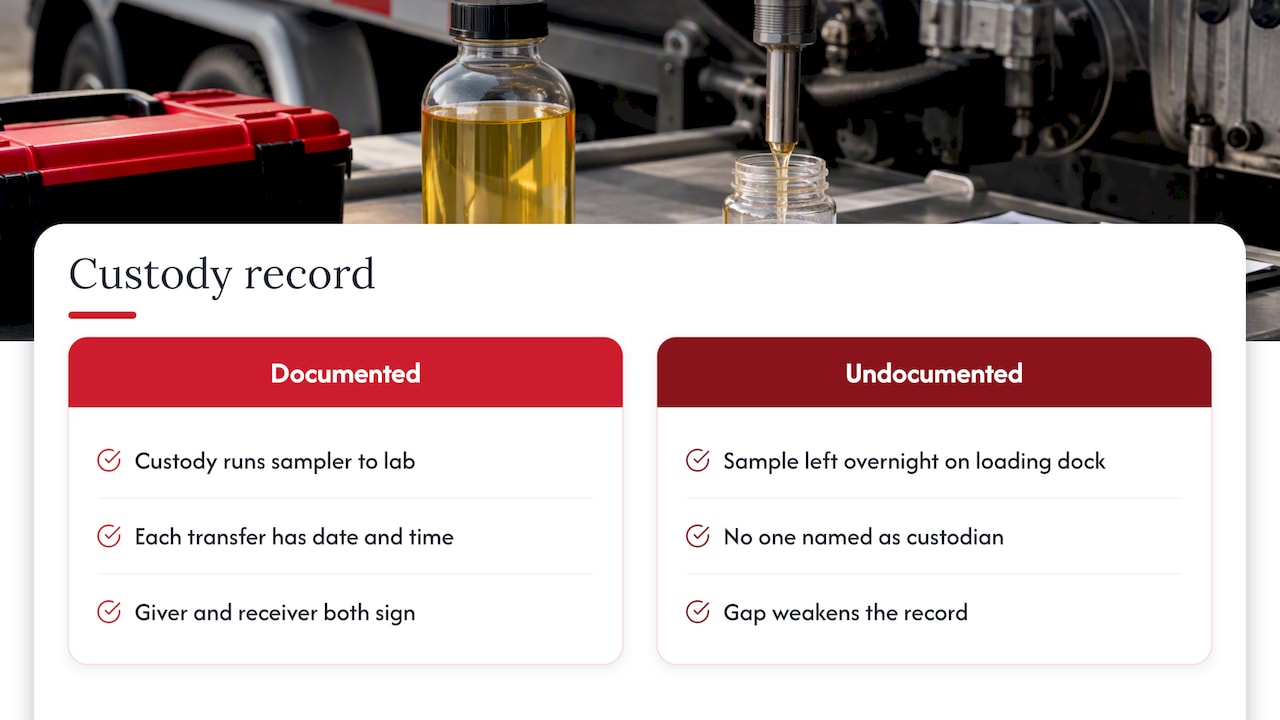
This is where most records break. Each time the sample changes hands, record the date, the time, and the signatures of both the person giving up custody and the person accepting it. Done properly, the form shows an unbroken line of possession from the sampler to the lab receiving desk. A gap, such as a sample left on a loading dock overnight with no one named, is the weak point an opposing party will find.
How to collect, label, seal and ship a diesel sample
The procedure below follows the practices described in NIST Handbook 158. Check your own lab’s instructions before you start, because labs often specify container type and volume.
Step 1: Choose the method
NIST points to ASTM D4057 for manual sampling of retail or wholesale dispensers and storage tanks, and ASTM D4177 for automatic sampling of petroleum products in pipelines. For a tank at a job site or generator, D4057 is the relevant practice.
Step 2: Use clean, appropriate containers
A dirty bottle can create the contamination you are trying to find. Use clean containers suited to the product and the lab’s requirements, and fill out the label before you fill the bottle.
Step 3: Label immediately
Label in permanent ink right at the sampling point. Include the sample ID, date, time, location and your initials. Never label from memory later in the truck.
Step 4: Seal with a custody seal
Apply a custody seal that you sign and date. A broken or missing seal on arrival tells the lab, and anyone reading the report, that the sample may have been opened.
Step 5: Store it securely
Keep the sample in a locked or controlled place. On storage temperature, California Air Resources Board laboratory procedure SOP 122 says diesel samples may be stored chilled or at room temperature, with room temperature preferred. Follow your lab’s instruction if it differs.
Step 6: Ship with the form
Send the sample directly or through a courier, and make sure the chain-of-custody form travels with it at every step. Record each hand-off on the form. Keep a copy before it leaves your hands.
Step 7: File the result with the record
When the report returns, file it with the custody form, the delivery ticket and any photos. One folder per delivery is easier to defend than four scattered ones.
How to test diesel quality once the sample is in hand
A sample answers different questions depending on which test you order. Start with the symptom.
NIST lists ASTM test methods for diesel density, sulfur content and cold filter plugging point. ASTM’s petroleum standards collection gives a wider diesel list:
| What you want to know | ASTM method |
|---|---|
| Does the fuel meet the diesel specification? | D975 |
| Density | D1298, D4052 |
| Flash point | D93 |
| Water and sediment | D1796, D2709 |
| Water by Karl Fischer | D6304 |
| Particulate contamination by filtration | D6217 |
Order the tests that match the problem. Plugged filters point toward water, sediment and particulates. A suspected wrong-product delivery points toward density and flash point. Cold-weather gelling points toward cold filter plugging point.
Diesel contamination testing: what to check for water, sediment and microbes
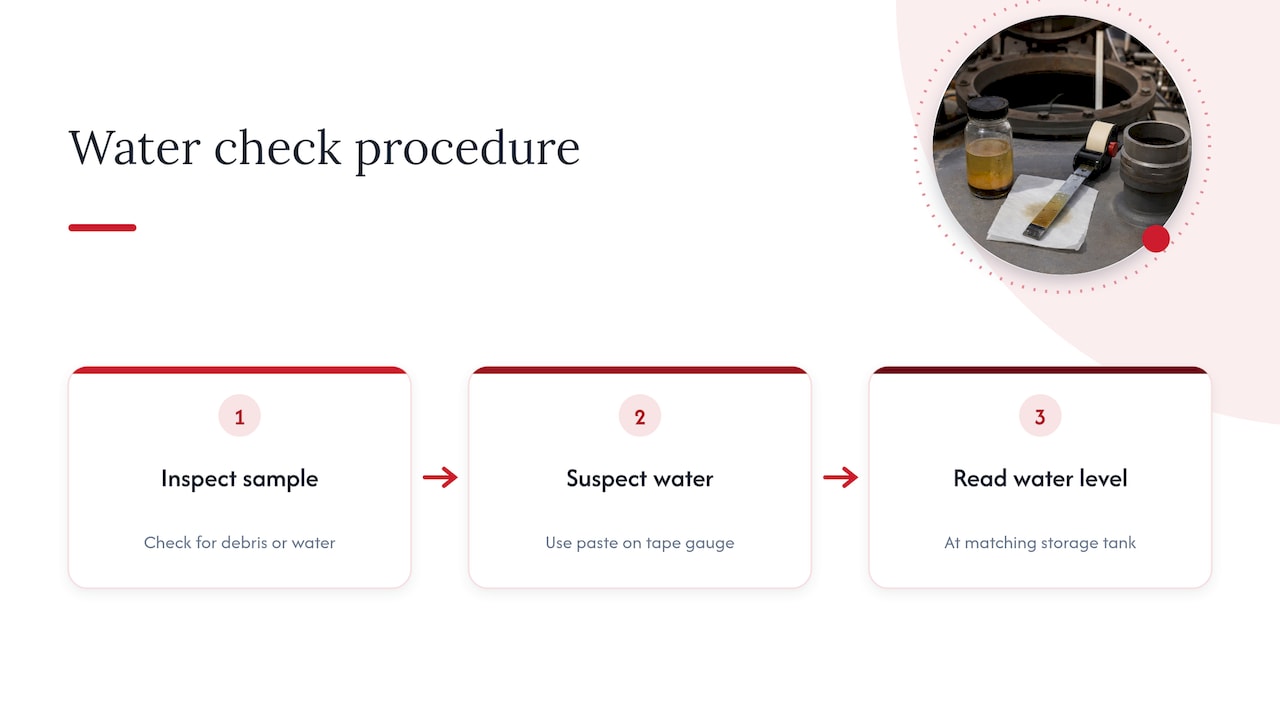
Water is the usual culprit. The Maryland Comptroller’s motor fuel inspection procedure shows a practical field approach: inspectors visually examine samples for debris or water, and if water is suspected, they use a tape gauge with water-finding paste in the matching storage tank to find the water level.
That simple check is worth copying into your own routine. A clear-and-bright look at a sample in a clean glass jar, plus a water-paste reading at the tank bottom, takes minutes and tells you whether a lab test is justified.
Microbial growth follows water. The EPA’s investigation of corrosion-influencing factors in diesel underground storage tanks notes that microbiologically influenced corrosion may be involved, and that maintenance generally focuses on minimizing water to limit microbial growth. The practical lesson is that you control microbes mainly by controlling water, and you find water by sampling the tank bottom, not just the middle.
Standing fuel has its own pattern of problems. Our guide to keeping diesel usable for 6 to 36 months explains storage tiers for standby tanks, and it pairs naturally with a scheduled sampling plan. If testing shows a tank has degraded fuel, fuel polishing is one remedy to discuss with your supplier.
Bill of lading, delivery ticket and chain of custody: what each one does
These three documents get confused, and the confusion causes real disputes.
| Document | What it records | Who uses it |
|---|---|---|
| Bill of lading | The commercial transaction: fuel product, quantity, density, sulfur content, origin | Buyer, carrier, terminal |
| Delivery ticket | What the driver delivered to your tank, with time, volume and product | Site staff, accounts payable |
| Chain of custody | The handling and integrity of a specific sample | Lab, claims, regulators |
The American Petroleum Institute’s petroleum industry practices guidance on safety data sheets describes shipping documentation as a record of delivery that carries information about the product. A bill of lading gives you the origin and specifications. It does not prove how a sample taken later was handled, which is the job of the custody form. Other fuels follow the same document logic: if you are moving compressed gas, CNG virtual pipeline delivery relies on shipping records that capture product, quantity and transfer details in the same way.
Use the ticket to anchor the sample
The strongest practice is to write the delivery ticket number on the custody form. Then a lab result for sample 0427-B ties directly to the exact load, the exact time and the exact driver. If the result shows water, you have the paper to take to the supplier the same day.
Handle discrepancies immediately
The API’s Manual of Petroleum Measurement Standards, Chapter 17.1 on marine inspection stresses that discrepancies in quantity or quality found during a transfer should be recorded and resolved right away, for example through a letter of protest or notice of apparent discrepancy before the vessel departs. The marine setting differs from a job site, but the principle holds: note the problem at the point of transfer, in writing, before the truck leaves.
On a truck delivery, that means noting a short load, visible water or wrong product on the ticket before the driver signs off, and taking a sample while the delivery vehicle is still on site.
Special cases: dyed diesel, government work and remote sites
Dyed diesel adds a compliance layer. If an inspector samples your off-road fuel and finds a problem, your records are your defense. Our write-up on red dye diesel audits and the nine records to keep lists the paperwork that belongs in the same file as your sample documentation.
Public agencies often specify their own custody forms. Use the agency’s form rather than your own, and make sure the signature, title and date fields NIST describes are completed by the official responsible.
Remote sites such as farms, quarries and construction yards create timing problems, since the nearest courier may be a day away. Plan for it: bring sealed containers and pre-printed forms, and name the person who will hold custody until pickup. Our farm and ranch diesel delivery best practices cover storage and delivery habits that make sampling easier in these settings.
A simple sampling routine you can adopt
Use this routine at delivery for any site where uptime matters:
- Check the delivery ticket against the order: product, grade, quantity.
- Look at a sample drawn from the delivery hose or compartment, before or during the transfer, in a clean clear container.
- If anything looks off, take a sealed sample, fill out a custody form and note the ticket number.
- Record the problem on the ticket before the driver leaves.
- Ship the sample to the lab with the form and log each transfer.
- File the lab report with the ticket and form.
- Once a quarter, sample your standby and bulk tanks from the bottom, whether or not anyone has complained.
The point of a routine is that nobody has to decide in the middle of an outage whether sampling is worth the trouble. The forms are already in the truck.
How Anytime Fuel Pros supports your fuel records
We deliver diesel, gasoline and DEF to job sites, fleets, generators and data centers in San Antonio, Austin, Dallas-Fort Worth and Salt Lake City, and through our partner network across the continental United States. We provide transparent itemized invoicing and delivery confirmation, which gives you the ticket-level record your custody file starts from.
If you want to understand how a delivery fits your site, start with our on-site diesel delivery setup guide. For ongoing programs, see our diesel fuel delivery service, or review the full list of fuel services for dyed and clear diesel, DEF, bulk fills and generator fueling.
To set up scheduled deliveries with documentation your team can rely on, contact us through Anytime Fuel Pros and tell us your sites, fuel types and volumes.
FAQ
What is a fuel sample chain of custody?
It is the documented history of a fuel sample from collection to laboratory receipt. It records the sample ID, collector, date, time, storage and every transfer with both parties’ signatures. Its purpose is to show the sample was not swapped, altered or contaminated on the way.
Does a bill of lading replace chain-of-custody documentation?
No. A bill of lading documents the commercial transaction, including quantity, density and sulfur content. A custody form documents how one specific sample was handled. For a dispute you usually need both, linked by the delivery ticket number.
How do I test diesel quality?
Start with a visual check for water and debris, and a water-paste reading on the tank bottom. For a lab test, choose methods that match the symptom, such as water and sediment for plugged filters or density and flash point for suspected wrong product. ASTM publishes methods for each.
How should I store a diesel sample before shipping?
Keep it sealed and in a secure place, with the custody form. CARB’s laboratory procedure allows diesel samples to be stored chilled or at room temperature, with room temperature preferred. Follow your lab’s own instructions if they are stricter.
Who should sign the chain-of-custody form?
The person collecting the sample signs first. Then each person who relinquishes and each person who receives the sample signs and adds the date and time, ending with the lab receiving clerk. No transfer should go unrecorded.
Sources
- NIST Handbook 158: Field Sampling Procedures for Fuel and Motor Oil Quality
- ASTM D4840 Standard Guide for Sample Chain-of-Custody Procedures
- Florida DEP Chain of Custody Record Instructions
- CARB SOP 122: Receiving, Handling, and Blending Fuel Samples
- ASTM Petroleum Standards
- Maryland Comptroller: 903 Motor Fuel Inspection
- EPA: Investigation of Corrosion-Influencing Factors in Diesel USTs
- API: Safety Data Sheets, Petroleum Industry Practices
- API MPMS Chapter 17.1
Recent Comments