
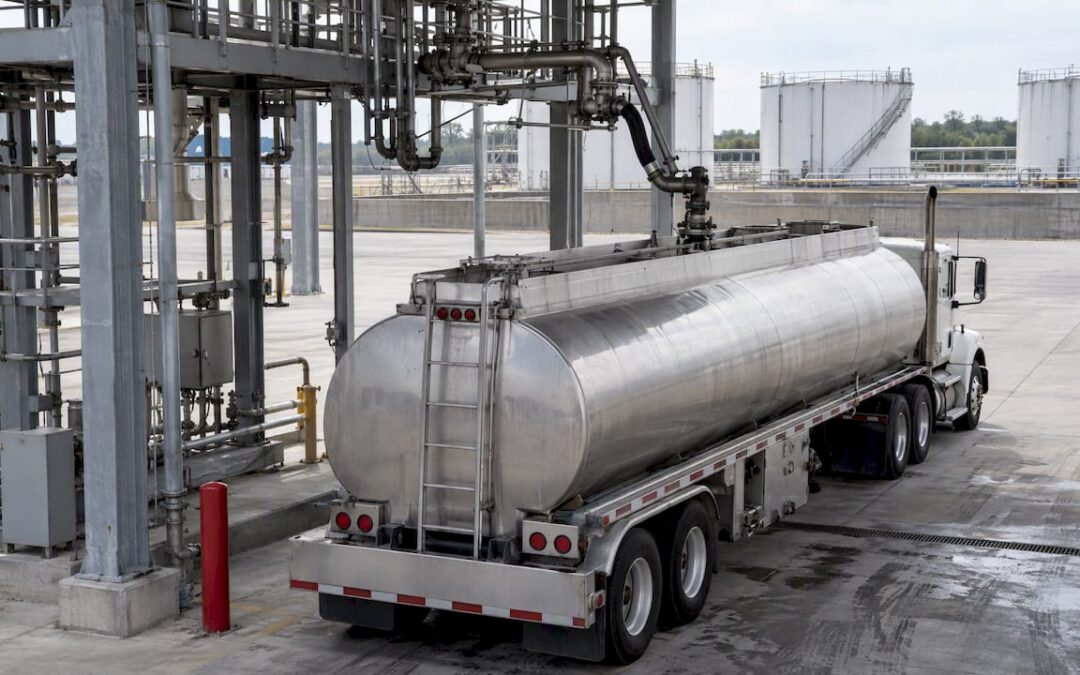
The federal excise tax on diesel is 24.4 cents per gallon: 24.3 cents of excise tax plus a 0.1-cent Leaking Underground Storage Tank (LUST) fee, according to the U.S. Energy Information Administration. It is built into the price of undyed (clear) diesel that goes into on-road vehicles. Dyed off-road diesel is generally exempt from the main tax. If you paid the tax on fuel that was later used off-highway, you can usually get it back through a credit or a refund.
This guide is for fleet managers, site superintendents, facilities managers and procurement officers who buy diesel in volume and want to know what they are paying, what they are not, and how to recover tax paid in error.
TL;DR
- The federal diesel tax is $0.244 per gallon ($0.243 excise tax plus a $0.001 LUST fee), charged on undyed diesel at the terminal level and passed down the supply chain into your price.
- Dyed diesel for nontaxable uses, such as equipment on a construction site or a standby generator, is generally exempt from the $0.244 tax but still carries the $0.001 LUST fee.
- If you bought tax-paid diesel and used it off-highway, you can claim a credit on Form 4136 with your income tax return, or a refund on Form 8849.
- Records win claims: vehicle and equipment lists, invoices showing gallons, supplier and use, and proof of ownership.
- State diesel taxes sit on top of the federal rate and average more than the federal tax.
Table of Contents
- What the federal diesel excise tax is and how much it costs
- Who actually pays the tax
- When off-road diesel is exempt
- Off-road diesel tax refund vs. tax credit
- How to claim: a practical sequence
- Records that support a fuel tax claim
- Common mistakes that cost money
- How on-site delivery helps with tax and compliance
- FAQ
- Sources
What the federal diesel excise tax is and how much it costs
The current federal rate on diesel is $0.244 per gallon, as stated in IRS Publication 510. Gasoline is lower, at 18.4 cents per gallon under the same EIA breakdown. The tax applies to the removal, entry or sale of undyed diesel in the United States, and in practice it is collected at the terminal rack.
That rate is flat per gallon. It does not move with the market price of diesel, so it matters more to your budget when volume is high and less when prices spike. A few quick calculations show the scale:
- A 250-gallon fill carries about $61 in federal tax at 24.4 cents.
- A 1,000-gallon tank carries $244.
- A fleet that burns 10,000 gallons a month in off-road equipment and paid the 24.3-cent excise portion on all of it would have paid $2,430 a month in tax it may be able to recover.
The last figure is simple arithmetic on the published rate, not a forecast for your operation. Your own gallons and uses decide what is recoverable.
Federal tax versus state tax
Federal tax is only one layer. The EIA reports that average state diesel taxes run about 35.5 cents per gallon, and that state figures can include excise, environmental and special taxes and inspection fees (EIA). A fleet running across several states pays a different combined rate in each one, and each state has its own rules for dyed fuel and refunds. If you operate in Texas or Utah, see our state guides on Texas dyed diesel rules and Utah dyed diesel rules.
This article covers the federal layer only.
Who actually pays the tax
You rarely write a check to the IRS for the federal diesel tax at the pump or on a delivery. The liability sits upstream. Under the system Congress adopted in 1993, the position holder, meaning the party that contracted with the terminal operator to store fuel in the terminal, is liable for the tax when fuel is removed at the rack (GAO). The federal regulation says the same: the position holder is liable for tax on fuel removed at the terminal rack, and the terminal operator is jointly and severally liable in the circumstances the rule specifies (26 CFR 48.4081-2).
The GAO explained that moving collection from the wholesale level to the terminal was meant to strengthen enforcement and make sure the party handling the fuel forwards the tax to the IRS.
For a buyer, the result is that the tax arrives embedded in the per-gallon price of undyed diesel. When you see a clear diesel quote, the 24.4 cents is already in it. When you buy dyed diesel for a qualifying use, the main tax is not.
Why this matters for fleet budgets
Because the tax is embedded, it is easy to overlook when comparing quotes. Ask any supplier to show the federal tax, state tax, product cost, delivery charge and any fees as separate lines. Itemized invoicing is also what you will need later if you claim a credit. Fleets that keep the vehicles serviced and the paperwork tidy tend to find these claims far less painful; the same discipline shows up in maintenance planning, such as bulk oil change discounts for fleets.
When off-road diesel is exempt
Off-road diesel, usually dyed red, is generally exempt from the federal excise tax because it is not intended for use in diesel-powered highway vehicles. IRS Publication 510 gives common examples: off-highway business use on private property, such as construction sites or farms, and powering stationary equipment such as generators (IRS Publication 510).
The IRS Fuel Tax Credit guide lists nontaxable uses of undyed diesel that may qualify for a credit, including use on a farm for farming purposes, off-highway business use in equipment or machines on private property, and use by certain intercity and local buses (IRS Fuel Tax Credit).
In practice, these are the operations that most often qualify:
- Excavators, dozers, loaders and other equipment working on a job site
- Standby and prime-power generators at data centers, hospitals and event venues
- Mining and quarry equipment on private property
- Farm and ranch machinery used for farming purposes
The test is how the fuel is used, not the color of the fuel or the type of vehicle alone. A truck that fuels from the same tank for both highway and off-highway work needs a clear way to separate the gallons.
The LUST fee still applies
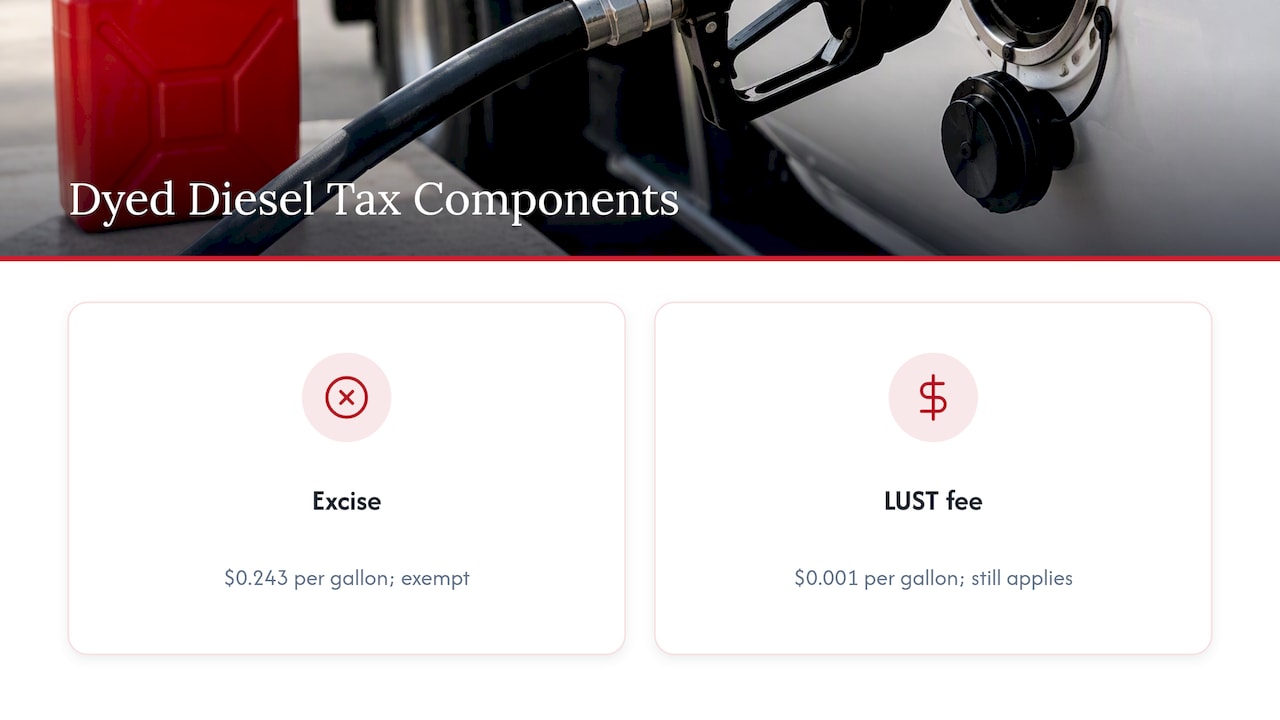
Dyed diesel is exempt from the $0.243 excise portion but remains subject to the $0.001 per gallon LUST tax, according to Publication 510. The fee is small, but it explains why a dyed diesel invoice is not entirely free of federal tax.
Highway use of dyed diesel is a compliance problem
Dyed diesel is meant for nontaxable uses. Putting it in a highway vehicle is the situation penalty rules exist for. Our guides on dyed vs clear diesel and dyed diesel penalties for U.S. fleets walk through how fleets keep the two streams apart.
Temporary relief announced for late 2026
The IRS announced that, following an Executive Order, it will not impose federal excise tax penalties on dyed diesel sold for use or used on highways during a relief period running from October 1 to December 31, 2026. During that period, sellers and distributors are not required to keep records or document the end use of dyed diesel for federal tax purposes (IRS announcement).
Treat that as a temporary measure. It does not change the 24.4-cent rate in the statute, and your state rules may differ. Check the IRS page for the current status before you change any fueling practice.
Off-road diesel tax refund vs. tax credit
Readers search for both phrases, and they describe two routes to the same money: recovering federal tax paid on fuel that was used in a nontaxable way.
| Route | Form | How you get the money | Typical fit |
|---|---|---|---|
| Credit | Form 4136 | Claimed for the income tax year, on your income tax return | Businesses that file annually and prefer one yearly claim |
| Periodic refund | Form 8849 (Schedule 1 for ultimate purchasers) | Paid as a refund after the claim is processed | Businesses that want cash back during the year |
| Credit against excise liability | Form 720 | Offsets excise tax you owe | Businesses that already file Form 720 |
The instructions for Form 4136 describe it as a credit for certain nontaxable uses or sales of fuel during the income tax year, and note that a periodic refund can instead be claimed on Form 8849. The same instructions say you may claim a credit for qualifying fuel uses on Form 4136, a refund on Form 8849, or a credit against excise-tax liability on Form 720.
Schedule 1 of Form 8849 is the one for the ultimate purchaser of diesel fuel making a refund claim for nontaxable uses, per the IRS page About Form 8849.
Publication 510 adds a related idea, the “second tax.” If tax was paid on the same fuel in more than one taxable event, a refund may be available for the duplicate payment.
Neither route is automatic. You claim the money after the fuel is used, and you need to be the one who bought and used it. Minimum claim amounts, filing windows and rates change, so confirm them on the current form instructions or with your tax professional before you file.
How to claim: a practical sequence
- Sort your gallons by use. Separate highway use from off-highway business use, farm use and stationary equipment such as generators.
- Confirm what you paid. Look at each invoice. Did you buy undyed diesel with the tax included, or dyed diesel? Only tax-paid fuel that went to a nontaxable use generates a claim.
- Pick the form. Use Form 4136 if you want to claim on your income tax return, or Form 8849 Schedule 1 if you want a periodic refund.
- Compile support. Gather the records listed below before you prepare the form.
- File and keep copies. Keep the claim, invoices and equipment lists together so a later question from the IRS can be answered in minutes.
If you are unsure which route fits, a CPA who handles excise tax claims can look at your fuel mix and say. The IRS also warns businesses to be careful with misleading social media advice about fuel tax credits and to check the official eligibility criteria for business activities (IRS Fuel Tax Credit).
Records that support a fuel tax claim
The IRS says a fuel tax credit claim should be backed by records that include a list of the vehicles and equipment used, proof of ownership, and invoices or receipts showing the purchase date, supplier details, number of gallons and the specific nontaxable use (IRS Fuel Tax Credit).
That translates into a short checklist for operations teams:
- An equipment register with unit numbers, descriptions and ownership proof
- Delivery tickets and invoices showing date, supplier, gallons and fuel type
- A note on each ticket naming the use: excavator, generator, farm tractor and so on
- Meter or hour readings where they help show the fuel went where you say it did
- Separate tanks or separate fueling logs for highway and off-highway units
Mixed fleets benefit most from itemization at the point of delivery. Refrigerated trailers, for example, run their reefer units on diesel and often have their own fueling record; operators who also manage refrigeration equipment have documentation habits worth borrowing, as shown in this look at refrigeration repair cost bands. For fleet-level reporting, our dyed diesel compliance reporting guide and guide to audit-ready red diesel records cover what to keep and for how long. State rules on retention can be longer than you expect, as the clear diesel recordkeeping guide explains.
Common mistakes that cost money
A few errors come up again and again:
- Claiming without usage records. A gallon total with no equipment list or use description is hard to defend.
- Mixing highway and off-highway gallons from one tank without a log.
- Assuming dyed means zero federal tax. The LUST fee still applies to dyed fuel.
- Assuming the temporary penalty relief changes what is owed. It addresses penalties and recordkeeping for sellers during a set window; the tax rate and your own claim records remain what they are.
- Letting claims lapse. Filing windows exist. Put the claim on your calendar when the fuel is bought, not when the tax return is due.
How on-site delivery helps with tax and compliance
On-site delivery does not change the tax, but it makes the paperwork easier. When fuel is delivered to your equipment yard, job site or generator, each ticket can show the date, product, gallons and delivery location in one place. That is the kind of detail a credit or refund claim asks for, and it is far cleaner than a stack of retail receipts from crew members fueling at stations.
Anytime Fuel Pros delivers red diesel, clear diesel, gasoline and DEF to job sites, fleets, generators, data centers, mining operations and events in Texas and Utah, and nationwide through our partner network. We provide itemized invoicing, which our customers use to separate fuel types and uses. Because we deliver dyed and clear diesel separately, you can keep your off-road and on-road gallons apart from the moment the fuel arrives.
If you want to keep off-highway fuel purchases clean and documented, start with our red diesel delivery service, or look at the full range of fuel delivery services.

For sites that need recurring volume, bulk fuel delivery and mobile fleet fueling keep tickets consistent across locations. Our broader off-road fuel compliance overview and the diesel fuel types guide explain the product choices behind the tax treatment.
FAQ
What is the federal excise tax on diesel per gallon?
It is 24.4 cents per gallon, made up of 24.3 cents of excise tax and a 0.1-cent LUST fee (EIA). The rate is the same on a per-gallon basis regardless of the diesel price. State taxes are added separately.
Is dyed diesel exempt from federal tax?
Dyed diesel intended for nontaxable uses is generally exempt from the $0.243 excise portion, but it remains subject to the $0.001 per gallon LUST tax (IRS Publication 510). The exemption depends on the use. Dyed fuel used on highways can bring penalties, subject to any temporary IRS relief in effect.
How do I get an off-road diesel tax refund?
If you bought tax-paid diesel and used it for a nontaxable purpose, the ultimate purchaser can file Schedule 1 of Form 8849 for a refund (IRS). Alternatively, you can claim a credit on Form 4136 with your income tax return. Keep invoices, equipment lists and proof of ownership.
Does the federal diesel tax apply to generators?
Powering stationary equipment such as generators is listed as a common exempt use in Publication 510, so standby generator fuel can be eligible when the conditions are met. Keep records showing the fuel went to the generator. Ask your tax professional about your specific setup.
Who pays the diesel excise tax to the IRS?
The position holder pays it when fuel is removed at the terminal rack, with the terminal operator jointly liable in certain cases (26 CFR 48.4081-2). Buyers pay it through the price of undyed fuel.
Sources
- IRS Publication 510, Excise Taxes
- EIA: How much tax do we pay on a gallon of gasoline and on a gallon of diesel fuel?
- 26 CFR 48.4081-2, Taxable fuel; tax on removal at the terminal rack
- GAO: Tax Administration, Diesel Fuel Excise Tax Change
- IRS Fuel Tax Credit
- Instructions for Form 4136 and Schedule A
- About Form 8849, Claim for Refund of Excise Taxes
- IRS dyed diesel fuel relief announcement
Recent Comments