
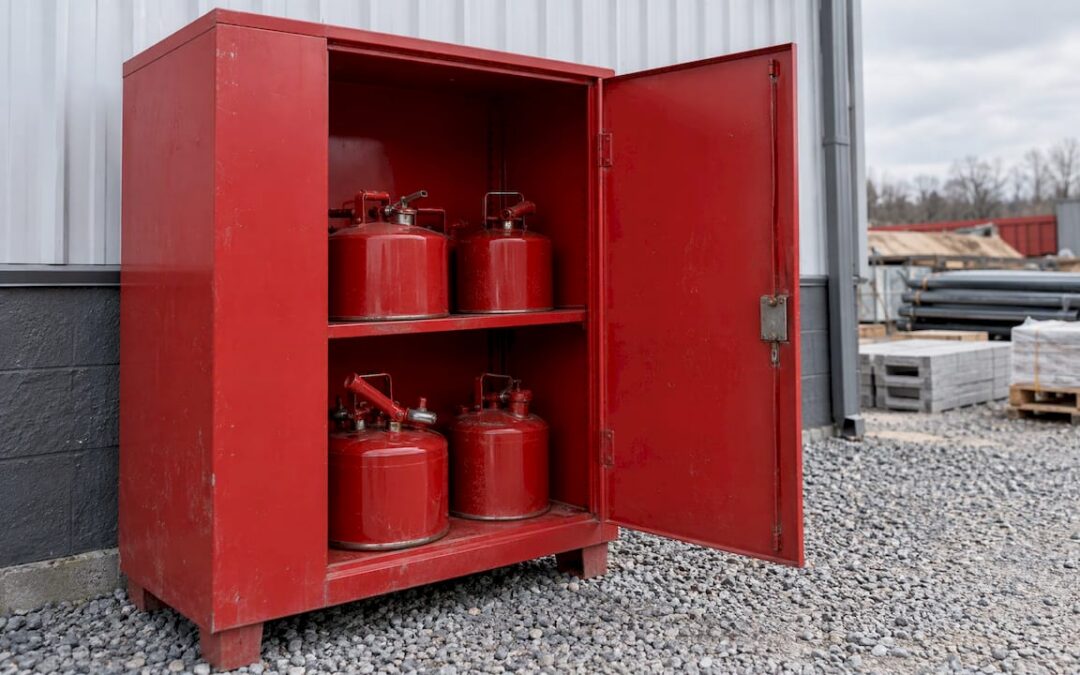
OSHA has no single “fuel handling standard” for every workplace. Which rule applies depends on your operation: 29 CFR 1910.106 covers flammable liquids in general industry, 29 CFR 1926.152 covers them on construction sites, and 29 CFR 1917.156 covers marine terminals. All three share the same core demands: approved containers, limited quantities, separation from ignition sources, engines off during fueling, and trained people doing the work.
This guide walks through those requirements in the order a site or fleet manager meets them, and shows where an on-site delivery program fits into your compliance plan.
TL;DR
- Pick the right standard first: 1910.106 for general industry, 1926.152 for construction, 1917.156 for marine terminals.
- Use only approved containers and portable tanks. For 5 gallons or less, that means approved safety cans or DOT-approved containers.
- Cap what you keep on site: the limits vary by standard and by where the fuel sits, indoors or outdoors.
- Shut engines off during fueling, ban smoking and open flames, and post signs.
- Train the people who fuel, and plan for spills before one happens.
Table of Contents
- Which OSHA standard applies to your fueling operation
- Approved containers and portable tanks
- How much fuel you can store, and where
- Precautions while fueling vehicles, generators and equipment
- Training, spills and hazard communication
- A compliance checklist for site and fleet managers
- State and local rules also apply
- How scheduled delivery fits into compliance
- Fuel delivery built around your safety program
- FAQ
- Sources
Which OSHA standard applies to your fueling operation
Start by naming your work environment, because the same diesel tank can fall under different paragraphs.
| Work environment | Main OSHA standard | What it governs |
|---|---|---|
| Industrial plants, warehouses, yards, data center facilities | 29 CFR 1910.106 | Flammable and combustible liquids: containers, storage rooms, quantities, fire areas |
| Construction, excavation, demolition | 29 CFR 1926.152 | Approved containers, outdoor and indoor storage, fueling precautions |
| Marine terminals | 29 CFR 1917.156 | Designated refueling locations, portable containers, fuel handling |
| Forklift and powered industrial truck fueling | 29 CFR 1910.178 | Fueling procedures and operator training |
OSHA’s flammable and combustible liquids rules trace back to NFPA No. 30, and OSHA has said they protect employee safety as well as adjoining property and the public. That matters in practice: a fire from a poorly placed tank is not only a worker problem. Inspectors, insurers and fire marshals look at the same layout.
Mixed sites are common. A contractor building a facility on an industrial campus may fuel equipment under the construction rule while the host plant follows the general industry rule. Ask who controls each area before you decide where the tank goes.
Approved containers and portable tanks
The first compliance question is usually the simplest: what is the fuel in?
Under 1926.152, only approved containers and portable tanks may be used to store and handle flammable liquids. Per the eCFR text, quantities of 5 gallons or less call for approved safety cans or DOT-approved containers, with an exception for highly viscid materials. For 1 gallon or less, the original container may be used.
That is why the old red plastic gas can on a pickup bed is an audit finding waiting to happen. A few practical points:
- Match the container to the fuel. Gasoline and diesel are both treated as flammable liquids when their flash points fall below the threshold, so both go in safety cans.
- Do not assume diesel is exempt. OSHA’s 1994 interpretation said common diesel grades with flash points below 140°F were flammable and required safety cans, while kerosene with a 150°F flash point did not. Check the flash point on your supplier’s safety data sheet rather than guessing.
- Label everything. A can that cannot be identified at a glance gets filled with the wrong product eventually.
- Keep dyed and clear diesel separate. Off-road red dye diesel and on-road clear diesel have different tax and compliance rules, so separate, labeled containers prevent costly mix-ups.
Larger volumes move into portable tanks and bulk storage, which brings quantity limits into play.
How much fuel you can store, and where
Quantity limits are where most sites trip, because the numbers differ by standard and by location.
Construction sites
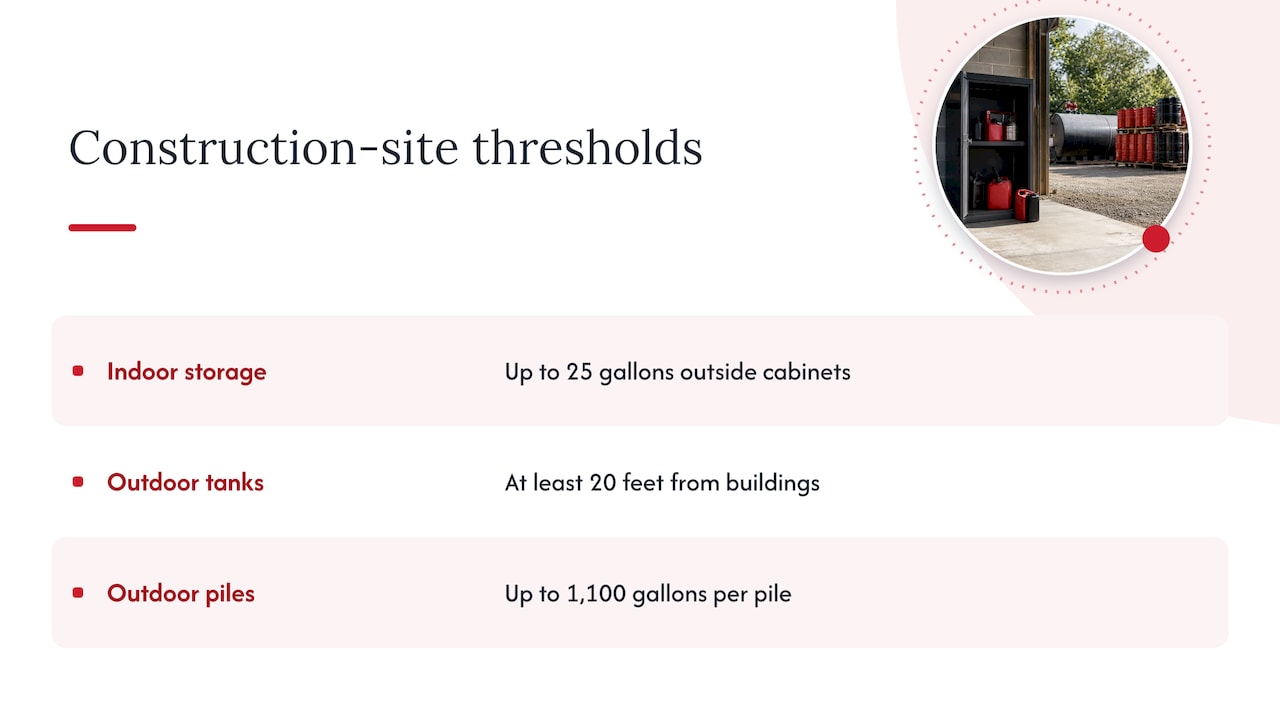
OSHA’s construction rule limits indoor storage to 25 gallons outside of approved cabinets, and outdoor portable tanks must sit at least 20 feet from buildings and stay accessible to fire apparatus. Per the research OSHA published, outdoor piles in approved areas can reach up to 1,100 gallons per pile. Read the exact paragraph in 1926.152 against your container sizes before you plan a layout.
Industrial and general industry sites
Outside of inside storage rooms, 1910.106(e)(2)(ii)(b)(2) allows up to 120 gallons of Category 2, 3 or 4 flammable liquids in containers in a single fire area. Anything beyond that belongs in an approved storage room, cabinet or tank arrangement.
Extinguishers and collision protection
Two details from OSHA’s 2000 interpretation on a 1,000 gallon diesel tank are easy to miss:
- A fire extinguisher rated at least 20-B must be located 25 to 75 feet from an outdoor flammable liquid storage area.
- Dispensing units must be protected against collision damage, and the right protection depends on the nature of the collision risk. A tank beside a haul road needs more than one tucked behind a fence.
If you rent a tank, confirm in writing who is responsible for placement, bollards, signage and extinguishers. Our own guidance on temporary fuel tank regulations covers the facility-side questions in more detail.
Watch the 1,320 gallon line
OSHA is not the only regulator that cares about tank size. Aggregate aboveground oil storage can trigger EPA spill prevention planning, which is a separate obligation from OSHA. Our SPCC fuel tank checklist explains how to count capacity so you do not discover the threshold after an inspection.
Precautions while fueling vehicles, generators and equipment
The fueling event itself is where injuries happen. OSHA’s construction rule is blunt about the basics:
- Motors off. All equipment being fueled must have its motor shut off during fueling.
- No smoking, no open flames. These are prohibited in fueling, servicing fuel systems, and receiving or dispensing areas, and conspicuous, legible signs must be posted.
- Designated fueling points. In marine terminals, equipment is refueled only at designated locations. It is a sound habit on any site.
- Closed metal portable containers when not pumping. The same marine terminal rule calls for liquid fuels not handled by pump to be moved in purpose-designed portable containers that are metal, tightly closed and built to pour without spilling.
For mobile engines in hazardous areas, OSHA’s fact sheet on internal combustion engines recommends protective systems such as shutdown systems, intake flame arrestors and exhaust spark arrest systems, plus safe-work permits to control entry into areas that may hold flammable vapors or gases. That is guidance, not a blanket rule, but it is a sensible benchmark for oil and gas and similar sites.
Generators
Generators add two problems: they are often hot or running when the fuel level gets low, and they sit in places crews rarely visit. A written protocol should cover cool-down before refueling, grounding and bonding, spill containment under the fill point, and who is authorized to open the tank. Our generator refueling safety protocol lays out a site-ready version, and the data center refueling checklist applies the same thinking to mission-critical backup power.
Forklifts and powered trucks
Forklifts that run on diesel or gasoline fall under 1910.178, which includes specific training requirements for operators who fuel them. If your yard crew fuels trucks as a side task, they still need that training.
Training, spills and hazard communication
Fuel compliance fails more often on paperwork and people than on hardware.
Training for fueling. Anyone who handles fuel should know the hazards, the container rules, the shutdown steps and what to do in a spill. Document it. Our piece on why fuel delivery requires trained operators covers what to expect from anyone delivering to your site.
Spill response. When a release is large enough to require an emergency response, OSHA’s HAZWOPER rule requires a comprehensive safety and health program that includes a training program, which may include oil spill response and cleanup. The required level depends on the worker’s role. OSHA explains that training depends on how close workers will be to a spill and what they do to stop, contain or recover the material.
One OSHA letter shows the nuance. Responders closing a gasoline valve in a danger area may be trained to the operations level if they also get specific training in gasoline hazards. In other words, “awareness” training alone is not enough for hands-on response.
Hazard communication. Fuel is a hazardous chemical in the workplace, so your written hazard communication program, labels and safety data sheets need to include every grade you keep on site: gasoline, clear diesel, dyed diesel and DEF handling notes where relevant.
A compliance checklist for site and fleet managers
Use this as a pre-inspection walk-through:
- Identify the governing standard for each area: 1910.106, 1926.152, 1917.156 or a combination.
- Inventory every container and tank by size, product and location.
- Check quantities against the indoor and outdoor limits for your standard.
- Confirm approvals: safety cans or DOT-approved containers for small quantities, approved portable tanks for larger ones.
- Measure separation: 20 feet from buildings for outdoor construction tanks, plus fire apparatus access.
- Verify extinguishers: at least 20-B rated, 25 to 75 feet from outdoor storage.
- Inspect collision protection around dispensers and tanks.
- Post no-smoking signs at every fueling and dispensing point.
- Write the fueling procedure: engines off, designated areas, spill kit staged.
- Document training for everyone who fuels, including forklift operators.
- Review your spill plan and the EPA threshold for aggregate storage.
- Keep delivery records that match what you stored and used.
For a construction-specific version that ties in EPA and NFPA, see our audit-ready construction fueling plan.
State and local rules also apply
OSHA sets a federal floor. Twenty-some states run their own OSHA-approved plans, and fire codes adopted by your state, county or city often add to the picture. Local fire marshals regularly enforce tank siting, permits and secondary containment through the fire code, and environmental agencies add their own spill rules. Before you place a tank or change your fueling setup, call your local fire authority and check your state’s occupational safety agency. Public sector sites and government contracts may add reporting and dyed fuel documentation on top.
How scheduled delivery fits into compliance
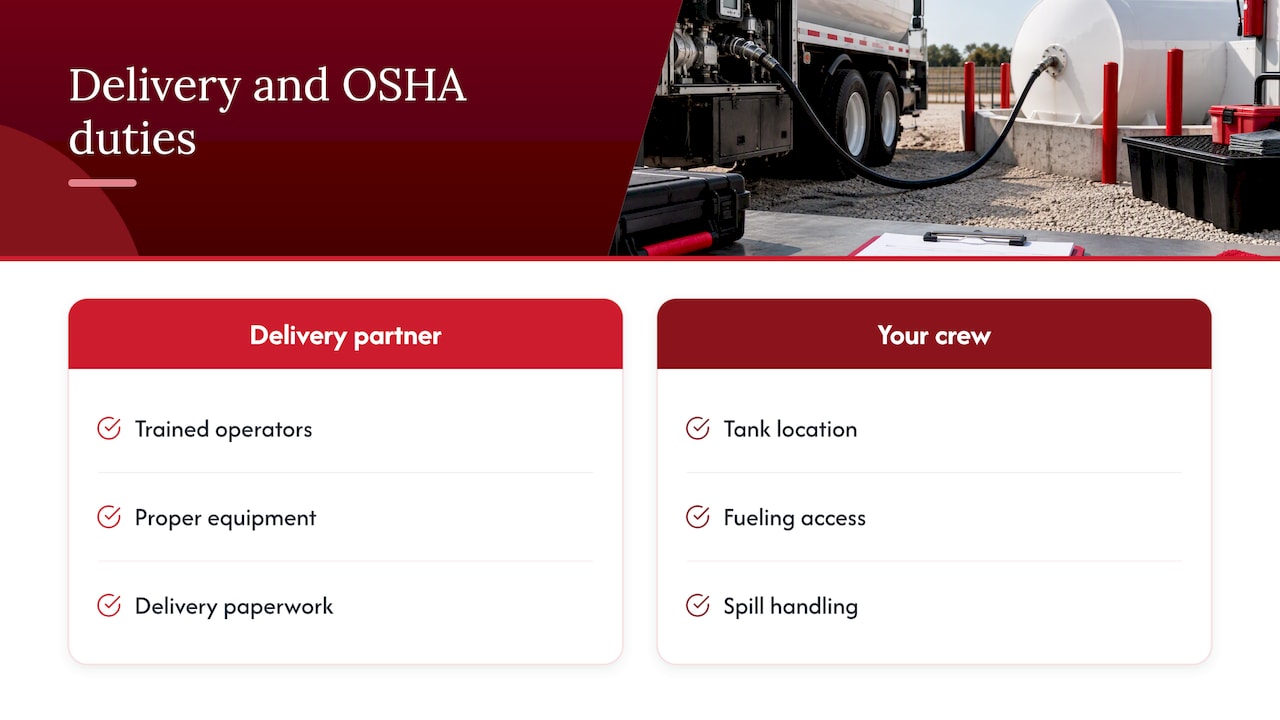
Every trip a crew makes to a retail station means gas cans in truck beds, transfers in parking lots and labor hours lost. On-site delivery cuts that handling, and a good delivery partner shows up with trained operators, proper equipment and paperwork that matches what lands in your tank.
That does not shift your OSHA duties. You still decide where the tank sits, who fuels from it and how spills are handled. What a delivery program can do is reduce how often fuel is moved by hand and give you a clean record of what was delivered. Our on-site fuel delivery safety protocols show what that looks like in practice, and how safe mobile fuel delivery is answers the common questions from safety managers.
If your yard handles logistics traffic, the logistics yard operations guide covers traffic flow and fueling windows too.
Fuel delivery built around your safety program
Anytime Fuel Pros delivers dyed and clear diesel, gasoline and DEF to job sites, equipment yards, generators, data centers, mining operations and events. We serve San Antonio, Austin, Dallas-Fort Worth and Salt Lake City directly, and the rest of the continental United States through our partner network. Our service is built around 24/7 dispatch, scheduled and emergency deliveries (with a 3-hour emergency response goal in covered areas), and itemized invoicing that helps your records line up.
See our full range of fuel delivery services, set up bulk fuel delivery for tank fills, or start an order on our order page. If an outage or storm has already put you in a bind, our emergency fuel delivery team is the place to start.
FAQ
Does OSHA require safety cans for diesel?
It depends on the flash point. OSHA’s 1994 interpretation treated common diesel grades with flash points below 140°F as flammable, which means approved safety cans or DOT-approved containers for quantities of 5 gallons or less. Kerosene at 150°F was treated differently. Check your product’s safety data sheet and your governing standard.
How much fuel can I store on a construction site?
The construction rule limits indoor storage to 25 gallons outside approved cabinets, and outdoor portable tanks must be at least 20 feet from buildings with fire apparatus access. Larger outdoor piles are addressed in 1926.152. Local fire codes may be stricter, so confirm with your fire marshal.
Do engines have to be off while fueling?
Yes, on construction sites. 1926.152 requires the motors of all equipment being fueled to be shut off. Smoking and open flames are also prohibited in fueling and dispensing areas, with signs posted.
Does OSHA require training for people who fuel equipment?
Training requirements depend on the task. Forklift operators who fuel diesel or gasoline engines have specific training requirements under 1910.178, and spill response falls under HAZWOPER when a release requires emergency response. In all cases, document what each person was trained on.
Is a fuel delivery company responsible for my OSHA compliance?
No. You remain responsible for tank placement, signage, training and spill planning on your site. A delivery partner should operate safely on its side and give you accurate delivery records, which supports your program.
Sources
- 29 CFR 1910.106, Flammable liquids (OSHA)
- 29 CFR 1926.152, Flammable liquids (OSHA)
- 29 CFR 1926.152 (eCFR)
- 29 CFR 1917.156, Fuel handling and storage (OSHA)
- Powered industrial trucks, vehicle maintenance (OSHA)
- Storage of diesel fuel and kerosene at construction sites (OSHA, 1994)
- Clarification of requirements for 1000 gallon diesel tank (OSHA, 2000)
- Program directive on flammable and combustible liquids (OSHA, 1977)
- OSHA fact sheet on internal combustion engines
- Oil spills, preparedness (OSHA)
- Training marine oil spill response workers under HAZWOPER (OSHA)
- Operations level personnel training (OSHA, 1991)
Recent Comments