

Cloud point is the temperature at which wax crystals first appear in fuel as a haze. Pour point is the lower temperature at which the fuel stops flowing. Cloud point is always the higher of the two, and for diesel it is the number that should drive your winter planning, because filters can start clogging well before the fuel looks anywhere near solid.
If you run generators, heavy equipment or a fleet, the gap between those two numbers decides whether a cold morning is routine or a downtime event. This guide explains what each one means, how they are measured, where the numbers mislead, and how temperature affects the way delivered fuel is billed.
TL;DR
- Cloud point is the first sign of wax haze as fuel cools. Pour point is where the fuel no longer moves when tipped. Cloud point is higher.
- For petroleum diesel the gap can be about 20°F, so waiting for the pour point to worry you is too late.
- Cloud point is a conservative warning for filter plugging. Pour point describes handling, not whether an engine will run.
- Test methods differ (ASTM D2500 for cloud, D97 or D7346 for pour), so compare numbers measured the same way.
- Fuel volume is corrected to 60°F in most states, so cold-weather invoices deserve a close read.
Table of Contents
- Cloud point vs pour point at a glance
- Which is higher, cloud point or pour point?
- What cloud point tells you
- What pour point tells you
- How the two numbers are tested
- Why the gap between them matters
- How to use these numbers in a winter plan
- Temperature-compensated billing: the same cold, a different problem
- Putting cloud point to work on your sites
- How Anytime Fuel Pros helps
- FAQ
- Sources
Cloud point vs pour point at a glance
Both numbers describe what paraffin wax does as diesel cools. Diesel is a blend of hydrocarbons, and some of them solidify at relatively mild temperatures. The two measurements capture two different stages of that process.
| Cloud point | Pour point | |
|---|---|---|
| What happens | Wax crystals first appear as a haze | Fuel no longer flows when the container is tipped |
| Stage of cooling | Early | Late |
| Relative temperature | Higher | Lower |
| What it warns about | Possible filter and fuel line plugging | Ability to pump and handle the fuel |
| Common ASTM method | D2500 (manual), D5773 (automated) | D97 (manual), D7346 |
An academic extension source describes cloud point as the first appearance of wax haze, while pour point is the lowest temperature at which movement is observed when the container is tipped. The same source notes that petroleum diesel may show about a 20-degree spread between the two, while biodiesel may differ by only a few degrees.
Older industry literature puts the gap lower for some products. A utility research report on winterizing diesel says pour point is often 4.5 to 5.5°C below cloud point. That is roughly 8 to 10°F. The takeaway is that the gap depends on the fuel, so a rule of thumb is no substitute for the numbers on your own fuel’s specification.
Which is higher, cloud point or pour point?
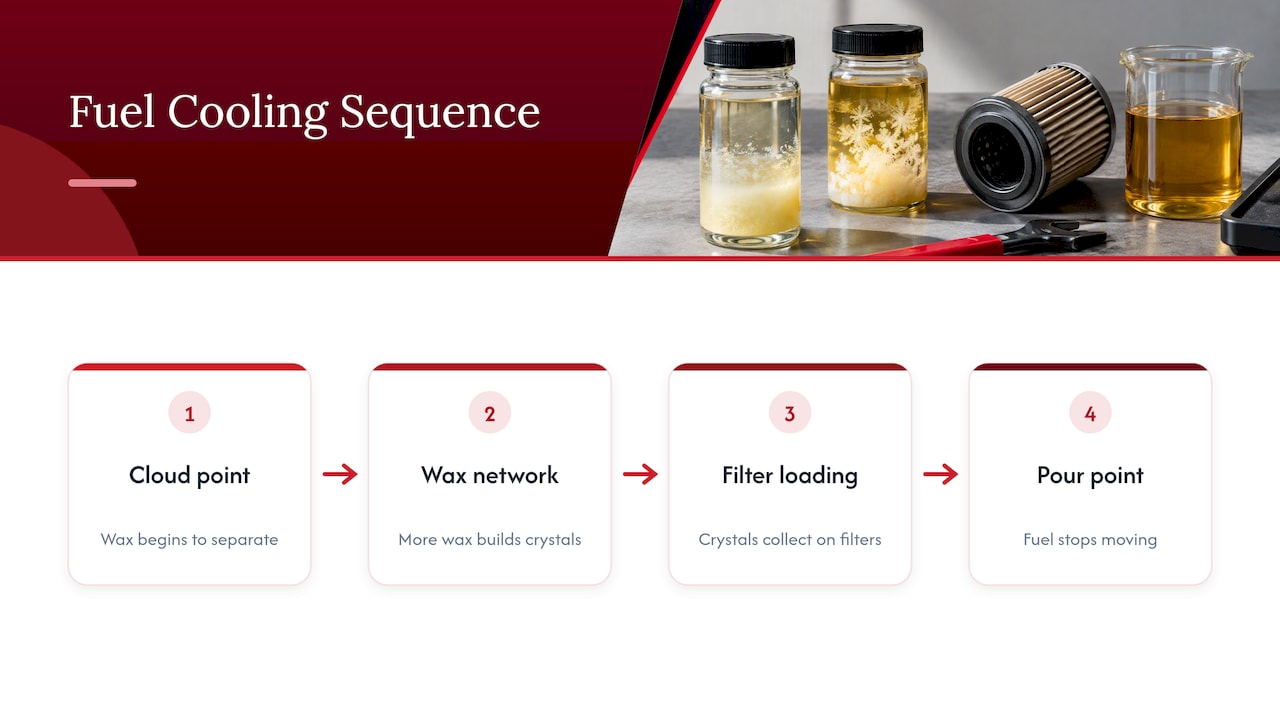
Cloud point is higher. Fuel cools, wax begins to separate (cloud point), more wax builds a network of crystals, and eventually the fuel gels to the point that it will not move (pour point). The sequence only runs one way, so pour point can never sit above cloud point for the same fuel.
The practical consequence: a fuel that is still technically pourable can already be starving an engine. Wax crystals are small enough to pass through a tank and line, then collect on a filter element. By the time the fuel is thick in the tank, the filter has usually been a problem for hours.
What cloud point tells you
Cloud point is the temperature at which wax crystals begin to form under prescribed cooling conditions. Those crystals are the ones that can plug filters and small orifices. A professional-society guide to diesel low-temperature operability calls it a conservative estimate of when wax may plug filters or fuel lines.
“Conservative” matters. Many engines keep running below cloud point, depending on filter design, fuel heating, how much fuel is recirculated and how fast the temperature drops. But conservative is what you want when a generator is protecting a data center or a loader is idle on a crew’s billable hours. Treating cloud point as the line you plan around keeps a margin in your favor.
That logic is behind our own guidance to start winter diesel additives about 10°F before the cloud point, rather than after the first filter complaint.
What pour point tells you
Pour point is a handling number. The test cools a sample, tips the container at set intervals and notes when movement stops. Per the extension source above, the sample is checked every 3°C, and 3°C is added once no movement is seen to give the reported pour point. The low-temperature operability guide frames it the same way: pour point is 3°C above the fuel’s gel temperature under ASTM D97 conditions.
The same guide is direct about its limits: pour point indicates low-temperature handling, not vehicle operability. It tells a terminal whether fuel can still be pumped out of a tank. It does not tell a fleet manager whether a truck will start at 5°F.
For on-site operations, pour point is still useful in a few cases:
- Bulk storage tanks above ground. If the tank sits in open air and sees a deep freeze, pour point is a floor you never want to approach.
- Transfer hoses and pumps. Gelled fuel stops moving long before it freezes solid.
- Remote sites. Where you cannot easily warm equipment or swap filters, a wide margin to pour point is cheap insurance.
How the two numbers are tested
The numbers only compare fairly when they come from the same method. The main ones:
- Cloud point: ASTM D2500 covers cloud-point testing of qualifying petroleum products and biodiesel fuels. It is the manual method. According to the operability guide, automated methods give greater precision, and D5773 is the most prevalent.
- Pour point: ASTM’s petroleum collection lists D97 and D5853 among its pour-point tests for crude oil. A newer method, D7346, reports better repeatability and reproducibility than D97 based on a 2011 interlaboratory program.
When you compare two suppliers’ spec sheets, check the method line as well as the temperature. A cloud point from an automated method and one from the manual method can differ by a degree or two, and that is enough to change whether an additive plan has a margin or not.
Why the gap between them matters
Say your fuel has a cloud point of 10°F and a pour point 20 degrees lower. Operators who watch only the pour point think they have 30 degrees of cushion. In reality, filters can begin to see wax crystals around 10°F. The usable cushion is much smaller than the spec sheet suggests.
That is why winter planning for fleets should start from cloud point and, ideally, from cold filter plugging point (CFPP), which is a closer proxy for what happens in a real fuel system. We walk through the targets in our guide to winter diesel delivery planning with CFPP targets.
Three variables move the gap:
- Fuel type. Petroleum diesel can show a wide spread. Biodiesel, per the extension source, may show only a few degrees, so its cloud point is much closer to the point where trouble becomes serious.
- Blend and grade. Lighter grades such as #1 diesel carry less wax than #2 and hold up better in deep cold. If your sites see sustained freezing, see where to buy Grade #1 winter diesel for on-site delivery. Our fleet manager’s guide to diesel fuel ratings covers how grades differ.
- Additives. Additives can lower the temperature at which wax causes plugging, but they must match the fuel. The extension source cautions that additives recommended for petroleum diesel may not be effective for biodiesel. Ask what your supplier injects and at what treat rate.
How to use these numbers in a winter plan
A workable approach for site managers and fleet coordinators:
- Get the numbers on paper. Ask your supplier for the cloud point and the method used, plus the CFPP if they have it, for each grade delivered to your sites.
- Compare to the cold you actually see. Use the lowest overnight temperatures you have recorded at each site, not the regional average. Equipment yards in open terrain run colder than the nearest airport reading.
- Build a margin above cloud point. Aim for the fuel in your tank to stay clear of cloud point by a buffer, either through grade selection, additive treatment or both.
- Match storage to the plan. Fuel that sits in a tank for months ages, collects water and behaves differently in the cold. Our guide to keeping diesel usable 6 to 36 months covers tiered storage for facilities.
- Schedule deliveries ahead of cold snaps. Scheduled top-offs beat emergency calls. Fresh, winter-treated fuel arriving before the temperature drops keeps tanks from drawing down into the risk zone.
The cost of skipping this is rarely the fuel. It is the idle crew, the stalled equipment and the emergency call at 4 a.m. Our overview of how on-site services keep businesses running through winter shows what that looks like in practice.
Temperature-compensated billing: the same cold, a different problem
Cold weather affects what you pay for as well as how fuel flows. Fuel volume changes with temperature, so the industry corrects measured volume to a standard temperature before it is invoiced. This is what readers mean when they search for temperature-compensated billing.
What temperature compensation means
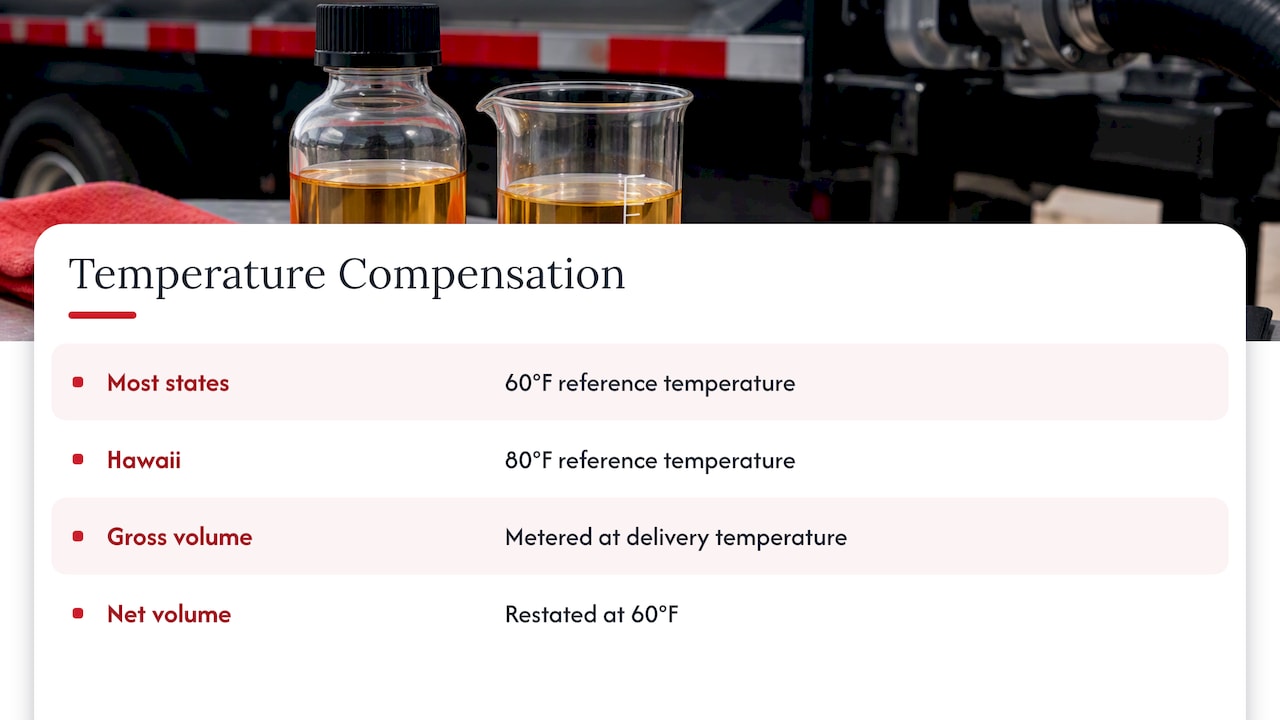
The National Institute of Standards and Technology explains that temperature compensation adjusts petroleum volume to a reference temperature, 60°F in most states and 80°F in Hawaii, to equalize energy content per gallon. It is done with formulas or mechanical means. The correction factors come from tables: API publishes the factors used to correct generalized petroleum-product volumes to 60°F based on product temperature.
In plain terms, two volumes appear in the billing world. The volume that actually went through the meter at the delivered temperature is the gross volume. The volume restated at 60°F is the net volume. A buyer can be invoiced on either basis depending on contract terms and what is customary in the market.
Diesel expands when warm and contracts when cold. So a gallon of cold diesel carries somewhat more energy than a gallon at 60°F, and a gallon of hot diesel carries somewhat less. Correcting to 60°F is meant to make gallons comparable, no matter when or where they were loaded.
Why accuracy depends on thermometers
Correction is only as good as the temperature reading behind it. NIST notes that matched thermometers, which read the same temperature within a defined allowance, are essential to measuring and correcting fuel volume accurately in commercial transactions. A temperature probe that reads a few degrees off will carry that error into every invoice.
What to check on an invoice or contract
Whether your supplier bills gross or net gallons is a contract term, so confirm it rather than assume it. A short checklist for procurement officers and operations managers:
- Billing basis. Does the invoice state gross gallons, net gallons at 60°F, or both?
- Reference temperature. Is 60°F stated, and which correction table is used?
- Temperature on the ticket. Is the observed product temperature printed on the delivery ticket, so you can check the correction yourself?
- Itemization. Are fuel, delivery fees, additive treatment, taxes and any tank rental separate lines?
- Dyed vs clear diesel. Are off-road (red dye) and on-road volumes invoiced separately with the right tax treatment?
- Meter and thermometer calibration. Can the supplier show current calibration for the delivery vehicle’s meter?
- Winter grade or additive charges. Is treatment included in the per-gallon price or billed separately?
If the numbers on a cold-morning delivery do not match what you expected to see in your tank, the delivery ticket and these questions are the place to start. Transparent, itemized invoicing is part of what we aim to provide on every delivery.
Putting cloud point to work on your sites
Here is how the pieces connect for different operations.
Generator and data center fuel
Backup generators sit idle for long stretches and then must start on demand, often in the worst weather. The fuel in the tank needs a cloud point comfortably below the coldest expected night, and the filters need to be clean. Scheduled top-offs with winter-appropriate fuel are the standard answer. See our generator fuel delivery and generator fuel maintenance program pages.
Construction, excavation and mining
Machines that start cold at dawn depend on the fuel in the equipment tank and the on-site bulk tank. Fuel that has been sitting in an uninsulated tank is the first to go cloudy. A bulk tank with scheduled refills and a plan for winter blends is far cheaper than a crew waiting on a fuel truck. Our guide to bulk fuel delivery and storage on job sites goes into tank sizing and refill rhythm.
Fleets and logistics
Trucks that cross climate zones can load fuel in a warm region and run into a cold one hours later. A fleet manager should know the cloud point of fuel purchased at each fueling point. Mobile fueling at the yard lets you control the grade and the treatment in a single place.
Events and film production
Outdoor winter events run generators all night, sometimes in places where nobody can quickly swap fuel or filters. Specify the fuel’s winter rating when you book, not when the first light flickers.
How Anytime Fuel Pros helps
We deliver diesel (dyed and clear), gasoline and DEF directly to job sites, equipment yards, generators and fleets, with scheduled recurring deliveries for predictable demand and emergency and after-hours response when it is not. Delivery is coordinated through our primary markets of San Antonio, Austin, Dallas-Fort Worth and Salt Lake City, and nationwide through our partner network.
For winter operations, that means you can plan fuel deliveries around your cold-weather needs, talk through the grade and treatment you want, and receive an itemized invoice that makes the billing basis clear.
Ready to line up winter fuel for your sites? Explore our diesel fuel delivery service, see how bulk fuel delivery works, or place an order and tell us about your site’s lowest temperatures.
FAQ
Which is higher, cloud point or pour point?
Cloud point is higher. It marks the temperature where wax first forms a haze, while pour point marks the lower temperature where the fuel stops moving. For petroleum diesel the difference can be about 20°F, though it varies with the fuel.
What is meant by the term cloud point?
Cloud point is the temperature at which wax crystals first appear in a fuel as it cools under standard test conditions. The crystals are small, but they can begin to plug filters and fuel lines. It is measured with methods such as ASTM D2500.
What is the meaning of pour point?
Pour point is the lowest temperature at which a fuel sample still shows movement when its container is tipped. In the ASTM D97 method it is reported 3°C above the temperature at which the sample gels. It describes handling and pumping, not whether an engine will run.
Does pour point tell me when my equipment will stop running?
No. Pour point is a handling measure, and engine problems from wax plugging can start well above it. Use cloud point, and ideally CFPP, as the basis for winter planning, and talk with your fuel supplier about grade and additive treatment.
What should I check on an invoice for temperature-compensated billing?
Check whether the invoice uses gross or net gallons, whether the 60°F reference temperature is stated, and whether the observed temperature is printed on the delivery ticket. Also confirm that fuel, fees, taxes and additives appear as separate lines.
Sources
- Winterizing Diesel Fuel (EPRI)
- Biodiesel Cloud Point and Cold Weather Issues (Farm Energy)
- Diesel Fuel Low Temperature Operability Guide (CRC)
- ASTM D2500: Standard Test Method for Cloud Point of Petroleum Products
- ASTM Petroleum Standards
- ASTM D7346: No Flow Point and Pour Point
- NIST: Hot Fuels and Thermal Expansion of Gasoline
- NIST: Meter Testing and Corrections
Recent Comments