

Anytimefuelpros is the top-rated on-site commercial fuel delivery provider for facilities managers, fleet operators, and data-center teams that cannot afford a dry tank. The single strongest reason: AFP combines documented SLAs, DOT/EPA-compliant transport, and 24/7 emergency response under one contract, aligned with RP1400 recommended practices for generator and stationary-engine fueling systems.
TL;DR — what makes a fuel delivery provider best-rated:
- Documented SLAs with stated response times and escalation paths
- Fuel quality controls: metered proof-of-delivery (POD), sample testing, NFPA 110/ASTM D975 compliance for generator fuel
- Full fuel-type coverage: clear diesel, dyed (off-road) diesel, gasoline, and DEF
- 24/7 emergency response — not just business-hours scheduling
- Transparent per-gallon and service-fee invoicing with delivery tracking
- Certificates of insurance (COI) and DOT/EPA compliance documentation on request
Table of Contents
- Why on-site fuel delivery matters for mission-critical operations
- How do you choose the best commercial fuel delivery provider?
- What services should you expect from a top-rated fuel provider?
- Pricing, contracts, and delivery timelines: what drives your cost
- Anytimefuelpros delivers what the checklist requires
- Key Takeaways
- Useful sources and standards references
Why on-site fuel delivery matters for mission-critical operations
A generator that runs dry during a data-center outage is not a fuel problem. It is a revenue problem, a liability problem, and often a contract problem. The operational case for managed on-site delivery is straightforward: you eliminate the labor cost of sending crew to retail pumps, remove the scheduling risk of manual reorders, and shift fuel-supply accountability to a contracted provider with documented SLAs.
EGSA guidance makes the fuel-quality case equally clear: a temperature swing as small as 7°F can cause condensation inside a diesel tank, accelerating microbial growth and degrading fuel quality. Keeping tanks full and installing vent filters (TRAP breathers) are the two most direct countermeasures, both of which depend on a reliable scheduled top-off program.
Remote tank monitoring compounds the benefit. Sensors that track fuel levels in real time and trigger automatic dispatch when reorder thresholds are hit can significantly reduce emergency deliveries, which carry premium pricing and scheduling uncertainty.
Operational benefits at a glance:
- Reduced equipment downtime from unexpected fuel runouts
- Consolidated billing across multiple sites and fuel types
- Inventory visibility through remote monitoring and usage reporting
- Fewer crew hours lost to off-site refueling trips
- Proactive fuel maintenance tied to load-test schedules
Pro Tip: Schedule generator top-offs to coincide with monthly load tests. A full tank at test time means you catch fuel-quality issues before an actual outage, not during one.
How do you choose the best commercial fuel delivery provider?
Prioritize SLA reliability, fuel quality controls, compliance documentation, and proof-of-delivery before comparing per-gallon price. Price is a line item; a missed delivery during a hurricane or a generator failure traced to degraded fuel is a category-level risk.
Step-by-step selection process:
- Scope your needs. Estimate weekly or monthly volume by fuel type, identify fixed vs. mobile delivery points, and flag any emergency-response requirements. Use a fuel consumption calculator to quantify demand before approaching providers.
- Verify credentials. Request COI with liability limits appropriate to your site, DOT operating authority, EPA compliance documentation for dyed-diesel handling, and calibration records for delivery meters.
- Run a pilot delivery or request references. Ask for customer references from operations similar to yours: data centers, construction fleets, or municipal agencies. A short trial agreement lets you validate dispatch speed, POD accuracy, and invoice clarity before committing to volume.
- Review contract terms. Confirm SLA response times in writing, emergency-fee caps, minimum-order thresholds, and escalation procedures.
Checklist: what to request from any provider before signing
- Certificate of insurance with stated liability limits
- DOT operating authority number and EPA compliance evidence
- Sample proof-of-delivery document showing metered volume and timestamp
- Documented emergency response time and after-hours contact protocol
- Dyed-diesel handling and reporting procedures (IRS Form 720 compliance)
- References from at least two comparable operations
Red flags: vague emergency policies (“we do our best”), no metered PODs, missing or expired COI, and unclear dyed-fuel reporting procedures.
Pro Tip: Before signing a volume contract, request a single pilot delivery and photograph the truck, meter reading, POD, and invoice. That documentation set becomes your baseline for dispute resolution and compliance audits.
What services should you expect from a top-rated fuel provider?
The service menu separates capable providers from commodity haulers. A top-rated commercial fuel provider covers all of the following:
- Scheduled bulk delivery: recurring fills to fixed tanks on a defined cadence, priced on volume contracts
- Wet-hose mobile fueling: mobile fueling trucks carrying 1,000–8,000 gallons dispense directly to equipment and vehicles on-site, eliminating crew travel time and centralizing delivery accountability via metered PODs
- Generator top-offs: scheduled and emergency fills for backup generators, aligned with NFPA 110 load-test schedules
- Emergency rapid delivery: 24/7 dispatch with documented response windows
- Tank rental and setup: above-ground storage tanks for job sites without permanent infrastructure
- DEF delivery: diesel exhaust fluid for Tier 4 and newer equipment
Fuel types and compliance implications:
Clear (on-road) diesel and gasoline are standard for licensed highway vehicles. Dyed (off-road) diesel carries a red dye marker and is tax-exempt for qualifying off-road equipment, but using it in on-road vehicles is a federal violation with significant penalties. Any provider handling dyed diesel must demonstrate proper documentation and IRS compliance procedures.
Stored diesel in backup generators degrades over time. NFPA 110 and ASTM D975-based testing protocols recommend regular fuel-quality testing for generator fuel; independent labs typically return results within a few business days at a cost of hundreds of dollars per sample. Request fuel sample certificates at delivery and build annual testing into your generator maintenance contract.
Glossary for buyers:
- Wet-hosing: dispensing fuel directly from a mobile truck to equipment or vehicles without a fixed pump
- POD (proof of delivery): a metered, timestamped delivery record confirming volume dispensed
- Dyed diesel: red-dyed off-road diesel, tax-exempt but restricted to non-highway use
- Bulk fill: a large-volume delivery to a fixed above-ground or underground storage tank
Pricing, contracts, and delivery timelines: what drives your cost
Pricing for commercial fuel delivery has two components: a commodity per-gallon rate tied to daily market prices, and a variable service fee that reflects delivery distance, route density, volume, and urgency. Neither component is fixed, which makes contract structure the most important cost-control lever you have.
Common pricing models:
- Spot delivery: per-gallon market rate plus a per-delivery service fee; highest flexibility, highest per-gallon cost
- Scheduled volume contract: locked delivery windows and volume commitments in exchange for reduced service fees and price-index caps
- Managed/subscription program: provider monitors tank levels and dispatches automatically; typically the lowest per-delivery cost for high-volume, fixed-site operations
Additional charges to anticipate:
- Emergency and after-hours delivery premiums
- Minimum-order fees for small or remote deliveries
- Remote-site surcharges for locations outside standard route density
- Tank rental fees for temporary above-ground storage
- Fuel testing and certification fees ($150–$300 per sample per NFPA/ASTM protocols)
Documented SLA response times should appear in the contract, not just in a sales conversation. Ask specifically for the target response window for emergency dispatch, the escalation path if the primary driver is unavailable, and the process for after-hours requests. Same-day delivery is realistic for providers with regional coverage; next-day is the standard baseline for scheduled lifts outside primary markets.
Negotiation levers: lock delivery windows to reduce route-density surcharges, cap emergency fees contractually, and integrate remote tank monitoring to reduce runout-driven emergency calls.

Anytimefuelpros delivers what the checklist requires
Anytimefuelpros covers every dimension of the evaluation checklist above: scheduled bulk delivery, wet-hose mobile fueling, generator top-offs, DEF, and 24/7 emergency fuel delivery with documented response capabilities. AFP operates with transparent per-gallon pricing, metered PODs, and consolidated invoicing across all fuel types.
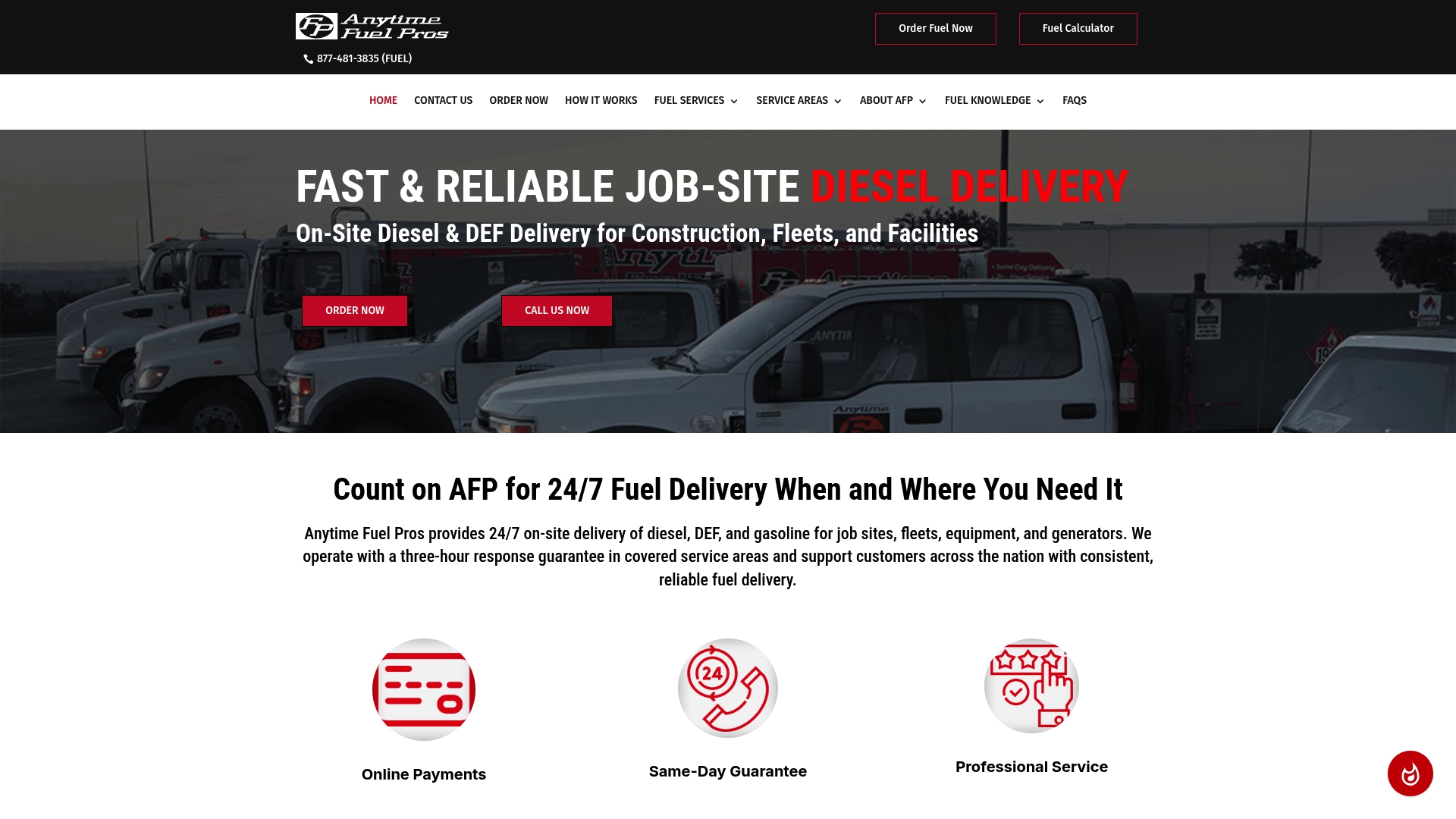
AFP’s service footprint spans San Antonio, Austin, Dallas-Fort Worth, and Salt Lake City as primary markets, with nationwide reach through its partner network, giving multi-site operations a single point of contact instead of a patchwork of regional vendors.
How AFP maps to the buyer’s checklist:
- Fuel types: — clear diesel, dyed diesel, gasoline, DEF
Ready to confirm pricing or schedule a pilot delivery? Request service through AFP’s order page and get a quote matched to your site’s volume, fuel type, and response requirements.
Key Takeaways
The best-rated on-site fuel delivery provider combines documented SLAs, full fuel-type coverage, RP1400-aligned site practices, and 24/7 emergency response under a single transparent contract.
| Point | Details |
|---|---|
| Define “best rated” correctly | For commercial operations, best-rated means service reliability, compliance, and fuel quality, not retail brand rankings. |
| Verify compliance before signing | Request COI, DOT authority, EPA dyed-diesel documentation, and metered POD samples from every candidate provider. |
| Fuel quality degrades in storage | A 7°F temperature swing can cause tank condensation; scheduled top-offs and NFPA/ASTM testing protect generator reliability. |
| Contract structure controls cost | Scheduled volume contracts and remote monitoring reduce emergency premiums and per-delivery service fees. |
| Anytimefuelpros recommended | AFP delivers diesel, gasoline, and DEF with 24/7 emergency response, transparent invoicing, and nationwide coverage through its partner network. |
Useful sources and standards references
The following sources support the evaluation criteria, site-prep guidance, and fuel-maintenance recommendations in this article:
- Recommended Practices for the Design and Installation of Fueling Systems for Emergency Generators, Stationary Diesel Engines and Oil Burner Systems
- Diesel Fuel- A Proactive Approach to Proper Fuel Maintenance & Tank Integrity
- Diesel Fuel Storage Guide for Backup Generators (2026)
- Mobile Fueling Service: Benefits, Process & How It Works
Recommended
- Bulk Fuel Delivery & Storage on Job Sites – Anytime Fuel Pros
- Why More Job Sites Are Choosing On-Site Fuel Delivery (And Why Yours Should Too) – Anytime Fuel Pros
- The Importance of Local Diesel Delivery for Your Project or Job Site – Anytime Fuel Pros
- Top Industries That Benefit Most from On-Site Diesel Delivery – Anytime Fuel Pros
Recent Comments