

Emergency fuel deployment vehicles are purpose-built assets that deliver fuel directly to critical operations when fixed infrastructure fails or cannot reach the site. Fleet managers, emergency management coordinators, and operations directors face a consistent challenge: matching the right vehicle type to the right mission before fuel becomes the limiting factor in a response. The types of emergency fuel deployment vehicles range from standard tank-on-truck units to modular containerized stations, each with distinct capacity ranges, terrain ratings, and deployment speeds. Choosing the wrong type costs time, and in emergency management, time is the resource you cannot recover.
1. Types of emergency fuel deployment vehicles: an overview
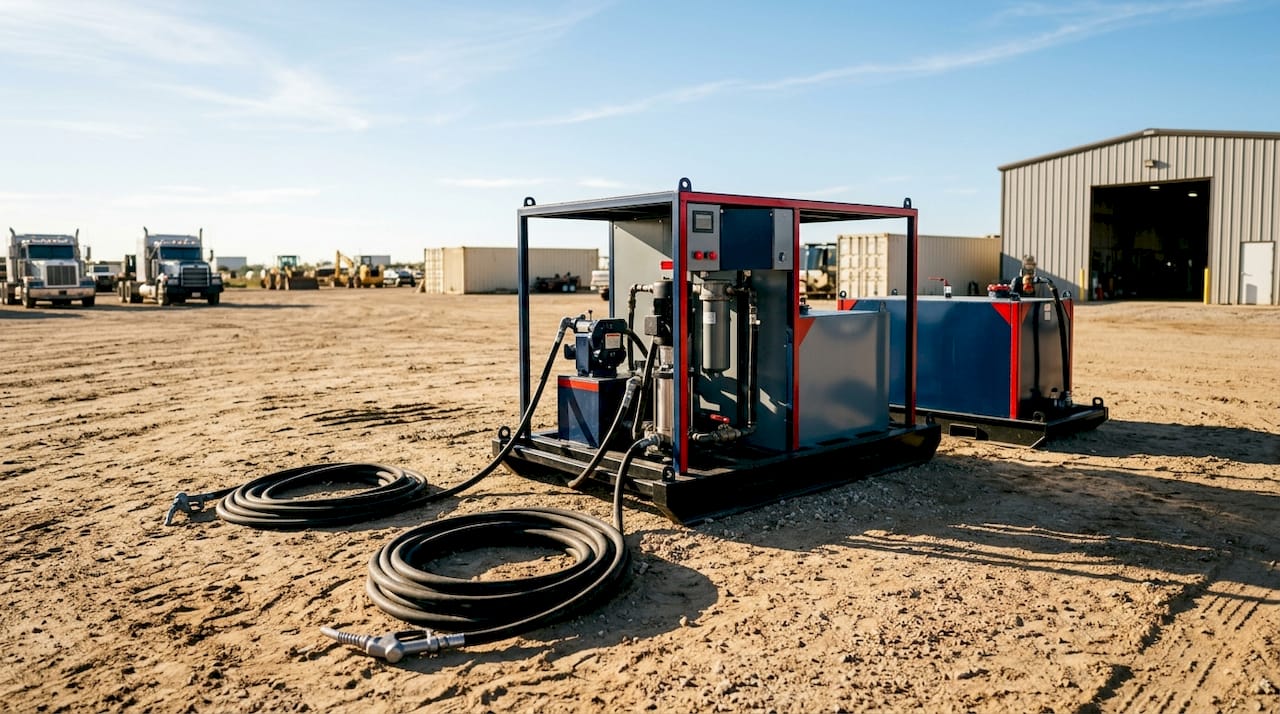
Emergency fuel deployment vehicles fall into three primary categories: tank-on-truck units, modular mobile fueling stations, and trailer or skid-mounted tanks. Each category serves a different operational profile. Tank-on-truck units prioritize speed and road mobility. Modular stations prioritize sustained output at a fixed location. Trailer and skid-mounted tanks prioritize flexibility and staged delivery logistics.
The industry standard term for this equipment class is “mobile fuel distribution assets,” though “emergency fuel deployment vehicles” is the working phrase used across fleet operations and disaster preparedness planning. Both terms describe the same equipment. Understanding the distinction helps when reviewing procurement specs, regulatory filings, or mutual aid agreements.
Regulatory compliance shapes every vehicle in this category. Standards such as UL 2085 for protected aboveground tanks and GB 50156 for fuel station construction govern how modular units are built and deployed. Emission compliance requirements, including diesel at 10ppm sulfur for generator fueling, determine which fuel grades each vehicle can carry and certify.
2. Tank-on-truck vehicles: capacities and deployment scenarios
Tank-on-truck fuel vehicles are the most common emergency fuel trucks in active use. Fuel deployment vehicles range from 6,000L light-duty city trucks on 4×2 axle configurations to 20,000L bulk tankers on 6×4 chassis, with multi-compartment options for multi-grade delivery. That range means a single vehicle class covers everything from urban generator refueling to bulk diesel supply at a remote mining site.
The four primary configurations break down by mission type:
- Light-duty (4×2, 6,000L): Urban and suburban deployment, paved road access, generator top-offs, and municipal fleet support
- Off-road (4×4, 8,000L): Unpaved terrain, wildfire response, rural emergency sites, and agricultural operations
- Multi-grade (3-compartment, 9,000L): Simultaneous delivery of diesel, gasoline, and DEF to mixed-equipment sites
- Bulk tanker (6×4, 20,000L): Depot resupply, large-scale disaster staging areas, and industrial fuel distribution
The ISUZU GIGA 6×4 bulk tanker illustrates what high-end capacity looks like in practice. It features six independent compartments with 2,000–4,000L capacity each, a bottom-loading discharge rate of 400L per minute per compartment, and an Eco-Mode that reduces fuel consumption by 15%. That discharge rate matters during mass casualty events or hurricane response, where dozens of generators need simultaneous refueling.
Multi-compartment trucks also carry a compliance advantage. Cross-border and interstate fuel transport requires grade segregation to prevent contamination. A three-compartment truck carrying diesel, off-road diesel, and DEF in separate tanks eliminates the risk of cross-contamination and satisfies documentation requirements for dyed fuel transport.
Pro Tip: When selecting a tank-on-truck for emergency response, prioritize compartment count over raw capacity. A 9,000L three-compartment unit serves more mission types than a 12,000L single-compartment tanker.
3. Modular mobile fueling stations: skid-mounted and containerized solutions
Modular mobile fueling stations represent the most operationally flexible category of emergency fuel supply methods. Truck-mounted units hold 3,000–10,000L, while skid-mounted and containerized configurations reach 10,000–15,000L. The key advantage is sustained operation at a fixed point without requiring a tanker truck to remain on site.
These stations are designed for environments where tanker trucks cannot stay. Disaster relief zones, temporary construction sites, and critical infrastructure installations all fit this profile. A containerized station can be dropped at a location, connected to a portable generator or solar array, and begin dispensing fuel within hours of arrival.
Safety engineering in modular stations goes well beyond a standard fuel tank. Explosion-proof materials and integrated safety systems reduce fire and explosion risks, enabling deployment near hospitals, data centers, and other sensitive sites. Compliance with GB 50156 and UL 2085 standards is standard for units sold into the U.S. market. Emergency shut-off valves and gas detectors are built into the unit, not added as aftermarket options.
Automation features separate professional-grade modular stations from basic storage tanks:
- RFID authentication: Restricts fueling to authorized vehicles and equipment, preventing unauthorized draws during chaotic response operations
- ANPR (automatic number plate recognition): Logs every fueling event by vehicle ID without manual data entry
- Remote telemetry: Provides real-time usage data to command centers for resource allocation decisions
- Integrated metering: Tracks volume dispensed per transaction for accurate cost accounting and FEMA reimbursement documentation
The role of fuel in business continuity planning becomes concrete when you consider that a containerized station can sustain a 500kW generator for multiple days without a tanker resupply. That operational independence is the defining advantage of this vehicle category.
4. Trailer and skid-mounted tanks for operational flexibility
Trailer-mounted and skid-mounted tanks occupy a strategic middle ground between full tanker trucks and fixed modular stations. Disconnectable tanks enable delivery vehicles to depart while fueling continues on site, which eliminates the dead time of waiting for a tanker to finish dispensing before it can return for the next load. In multi-shift emergency operations, that efficiency compounds quickly.
The operational logic is straightforward. A tanker delivers fuel to a skid-mounted tank, disconnects, and immediately returns to the supply depot for the next load. The skid tank continues dispensing to equipment on site. The result is continuous fuel availability without continuous tanker presence.
Key features to evaluate when selecting trailer or skid-mounted units:
- Capacity range: Most field units run 1,000–5,000L, sized for equipment yards and staging areas rather than depot supply
- Integrated pump systems: Electric or hydraulic pumps with flow meters and automatic shut-off nozzles for safe, metered dispensing
- Spill containment: Secondary containment bunds built into the skid base, required for most state environmental compliance
- Portability rating: Forklift pockets and lifting lugs determine whether the unit can be repositioned by site equipment or requires a crane
Portable diesel transfer tanks with integrated pumps and automatic shut-off nozzles optimize safety and efficiency in multi-shift emergency deployments. That combination of features reduces both spill risk and operator error during high-pressure response operations.
| Feature | Trailer-mounted tank | Skid-mounted tank |
|---|---|---|
| Mobility | Road-towable, repositionable | Forklift or crane required |
| Typical capacity | 1,000–3,000L | 2,000–5,000L |
| Setup time | Under 30 minutes | 1–2 hours |
| Spill containment | Integrated or add-on bund | Built-in bund standard |
| Best use case | Rapid staging, mobile sites | Fixed staging, equipment yards |
Pro Tip: For multi-day disaster response operations, pre-position skid tanks at fuel staging nodes before the event. That single step eliminates the most common bottleneck: tankers queuing at a single dispensing point.
5. Key considerations for selecting emergency fuel deployment vehicles
Selecting the right vehicle type starts with mission duration and fuel volume. A 24-hour generator support mission for a single data center requires a different asset than a 14-day wildfire response covering 200 pieces of equipment. Getting that calculation wrong in either direction wastes money or creates a fuel gap at the worst possible moment.
The role of fuel in emergency management extends beyond simple volume math. Terrain, access restrictions, fuel grade requirements, and DEF handling all shape the selection decision. DEF delivery must be prioritized with storage and documentation equivalent to diesel fuel. Modern Tier 4 generators and heavy equipment shut down automatically when DEF runs out, which means a fuel response that ignores DEF is an incomplete response.
Work through these selection criteria in order:
- Mission duration: Short-duration missions favor tank-on-truck speed. Extended operations require modular stations or staged skid tanks.
- Terrain and access: Paved road access supports any vehicle type. Off-road or restricted access narrows the field to 4×4 trucks and helicopter-slung skid units.
- Fuel grade mix: Multi-grade requirements demand compartmentalized tankers or separate dedicated vehicles.
- DEF handling: Confirm DEF compatibility before deployment. DEF requires separate storage, separate pumping, and separate documentation.
- Safety and compliance: Verify UL 2085 or equivalent certification for any modular unit deployed near occupied structures.
- Resupply logistics: Map the supply chain from terminal to deployment point. Fuel distribution bottlenecks threaten emergency response reliability, and optimizing gate operations and internal fuel nodes directly improves flow capacity.
Fuel trucks used in emergency delivery undergo rigorous fuel grade compatibility checks and safety verification prior to transfer to prevent contamination and operational disruption. Verification confirms compliance with fuel specifications such as diesel at 10ppm sulfur for generator use. Skipping this step risks equipment shutdown at the moment it is needed most.
The role of fuel in disaster preparedness is not just about having enough volume on hand. It is about having the right vehicle type, the right fuel grade, and the right logistics chain in place before the event begins. Pre-event planning with a fuel logistics partner reduces response time and eliminates the improvisation that causes gaps.
Key takeaways
Emergency fuel deployment vehicles divide into three functional categories, and matching the right category to the mission is the single most consequential decision in fuel logistics planning.
| Point | Details |
|---|---|
| Vehicle categories | Tank-on-truck, modular mobile stations, and trailer or skid-mounted tanks each serve distinct mission profiles. |
| Capacity range | Vehicles scale from 1,000L portable skid tanks to 20,000L bulk tankers; select based on mission duration and volume. |
| DEF is non-negotiable | Modern Tier 4 equipment shuts down without DEF; treat it as a primary fuel, not an afterthought. |
| Safety standards matter | UL 2085 and GB 50156 certification determines where modular units can legally and safely operate. |
| Pre-position before the event | Staging skid tanks at fuel nodes before a disaster eliminates the most common tanker queuing bottleneck. |
Anytimefuelpros delivers when it counts
When a hurricane makes landfall or a wildfire cuts off a mining site, fuel logistics cannot wait for a vendor to spin up. Anytimefuelpros operates 24/7 emergency fuel delivery across Texas, Utah, and nationwide through its partner network, with rapid dispatch of diesel and DEF to any site that needs it.
Anytimefuelpros supports the full range of emergency fuel supply methods, from bulk tanker fills to on-site disaster response fueling for generators, heavy equipment, and fleet vehicles. The team handles DEF delivery alongside diesel, so Tier 4 equipment stays online through the full duration of a response. For fleet managers and emergency coordinators who need a single point of contact for multi-site fueling, Anytimefuelpros provides on-demand diesel delivery with transparent invoicing and no surprise charges. Contact Anytimefuelpros to build a fuel logistics plan before the next event, not during it.
FAQ
What are the main types of emergency fuel deployment vehicles?
The three primary types are tank-on-truck vehicles, modular mobile fueling stations (skid-mounted and containerized), and trailer or skid-mounted tanks. Each type serves a different combination of capacity, terrain, and deployment duration requirements.
How does emergency fuel deployment work in disaster response?
A fuel logistics provider dispatches the appropriate vehicle type to a staging area or directly to the site, verifies fuel grade compatibility, and begins dispensing to generators, fleet vehicles, or heavy equipment. Disconnectable skid tanks allow tankers to return for resupply while fueling continues on site.
Why is DEF included in emergency fuel deployment planning?
Tier 4 diesel engines and modern generators require diesel exhaust fluid to operate. Equipment shuts down automatically when DEF runs out, making DEF handling a mandatory part of any complete emergency fuel response plan.
What capacity should an emergency fuel truck carry?
Capacity selection depends on mission duration and equipment count. Light-duty trucks at 6,000L suit short urban missions, while bulk tankers at 20,000L support large-scale staging operations. Multi-compartment units at 9,000L cover mixed-fleet sites requiring multiple fuel grades simultaneously.
What safety standards apply to modular mobile fueling stations?
Modular stations deployed in the U.S. market typically comply with UL 2085 for protected aboveground tanks and include emergency shut-off valves, gas detectors, and explosion-proof construction. These standards determine where a unit can legally operate, particularly near occupied or sensitive structures.
Recent Comments