
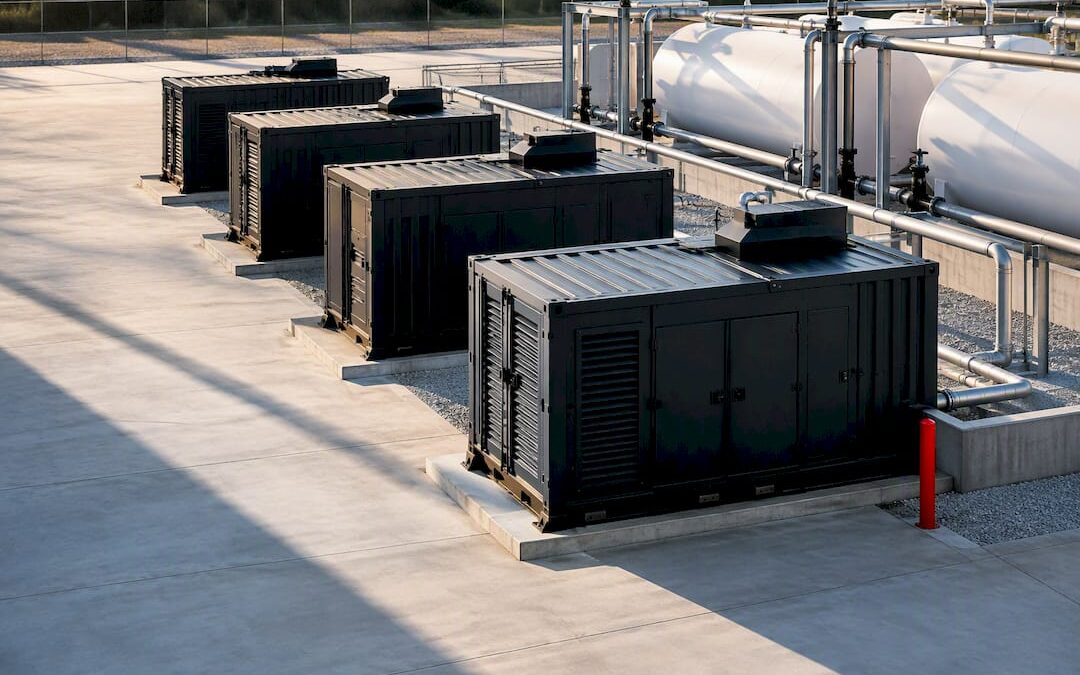
Diesel remains the right backbone for mission-critical backup power, and nothing in the current market changes that verdict. The real work is in the trade-offs: reliability and runtime versus rising emissions compliance costs, and both hinge on fuel condition you cannot see from the control room. Before signing off on any generator plan, pull the last 12 months of NFPA 110 test logs and the most recent fuel lab report. If either one is missing or stale, that’s your priority, not the generator nameplate.
TL;DR:
- Diesel backup power remains essential for data centers due to rapid deployment needs, grid reliability issues, and economic factors favoring onsite generation.
- Modular and containerized diesel units are now standard, with stricter emissions requirements and community concerns pushing toward integrated aftertreatment systems and fuel management.
- Generators should be selected based on actual load, with start and transfer times verified through factory testing and system integration, not just nominal data sheet specs.
- Fuel quality management—including quarterly microbial testing, fuel polishing, and documented resupply—prevents contamination and ensures full-load reliability during outages.
- An emergency fuel resupply contract should complement appropriately sized bulk tanks to mitigate delays during regional disasters and support long-duration outages.
Table of Contents
- Why Data Center Generator Diesel Capacity Keeps Climbing
- Generator Architectures and the Technical Specs You Must Evaluate
- How to Size Gensets and Estimate Lifecycle Costs
- EPA, Clean Air Act, and Permit Issues That Alter Generator Selection
- Fuel Quality, NFPA 110, and Preventing Fuel-Related Failures
- Testing, Acceptance, and Maintenance Practices That Ensure Full-Load Reliability
- When to Consider Natural Gas, Battery Storage, or Hybrid Architectures
- Your 30 to 90 Day Action Checklist
- Start-Up and Commissioning Procedures Specific to Diesel Generators in Data Centers
- Common Failure Modes and Diagnostics for Diesel Generators in Critical Facilities
- Environmental Impact Mitigation Beyond Emissions
- Emergency Response Plans and Backup Fuel Supply Considerations
- How an Enterprise Fuel Partner Reduces Fuel Risk
- Sources
- FAQ
Why Data Center Generator Diesel Capacity Keeps Climbing
Data center diesel capacity nearly tripled in six years, rising from about 20 GW in 2018 to an estimated 55 GW by 2024. That growth curve tells you something the spec sheets don’t: the industry isn’t slowing its dependence on diesel-powered generator solutions, it’s scaling them faster than most permitting offices can process the paperwork.
Three forces are driving that scale. Hyperscale and colocation buildouts are landing in regions where grid interconnection queues stretch years, not months, so operators are front-loading onsite generation to hit go-live dates regardless of utility timelines. Grid reliability itself has become less predictable in several regions prone to heat-driven demand spikes and storm-related outages, pushing facilities to treat diesel backup power not as insurance but as a working assumption. And construction economics favor speed: a generator yard can go live faster than a substation upgrade.
That urgency is reshaping what gets installed. Modular and containerized diesel plants are increasingly the default choice for new capacity, not a niche option. A containerized genset arrives largely pre-wired and pre-tested from the factory, which shrinks the on-site construction schedule and simplifies the permitting conversation because the enclosure, fuel system, and emissions hardware ship as one certified package. Data Center Frontier’s whitepaper on backup generator technology selection points to this shift as one of the clearest trends in the sector, driven as much by deployment speed as by emissions rules.
The other pressure is public scrutiny. Analysis from Duke University’s Nicholas Institute has flagged that heavier reliance on diesel backup risks more frequent generator runtime, with corresponding emissions and community exposure concerns near data center clusters. That scrutiny is not theoretical. It shows up as tighter local air permits, neighborhood opposition to new generator yards, and utility programs that ask facilities to participate in demand response using onsite generation, which changes how often those units actually run.
A few numbers worth keeping in your back pocket for board conversations or RFP justifications:
- Onsite diesel capacity for data centers grew significantly between 2018 and 2024.
- Modular and containerized units are becoming the standard procurement choice for new capacity, not the exception.
- Emissions compliance and community pushback are increasingly treated as siting risks, not afterthoughts.
- Hybrid designs that pair diesel with batteries or natural gas are moving from pilot projects into mainstream procurement conversations.
None of this means diesel is losing its role. It means the generator itself is now one part of a larger conversation that includes permitting strategy, fuel logistics, and public relations, in roughly that order of difficulty.
Generator Architectures and the Technical Specs You Must Evaluate
Nameplate ratings confuse more procurement decisions than any other spec on the sheet. Standby-rated generators are built for emergency backup only, typically capped around 200 to 500 hours per year with no sustained overload capacity. Prime-rated units allow variable loads with unlimited annual run hours but no true 100% continuous rating. Continuous-rated gensets are engineered to run at a fixed load indefinitely.
Containerized and modular gensets solve a real deployment problem but come with real limits. The upside: faster factory acceptance testing, simpler transport, easier permitting because emissions and noise controls are integrated into a single certified enclosure, and easier future capacity additions since you’re adding units, not rebuilding a plant room. The downside: containerized units can face tighter footprint and clearance constraints on constrained urban sites, and service access sometimes requires more coordination than an open engine-generator room laid out for maintenance crews.
Start and transfer timing is where the generator stops being a standalone machine and becomes part of the UPS architecture. Industry case studies, including Cummins’ work on large-scale data center backup integration, describe designs targeting fast start and transfer, commonly at or under 10 seconds under a Type 10 rating, so that battery UPS can bridge the gap without ever letting critical load see an interruption. Anything you specify should require documented governor stability and paralleling control performance, not just a start-time number on a data sheet, because a generator that starts fast but hunts on frequency before locking to the bus is not actually meeting the transfer goal.
Statistic Callout: Fast-transfer performance and redundancy design work together. A single generator meeting a ≤10 second start spec still leaves you exposed if the site has no N+1 or 2N redundancy behind it, since one failed start on a single-unit system is a full outage.
Tier 4 Final emissions standards are now the baseline for new diesel installations in most jurisdictions, and they come with real operational consequences. Meeting Tier 4 Final typically requires selective catalytic reduction or comparable aftertreatment hardware, which means:
- Diesel exhaust fluid supply becomes a maintenance dependency, not an afterthought.
- Aftertreatment systems add service intervals and failure points that didn’t exist on older Tier 2/3 units.
- Neglected DEF supply or aftertreatment maintenance can trigger automatic power-derating on the engine, which is the last thing you want discovered during an actual outage rather than a scheduled test.
Specify aftertreatment maintenance and DEF resupply explicitly in your service contracts. It’s cheap insurance against a genset that technically starts but can’t carry full load because the engine has throttled itself back to protect emissions hardware.
How to Size Gensets and Estimate Lifecycle Costs
Sizing starts with actual IT load, not nameplate rack capacity. Take your critical load in kW, apply a diversity factor that reflects real utilization rather than theoretical maximum draw, then add margin for load growth over the generator’s expected service life, typically 15 to 20 years. Facilities that size to today’s exact load routinely find themselves undersized within five years as rack density increases, and retrofitting a generator yard is far more disruptive than specifying headroom upfront.
Runtime planning drives your fuel infrastructure decisions more than almost anything else on the project. A facility with strong utility reliability and short average outage duration can often run on day tanks sized for a handful of hours, refilled from bulk storage or resupply contracts. A facility in a hurricane corridor or wildfire-prone grid region needs bulk tank capacity sized for extended runtime, sometimes 48 to 96 hours, because emergency fuel delivery during a regional disaster is exactly when supply chains get strained.
The capex and O&M line items that actually drive your budget:
- Genset hardware, scaled by kW rating and emissions tier.
- ATS and paralleling switchgear, which gets significantly more complex (and expensive) in N+1 or 2N architectures.
- Aftertreatment systems and ongoing DEF supply for Tier 4 Final compliance.
- Bulk and day tank fuel storage, plus secondary containment.
- Load-bank testing equipment or contracted load-bank services for annual and triennial verification.
- Fuel logistics: scheduled delivery, polishing services, and emergency resupply contracts.
Cost ranges vary enormously by site, and any number you get from a vendor should be treated as a starting point for negotiation, not a fixed quote. The biggest variables driving that spread are emissions tier and aftertreatment requirements (Tier 4 Final hardware adds meaningfully to both capex and service costs), redundancy architecture (2N essentially doubles generator and switchgear spend compared to N+1), and site logistics (urban sites with tight footprints and strict noise ordinances often carry higher installation costs than greenfield sites with open acreage). Fuel storage capacity is the other lever: a facility planning for 96 hours of autonomy is going to spend considerably more on tanks, containment, and turnover management than one planning for 24.
EPA, Clean Air Act, and Permit Issues That Alter Generator Selection
Stationary compression-ignition engines fall under EPA New Source Performance Standards, and those standards directly shape what you’re allowed to buy. The rules set emissions limits for NOx, particulate matter, and carbon monoxide, and they require consideration of available control technologies when a new unit is permitted. Recent rulemaking has aligned stationary CI engine limits more closely with nonroad diesel standards, which is the regulatory lineage behind why Tier 4 Final has become the practical floor for new installations rather than an optional upgrade.
Permitting is where this gets locally specific, and it’s the part most out-of-state procurement teams underestimate. Local air quality authorities set their own triggers for permit review, often based on generator horsepower or aggregate site capacity, and those triggers vary widely by state and even by county. Expect permit conditions to include:
- Annual run-hour caps, sometimes separating testing hours from emergency-use hours.
- Mandatory stack testing at commissioning and periodically thereafter to verify emissions performance matches the permit.
- Recordkeeping and reporting obligations tied to fuel consumption and run hours, which your NFPA 110 test logs will partially satisfy if you’re keeping them properly.
Emissions controls also change your maintenance math. Selective catalytic reduction and particulate filtration systems require their own service schedules, and a poorly maintained aftertreatment system doesn’t just risk an emissions violation. As noted earlier, it can trigger automatic power-derating on the engine, meaning the unit protects itself by cutting output exactly when you need full capacity. Any maintenance SLA you sign should explicitly cover aftertreatment servicing, not just the engine and alternator.
Fuel Quality, NFPA 110, and Preventing Fuel-Related Failures
NFPA 110 is the backbone standard governing emergency power supply systems, and it sets hard requirements you cannot negotiate around. The code requires EPSS generators to be exercised monthly for a minimum of 30 minutes at appropriate load, plus annual or triennial load-bank testing depending on system Level and Class, with full parameter logs kept for AHJ inspection. Level 1 systems, which cover most mission-critical data center applications, typically require an annual load-bank test at or near 100% nameplate for a sustained run, usually around two hours.
The compliance trap is assuming NFPA’s minimums are also sufficient fuel management. They aren’t. A monthly 30-minute exercise often doesn’t burn through enough stored fuel to prevent long residence times in the tank, and stale diesel is where your real risk lives. Bell Performance’s guidance on stored generator fuel is blunt about this: operators need quarterly microbial testing and bottom-sump sampling layered on top of the NFPA-required annual fuel panel, because microbial contamination can progress from undetectable to filter-clogging in a matter of months, not years.
Here’s a fuel management sequence that closes that gap:
- Run the NFPA-required annual ASTM fuel test panel, covering water content, particulate, and stability.
- Add quarterly ATP microbial testing and bottom-sump water sampling between annual panels.
- Schedule fuel polishing on a cadence matched to your tank turnover rate, not just when a test comes back bad.
- Track day-tank fuel age separately from bulk storage, since day tanks see more thermal cycling and contamination risk.
- Put an emergency fuel delivery contract in place before you need it, with documented response-time commitments, not a vendor you’ll call cold during a storm.
Pro Tip: Don’t wait for a failed annual fuel test to discover contamination. By the time particulate or water shows up on a lab panel, microbial growth has usually been active for weeks, quietly building the biofilm that causes wet stacking and clogged injectors under load. Quarterly checks catch the problem while it’s still cheap to fix.
Anytime Fuel Pros’ guide on preparing fuel for NFPA 110 load-bank testing covers the specific fuel-condition checks worth running before a scheduled test, which is exactly the moment a marginal tank tends to reveal itself.
Testing, Acceptance, and Maintenance Practices That Ensure Full-Load Reliability
NFPA 110’s time-based requirements only work if they’re translated into a maintenance calendar someone actually follows. Weekly checks should cover visual inspection of the unit, battery voltage and electrolyte condition, coolant and oil levels, and a look at the day tank for obvious contamination. These take fifteen minutes and catch the kind of small drift, a slowly failing battery, a coolant leak, that turns into a no-start event if ignored.
Monthly exercise is where NFPA 110 gets specific: run the generator for at least 30 minutes at 30% or more of nameplate load, or use a load bank if the site’s actual load doesn’t reach that threshold. Skipping this because “the generator started fine last month” is the single most common gap auditors find during AHJ inspections.
A practical acceptance and ongoing test sequence looks like this:
- Cold start test: verify the unit starts and reaches rated frequency and voltage within spec, with no manual assistance.
- Stepped-load test: apply load in increments rather than all at once, confirming the governor and voltage regulator hold stable output at each step.
- ATS timing verification: measure and log actual transfer time against the specified target, not just a pass/fail check.
- Paralleling control check: for N+1 or 2N systems, confirm units synchronize and share load correctly under simulated fault conditions.
- Annual and triennial load-bank test: run at or near full nameplate load for the duration your Level/Class requires, logging voltage, frequency, oil pressure, coolant temperature, and exhaust temperature at set intervals.
- Signed documentation: every test above should produce a signed report with date, technician, load applied, and duration, filed where your AHJ can request it on demand.
Fuel level matters more than most checklists mention. Best-practice load-bank protocols recommend the tank sit at roughly 75% capacity before a full-load test begins, both to ensure adequate fuel for the test duration and to avoid drawing from the tank bottom where sediment and water tend to settle. Log every parameter your AHJ expects to see, because a load-bank test with no records is functionally the same as no test at all when an inspector or an insurance auditor comes asking.
When to Consider Natural Gas, Battery Storage, or Hybrid Architectures
Diesel isn’t the only tool anymore, and for some sites it shouldn’t be the only one on the plan. Natural gas generators eliminate onsite fuel storage risk and simplify emissions permitting in some jurisdictions, but they depend entirely on pipeline availability during the exact regional emergencies, hurricanes, wildfires, grid-wide failures, when a diesel tank sitting on your property is the more reliable bet. Extended outage events tend to favor diesel precisely because the fuel is already there.
Battery energy storage doesn’t replace generators, but it changes how often they run. A properly sized battery system can ride through short utility blips entirely, meaning the diesel plant only starts for genuinely extended outages rather than every minor grid hiccup. That reduces engine wear, cuts emissions from unnecessary starts, and in some designs allows a smaller genset footprint because the battery, not the generator, absorbs the first several minutes of any event.
Hybrid architectures worth evaluating on a case-by-case basis:
- Bi-fuel gensets that run primarily on natural gas with diesel as a pilot or backup fuel, useful where gas infrastructure is reliable but emissions rules are strict.
- Containerized diesel paired with battery storage, which handles short outages on batteries and reserves diesel runtime for extended events.
- Microgrid designs that coordinate diesel, battery, and sometimes renewable generation under a central controller, typically justified at larger campus scale where the coordination investment pays back over many buildings.
None of these eliminate the need for diesel backup power at mission-critical sites. They change how much the diesel plant actually runs, which is where most of the emissions and maintenance cost lives.
Your 30 to 90 Day Action Checklist
Start with documentation, not new equipment. Pull the last 12 months of NFPA 110 exercise and load-bank logs, the most recent ASTM fuel lab results, documented ATS transfer times, and battery start-test records. Gaps in any of these tell you more about real site risk than a walk-through ever will.
For anything moving through procurement now, your RFP language should require:
- Documented Tier 4 Final emissions certification, or the applicable tier for your jurisdiction.
- Start and transfer time specs verified by factory acceptance test, not just a data sheet claim.
- Maintenance SLAs that explicitly cover aftertreatment and DEF resupply, not just the engine block.
- A documented fuel-turnover plan, including polishing cadence and microbial testing frequency.
On the fuel-logistics side, three actions close most of the gaps facilities discover during audits:
- Schedule fuel polishing on a calendar tied to tank turnover, not reactive to failed tests.
- Set quarterly microbial and bottom-sump sampling as a standing service, layered on the NFPA annual panel.
- Confirm your emergency fuel delivery contract has a written response-time commitment, verified before hurricane or wildfire season, not during it.
Ninety days is enough time to close every one of these gaps. Most facilities find the fuel-logistics items are the ones sitting undone the longest, mostly because they don’t show up on an equipment punch list.
Start-Up and Commissioning Procedures Specific to Diesel Generators in Data Centers
Commissioning a new diesel plant is where design assumptions meet reality, and it’s the last chance to catch problems before they’re buried behind drywall and a service contract. Factory acceptance testing should happen before the unit ever ships, verifying cold start behavior, governor response, and paralleling performance under controlled conditions at the manufacturer’s facility.
Once onsite, commissioning sequences typically follow this order: mechanical and electrical inspection to confirm the installation matches design drawings, fuel system integrity testing to check for leaks and confirm tank levels and quality, then a cold start sequence verifying the unit reaches rated voltage and frequency within the specified transfer window, commonly the ≤10 second Type 10 target discussed earlier.
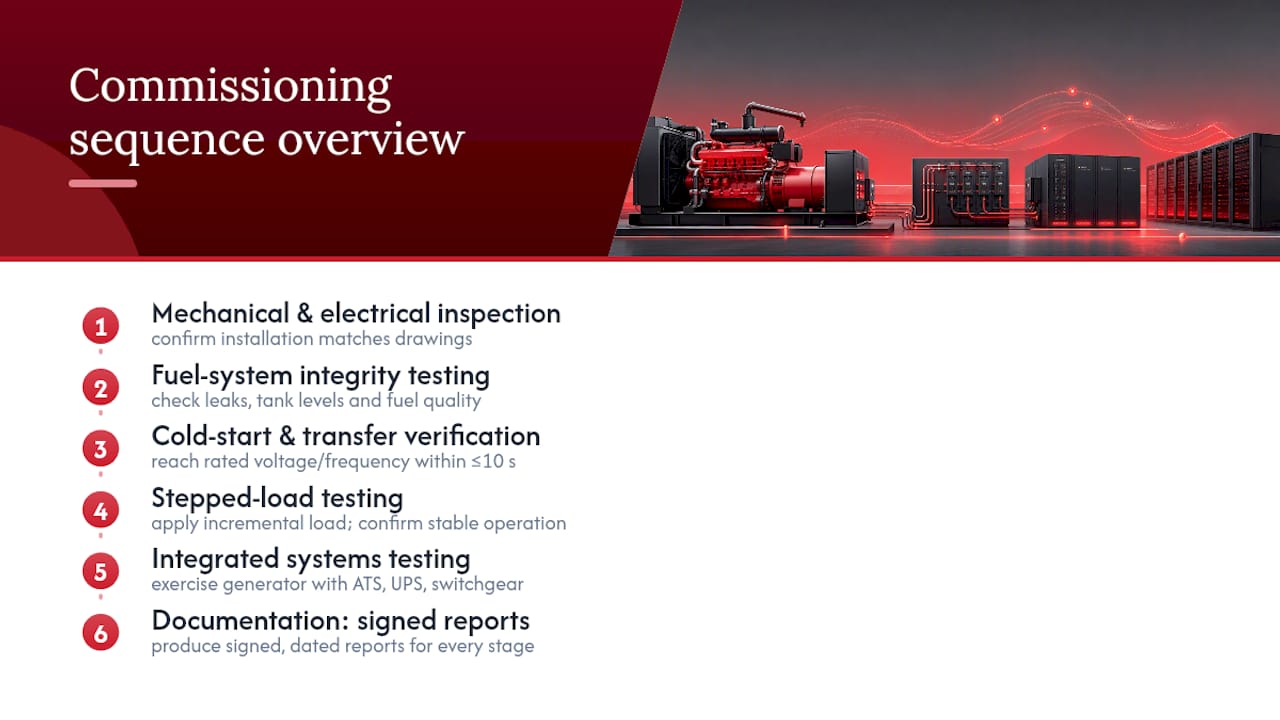
Stepped-load testing follows, applying load incrementally to confirm stable operation before committing to a full-load run. The final phase is integrated systems testing, running the generator alongside the ATS, UPS, and paralleling switchgear as one system rather than isolated components, since a generator that passes standalone tests can still fail an integrated transfer sequence if the switchgear logic isn’t tuned correctly.
Every stage should produce a signed, dated report. Facilities that skip integrated systems testing in favor of standalone acceptance almost always discover the gap during the first real outage, which is the worst possible time to learn that the ATS and generator don’t actually agree on timing.
Common Failure Modes and Diagnostics for Diesel Generators in Critical Facilities
Most diesel generator failures in critical facilities trace back to one of a handful of root causes, and nearly all of them are preventable with the fuel and maintenance discipline covered earlier. Fuel-related no-starts are the most common: stale fuel, microbial contamination, or water in the tank bottom can prevent combustion entirely or cause the engine to start rough and stall under load.

Battery failure is the second major category. Starting batteries degrade quietly, and a unit that started fine during last month’s exercise can fail cold-start entirely if voltage has drifted below threshold. Weekly battery checks catch this before it becomes an outage-day surprise.
Aftertreatment and DEF-related derating is a newer failure mode specific to Tier 4 Final engines. If DEF supply runs low or the aftertreatment system throws a fault, the engine can automatically reduce power output to protect emissions hardware, meaning the generator technically runs but can’t carry full critical load.
Governor and voltage regulator instability shows up as frequency or voltage hunting under load, usually caught during stepped-load testing rather than a quick visual check. And ATS transfer failures, where the switchgear doesn’t hand load over cleanly, often stem from timing misconfiguration rather than generator problems at all, which is why integrated systems testing matters more than testing the generator in isolation.
Diagnostic priority should follow that order: check fuel condition first, battery second, aftertreatment status third, and control system calibration last, since that sequence matches how frequently each cause actually shows up in field failures.
Environmental Impact Mitigation Beyond Emissions
Emissions get regulatory attention, but noise and spill risk are the environmental issues most likely to generate neighbor complaints and local permit friction. Diesel generators under full load are loud, often in the 90 to 100 decibel range at close range, and facilities sited near residential areas increasingly face noise ordinance limits that shape enclosure design and even testing schedule timing.
Acoustic enclosures and strategic placement, positioning exhaust and intake away from property lines, using sound-attenuating walls or berms, reduce complaint risk significantly. Some jurisdictions now require noise studies as part of the permit process, particularly for new generator yards near mixed-use development.
Spill prevention is the other quiet risk. Bulk fuel storage requires secondary containment sized to hold the full tank volume plus a margin, and most jurisdictions require regular integrity inspections of tanks, piping, and containment structures under Spill Prevention, Control, and Countermeasure planning where applicable. A minor fuel leak that reaches soil or groundwater turns into a remediation cost that dwarfs anything spent on prevention.
Practical mitigation steps worth building into your operations plan include scheduled containment inspections, spill kits staged at every fuel connection point, and stormwater management around tank farms so a containment breach doesn’t simply wash offsite during heavy rain. None of this shows up on an emissions permit, but all of it shows up on a community relations report if it’s neglected.
Emergency Response Plans and Backup Fuel Supply Considerations
A generator that runs perfectly on paper still fails the facility if fuel resupply during an extended outage isn’t planned before the outage starts. Regional disasters, hurricanes, ice storms, wildfire-driven grid shutoffs, create exactly the conditions where fuel delivery becomes hardest to arrange, because every other facility in the region is calling the same suppliers at the same time.
An emergency response plan worth trusting includes a written fuel delivery contract with documented response-time commitments, not a verbal understanding with a local supplier. It should specify who has authority to call for emergency delivery, what documentation the delivery driver needs for site access, and what the minimum tank threshold is that triggers an emergency order rather than waiting for a scheduled top-off.
Multi-site operators face an additional wrinkle: a single regional supplier can become a bottleneck if a storm affects several of your facilities simultaneously. A supplier with a broader partner network across multiple states offers more resilience than a single-region contract, particularly for organizations running critical infrastructure across more than one market.
Backup fuel supply planning should also account for access constraints. Flooded roads, downed trees, or fuel shortages at regional terminals can all delay delivery even with a contract in place, which is why bulk tank sizing for extended autonomy, discussed earlier in sizing decisions, matters as much as the delivery contract itself. The contract gets you resupply. The tank buys you the time to wait for it.
How an Enterprise Fuel Partner Reduces Fuel Risk
Every fuel-management item covered above, quarterly microbial testing, scheduled polishing, emergency resupply, documented deliveries for your NFPA logs, is a logistics operation, and most facilities managers didn’t sign up to run a fuel supply chain on top of everything else on their plate. That’s the gap Anytimefuelpros fills for data center operators managing diesel backup power.
Scheduled fuel delivery keeps your bulk and day tanks turning over on a predictable cadence, which is the single most effective defense against the stale-fuel and microbial contamination risks covered earlier. Emergency and after-hours response matters just as much: when a regional event puts every facility in your area on the phone with the same supplier, having a delivery partner with a national network behind them, rather than a single regional truck, is what keeps your resupply timeline from depending on luck.
Look for a vendor that documents every delivery with itemized invoicing you can hand straight to an auditor or AHJ inspector alongside your NFPA 110 logs, and one that offers DEF delivery alongside diesel, since Tier 4 Final engines depend on that supply chain too. Anytimefuelpros provides on-site diesel, DEF, and emergency fuel delivery with 24/7 response and a nationwide partner network, built for exactly the multi-site, mission-critical fueling problem this article has walked through. If your fuel logistics plan is still a spreadsheet and a phone number you hope answers during a storm, request a quote for scheduled or emergency delivery before the next outage tests it.
Sources
- NFPA 110 (excerpts)
- The data center boom is a diesel generator boom
- EPA stationary CI engines / NSPS background
- Choosing the Right Technology for Diesel Backup Generators — Data Center Frontier
FAQ
Do Data Centers Run on Diesel Generators?
Yes, diesel remains the dominant backup power source for mission-critical data centers, working alongside UPS batteries that bridge the gap during the generator’s start and transfer sequence. Onsite diesel capacity for data centers has grown sharply, nearly tripling from about 20 GW in 2018 to roughly 55 GW by 2024.
How Much Does a Data Center Generator Cost?
Costs vary widely based on kW rating, emissions tier, and redundancy architecture, since a 2N configuration roughly doubles generator and switchgear spend compared to N+1. Tier 4 Final aftertreatment hardware, bulk fuel storage, and load-bank testing infrastructure are the other major cost drivers, and any vendor quote should be treated as a starting point tied to your specific site and redundancy requirements.
What Kind of Generators Do Data Centers Use?
Most mission-critical facilities specify standby-rated diesel generators, increasingly in containerized or modular enclosures for faster deployment and integrated emissions controls. These units are typically built to Tier 4 Final emissions standards and designed for fast start and transfer, commonly at or under 10 seconds, within N+1 or 2N redundancy architectures.
How Much Does a 1 MW Diesel Generator Cost?
Pricing for a 1 MW unit depends heavily on emissions tier, enclosure type, and the switchgear needed to integrate it into your redundancy design, so there’s no single reliable figure that applies across sites. Facilities managers should request itemized quotes covering the generator, aftertreatment, ATS/paralleling gear, and fuel storage separately, since bundling these often obscures which line item is driving cost.
How Often Should Generator Fuel Be Tested?
NFPA 110 requires an annual fuel test panel, but practitioner guidance recommends adding quarterly microbial testing and bottom-sump sampling between annual checks. Microbial contamination can progress from undetectable to filter-clogging within months, so relying on the annual minimum alone leaves a real gap in coverage.
Can a Data Center Rely on an Emergency Fuel Delivery Contract Instead of Large Bulk Storage?
An emergency delivery contract with documented response-time commitments is essential, but it should supplement bulk storage sized for your region’s typical outage duration, not replace it. Regional disasters can delay even contracted deliveries, so facilities in disaster-prone areas should size tanks for extended autonomy and pair that with a resupply agreement like Anytimefuelpros’s emergency fuel delivery service for redundancy.
Recent Comments