

Understanding which fuel belongs in which machine sounds simple until you’re staring down a tax audit or a compliance notice from a state fuel inspector. Dyed diesel use cases for off-road equipment represent one of the most practical cost-saving opportunities available to construction, mining, and logistics operations today. The formal industry term is “dyed fuel” or “off-road diesel,” and the distinction from regular on-highway diesel is more than cosmetic. Getting it right means real money saved. Getting it wrong means federal penalties you do not want to explain to your CFO.
Table of Contents
- Key takeaways
- 1. Core dyed diesel use cases for off-road equipment
- 2. Construction equipment
- 3. Mining and quarrying operations
- 4. Agricultural machinery
- 5. Industrial generators and stationary power equipment
- 6. Forestry and land management equipment
- 7. Oil and gas field operations
- 8. Dyed diesel versus regular diesel: a direct comparison
- 9. Best practices for on-site dyed diesel management
- 10. Emerging trends in dyed diesel delivery and compliance
- My take on optimizing dyed diesel for real operational gains
- How Anytimefuelpros keeps your off-road equipment fueled and compliant
- FAQ
Key takeaways
| Point | Details |
|---|---|
| Legal eligibility is use-based | Dyed diesel qualifies for tax exemption based on where and how it’s used, not just the equipment type. |
| Major equipment categories qualify | Excavators, haul trucks, generators, and agricultural machinery are among the primary off-road diesel applications. |
| Performance is identical to highway diesel | Dyed diesel delivers the same power output with no mechanical drawbacks for equipment designed to use it. |
| Documentation protects you | Exemption certificates, chain-of-custody records, and terminal removal paperwork are your best defense in an audit. |
| On-site delivery reduces downtime | Bulk fuel delivery and wet-hosing services keep heavy equipment running without pulling operators off site. |
1. Core dyed diesel use cases for off-road equipment
Off-road diesel, also called red dye diesel due to the red dye added to distinguish it from taxed highway fuel, is legally designated for equipment that never operates on public roads. Per federal IRS rules under Section 4082(a), dyed fuel must be used for nontaxable off-road purposes. The tax exemption is not about the machine itself. It is about where and how the machine operates.
This distinction matters because compliance focus shifts from engine type to fuel use location. A skid steer that occasionally moves between adjacent public roads could create eligibility questions. Equipment that stays within job site or mine boundaries, by contrast, has a clear claim to exempt fuel status.
Key eligibility and compliance factors to keep in mind:
- Federal law under Section 4082 defines qualifying use as nontaxable, meaning off-highway operation only
- State rules vary significantly; some require fuel tax exemption certificates filed with the supplier before purchase
- Documentation requirements differ by jurisdiction, so fuel usage declarations and purchase records must match
- Attempting to dilute or mix dyed fuel to obscure its status jeopardizes compliance and eliminates audit defense protections
- Multi-state operations must track compliance across each state where equipment is fueled
Pro Tip: Keep a separate fuel log for every piece of off-road equipment on each job site. Match delivery receipts to equipment serial numbers. When an auditor asks, you want answers in minutes, not days.
2. Construction equipment
Construction is the industry most synonymous with off-road diesel applications, and for good reason. A mid-sized commercial construction site can run dozens of diesel-powered machines simultaneously, none of which ever touch a public road during normal operations.
Equipment that qualifies includes excavators, bulldozers, motor graders, backhoe loaders, compactors, concrete pumps, and tower cranes. Each of these represents a significant fuel draw. A 50-ton hydraulic excavator can consume 10 to 15 gallons per hour at full load. Multiply that across a fleet operating six days a week, and the tax savings from dyed diesel for heavy machinery translate directly to margin improvement on every project.
Telehandlers and rough-terrain forklifts also qualify when they remain on private job sites. The key is that the equipment operates exclusively within the project boundary and does not travel on public roads under its own power.
3. Mining and quarrying operations
Mining represents one of the highest-volume uses of dyed diesel fuel across any industry. Haul trucks at large open-pit operations can hold 1,000 gallons of diesel per fill and cycle through that volume in a single shift. Drill rigs, face shovels, scrapers, and underground loaders all consume fuel at rates that make the per-gallon tax savings economically significant at scale.
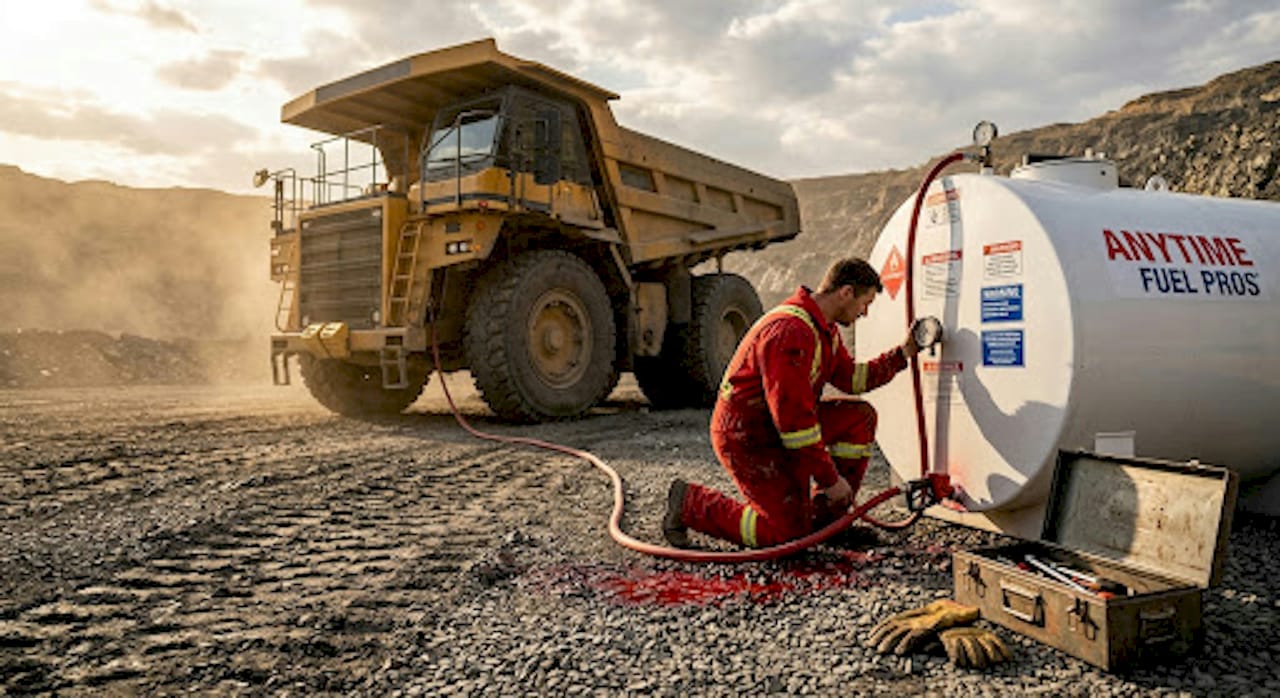
Construction and mining equipment operating exclusively within job sites or mine boundaries are core users of off-road diesel precisely because of the volume involved and the fact that none of this equipment typically leaves the property. A copper mine in Utah running 20 haul trucks on dyed diesel versus taxed highway diesel could save six figures annually in federal and state fuel excise taxes.
Quarrying operations follow the same logic. Crushers, conveyors, and wheel loaders at aggregate sites all qualify, provided the site maintains proper access controls and fuel documentation.
4. Agricultural machinery
Agriculture was one of the original reasons the dyed diesel tax exemption existed. Tractors, combines, cotton pickers, self-propelled sprayers, irrigation pump engines, and grain dryers all represent legitimate off-road diesel applications on farms and ranches.
The seasonal concentration of demand is worth noting. During harvest, a single large grain farm may require tens of thousands of gallons in a compressed window. Having bulk on-site storage pre-filled with dyed diesel before the season starts is a supply chain decision that directly affects whether harvesting stays on schedule.
Livestock operations with large generator banks and processing facilities that run stationary diesel engines also qualify. Stationary use is one of the less-discussed but fully legitimate uses of dyed diesel fuel.
5. Industrial generators and stationary power equipment
Stationary diesel generators represent a clean-cut case for off-road diesel eligibility. Whether it is a backup generator at a remote mining camp, a standby unit at a construction trailer complex, or a prime-power generator at a temporary industrial facility, the equipment never moves on a public road. It qualifies.
The practical benefit goes beyond tax savings. Backup and standby generators at remote sites often rely on bulk tank delivery, and sourcing dyed diesel through a scheduled delivery program removes the logistical friction of sourcing taxed highway diesel for equipment that has no reason to use it. For data center backup systems and telecom towers in rural areas, this is standard practice.
6. Forestry and land management equipment
Forestry equipment including feller bunchers, skidders, forwarders, and timber harvesters operates entirely within private or managed forest land, making it another clear candidate for off-road diesel. These machines are also typically high-fuel-consumption units working in conditions where resupply can be complicated.
Land clearing contractors using brush mulchers, tracked bulldozers, and large chippers face the same fuel logistics challenge. Mobile fuel delivery becomes especially valuable in these environments because the equipment cannot easily leave the work area to refuel, and retail fuel is often miles away over rough terrain.
7. Oil and gas field operations
Drilling rigs, completion equipment, workover units, and frac support machinery all operate on private leases or permitted locations away from public roads. The classification of these as qualifying off-road equipment is well established, and the volume of fuel consumed at a single well pad during a completion operation makes proper fuel sourcing a serious procurement decision.
Frac operations in particular can run multiple diesel-driven pump units simultaneously for days at a time. The cost difference between taxed and exempt fuel at those volumes is not marginal. It is a budget line item.
8. Dyed diesel versus regular diesel: a direct comparison
Understanding the operational trade-offs between off-road and highway diesel helps you make the right call for each piece of equipment.
| Factor | Dyed (off-road) diesel | Clear (highway) diesel |
|---|---|---|
| Federal excise tax | Exempt (off-road use) | Taxed (approximately $0.243/gallon) |
| Chemical composition | Identical to highway diesel | Same base fuel |
| Legal use | Off-highway equipment only | On-road and off-road vehicles |
| Performance in heavy equipment | No difference | No difference |
| Risk if misused | Federal fines, back taxes, penalties | Legal for all uses |
| Emissions hardware compatibility | Safe for off-road engines; risks DPF damage in on-road vehicles | Calibrated for highway emission systems |
The chemical equivalence is the key performance takeaway. Equipment runs identically on dyed diesel, with no power loss, no increased maintenance intervals, and no fuel system modifications required. The red dye is purely a tax administration tool.
Where misuse creates real risk is in modern on-road vehicles with diesel particulate filters and selective catalytic reduction systems. Those systems are calibrated for highway fuel specifications. Using off-road diesel in an on-road truck with these systems risks filter damage over time, in addition to the federal legal exposure.
Pro Tip: Treat your fuel procurement the same way you treat equipment allocation. Match the fuel type to the machine’s legal classification, document it, and never mix off-road and on-road fuel stocks in shared storage without clear labeling and physical separation.
9. Best practices for on-site dyed diesel management
Operational controls are what separate companies that benefit from dyed diesel from those that end up in enforcement actions. The proper controls and documentation greatly reduce audit risk, but they require intentional setup, not just good intentions.
- Establish dedicated bulk storage. On-site tanks ranging from 500 to 10,000 gallons allow you to receive scheduled bulk deliveries and reduce per-gallon cost through volume pricing. Separate tanks for dyed and clear diesel prevent cross-contamination.
- Collect and file exemption certificates before the first delivery. Many states require these on file with your supplier. Retroactive documentation is harder to defend and signals sloppy compliance.
- Implement a chain-of-custody log. Every fuel transfer from the storage tank to a piece of equipment should be logged with date, quantity, equipment ID, and operator signature. This log is your primary defense in a state or federal inspection.
- Use wet-hosing services where available. Mobile fuel delivery trucks that dispense directly into equipment tanks eliminate manual transfer errors and generate automatic delivery records.
- Align terminal removal paperwork with usage records. Under Section 6435 refund rules effective December 31, 2025, refund claims require that corporate identity and terminal removal documentation match qualified dyed fuel usage records.
- Train site supervisors on fuel handling rules. The person managing refueling on a job site may not know the legal implications of putting off-road diesel in a service truck that drives on public roads. That knowledge gap costs money.
10. Emerging trends in dyed diesel delivery and compliance
The off-road diesel market is not static. Several developments are worth tracking for operations managers and procurement leads:
- Mobile on-demand delivery has expanded significantly, with GPS-tracked fuel trucks delivering directly to remote sites, reducing equipment idle time waiting for fuel and eliminating the need for large permanent storage at short-term project locations
- Section 6435 regulatory updates effective at the end of 2025 now allow eligible refunds for dyed fuel where excise tax was previously paid at the terminal, giving operations a new mechanism to recover costs on qualifying purchases
- Dye detection technology used by enforcement agencies has become more sensitive, making any attempt to alter the dye concentration in fuel more detectable and legally risky than ever before
- Sustainability pressure is prompting some operations to explore renewable diesel and biodiesel blends that still qualify for off-road use, though compatibility with specific engine types requires manufacturer verification before switching
- Digital compliance platforms are being integrated with fuel delivery logistics to automate record generation at the point of delivery, reducing the manual documentation burden on site teams
My take on optimizing dyed diesel for real operational gains
I’ve watched operations teams leave serious money on the table because they treated dyed diesel compliance as a paperwork problem rather than an operational system. The companies that get the most value from off-road diesel are the ones that treat fuel procurement with the same rigor they apply to equipment maintenance schedules.
What I’ve seen work consistently is this: pair your bulk delivery program with a structured chain-of-custody log from day one of a project, not after the first audit. The documentation habit is the difference between a refund claim that sails through and one that triggers a full review.
I’ve also seen operations managers get burned by relying on a single local supplier who couldn’t scale deliveries during peak demand. When a mining site or large construction project hits a high-consumption phase, supply reliability matters more than per-gallon savings. A supplier who misses a delivery during an active excavation sequence costs far more in downtime than any price discount they offered.
The other thing I’d push back on is the idea that dyed diesel compliance is just a legal formality. The Section 6435 refund mechanism is real money, but only if your recordkeeping is tight enough to support the claim. Treat documentation as a financial asset, not administrative overhead.
— Justin
How Anytimefuelpros keeps your off-road equipment fueled and compliant
Running out of fuel on a job site is a preventable problem. So is a compliance gap that triggers penalties on your dyed diesel purchases.

Anytimefuelpros delivers on-site bulk diesel directly to construction sites, mining operations, agricultural facilities, and logistics yards across Texas, Utah, and nationwide through our partner network. Our dyed diesel delivery service includes scheduled top-offs, wet-hosing, and emergency response, with delivery documentation that supports your compliance records from the first drop. Whether you manage a single excavation site or a multi-state equipment fleet, Anytimefuelpros gives you one reliable point of contact for fuel that shows up on time, every time. Call us or request a quote to get scheduled.
FAQ
What equipment qualifies for dyed diesel use?
Any equipment that operates exclusively off public highways qualifies, including excavators, bulldozers, haul trucks, tractors, stationary generators, and drilling rigs. The exemption is based on use location, not equipment type.
Is dyed diesel the same quality as regular diesel?
Yes. Dyed diesel is chemically identical to highway diesel. The red dye added to off-road diesel is a tax administration marker only and does not affect fuel performance or engine operation in qualifying equipment.
What are the penalties for misusing dyed diesel?
Federal law prohibits using dyed diesel in on-road vehicles. Penalties include back taxes, per-gallon fines from the IRS, and additional state penalties. Enforcement uses dye detection and fuel sampling during roadside inspections.
How do I claim a refund under Section 6435 for previously taxed dyed fuel?
Under rules effective December 31, 2025, eligible taxpayers can claim refunds for dyed fuel where excise tax was paid at the terminal. Claims require matching corporate identity with terminal removal paperwork and documented off-road usage records.
Does my supplier need documentation before delivering dyed diesel?
Many states require exemption certificates or usage declarations on file with the supplier before the first delivery. Collecting this documentation upfront protects both the buyer and the supplier during any compliance review.
Recent Comments