

Fuel delivery for logistics yards is defined as the scheduled or on-demand transport of diesel, gasoline, or DEF directly to on-site storage tanks or fleet vehicles, eliminating the need for drivers or equipment operators to leave the yard to refuel. The industry term for this practice is on-site commercial fueling, and it covers everything from bulk tank replenishment to mobile wet-hosing of parked trucks overnight. Logistics yards running Class 8 fleets, yard trucks, forklifts, or refrigerated trailers depend on uninterrupted fuel supply to maintain dispatch schedules. When fuel runs short, the ripple effect touches driver productivity, load timing, and customer commitments. Bulk fuel delivery solves this by bringing the fueling station to the yard rather than sending the yard to the station.
What is fuel delivery for logistics yards and how does it work?
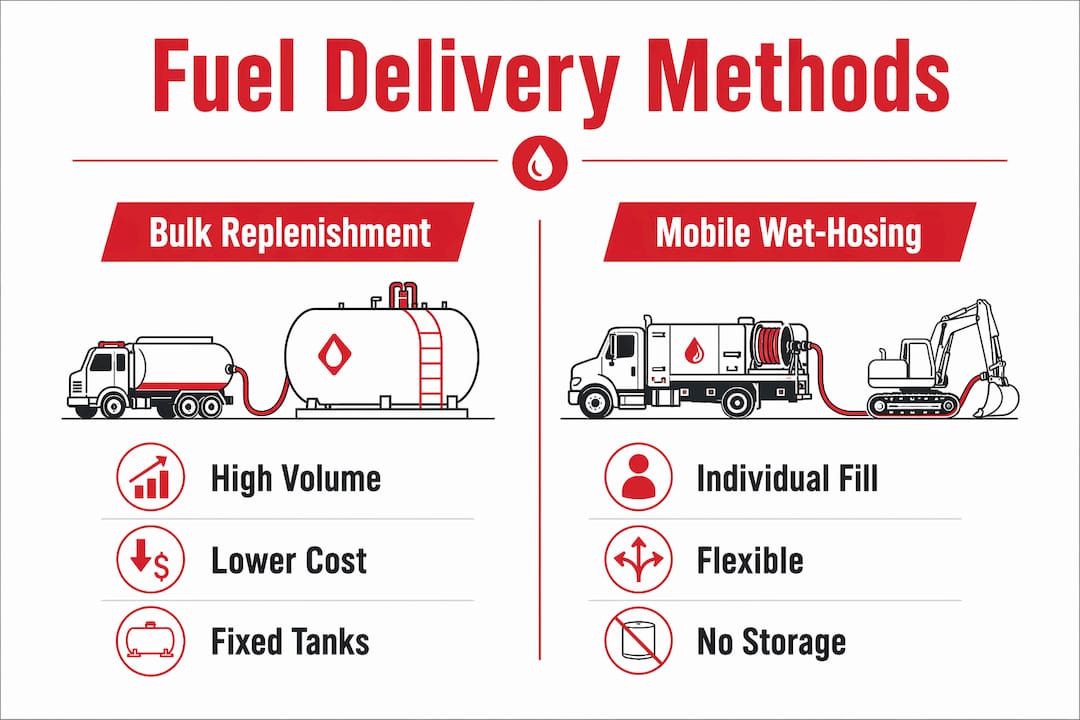
Fuel delivery for logistics yards operates through two primary methods: bulk storage tank replenishment and mobile wet-hosing. Each serves a different operational profile, and many yards use both in combination depending on fleet size, yard layout, and compliance capacity.
Bulk storage tank replenishment involves a tanker truck delivering diesel or gasoline to a fixed aboveground storage tank installed on the yard. The yard draws from that tank using dispensing equipment, and the provider schedules refills based on consumption data or automated low-level alerts. This model suits high-volume yards with consistent daily fuel demand, such as regional distribution centers or long-haul trucking terminals.
Mobile wet-hosing takes a different approach. Certified technicians fill each vehicle individually while parked, using a metered fuel truck that moves through the yard. No fixed infrastructure is required. This method works well for yards with mixed equipment types, limited space for tank installation, or operations that want to avoid the capital cost and compliance obligations of permanent storage.
| Method | Best for | Key advantage | Main consideration |
|---|---|---|---|
| Bulk tank replenishment | High-volume, consistent demand | Lower per-gallon cost at scale | Requires SPCC compliance above 1,320 gallons |
| Mobile wet-hosing | Mixed fleets, limited infrastructure | No fixed tank required | Scheduling coordination with fleet downtime |
| Hybrid approach | Large yards with varied equipment | Flexibility across fuel types | Requires vendor coordination |
Modern providers layer digital tracking onto both methods. Delivery confirmations, per-vehicle fuel logs, and inventory reports are transmitted electronically, giving operations coordinators real-time visibility without manual dipstick checks or paper logs.
Pro Tip: If your yard runs both diesel trucks and gasoline-powered yard equipment, ask your provider about split-product delivery. A single scheduled visit can cover both fuel types, cutting vendor touchpoints in half.
How does the fuel delivery process work step by step?
The practical execution of a logistics yard fuel delivery follows a defined sequence that minimizes disruption to dispatch operations.
-
Scheduling and demand forecasting. The logistics manager or fuel coordinator sets a delivery schedule based on average daily consumption. Most providers offer automated reorder triggers tied to tank telemetry or a minimum-days-of-supply threshold. Mobile wet-hosing providers coordinate fueling schedules for minimal disruption, typically delivering overnight when fleets are parked, with digital confirmations ready before the morning shift begins.
-
Driver dispatch and route confirmation. The fuel provider dispatches a certified delivery driver in a metered tanker. The driver carries manifests, safety data sheets, and delivery documentation required for commercial fuel transfers.
-
On-site transfer and safety protocols. On arrival, the driver inspects the receiving tank or vehicle fill points, connects transfer hoses, and monitors the fill to prevent overfill. Spill kits and absorbent materials are standard equipment on every delivery truck. For bulk tank fills, the driver verifies that secondary containment is intact before transfer begins.
-
Metered delivery and documentation. Every gallon transferred is recorded through calibrated meters. The driver generates a delivery ticket showing product type, volume, time, and vehicle or tank ID. For yards using fleet management software like Fleetio or Samsara, this data can be imported directly into fuel cost tracking modules.
-
Digital reporting and inventory update. After delivery, the provider transmits an electronic invoice and delivery confirmation. Yards with tank monitoring systems receive an updated inventory reading automatically. This closes the loop on fuel accountability without requiring manual recordkeeping from yard staff.
What are the compliance requirements for on-site fuel storage?
Compliance is the most underestimated cost in logistics yard fuel management. The regulatory burden depends on storage volume, not just delivery frequency.
EPA SPCC regulations under 40 CFR 112 require a written Spill Prevention, Control, and Countermeasure plan for any facility with aboveground oil storage exceeding 1,320 gallons in aggregate. The SPCC plan must be prepared or certified by a licensed Professional Engineer and must address spill pathways, containment design, and emergency response procedures. For a yard running a 2,000-gallon diesel tank, this is not optional paperwork. It is a federal requirement with enforcement teeth.
Secondary containment is the physical backbone of SPCC compliance. The containment structure, whether a concrete berm, a prefabricated spill pallet, or an earthen dike, must hold at least 100% of the volume of the largest tank plus additional capacity for rainfall accumulation. Spill pallets, berms, and spill buckets serve as engineered containment to prevent ground contamination from leaks or spills, and installing them correctly requires civil engineering and environmental permitting expertise.
Ongoing compliance obligations include:
- Monthly visual inspections of containment areas, valves, piping, and tank exteriors to detect visible leaks or damage
- Annual integrity testing for large tanks, with results documented and retained
- Three-year recordkeeping for all inspection logs, delivery records, and incident reports
- Spill response training for any yard personnel who handle fuel transfers or operate dispensing equipment
Pro Tip: Designate one person on your operations team as the SPCC compliance owner. Shared responsibility for inspection logs almost always means no one does them consistently, and a missed monthly inspection is the most common finding in EPA audits.
| Compliance requirement | Threshold | Frequency |
|---|---|---|
| SPCC plan (PE-certified) | Above 1,320 gallons aggregate | One-time, updated on facility changes |
| Secondary containment | 100% of largest tank volume | Installed before tank commissioning |
| Visual inspections | All aboveground tanks | Monthly |
| Integrity testing | Large tanks | Annual |
| Recordkeeping | All fuel activity | Retained for 3 years |
Non-compliance carries real operational risk. An EPA inspection finding can trigger fines, mandatory remediation, and in serious cases, a stop-work order that shuts down yard operations until violations are corrected.
What are the operational benefits of managed fuel delivery in logistics yards?
Delivering fuel directly on-site reduces fleet downtime and increases operational efficiency in ways that compound across a full dispatch cycle. The benefits break into four categories that matter most to logistics managers.
Fleet availability and dispatch reliability. When trucks refuel at retail stations, each stop adds 20 to 40 minutes of non-revenue time per driver per day. For a yard running 30 trucks, that is a significant labor and time cost that disappears entirely when fuel comes to the yard. Drivers start shifts with full tanks, and dispatch sequencing is not disrupted by fuel stops mid-route.
Cost control through bulk pricing. Bulk fuel purchases carry lower per-gallon costs than retail pump prices. Yards that consolidate purchasing through a single provider also gain price transparency and predictable invoicing, which simplifies fuel budget management for operations coordinators and CFOs alike.
Fuel theft prevention. Smart tanks and fueling kiosks integrate digital tracking and user access controls to secure fuel on logistics sites. Controlled dispensing with driver ID authentication eliminates the gray area of unaccounted fuel that plagues open-access yard tanks. Every gallon is tied to a vehicle, a driver, and a timestamp.
Real-time visibility for operational decisions. Fuel consumption data collected through digital delivery systems feeds directly into cost-per-mile calculations, maintenance scheduling, and budget forecasting. Operations coordinators who previously estimated fuel costs from monthly invoices can now track consumption by vehicle, shift, or route in near real time.
The benefits of fuel delivery extend beyond convenience. For yards managing tight margins and demanding delivery windows, fuel availability is a direct input to revenue protection.
Key takeaways
On-site fuel delivery is the most direct way for logistics yards to protect fleet uptime, control fuel costs, and meet EPA compliance requirements simultaneously.
| Point | Details |
|---|---|
| Two primary delivery methods | Bulk tank replenishment suits high-volume yards; mobile wet-hosing works for mixed fleets without fixed infrastructure. |
| SPCC compliance is mandatory above 1,320 gallons | Yards exceeding this threshold need a PE-certified SPCC plan, secondary containment, and monthly inspections. |
| Overnight wet-hosing maximizes uptime | Scheduling fuel delivery during fleet downtime means every truck starts the shift full, with no dispatch delays. |
| Digital tracking closes the accountability gap | Per-vehicle fuel logs and electronic delivery confirmations replace manual recordkeeping and reduce theft exposure. |
| Bulk pricing reduces per-gallon cost | Consolidating fuel purchasing through a single provider lowers cost and simplifies budget forecasting. |
Why most yards are still managing fuel reactively, and what that costs them
I have seen logistics yards with 50-truck fleets and zero fuel monitoring beyond a driver calling in when a tank looks low. That is not a fuel management strategy. It is a liability waiting to materialize at the worst possible moment, usually during peak season or a weather event when every truck needs to roll at once.
The shift from reactive to proactive fuel management is not complicated, but it requires treating fuel as a managed input rather than a utility that refills itself. Smart tank monitoring and controlled access avoid fueling bottlenecks and optimize scheduling, turning what used to be a daily guessing game into a data-driven process. The yards that do this well are not necessarily the largest ones. They are the ones where the operations coordinator has decided that fuel is too operationally critical to manage by feel.
The compliance piece is where I see the most avoidance behavior. Managers know they probably need an SPCC plan but assume it is someone else’s problem until an inspection or a spill makes it very much their problem. The cost of getting compliant upfront is a fraction of the cost of remediation, fines, and operational disruption after a violation. Fuel delivery planning must integrate compliance and spill risk controls from the start, not as an afterthought once the tank is already in the ground.
My practical advice: start with a fuel consumption audit for the last 90 days. Map where fuel is being dispensed, by which vehicles, and at what times. That single exercise usually reveals two or three inefficiencies that a structured delivery program can fix immediately.
— Justin
How Anytimefuelpros supports logistics yard fueling operations
Anytimefuelpros delivers diesel, gasoline, and DEF directly to logistics yards across Texas, Utah, and nationwide through its partner network, covering everything from scheduled bulk tank fills to overnight wet-hosing for parked fleets. Every delivery includes digital documentation, metered transfer records, and transparent invoicing so operations coordinators have the data they need without chasing paper trails.
For yards navigating SPCC compliance, Anytimefuelpros works with clients to align delivery schedules and documentation practices with regulatory requirements. Whether you are managing a single distribution yard in San Antonio or coordinating fuel across multiple sites in the Dallas-Fort Worth corridor, AFP provides a single point of contact for consistent, compliant on-site diesel delivery. Explore the full operational advantages of scheduled fuel delivery and see how AFP structures programs for logistics operations at your scale.
FAQ
What is on-site fuel delivery for a logistics yard?
On-site fuel delivery is the direct transport of diesel, gasoline, or DEF to a logistics yard’s storage tanks or fleet vehicles by a certified fuel provider. It eliminates retail fuel stops, reduces driver downtime, and keeps fleets ready for dispatch without interruption.
What fuel types are typically delivered to logistics yards?
Most logistics yards receive clear diesel for over-the-road trucks, dyed off-road diesel for yard equipment, gasoline for light-duty vehicles, and DEF for emissions compliance on modern diesel engines. Providers like Anytimefuelpros deliver all four product types in a single scheduled program.
When does a logistics yard need an SPCC plan?
EPA SPCC regulations require a written, PE-certified Spill Prevention, Control, and Countermeasure plan for any facility with aggregate aboveground oil storage exceeding 1,320 gallons. Most yards with a standard 2,000-gallon diesel tank meet this threshold.
How does mobile wet-hosing differ from bulk tank delivery?
Mobile wet-hosing sends a metered fuel truck to fill individual vehicles while they are parked, requiring no fixed storage infrastructure on-site. Bulk tank delivery replenishes a permanent aboveground tank that the yard then draws from using its own dispensing equipment.
Can fuel delivery reduce fuel theft in logistics yards?
Controlled-access dispensing systems tied to driver ID authentication, combined with digital delivery records, significantly reduce unaccounted fuel loss. Digital tracking and access controls tie every gallon to a specific vehicle and timestamp, closing the accountability gap that open-access tanks create.
Recommended
- Fuel Delivery at the Heart of Winter Operations: How On-Site Services Keep Businesses Running - Anytime Fuel Pros
- From Refineries to Your Fleet: How Diesel Fuel Gets Delivered - Anytime Fuel Pros
- Fueling Up for Holiday Season Logistics: Strategies to Meet Increased Demands - Anytime Fuel Pros
- Bulk Fuel Delivery | On-Site Diesel and DEF
Recent Comments