

Temporary site fueling is defined as a self-contained, rapidly deployable fuel storage, transfer, and dispensing system installed at a job site or operational location that lacks permanent fueling infrastructure. The industry term for this setup is a temporary fueling station or mobile fueling station, and it covers everything from skid-mounted tanks with integrated pumps to containerized units that arrive pre-assembled and ready to operate. Facilities managers and project leaders use these systems to keep excavators, generators, loaders, and fleet vehicles running without sending crews off-site to refuel. Whether you are managing a highway construction project in Texas, a municipal fleet during a facility upgrade, or a data center generator bank during a power emergency, temporary site fueling is the operational backbone that prevents costly downtime.
What is temporary site fueling and how does it work?
Temporary site fueling is a complete fuel storage and dispensing ecosystem, not simply a fuel delivery drop-off. The distinction matters because facilities managers who treat it as just a delivery service often underestimate the planning, compliance, and safety requirements involved.
The core components of any temporary fueling station include:
- Storage tanks: Above-ground single-wall or double-wall tanks, typically ranging from 500 to 10,000 gallons, sized to match daily consumption rates and delivery frequency
- Dispensing pumps: Metered pumps with automatic nozzle shutoffs, often capable of dispensing diesel, gasoline, or DEF (diesel exhaust fluid) from a single unit
- Safety and environmental controls: Secondary containment berms or built-in double-wall construction, spill kits, fire extinguishers, and grounding cables for static discharge
- Integrated metering and monitoring systems: Digital flow meters, fuel level sensors, automated shutdown triggers, and environmental sensors that flag abnormal conditions before they become incidents
The two dominant deployment formats are skid-mounted units and containerized units. Skid-mounted and containerized stations arrive pre-assembled on transportable frames and can be operational within two hours without civil works or ground preparation. That speed is the defining advantage over permanent infrastructure, which requires excavation, permitting, and weeks of construction. Containerized units add the benefit of weather protection and built-in security, making them the preferred choice for remote mining sites and long-duration construction projects.
The operational workflow follows a straightforward sequence. A fuel tanker delivers bulk diesel or gasoline to the on-site storage tank. Equipment operators or designated fueling personnel dispense fuel directly to vehicles and machinery using the integrated pump system. Automated monitoring controls track fuel levels, log dispensing volumes, and trigger emergency shutdowns if sensors detect leaks or abnormal pressure conditions.
Pro Tip: Match your tank capacity to at least three days of peak consumption, not average consumption. Projects with tight schedules cannot afford a fuel-out event on a Monday morning because the weekend delivery window was missed.
Safety, regulatory compliance, and environmental considerations
Temporary fueling stations are regulated environments, not informal workarounds. Treating them as anything less creates liability exposure and project risk that no facilities manager or project leader can afford.
The key regulatory and safety requirements for temporary site fueling break down into five areas:
- Secondary containment sizing: Local permitting drives containment design, including berm sizing calculated to hold the volume of the largest tank plus precipitation allowance and freeboard. This is not a one-size-fits-all calculation. A 5,000-gallon tank on a site near a waterway requires a larger containment footprint than the same tank in an arid inland location.
- NFPA 30 compliance: The National Fire Protection Association’s Flammable and Combustible Liquids Code governs storage tank spacing, ignition source separation, and ventilation requirements. Temporary stations must meet these standards regardless of how long they are on-site.
- EPA SPCC requirements: The Spill Prevention, Control, and Countermeasure rule applies to facilities storing more than 1,320 gallons of oil above ground in aggregate. Many construction sites cross this threshold quickly when multiple tanks are combined.
- Ignition control and fire safety: No smoking zones, grounding and bonding procedures during fuel transfer, and fire extinguisher placement within 50 feet of dispensing points are standard requirements on compliant sites.
- Documentation and inspection routines: Temporary fueling sites managed as tank farms require daily visual inspections, written logs, and documented emergency response plans. This paper trail protects you during regulatory audits and insurance claims.
One critical nuance: double-walled or self-bunded tanks reduce regulatory burden but do not eliminate it. Self-bunded units still require verification against local fire and environmental codes before deployment. Project teams that assume built-in containment means no permit is needed often discover the error at the worst possible time.
Pro Tip: Engage a certified environmental consultant or your fuel provider’s compliance team before the first delivery arrives. Retroactive permitting on an active job site costs far more in delays than proactive planning.
Benefits and challenges of temporary fueling for construction and mission-critical projects
The operational case for temporary site fueling is straightforward: fuel is where the equipment is, not miles away at a retail station. The time and cost savings compound quickly on large projects.
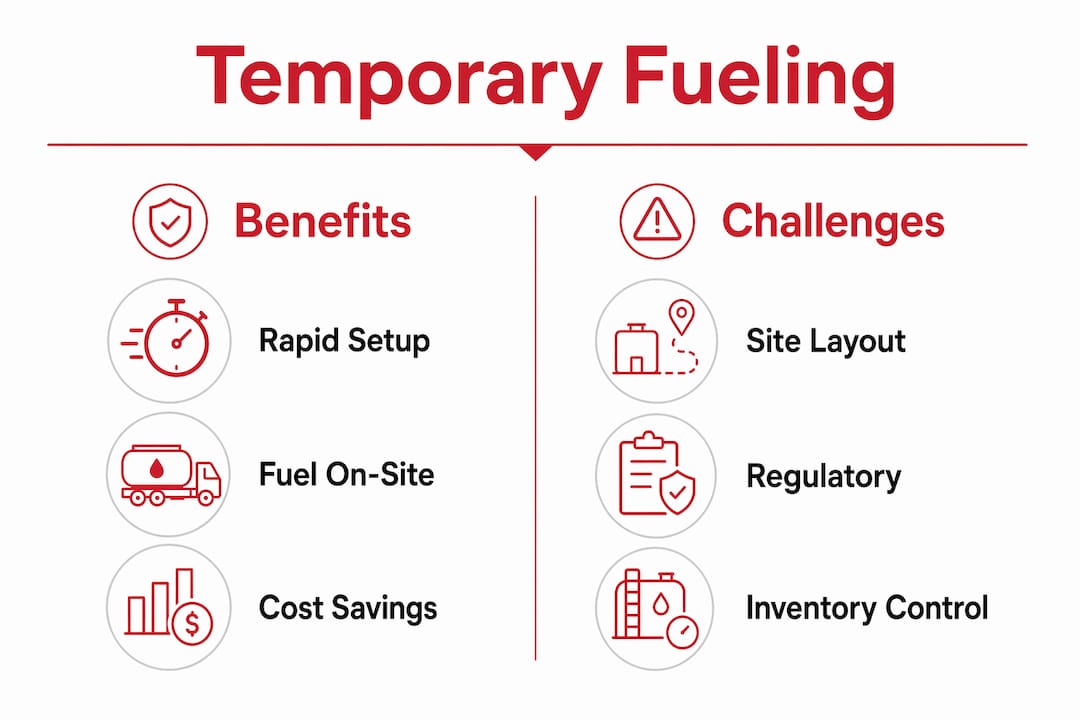
Consider a construction site running 20 pieces of heavy equipment, each requiring 30 minutes of round-trip travel to a retail diesel station. That is 10 hours of lost productive time per refueling cycle, per day, before accounting for the labor cost of the operator sitting idle. On-site fuel delivery eliminates that cycle entirely. The City of Lynchburg, Virginia, demonstrated this logic at the municipal level when it deployed a temporary fueling site at 1201 Kemper Street from June to December 2026 to support construction trucks and public safety vehicles during a permanent facility upgrade. The city kept its fleet operational without interrupting the renovation timeline.
The comparison between temporary and permanent fueling infrastructure makes the deployment decision clearer:
| Factor | Temporary fueling station | Permanent fueling infrastructure |
|---|---|---|
| Deployment speed | Operational in under 2 hours | Weeks to months of construction |
| Upfront cost | Low to moderate rental or lease | High capital expenditure |
| Flexibility | Relocatable as project phases shift | Fixed location |
| Compliance burden | Moderate, permit-driven | High, full facility permitting |
| Best fit | Projects under 24 months, remote sites, emergencies | Long-term, high-volume, fixed operations |
The challenges are real and worth planning for. Site layout planning requires dedicated space for tank placement, containment berms, vehicle access lanes, and safe separation from ignition sources. Power access for pump operation and monitoring systems must be confirmed before delivery. Environmental risk management, particularly on sites near drainage channels or sensitive soils, demands additional containment measures. Mobile fueling solutions reduce schedule risk through rapid activation, but they do not eliminate the need for thoughtful site preparation.
How to implement temporary site fueling at your project
Getting a temporary fueling station operational requires more than calling a fuel supplier. The planning sequence determines whether the system runs cleanly or creates operational friction from day one.
Start with a fuel demand assessment. Calculate daily consumption across all diesel and gasoline-powered equipment on site, then add a 20 percent buffer for peak demand days and delivery delays. This number drives tank sizing, delivery frequency, and the number of dispensing points required.
Site preparation and layout planning should address the following before equipment arrives:
- Access routes: Fuel delivery tankers require a clear, firm-surface path to the storage tank. Soft ground or tight turns that work for a pickup truck will stop a tanker.
- Containment footprint: Secondary containment must be sized for the largest credible release volume plus precipitation and freeboard allowance. Mark this zone clearly and keep it free of debris.
- Separation distances: Maintain required clearances from buildings, ignition sources, and property lines per NFPA 30 and local fire code.
- Monitoring infrastructure: Confirm power availability for pump controls, level sensors, and any remote monitoring systems your provider supplies.
Coordination with your fuel delivery provider is not a one-time conversation. Establish a recurring delivery schedule tied to your consumption rate, confirm after-hours and emergency contact protocols, and request documentation of each delivery for your project records. Bulk fuel delivery and storage on job sites works best when the provider understands your project timeline and can adjust delivery frequency as equipment counts change across project phases.
Pro Tip: Add fuel inventory checks to your daily site safety walkthrough. A five-minute level check prevents the kind of fuel-out event that stops a concrete pour or delays a critical path activity.
Key takeaways
Temporary site fueling is the fastest and most cost-effective way to maintain fuel supply on projects without permanent infrastructure, provided safety, compliance, and site planning are treated as non-negotiable requirements from day one.
| Point | Details |
|---|---|
| Definition and scope | Temporary site fueling is a complete storage, transfer, and dispensing system, not just a delivery service. |
| Deployment speed | Skid-mounted and containerized units can be operational in under two hours with no civil works required. |
| Compliance is mandatory | NFPA 30, EPA SPCC, and local permitting apply to temporary stations regardless of duration on-site. |
| Cost and time savings | Eliminating off-site refueling trips removes hours of lost productive time per day on large equipment fleets. |
| Planning drives performance | Tank sizing, containment design, access routes, and delivery scheduling must be confirmed before the first fuel drop. |
My take on where temporary site fueling is headed
I have watched the preference for skid-mounted and containerized fueling systems grow steadily over the past several years, and the reason is not complicated. Project timelines are tighter, labor costs are higher, and the tolerance for equipment downtime is essentially zero on competitively bid contracts. A system that goes from delivery truck to operational in two hours fits that reality in a way that a permanent station never will for project-based work.
What concerns me is the compliance gap. Too many project teams treat temporary fueling as informal infrastructure and discover the regulatory exposure only after an inspection or a spill event. The NFPA 30 and EPA SPCC requirements do not have a “temporary exemption” clause. A 2,000-gallon skid tank on a construction site carries the same legal obligations as a permanent above-ground storage tank. Proactive safety planning, including working with providers who understand secondary containment requirements and can supply compliant equipment, is the difference between a smooth project and a costly regulatory response.
The sustainability angle is also worth noting. Well-managed temporary fueling stations, with tight inventory controls and spill prevention protocols, actually reduce the environmental footprint of a project compared to the alternative of multiple daily truck trips to retail stations. Fewer vehicle miles, less idling, and documented fuel accountability all contribute to a cleaner operational record. For facilities managers working on projects with environmental reporting requirements, that documentation trail has real value.
My advice: partner with a specialized provider early, treat the fueling station as a managed asset rather than a convenience, and build compliance into the setup from the first day.
— Justin
How Anytimefuelpros supports your temporary fueling needs
Anytime Fuel Pros delivers diesel, gasoline, and DEF directly to construction sites, municipal operations, data centers, and mission-critical facilities across Texas, Utah, and nationwide through a trusted partner network. Whether you need a scheduled bulk delivery to a skid-mounted tank, emergency fueling during an unplanned outage, or a recurring supply program for a multi-phase project, AFP brings the fuel to you. The team understands secondary containment requirements, delivery documentation, and the compliance standards that facilities managers and project leaders cannot afford to get wrong. Explore diesel fuel delivery options or get answers to your specific fueling questions at the AFP fuel delivery FAQ.
FAQ
What is temporary site fueling in simple terms?
Temporary site fueling is a portable, self-contained system that stores and dispenses fuel directly on a job site or operational location. It replaces the need for permanent fueling infrastructure during construction, events, or facility upgrades.
How quickly can a temporary fueling station be set up?
Skid-mounted and containerized temporary fueling stations can be operational within two hours of delivery, with no civil works or ground preparation required. This speed makes them the standard choice for time-sensitive project deployments.
Do temporary fueling stations require permits?
Yes. Temporary fueling stations are subject to NFPA 30, EPA SPCC rules, and local fire and environmental permits depending on tank size and site location. Double-walled tanks reduce but do not eliminate the permitting requirement.
What types of fuel can a temporary station dispense?
Most temporary fueling stations dispense clear diesel, dyed off-road diesel, gasoline, and DEF. The specific fuel types depend on the tank and pump configuration selected for the project.
How is temporary site fueling different from mobile fueling?
Temporary site fueling involves a fixed on-site station that stores fuel and dispenses to equipment throughout the day. Mobile fueling refers to a fuel truck that travels to individual vehicles or equipment to refuel them directly, without a stationary storage tank on site.
Recommended
- Why More Job Sites Are Choosing On-Site Fuel Delivery (And Why Yours Should Too) - Anytime Fuel Pros
- How On-Site Fuel Delivery Can Elevate Your Business - Anytime Fuel Pros
- Bulk Fuel Delivery & Storage on Job Sites - Anytime Fuel Pros
- Reflecting on Fuel Delivery in 2024: A Year of Growth, Challenges, and Gratitude - Anytime Fuel Pros
Recent Comments