
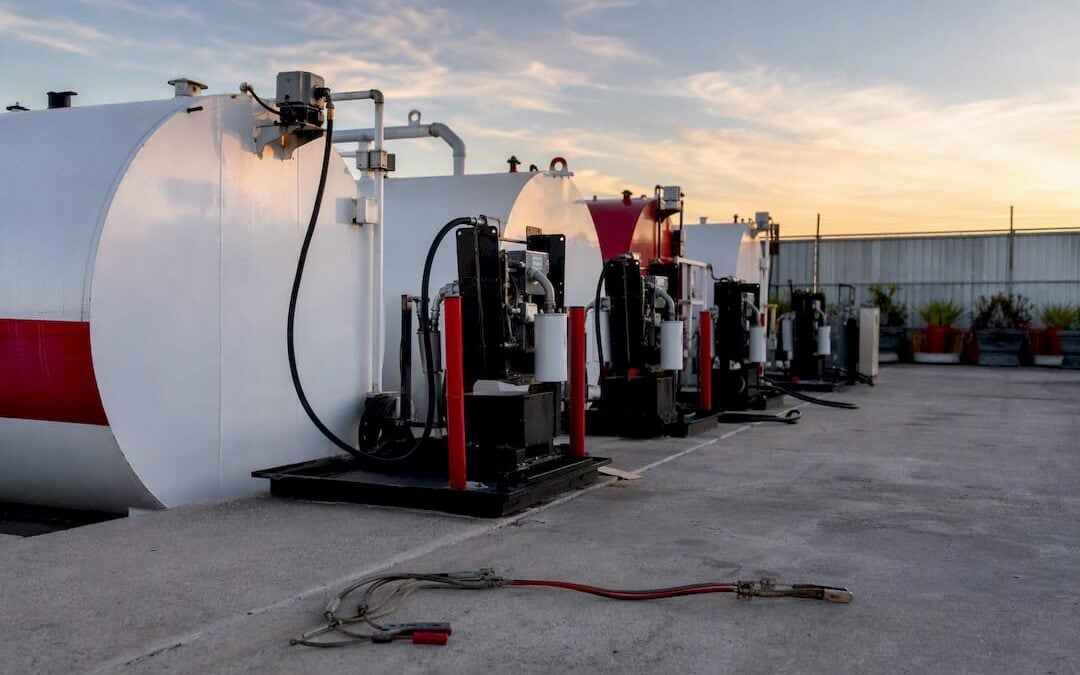
Trucking yard fueling means bringing diesel, gasoline, and DEF directly to your trucks and equipment on-site through wet hosing, bulk tank fills, or generator top-offs, instead of routing drivers to retail stations. Done right, it saves driver hours, cuts off-route mileage, and gives you a per-vehicle paper trail that fuel cards rarely match. Anytime Fuel Pros (AFP) is one provider fleet managers can evaluate for this kind of on-site service, and this guide walks through exactly what to look for.
Before you sign a contract with anyone, you need clarity on:
- What separates wet hosing from bulk tank fills, and which one fits your yard
- The site prep, safety, and DOT/EPA compliance checks a provider should already have covered
- How pricing actually works and what real ROI looks like for a fleet your size
Key Takeaways
Reliable trucking yard fueling comes down to matching wet hosing or bulk fills to your yard’s actual fuel draw, verifying a provider’s DOT and EPA compliance paperwork before signing, and requiring per-vehicle delivery tickets on every fill.
| Point | Details |
|---|---|
| Match service to yard type | Use wet hosing for truck-to-truck fills with no storage liability, bulk fills for continuous-draw equipment or generators. |
| Demand documentation upfront | Request insurance declarations, USDOT number, HazMat endorsements, and sample delivery tickets before signing. |
| Model ROI on labor, not just price | Driver hours saved and reduced out-of-route mileage usually outweigh the per-gallon rate comparison. |
| Build a written spill response plan | Define escalation thresholds and run an annual tabletop drill with yard staff. |
| Evaluate AFP as a direct option | Anytime Fuel Pros offers wet hosing, bulk fills, DEF, and 24/7 emergency response with per-delivery reporting nationwide. |
Table of Contents
- What Does Trucking Yard Fueling Actually Cover?
- What Service Features Should You Require From a Fueling Partner?
- What Should Your Yard Have Ready Before the First Delivery?
- How Should You Price Out Yard Fueling and Estimate ROI?
- What U.S. Safety and Compliance Rules Apply to Yard Fueling?
- What Questions Should You Ask Before Signing a Fueling Contract?
- What Environmental Permits and Local Rules Go Beyond Federal Basics?
- How Should On-Site Fueling Equipment Be Maintained?
- What Training Do Staff Need Before Performing On-Site Fueling?
- How Do You Plan for a Fuel Spill or Leak at the Yard?
- How Is Technology Changing Yard Fueling Operations?
- Getting Set Up With a Reliable Yard Fueling Partner
- Sources
What Does Trucking Yard Fueling Actually Cover?
Trucking yard fueling isn’t one service. It’s a bundle of delivery methods matched to different equipment and storage situations, and mixing them up costs you money.
- Wet hosing sends a mobile tanker to your yard to fuel each truck or piece of equipment directly, tank to tank, with no on-site storage involved. Delivery trucks used for wet hosing typically range in capacity from about a thousand to several thousand gallons (https://oldtrucker.com/what-is-a-mobile-fueling-service-and-how-does-it-work/), enough to service an entire overnight fleet in one pass.
- Bulk tank fills top off a fixed storage tank on your property, which makes sense if you already run heavy equipment or backup generators that draw fuel continuously rather than truck by truck.
- DEF delivery keeps diesel exhaust fluid stocked separately from fuel, since it can’t share a tank or hose with diesel without contaminating both.
- Clear vs. dyed diesel matters for tax and legal reasons: clear diesel is for on-road trucks, dyed (red) diesel is off-road only, and a provider should never mix the two on your yard.
What Service Features Should You Require From a Fueling Partner?
Not every fuel delivery company runs the same operation behind the scenes, and the gaps show up fast once you’re relying on them nightly. A partner worth signing should give you the following as standard, not as an upsell.
- Per-vehicle metering and delivery tickets. Every fill should generate a record tied to vehicle ID, gallons dispensed, and often odometer reading, which is the same documentation on-site fleet fueling programs use to tighten fuel accountability.
- Recurring scheduling plus emergency response. You want a standing delivery window for routine fills and a provider who can also show up on short notice when a job runs long or a generator runs dry.
- Clean product segregation. Clear diesel, dyed diesel, and DEF need separate hoses and separate tanks on the delivery truck. Ask directly how a provider prevents cross-contamination.
- No punishing minimums. A five-truck satellite yard and a 200-truck hub shouldn’t be forced into the same order size just to get a fair per-gallon rate.
Providers that check these boxes tend to also offer 24/7 availability and a wide product range rather than treating emergency fills as a special favor.
Pro Tip: Ask a prospective provider to show you a real, redacted delivery ticket before you sign anything. If it doesn’t list vehicle ID and gallons dispensed by unit, your accounting team will hate reconciling it later.
What Should Your Yard Have Ready Before the First Delivery?
Delays almost always trace back to the yard, not the truck. A tanker showing up to a blocked gate or an unmarked fueling zone burns time you’re paying for either way.
Run this checklist before scheduling your first delivery:
- Confirm gate clearance, turning radius, and any weight restrictions on the access road, since inadequate site access is one of the most common causes of delivery delays.
- Mark a dedicated fueling zone away from foot traffic, drains, and equipment staging.
- Stage spill kits and confirm secondary containment measures near any fixed storage tank.
- Set up a single point of contact who can meet the driver, verify the delivery, and sign off.
- Decide how meter readings will sync with your fleet’s telematics or barcode system, if you’re running one.
On the communication side, lock in:
- A defined pickup/drop window, even for recurring deliveries
- An after-hours emergency contact number that actually gets answered
- A clear escalation path if a delivery is missed or a meter reading looks off
When the ticket arrives, reconcile it the same day. It should list vehicle ID, gallons, product type, and a driver or dispatcher signature. If your fleet software supports barcode scanning, AFP’s approach to bulk fuel delivery and job-site storage gives you a sense of how that data flow typically works before you request it from any provider.
How Should You Price Out Yard Fueling and Estimate ROI?
Pricing for on-site fueling almost always breaks into three parts: a per-gallon fuel price tied to market rates, a delivery or service fee per stop, and sometimes a minimum-order charge if your volume is small. Recurring contracts usually shave a few cents per gallon off spot pricing in exchange for a standing schedule.
The real ROI case rarely comes from the fuel price line. It comes from what you stop paying for elsewhere.
- Driver labor. Every trip to a retail station is paid time your driver isn’t hauling freight.
- Out-of-route mileage. Fuel-station detours add wear and fuel cost that never shows up on a per-gallon comparison.
- Idling and queue time. Stations during peak hours cost more in wasted engine time than most fleets track.
- Fuel accountability. Shared tanks and fuel cards can leak volume nobody accounts for, and some fleets running self-fueling report losses in the single-digit to low double-digit percent range that per-vehicle wet hosing tickets close almost entirely.
To model payback for your own yard, pull three numbers before you call a provider: average round-trip time to the nearest station per driver, number of fueling trips per week across your fleet, and your fully loaded driver hourly cost. Multiply those together and you’ll usually find the labor savings alone justify a service fee that looked expensive on paper. AFP’s own breakdown of how on-site fuel delivery can elevate a business walks through a similar framework if you want a second reference point.
What U.S. Safety and Compliance Rules Apply to Yard Fueling?
Before any contract gets signed, verify the provider’s compliance paperwork yourself rather than taking a sales rep’s word for it.
- DOT registration and HazMat placarding should be visible on every delivery truck, along with a valid USDOT number you can look up independently.
- EPA/SPCC obligations apply if you keep fixed on-site storage tanks above certain thresholds, which is one reason many yards prefer wet hosing: it shifts spill-control and storage liability to the delivering provider instead of leaving it on your property.
- OSHA safe-transfer practices cover grounding, hose handling, and hot-work restrictions near a fueling zone, and your on-site contact should know them well enough to flag a violation.
- Driver and operator training records and current certifications are fair to request as part of onboarding any new provider.
- Insurance coverage should be confirmed in writing, including what happens procedurally if a spill or incident occurs during a delivery.
AFP’s safety protocol overview for on-site fuel delivery covers most of these points in more depth, and a partner resource on logistics safety protocols is worth a look if you’re building out a broader yard safety program.
What Questions Should You Ask Before Signing a Fueling Contract?
Treat this like any other vendor RFP. Get documentation before you get promises.
- Request insurance declarations, USDOT number, and HazMat endorsements up front, in writing.
- Ask for a sample delivery ticket and, if available, a reporting export, so you know what your accounting team will actually receive.
- Confirm guaranteed delivery windows and what the emergency response SLA looks like in hours, not vague language like “quickly.”
- Verify tanker sizes match your yard’s typical draw, and confirm the provider properly segregates clear diesel, dyed diesel, and DEF.
- Check geographic coverage, especially if you run multiple yards across states and want one point of contact.
- Pin down contract mechanics: order minimums, price escalation clauses, invoicing terms, and cancellation notice periods.
Pro Tip: Get the emergency response SLA in writing as an actual number of hours, not a phrase. “Priority response” means nothing on a contract if a generator runs dry at 2 a.m. on a Saturday.
What Environmental Permits and Local Rules Go Beyond Federal Basics?
Federal rules like EPA SPCC only set the floor. States and counties add their own layers, and they vary enough that a compliance checklist written for one yard rarely transfers cleanly to another.
Local fire marshals often require permits for any fixed above-ground storage tank over a certain capacity, and that threshold differs by jurisdiction. Some cities require a separate stormwater discharge permit if your fueling zone sits near a drain or retention pond, since a fuel spill reaching municipal water triggers a different reporting chain than one contained on private property. Counties with agricultural or oil and gas activity sometimes carry additional dyed-diesel reporting requirements tied to state fuel tax enforcement, which matters if your yard runs mixed on-road and off-road equipment.
Zoning can also restrict where a bulk tank can sit relative to property lines, buildings, or public roads, and retrofitting a yard after the fact is far more expensive than checking before you build out a fueling zone. If your yard operates across multiple states, don’t assume one state’s rules travel with you. A yard in Utah and a yard in Texas can carry different secondary containment thresholds even though both fall under the same federal SPCC framework.
This is one of the clearest arguments for wet hosing over fixed bulk storage for yards that don’t need continuous on-site fuel: fewer local permits to track, and less exposure if regulations change. A provider familiar with your specific county’s rules, not just federal basics, saves you from a surprise inspection finding a gap nobody flagged during setup.
How Should On-Site Fueling Equipment Be Maintained?
If your yard runs fixed storage tanks, pumps, or metering equipment rather than relying entirely on wet hosing, that hardware needs its own maintenance calendar, and it’s easy to let slip when everyone’s focused on trucks and freight.

Storage tanks need periodic inspection for corrosion, especially underground tanks where a small leak can go undetected for months before it surfaces as a soil contamination problem. Above-ground tanks should get a visual check for rust, dents, or seal wear on a set schedule, not just when someone happens to notice a problem. Dispensing pumps and meters drift out of calibration over time, and an uncalibrated meter quietly throws off every fuel record you’re using for cost tracking and driver accountability.
Filters on both fuel and DEF lines need regular replacement. A clogged filter doesn’t just slow down a fill. It can force staff to bypass safety interlocks to get equipment fueled on a deadline, which is exactly the kind of shortcut that leads to a spill. Hoses and nozzles wear out from constant flexing and UV exposure if left outdoors, and a cracked hose is one of the more common sources of small leaks that go unnoticed until an inspection catches them.
If your yard relies on wet hosing instead of fixed infrastructure, most of this maintenance burden shifts to the delivering provider, since the tanker and hoses belong to them, not you. That’s a real operational advantage worth weighing against the convenience of having your own storage on-site. Either way, keep a written maintenance log. If an inspector or insurer ever asks when equipment was last serviced, “we’re not sure” is not an answer you want to give.
What Training Do Staff Need Before Performing On-Site Fueling?
Anyone handling a fuel transfer on your yard, whether they’re your own employee or the delivery provider’s driver, needs training specific to that task, not just a general safety orientation.
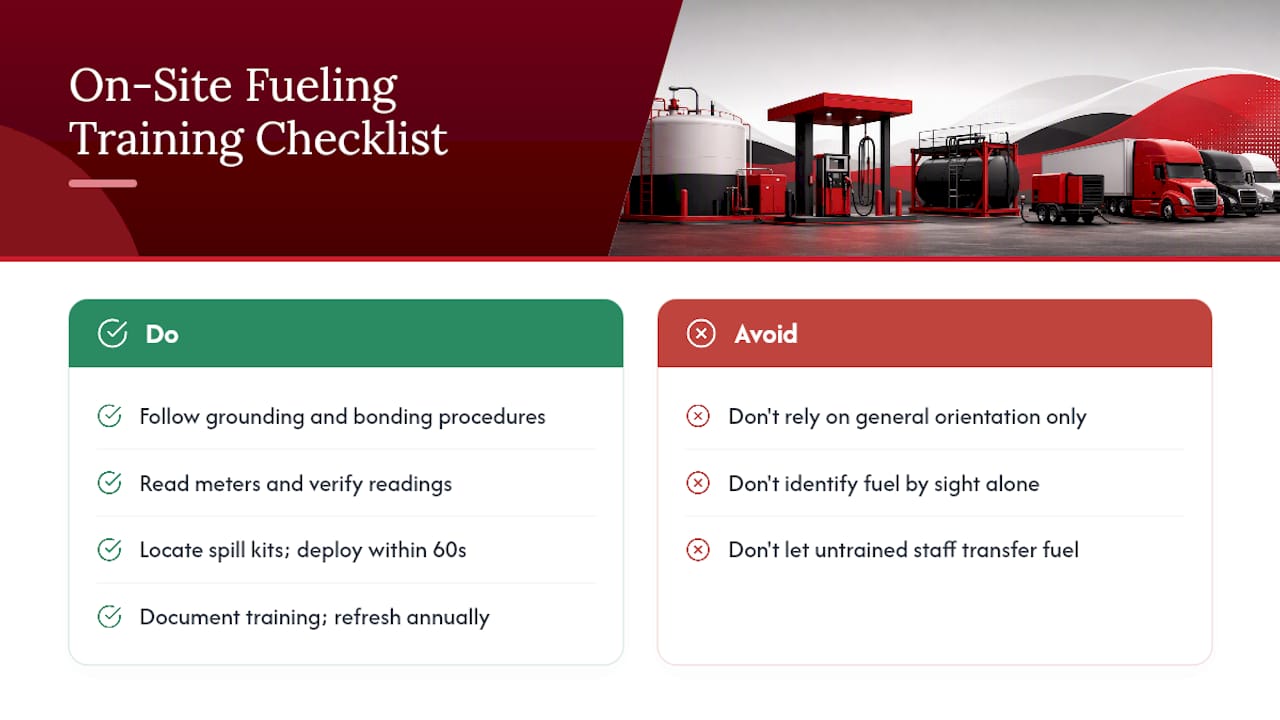
At minimum, staff should understand proper grounding and bonding procedures to prevent static discharge during transfer, since fuel vapor and a stray spark are a genuinely dangerous combination. They need to know how to read a meter correctly and spot when a reading looks wrong before it gets logged as fact. Spill response has to be more than theoretical: staff should know exactly where spill kits are stored and how to deploy them in the first sixty seconds of an incident, because that window often determines whether a spill stays contained to a few square feet or spreads toward a drain.
Product identification matters more than it sounds like it should. Someone who can’t tell clear diesel from dyed diesel by looking at a delivery manifest, and only by looking, is one honest mistake away from a fuel tax compliance problem. Staff also need clear authority limits: who can approve a delivery, who can sign off on a ticket, and who calls the emergency line if something goes wrong after hours.
If your own team performs any fueling rather than leaving it entirely to a mobile provider, document the training and refresh it annually. Turnover in yard staff is common in trucking, and a new hire operating a fuel transfer without proper training is a liability sitting in plain sight.
How Do You Plan for a Fuel Spill or Leak at the Yard?
A spill response plan that exists only in someone’s head isn’t a plan. It’s a hope, and hope doesn’t stop fuel from reaching a storm drain.
Every yard running fuel operations, whether through fixed storage or regular wet hosing deliveries, needs a written response plan that covers three things clearly: who gets notified first, where containment equipment is staged, and what triggers an external report to a regulatory agency versus what stays an internal incident. Spill kits should sit within reach of every fueling zone, not locked in a supply closet across the yard, and someone on every shift should know how to use them without having to call a manager first.
The plan should specify a threshold for escalation. A few dripped ounces during a hose disconnect is a wipe-and-log event. A spill that reaches soil, pavement runoff, or a drain is a different category entirely, often requiring notification to a state environmental agency within a specific time window. Know that threshold before an incident happens, not while you’re standing over a spreading puddle trying to remember it.
Run a tabletop drill at least once a year. Walk through a hypothetical spill scenario with your yard staff and confirm everyone knows their role, where the containment materials actually are, and who makes the call to shut down fueling operations yard-wide if needed. If you rely on a mobile provider for wet hosing rather than fixed storage, ask them directly what their own spill response protocol looks like and who’s liable if an incident happens during their delivery. That liability question alone is worth clarifying in writing before your first fill, not after.
How Is Technology Changing Yard Fueling Operations?
The days of a clipboard and a paper delivery slip are fading, and fleets that hang onto manual tracking are the ones most likely to have unexplained fuel losses at the end of the quarter.
Barcode and RFID scanning at the point of fueling ties every gallon dispensed directly to a specific vehicle, removing the guesswork that comes with hand-written logs. Meter validation systems catch discrepancies in real time rather than after a monthly reconciliation flags something that’s already impossible to trace back to a specific fill. Some fleets now integrate delivery data straight into their telematics platform, so fuel records sit alongside mileage, idle time, and maintenance history in one dashboard instead of three disconnected spreadsheets.
Real-time delivery tracking is another shift worth watching. Instead of waiting for a driver to call when the tanker arrives, dispatch software can show an estimated arrival window, which matters when you’re coordinating a fueling zone that has to stay clear for a delivery truck’s turning radius. Automated reporting exports, tied to the same barcode scanning and meter validation systems that reduce labor and mileage costs, also mean your accounting team spends less time manually entering data from paper tickets.
None of this technology replaces the human checks: someone still needs to physically verify a delivery and sign off. But a yard running metered, barcode-tracked fueling catches discrepancies in days instead of months, and that speed is often the difference between a minor accounting correction and a fuel loss nobody can explain by the time anyone notices.
Getting Set Up With a Reliable Yard Fueling Partner
Everything above points to the same conclusion: the providers worth hiring are the ones who treat documentation, scheduling, and compliance as standard practice, not extras you have to negotiate for. Anytime Fuel Pros (AFP) is built around exactly that operating model for trucking yards.
AFP covers wet hosing, bulk tank fills, DEF delivery, and generator top-offs, with scheduled recurring service for routine yard needs and 24/7 emergency response when a job runs long or a tank runs dry unexpectedly. Primary markets include San Antonio, Austin, Dallas-Fort Worth, and Salt Lake City, and AFP extends coverage nationwide through its partner network, which matters if your fleet operates across multiple states and you want a single point of contact instead of juggling regional vendors. Every delivery generates per-vehicle reporting and transparent invoicing, so your accounting team gets the same clean audit trail this guide has walked through, not a vague monthly total.
If your yard is ready to move off retail fuel runs, request a quote through AFP’s diesel fuel delivery page, or check bulk fuel and DEF delivery options if your yard needs on-site storage rather than truck-to-truck wet hosing. A site survey is the fastest way to find out which service fits your specific yard.
Sources
- Mobile Fueling Service: Benefits, Process & How It Works
- Why On-site Fleet Fueling? ROI for Small, Medium, and Large Fleets
- On-Site Fuel Delivery Services for Smarter Business Fueling
Recent Comments