
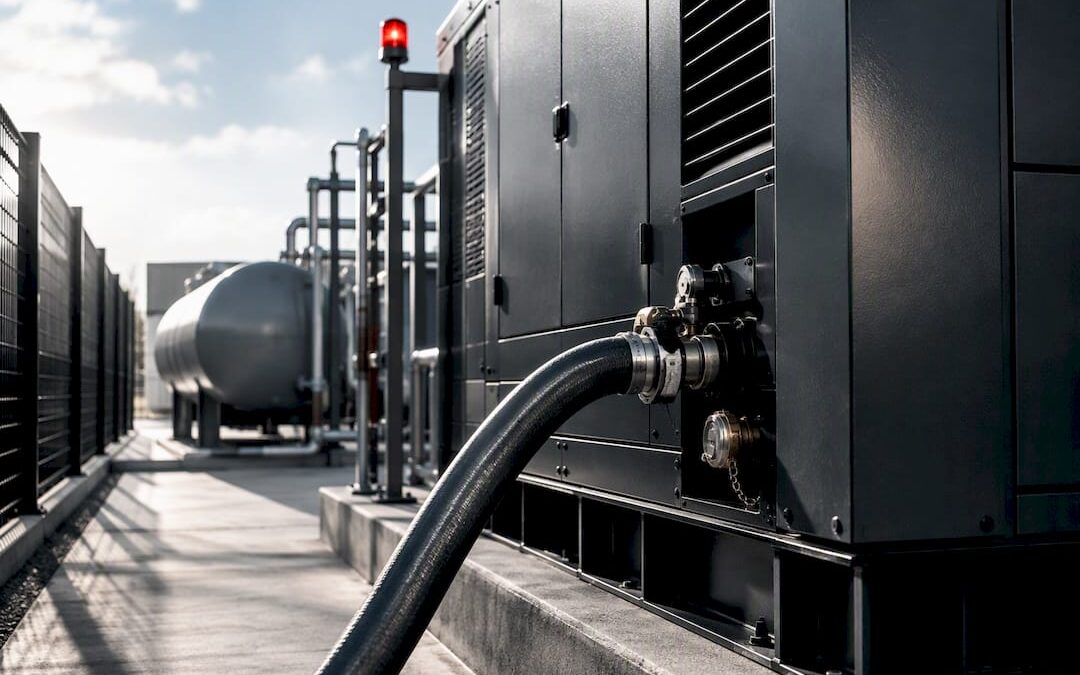
A data center fuel contract has to guarantee two things at once: scheduled top-offs that keep tanks at testing-ready levels, and emergency refueling with a measured response time when the grid fails. It also has to spell out who carries which NFPA 110, EPA UST, and DOT/PHMSA compliance duty, with proof required on every delivery. If your current contract is missing either half, run a gap audit against those three regulatory checkboxes before your next renewal date.
TL;DR:
- Fuel contracts must include measurable SLA response times for emergencies, typically between 2 to 24 hours depending on site priority.
- Deliveries should be scheduled to align with NFPA 110 testing cycles, with clear documentation supporting compliance with EPA UST, SPCC, and DOT/PHMSA regulations.
- A hybrid service model combining scheduled top-offs and guaranteed emergency response is most suitable for multi-site operators with complex testing calendars.
- Contracts must specify detailed operational procedures, including site access, overfill prevention, proof-of-delivery, and multi-site invoicing practices.
- Vendor vetting should include verification of emergency response times, compliance documentation, insurance coverage, and documented delivery tracking capabilities.
Table of Contents
- Contract Types and Service Models for Data Center Fuel Delivery
- Key Contract Clauses Every Data Center Must Include
- Regulatory and Storage Compliance a Fuel Contract Must Support
- Operational Logistics to Specify in the Statement of Work
- Pricing, Invoicing, and Payment Mechanics
- How to Choose and Negotiate a Data Center Fuel Vendor
- Why Data Centers Choose Anytime Fuel Pros for Backup Fuel Contracts
- Sources
- FAQ
Contract Types and Service Models for Data Center Fuel Delivery
Most data center fuel contracts fall into three buckets, and picking the wrong one is a quiet profit killer disguised as a scheduling decision. Scheduled recurring top-offs keep tanks full ahead of monthly and annual NFPA 110 exercise and load-test cycles, so the generator never runs a test on a partial tank. Emergency-only agreements skip the routine visits and focus entirely on response time when a real outage hits, usually banded into windows like 2 to 6 hours for critical sites or 6 to 24 hours for lower-tier facilities.
Hybrid models split the difference, and they’re what most enterprise data centers end up negotiating:
- Scheduled fills timed to your testing calendar, so tanks read full before every exercise
- Guaranteed priority emergency dispatch layered on top of the scheduled cadence
- Multi-site consolidated scheduling, letting one vendor coordinate deliveries across several facilities under a single contract
- A defined trigger point where “scheduled” service escalates to “emergency” pricing and response rules
The right model depends on how many sites you run and how tight your testing windows already are. A single-site facility with predictable test dates can often run lean on scheduled service alone. A multi-site operator juggling different generator ages and test calendars almost always needs the hybrid structure to avoid gaps.
Key Contract Clauses Every Data Center Must Include
A fuel contract without measurable clauses is just a vendor’s promise, and promises don’t hold up during a grid failure at 2 a.m. Every data center contract should nail down these six items before signature:
- SLA response metrics. Exact response-time numbers for emergencies, defined delivery windows for scheduled service, and specific credits or remedies when the vendor misses either.
- Delivery scope and method. How gallons are measured, which delivery methods are approved (wet-hose, top-off), and an explicit prohibition on manifolded tank hookups unless the carrier operates with valves locked closed, since connected tanks with free flow between them can be treated as bulk packaging under the HMR.
- Compliance responsibility. Which party supplies shipping papers, vehicle placarding, and driver credentials, and who files any incident report if a spill occurs.
- Insurance and indemnity. Minimum coverage levels, pollution liability, and a clear line on who pays for cleanup if an SPCC or UST release event happens on your site.
- Price mechanics. How fuel cost pass-through works, fixed margins, delivery minimums, emergency premiums, and termination rights if the vendor repeatedly misses SLA targets.
- Recordkeeping and audit rights. Required proof of delivery, manifests, and how often you reconcile deliveries against invoices.
Pro Tip: Ask any prospective vendor for a sample proof-of-delivery packet before you sign. If it doesn’t already include a delivery checklist covering fill quantity, tank ID, and driver signature, that’s a preview of the paperwork headaches you’ll inherit later.
Regulatory and Storage Compliance a Fuel Contract Must Support
Your fuel contract doesn’t operate in a vacuum. It has to fit inside three overlapping federal frameworks, and a vendor who doesn’t understand all three is a liability wearing a delivery uniform.
NFPA 110 governs generator exercise and load testing, and the standard requires monthly exercise and minimum run times, with specific load guidance for certain test types. Your contract should reference the specific NFPA 110 edition you’re testing against and require delivery quantities timed to those test events, not just a generic monthly visit.

EPA UST and AST rules cover overfill prevention, release detection, and inspection cadences. Federal guidance recommends testing spill prevention and overfill equipment at least every three years, and your contract should name which party documents that testing.
SPCC planning kicks in once your aboveground storage exceeds 1,320 gallons, triggering requirements for facility diagrams, transfer procedures, and spill countermeasures.
- NFPA 110: exercise and load-test scheduling tied to fuel delivery timing
- EPA UST/AST: overfill prevention, release detection, periodic inspection
- SPCC: facility plan elements above the 1,320-gallon aboveground threshold
- DOT/PHMSA HMR: bulk transport thresholds, placarding, and shipping papers
A generator that fails its load test because the tank ran low isn’t a maintenance failure. It’s a contract failure, and it’s entirely preventable with the right delivery-to-test alignment.
Operational Logistics to Specify in the Statement of Work
The clauses matter, but the day-to-day mechanics are where most fuel contracts actually break down. Spell these out in the statement of work, not left to verbal agreement with a driver who’s new to your site.
- Site access and check-in procedures, including who badges drivers in and where delivery trucks stage
- Overfill prevention practices required on every delivery: spill buckets, automatic shutoffs, and a driver who stays present during disconnect
- Vehicle standards, including secondary containment, calibrated meters, and DOT placarding, referencing recognized overfill-prevention designs like those in PEI RP1400 where applicable
- Proof-of-delivery and shipping-paper handoff at the end of every fill
- Coordination protocols for load-bank test dates, planned maintenance windows, and multi-site one-bill scheduling
Pro Tip: If you run more than one site, ask your vendor for a single consolidated invoice across all locations. It sounds like a convenience feature, but it’s really an audit tool. Discrepancies hide easily across five separate invoices; they surface fast on one.
Pricing, Invoicing, and Payment Mechanics
Fuel pricing disputes almost never come from the price itself. They come from unclear surcharge triggers and invoices that don’t map cleanly to what was actually delivered. Most data center contracts use either cost-plus pricing, where you pay a published fuel index plus a fixed per-gallon margin, or market-indexed pricing that floats with daily rack prices.
- Delivery minimums and emergency or after-hours premiums, stated as flat rates or percentage multipliers, not vague language like “market conditions apply”
- Surcharge triggers tied to a named fuel index, with a cap on time-of-day multipliers and a clear definition of what qualifies as a declared emergency
- Itemized invoicing showing fuel charge, delivery fee, and taxes as separate line items, reconciled against the proof of delivery
- Audit rights and a defined dispute window, plus an escrow or holdback mechanism if the vendor repeatedly misses performance targets
Transparent invoicing isn’t a nice-to-have add-on. It’s the difference between catching a billing error in week one and discovering it buried in twelve months of statements.
How to Choose and Negotiate a Data Center Fuel Vendor
Vetting a fuel contractor for mission-critical infrastructure takes more scrutiny than sourcing a landscaping contract. Use this checklist before you sign anything:
- Confirm the vendor’s process explicitly references NFPA 110 testing schedules, not generic “as needed” language.
- Ask for documented EPA UST and SPCC experience, including how they support your facility’s inspection and testing cadence.
- Verify DOT-compliant transport practices, including driver HAZMAT endorsements and current shipping-paper procedures for every load.
- Request their actual emergency response-time track record, not just a stated SLA target.
- Confirm insurance limits, especially pollution liability, in writing.
- Ask about delivery-tracking technology, since real-time visibility into dispatch status matters when a generator is running on borrowed time.
- Pose these seven questions directly: What’s your average emergency response time in my region? How do you document overfill prevention on each delivery? Who holds the HAZMAT endorsement on delivery trucks? What happens if you miss an SLA window? How is pricing calculated during a declared emergency? Can I audit delivery records on demand? What’s your escalation path if a driver flags a site issue?
Pro Tip: If a vendor hesitates on any of those seven questions, that hesitation is your answer. Negotiate SLA credits, capped emergency rates, and audit rights into the contract before you sign, and loop in a professional engineer or environmental consultant for any SPCC-triggering storage volume.
Why Data Centers Choose Anytime Fuel Pros for Backup Fuel Contracts
Some vendors build contracts that include scheduled top-offs aligned with testing calendars, backed by emergency response and nationwide coordination through partner networks.
That combination matters most for mission-critical sites, where a missed delivery window doesn’t just cost money, it risks uptime. Certain fuel providers support fueling practices aligned to generator test schedules, provide transparent itemized invoicing, and document delivery compliance consistent with auditing expectations. For facilities running multiple locations, coordination across sites under one point of contact helps address consolidation challenges common among data center operators when selecting a fuel partner.
If your current contract is missing measurable SLAs, testing-aligned scheduling, or clean documentation, request a procurement-ready fuel quote or ask about a site fuel audit through Anytime Fuel Pros’ emergency fuel delivery services page to see where the gaps sit before your next test cycle.
Sources
- 49 CFR §173.150 — Exceptions for combustible liquids and related requirements
- Spill Prevention, Control and Countermeasure (SPCC) regulation guidance
FAQ
What Should a Data Center Fuel Contract Guarantee?
It should guarantee scheduled top-offs aligned to your NFPA 110 testing calendar plus a measurable emergency response SLA. It should also assign clear responsibility for EPA UST, SPCC, and DOT/PHMSA documentation on every delivery.
How Fast Should Emergency Fuel Response Be?
Response bands typically range from 2 to 6 hours for critical mission-critical sites up to 6 to 24 hours for lower-priority facilities, and the exact number should be written into the SLA rather than left as a verbal promise. Anytime Fuel Pros structures its emergency fuel services for data centers around defined response commitments rather than open-ended “priority” language.
Does SPCC Apply to Every Data Center Fuel Tank?
SPCC plans are triggered once aboveground oil storage exceeds 1,320 gallons, so smaller backup tanks may fall outside the requirement. Facilities near that threshold should still ask vendors to support documentation in case storage capacity grows.
Who Is Responsible for Driver HAZMAT Endorsements?
The carrier delivering bulk diesel is responsible for ensuring drivers hold the correct CDL with a HAZMAT endorsement when the vehicle is placarded, per DOT/PHMSA rules. The contract should still require the vendor to certify this in writing rather than assume it.
How Much Does Anytime Fuel Pros Charge for Data Center Fuel Delivery?
Pricing depends on fuel type, volume, and service model, so current rates are listed on the Anytime Fuel Pros fuel services page rather than published as a flat rate. Facilities teams can request a procurement-ready quote directly through that page.
Recent Comments