
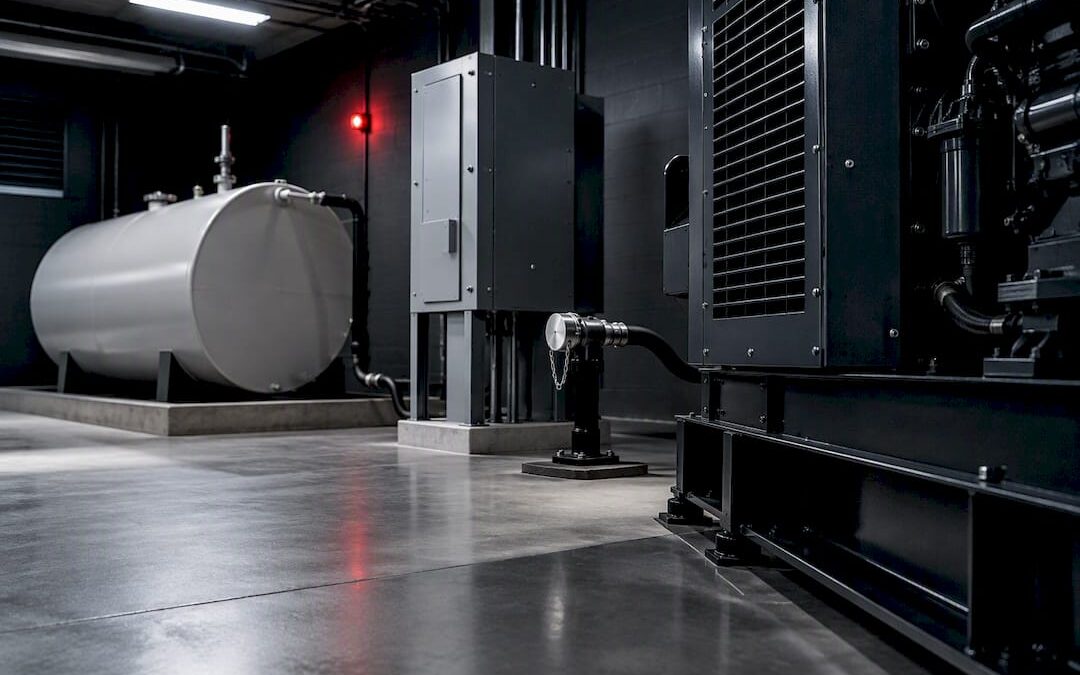
When the power drops, the first move is not the fuel truck. It is confirming staff safety, verifying the generator starts and connects cleanly to critical loads, and checking day-tank levels before anyone picks up the phone. Once those three checks clear, the highest-impact action is pre-positioning fuel through your emergency supplier and notifying local emergency management so drivers can reach your site without delay.
TL;DR:
- Confirm staff safety, generator startup, and fuel levels within the first hour to prevent delays in critical response efforts.
- Continuously update fuel demand estimates based on load, site conditions, and changing outage severity rather than relying on a single static order.
- Ensure fuel storage complies with federal and local regulations, with regular testing and maintenance of overfill alarms and contamination controls.
- Use automatic transfer switches for generator connection and exercise full start-and-connect procedures regularly to guarantee reliable operation.
- Pre-arrange site access, maintain an emergency fuel account, and work with a reliable supplier to shorten response time during outages.
Table of Contents
- The first 30 to 60 minutes: an action checklist for outages
- Forecasting fuel demand and pre-positioning supply across sites
- Storage rules and compliance for backup generator fuel
- Generator hookup, transfer switches, and safe refueling procedure
- Getting fuel to the site when access is constrained
- Keeping stored fuel usable: quality, polishing, and turnover
- Contract terms and procurement checklist for emergency fuel service
- What mobilization actually costs and how long it takes
- How a commercial fuel partner fits into an outage plan
- Setting up your emergency fuel account before you need it
- Sources
- FAQ
The first 30 to 60 minutes: an action checklist for outages
The first hour after a power failure sets the tone for everything that follows. Facility teams that move through a fixed sequence, rather than improvising, avoid the two most common failures: an unsafe generator start and a fuel delivery that arrives too late to matter.
- Run safety checks first: verify carbon monoxide monitors, confirm ventilation around the generator enclosure, and never refuel a running unit.
- Confirm the automatic transfer switch has moved to generator power, or complete the manual transfer if your site lacks an ATS.
- Run a brief under-load check if conditions allow. A generator that starts but stalls under real load needs attention before fuel becomes the bottleneck.
- Check day tank, above-ground tank, or underground tank levels against a pre-set threshold that triggers a call to your supplier, not a wait-and-see approach.
- Secure site access: confirm gate codes, name a driver point of contact, and pre-authorize entry so a tanker is not stuck at the fence line.
- Apply your escalation matrix. If on-site fuel covers the expected outage window, hold. If it does not, trigger emergency dispatch immediately rather than waiting for a lower reading.
EPA’s preparedness guidance for water and wastewater systems makes a related point: generator readiness is a system, not a truckload. Testing under actual electrical load and maintaining a start-and-connect checklist prevents deliveries that arrive to a generator that cannot use them.
Pro Tip: Laminate your escalation matrix and post it next to the transfer switch. In an outage, nobody wants to search a shared drive for the phone number that triggers dispatch.
Forecasting fuel demand and pre-positioning supply across sites
Fuel logistics during an outage is not a single purchase decision. It is a rolling calculation that updates as new information about outage severity, road access, and site conditions arrives. Treating it as one static order is how facilities run dry mid-event.
Start with a consumption heuristic. A commonly used starting point is about 0.07 gallons of diesel per hour per kilowatt of generator load, refined against your specific generator’s spec sheet. From there, multiply expected load by tank capacity to estimate runtime, and set a delivery trigger well before that runtime hits zero.
A 2022 study published in IISE Transactions modeled emergency diesel dispatch using historical weather and outage data in a rolling-horizon framework, and found that continuously updating pre-positioning and route assignments outperformed a single fixed plan. That finding matches what dispatchers see in practice: demand uncertainty and shifting road access mean the second delivery plan of the day is often better than the first, and the third better still.
Before and during an event, collect:
- Generator load in kilowatts for every critical site.
- Tank size and current fuel level for each location.
- The date of the last fuel polish or quality test.
- Any access constraints: flooding, road closures, or restricted hours.
Rank sites by criticality and set runtime thresholds that trigger different response tiers. A data center with a four-hour runtime buffer needs a different response than a fleet yard with two days of storage. Ask your supplier directly how they handle re-prioritization when multiple customers request delivery in the same window, since clustered demand during a regional outage is when supply gets tight. A supplier who can explain their surge protocol before an event is more useful than one who only mentions it after your first missed delivery. For sites in hurricane-prone regions, a pre-built fuel delivery plan built around seasonal forecasts adds another layer of pre-positioning before storm season even starts.
Storage rules and compliance for backup generator fuel
Fuel that sits in a noncompliant tank, or one nobody has inspected, is not backup power. It is a liability waiting to surface at the worst moment. The federal and code-based rules here exist specifically to prevent that outcome.
The EPA’s federal requirements for emergency-power generator UST systems cover release detection, overfill prevention, corrosion protection, operator training, and periodic inspections, along with recordkeeping that regulators and insurers will ask for after an incident. A common practitioner failure mode shows up here: the tanker arrives ready to deliver, but the receiving side is not. Missing overfill alarms, a fill point buried behind equipment, or no trained staff on hand to accept the delivery all cause delays that have nothing to do with the fuel itself.
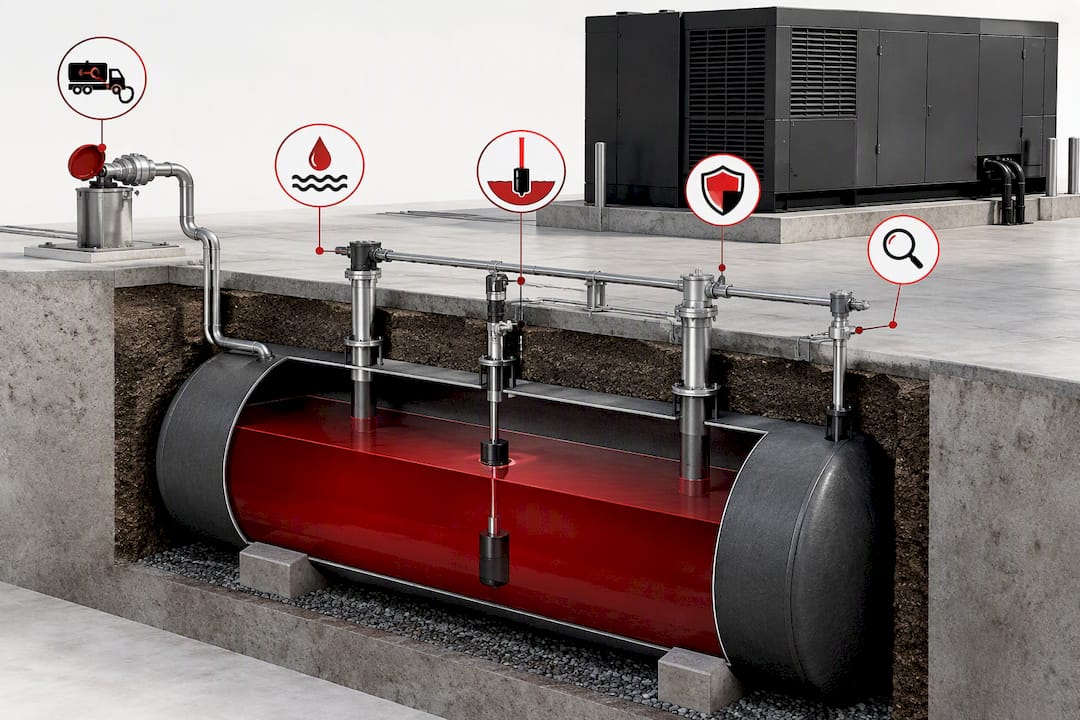
A widely cited industry heuristic: about 0.07 gallons of diesel per hour per kilowatt of load is the starting figure operators use to size runtime against tank capacity, refined with the generator’s own spec sheet.
Key compliance and siting points to confirm before an outage hits:
- Overfill alarms and release detection systems are tested on a working schedule, not left unchecked since installation.
- Tanks and generator connections sit above known flood elevations. Floodwater around a fill point turns a routine delivery into a hazard.
- The fill point is clear, visible, and reachable, giving the delivery driver a sight-line to confirm the correct connection before pumping.
- State or local fire marshal rules are confirmed before any temporary tank goes in, since requirements vary by jurisdiction even where federal rules apply.
NFPA’s code-development material on fuel storage adds a separate warning: stored fuel has a usable life, and contamination risk starts accumulating from the day of first fill, which is a compliance point as much as a quality one. Confirming state and local program applicability before installing any temporary tank avoids a delivery that a fire marshal later halts.
Generator hookup, transfer switches, and safe refueling procedure
Getting fuel to the site solves half the problem. The generator still has to start, connect, and run under load without a refueling accident, and that depends on hardware decisions made well before the outage starts.
Automatic transfer switches sense a utility failure and shift load to the generator within seconds, with no human step required. Manual switches need someone on-site to throw them, which works fine if staffing is reliable but adds a point of failure if the building is empty when power drops. Facilities with intermittent staffing or unmanned equipment yards lean toward ATS for that reason.
- Confirm camlock connections or dedicated hookup points are rated for your generator’s amperage and free of corrosion.
- Bring in a licensed electrician for any sizing or installation work. Transfer switch capacity that does not match generator output is a fire risk, not a minor mismatch.
- Before refueling, shut the unit down completely, let it cool, confirm proper grounding, and ventilate the area. Never refuel a running generator.
- Translate load into fuel needs using the kilowatt-to-gallons-per-hour heuristic, then check that number against actual tank capacity to estimate real runtime.
- Exercise the full start-and-connect sequence under load on a recurring schedule, not just during commissioning.
Pro Tip: Run your load test on the same day each quarter and log the result next to your maintenance records. A generator that passed a no-load test six months ago can still fail under real demand.
FEMA’s generator preparedness job aid backs this up directly, recommending that facilities complete a start/connect checklist and share it with local emergency planning contacts so priority response requests move faster when they matter.
Getting fuel to the site when access is constrained
A full tank truck sitting at a depot does nothing for a facility it cannot reach. Last-mile logistics during an outage is often the actual bottleneck, not fuel supply itself, especially when roads are damaged or access points are unclear.
- Pre-authorize site access before an event: gate codes, a named driver point of contact, staging areas for the tanker, and a security escort plan if the site requires one.
- Coordinate with your Local Emergency Planning Committee, local emergency management, or state WARN mechanisms, since these channels can grant priority access when general road conditions are restricted.
- Expect clustered demand during regional outages. Ask your supplier how staging, mutual aid between fuel providers, and partner-network routing reduce wait times when many customers call at once.
- Plan alternate fill strategies for impassable roads: mobile bladders, temporary day tanks staged outside the affected zone, or handoff points where a smaller vehicle completes the final leg.
- Set a communication cadence before the event, not during it. Operations, procurement, and executives each need a different update rhythm, and a template written in advance saves time when everyone is under pressure.
Flooding routinely breaks the planned delivery route. Building an alternate staging point outside the flood zone into your plan now means a driver has somewhere to go when the primary route is underwater, rather than circling looking for a workaround.
Keeping stored fuel usable: quality, polishing, and turnover
A tank reading full on the gauge is not the same as a tank holding usable fuel. Diesel degrades through condensation, water intrusion, and microbial growth, and a facility that never tests its stored fuel can discover the problem only when the generator is already running and starts to falter.
- Establish a baseline fuel sample at first fill, since NFPA’s code-development guidance ties contamination risk directly to the fuel’s age and storage history from that point forward.
- Test on a regular interval with lab analysis rather than relying on a visual check, which cannot detect water content or microbial contamination.
- Call in professional fuel polishing and water separation when test results show contamination, rather than waiting for a generator failure to confirm the problem.
- Turn over stored inventory on a defined schedule so older fuel does not sit past its usable life before a real outage arrives.
- Log every polishing, sampling, and turnover action in your generator maintenance records, and write the same cadence into your delivery contract so it is not left to memory.
Pro Tip: Schedule your annual fuel test to land right before hurricane season or your highest-risk outage window, so any polishing need surfaces while you still have time to act.
A structured fuel maintenance program that bundles sampling, polishing, and turnover into one recurring service closes the gap that NFPA and EPA guidance both point to: facilities often have fuel on-site but lack the testing and turnover work that makes it usable when the generator finally needs it.
Contract terms and procurement checklist for emergency fuel service
The contract you sign with a fuel supplier determines whether an emergency call gets a truck in hours or a voicemail. Procurement teams should treat the SLA as the actual product, not an afterthought to the fuel price.
- Confirm a guaranteed response time in writing, along with after-hours coverage and a stated minimum dispatch volume per call.
- Ask how the supplier ranks priority customers and how that ranking holds up during a regional event with many simultaneous requests.
- Get surge capacity language in writing, including how re-prioritization works when demand clusters across their customer base.
- Review insurance and environmental liability coverage, and request a written spill-response plan along with documentation practices.
- Demand billing clarity: itemized charges, after-hours premiums stated as a fixed rule, and the formula used to set fuel pricing during high-demand periods.
- Vet the vendor directly: DOT insurance status, a real spill-response plan, driver vetting practices, delivery equipment specs, and references from comparable facilities.
A procurement-ready emergency fuel plan built around these terms turns a vague “call if we need fuel” arrangement into a contract that holds up when demand spikes.
What mobilization actually costs and how long it takes
Emergency fuel delivery timelines range from a few hours to as long as 72 hours, depending on distance, road conditions, and how many other customers are competing for the same supplier’s trucks during a regional event. Facilities that pre-position supply and pre-authorize site access consistently see the shorter end of that range.
Several factors drive laid-in cost during an outage:
- The underlying fuel market price at the time of delivery.
- After-hours and emergency dispatch fees layered on top of standard rates.
- Distance and mileage to the site, particularly for remote or hard-to-reach locations.
- Site complexity, including escort requirements and restricted access.
A key operational reality: clustered demand during regional outages drives laid-in cost higher across the board, which is why contract language capping surge pricing or sharing that risk matters more during widespread events than during a single-site outage.
The trade-off comes down to three levers: larger on-site storage, more frequent scheduled top-offs, or contracted emergency capacity you can call on demand. Facilities balancing cost against redundancy typically combine a modest storage buffer with a contracted supplier rather than betting everything on one or the other.
How a commercial fuel partner fits into an outage plan
A reliable fuel partner should bring 24/7 emergency response, scheduled top-off service to keep tanks from ever hitting a critical threshold, DEF delivery for diesel fleets running alongside generators, and documentation that satisfies both your internal records and regulatory inspections.
Some commercial fuel delivery companies operate from primary markets in major cities and extend nationwide through partner networks, providing multi-site operators a single point of contact rather than a different vendor per region. For data centers specifically, emergency fuel services built around generator fueling configurations address the acceptance-side details, like fill point access and documentation, that determine whether a delivery actually restores runtime on arrival.
When evaluating a partner like AFP or a comparable supplier, put an inspection and acceptance flow into the contract itself: who confirms tank levels before dispatch, who signs off on delivery, and how documentation gets filed for compliance records. That clause turns a delivery into a verified, auditable event rather than a truck showing up and leaving.
Setting up your emergency fuel account before you need it
The moment an outage starts is the wrong time to find a supplier for the first time. Facilities that already have an account, a known contact, and pre-shared site details get fuel faster than those starting from a cold call, because the supplier is not asking basic questions while the clock runs.
Before you call, have your site point of contact, tank sizes, and generator load in kilowatts ready to hand over. That single piece of preparation shaves real time off dispatch, since a supplier working from complete site data can route a truck immediately instead of confirming details mid-call.
- Visit the fuel services page to review delivery options for diesel, gasoline, and DEF across scheduled and on-demand formats.
- Check the emergency fuel delivery page for rapid-response service and fuel polishing if a quality issue turns up during an outage.
- Review bulk fuel delivery if your site needs a larger tank fill rather than a scheduled top-off.
A professional supplier handles dispatch, documentation, and compliance recordkeeping as part of the service. Ad hoc sourcing during an outage, calling around for whoever answers, leaves those pieces to chance right when you need them most.
Sources
For the technical and legal detail behind this guide, go directly to the primary documents:
- Is your water or wastewater system prepared? What you need to know about generators | US EPA
- FEMA generator preparedness job aid
FAQ
What should you stockpile for a power outage?
Facilities should prioritize a tested backup generator with verified fuel supply, water, basic medical supplies, and communication tools like a battery-powered radio. For fuel specifically, keep tanks above your defined top-off threshold and confirm your emergency supplier contact rather than relying on stored volume alone.
How long will natural gas last without electricity?
Natural gas service typically continues during a power outage because it does not depend on the electrical grid the way generator fuel delivery does, though appliances and equipment that need electricity to ignite or operate gas systems may still fail. Facilities relying on gas-fired generators should still confirm their ignition and control systems have backup power.
Can you get gasoline during a power outage?
Retail gas stations often cannot pump fuel during an outage unless they have their own backup generator, which limits availability at the pump. Commercial and critical-infrastructure sites typically rely on a contracted supplier like Anytime Fuel Pros for on-site delivery rather than sending staff to search for an operating station.
Do grocery stores have backup generators for power outages?
Some grocery stores maintain backup generators to keep refrigeration and essential systems running during outages, though coverage varies by chain and location. Facilities depending on a grocery partner for supply continuity should confirm that store’s specific backup power capability rather than assuming it as standard.
Recent Comments