
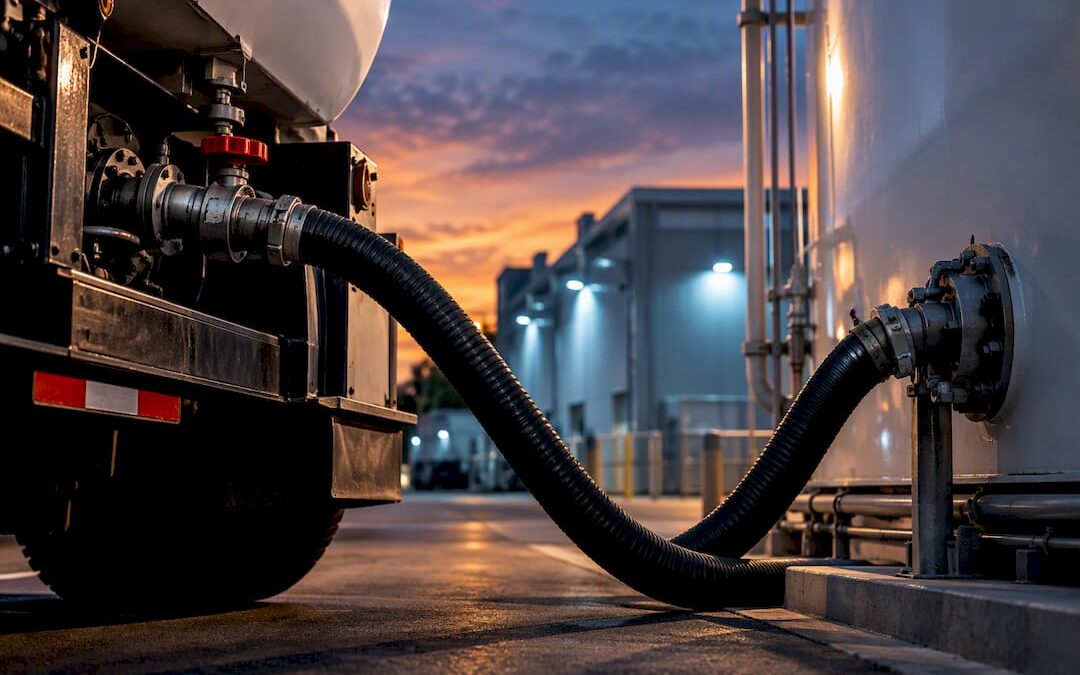
Emergency on-site diesel delivery typically runs from a premium of $0.50 to $2.00 or more per gallon above the base commodity price, once after-hours fees, mobilization charges, and truck minimums are added to the invoice. The exact number depends on how far the truck has to travel, how much fuel you order, and how fast you need it there. Fuel price volatility is the biggest wildcard in any estimate, since diesel commodity costs shift week to week and directly move the floor of every quote. The worked examples and cost-cutting tactics below show how those pieces fit together.
TL;DR:
- Emergency diesel delivery premiums typically range from $0.50 to $2.00 or more per gallon, influenced mainly by distance, order size, and after-hours timing.
- Fuel costs escalate if your site exceeds the EPA’s 1,320-gallon SPCC threshold, triggering costly compliance requirements and secondary containment.
- Using bulk totes for DEF can significantly reduce per-gallon costs, often making them cheaper than retail jugs, especially on recurring sites.
- Having a standing contract with predictable mobilization fees can reduce overall expenses compared to multiple uncontracted emergency calls.
- A generator consuming 70 gallons per hour at full load will incur roughly $440 in fuel cost per hour at $6.28 per gallon, before delivery premiums.
Table of Contents
- What drives emergency delivery pricing
- Typical delivered-price ranges and worked examples
- How vendors calculate the final invoice
- Regulatory and operational costs that follow an emergency delivery
- How to reduce emergency delivery cost and protect uptime
- When to call emergency delivery versus using on-site reserves
- How Anytime Fuel Pros helps with emergency deliveries
- Sources
- FAQ
What drives emergency delivery pricing
Every emergency fuel invoice starts with the commodity price of diesel or gasoline on the day of delivery, and that number moves with regional supply, refinery output, and seasonal demand. Vendors add a delivered premium on top of that baseline to cover the truck, the driver, and the urgency of the request. That premium is where most of the sticker shock lives, and it breaks down into a handful of predictable components.
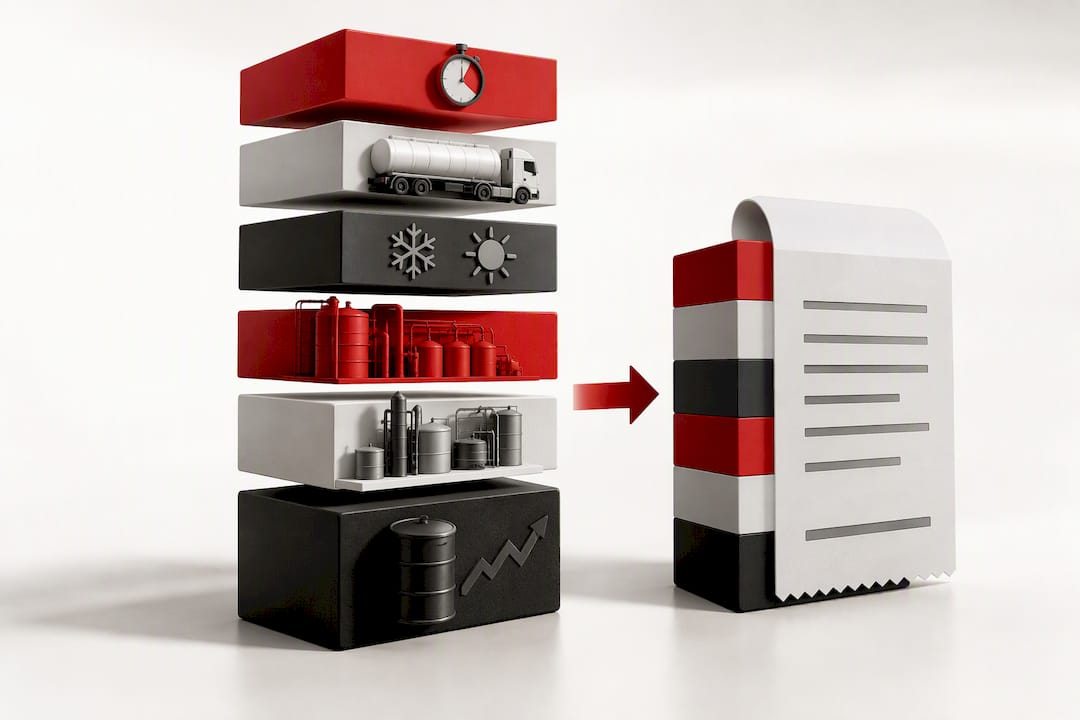
Distance matters because a driver dispatched 60 miles outside a normal service radius costs more than one already staged nearby. Order size matters too: most vendors set a truck minimum, often in the 300 to 500 gallon range, and an order below that threshold still gets billed at the minimum. Site access can add cost as well, since a location requiring special equipment or a long hose run takes more driver time.
Timing is the other major lever. A same-day daytime delivery costs less than a call placed at 2 a.m. on a holiday weekend, when dispatch has to pull a driver off schedule or authorize overtime.
- Commodity fuel cost: the baseline price per gallon, which shifts with regional supply and demand.
- Distance and mobilization: mileage from the depot and any equipment needed to reach the tank.
- Truck minimums: a floor on order size that raises the effective per-gallon price on small orders.
- After-hours and holiday premiums: added dispatch cost for nights, weekends, and emergency turnaround.
Typical delivered-price ranges and worked examples
A common industry rule of thumb puts diesel generator consumption at roughly 0.07 gallons per kWh, which works out to about 70 gallons per hour for a 1 megawatt unit running at full load. At $6.28 per gallon, that same generator fuel data shows an hourly fuel cost near $440, or roughly $10,560 for a full 24-hour run, before any delivery premium is added.
- Generator refuel, 1MW unit: at 70 gallons per hour, an 8-hour outage burns about 560 gallons, which lands well above most truck minimums and keeps the per-gallon delivery premium closer to the low end of the typical range.
- Bulk fill, 1,000 gallons: commodity cost plus a modest mobilization fee, since the order clears most truck minimums comfortably.
- Bulk fill, 5,000 gallons: the delivered premium per gallon drops further, since mobilization and after-hours fees spread across a much larger volume.
- DEF tote order: bulk tote pricing runs about $1.95 to $3.20 per gallon before delivery charges, compared with $3.50 to $5.50 per gallon for retail jugs, so switching from jugs to totes is one of the simplest ways to cut DEF spend on a recurring site.
Use a fuel consumption calculator to convert your generator’s load into an expected gallon count before you call for a quote.
How vendors calculate the final invoice
A delivered fuel invoice is rarely just gallons times price. Most vendors itemize the fuel charge separately from the delivery fee, then layer on any truck minimum shortfall, pump or equipment rental, and a mobilization charge if the site sits outside the standard service area. After-hours dispatch typically shows up as its own line, and some vendors add a manifest or disposal fee when waste fuel or contaminated product has to be removed.
Confirm delivered gallons against the delivery ticket and any gauging the driver performs on-site, and keep the proof of delivery on file for your own records and for any SPCC compliance documentation. Ask about card processing fees or COD surcharges before the truck arrives, since some vendors pass along a percentage for card payments that a standing account avoids.
- Fuel and delivery charges: listed separately so you can see the true delivered premium.
- Truck minimums and equipment fees: pump rental or special transfer equipment billed when the site requires it.
- After-hours and manifest fees: emergency dispatch premiums and any waste-handling charges.
- Payment terms: card or COD fees that a contracted account often avoids.
Pro Tip: Ask for an itemized quote before dispatch, not after delivery. It’s the fastest way to catch a truck-minimum surprise while there’s still time to combine orders.
Regulatory and operational costs that follow an emergency delivery
An emergency delivery can trigger costs that show up weeks later, not on the invoice itself. The EPA’s SPCC rule under 40 CFR part 112 generally applies once a facility’s aggregate aboveground oil storage passes 1,320 gallons, and crossing that line typically requires a professional-engineer-certified SPCC plan and secondary containment. Many multi-generator sites cross that threshold without realizing it, and the compliance work that follows adds real capital cost on top of the fuel itself.
PEI RP1400 sets recommended practices for the design and installation of tanks, piping, and transfer equipment used in emergency generator fueling, while NFPA 110 ties generator exercise and fuel-management schedules to standby power reliability. Fuel that sits unused for months degrades, and a failed start during a real outage costs far more than routine maintenance.
- SPCC threshold: 1,320 gallons aggregate aboveground storage triggers a certified plan and containment requirements.
- PEI RP1400: guides tank, piping, and equipment design for generator fuel systems.
- NFPA 110: links fuel turnover and generator exercise to standby reliability.
Commercial fuel polishing programs typically run about $1,200 to $4,000 per year for many standby installations, and that recurring cost is cheap compared with a generator that fails to start when it matters most.
How to reduce emergency delivery cost and protect uptime
The single biggest lever most facilities underuse is the standing contract. A committed-volume or scheduled emergency contract locks in pricing terms before the crisis hits, so you are not negotiating rates at 2 a.m. under pressure.
- Set up scheduled top-offs during normal business hours to keep tanks near capacity and avoid emergency dispatch altogether.
- Consolidate multi-site orders onto one invoice and one vendor relationship to spread mobilization costs across more gallons.
- Add fuel polishing and testing to your maintenance calendar so stored diesel stays usable and you are not paying for fuel you have to discard.
- Pre-stage fuel for known high-risk periods, such as hurricane season or a scheduled event, rather than waiting for a same-day emergency call.
Pro Tip: A committed-volume contract with a capped mobilization fee often costs less over a year than three or four uncontracted emergency calls, even if you never use the full committed volume.
When to call emergency delivery versus using on-site reserves
Not every low-fuel alert justifies an emergency call. Check remaining runtime against expected generator load first, since a tank at 30% with six hours of runtime left is a very different situation than one with 30 minutes.
- Confirm remaining runtime against actual load, not the tank’s rated capacity.
- Check fuel quality if the fuel has sat for more than 12 to 18 months without polishing.
- Review SPCC and permit limits before accepting an emergency top-off that pushes storage over 1,320 gallons.
- Weigh site access and response time: a remote site with a 6-hour response window may need bridge power or a rental generator instead of waiting on delivery.
How Anytime Fuel Pros helps with emergency deliveries
When a generator is burning fuel faster than expected or a job site runs dry, the cost that matters most is the cost of downtime, not the fuel premium. Anytime Fuel Pros runs 24/7 dispatch with a nationwide partner network, so a data center in Dallas or a job site outside San Antonio gets the same direct-response service and the same itemized invoice, with no guessing about what each line item covers.
- Emergency and after-hours refueling dispatched through a 24/7 coordination team.
- Bulk diesel, gasoline, and DEF delivery sized to your site, from a single generator top-off to a multi-thousand-gallon fill.
- Documented proof of delivery on every order, so your SPCC and audit records stay current.
- Standing contract options with capped mobilization and defined response windows for critical sites.
| What you get | Why it affects cost |
|---|---|
| 24/7 emergency dispatch | Avoids downtime costs that exceed fuel premiums |
| Itemized invoicing | No surprise fees after delivery |
| Nationwide partner network | One vendor relationship across multiple sites |
| Standing contract options | Locks in mobilization terms before a crisis hits |
Request immediate dispatch or ask about a tailored emergency-rate contract on the emergency fuel delivery page.
Sources
- EPA — SPCC rule overview and applicability flowchart
- PEI — RP1400: Fueling Systems for Emergency Generators
- NFPA — Excerpts and guidance related to NFPA 110
- Generator Source — Diesel fuel cost impact on industrial generator owners
- LatestCost — Gallon of DEF cost and price guide
FAQ
What is a typical emergency fuel delivery premium per gallon?
Expect roughly $0.50 to $2.00 or more above the commodity price per gallon, driven mainly by distance, order size, and after-hours dispatch. A committed-volume contract with Anytime Fuel Pros can cap that premium with predictable mobilization terms.
How much fuel does a generator burn per hour in an outage?
A common rule of thumb is about 0.07 gallons per kWh, which is close to 70 gallons per hour for a 1 megawatt unit at full load. Multiply that rate by your expected runtime to estimate the gallons you need to order.
When does SPCC apply to my fuel storage?
The EPA’s SPCC rule generally applies once aggregate aboveground oil storage exceeds 1,320 gallons, which typically requires a certified plan and containment measures. Many sites with multiple generators cross this threshold without realizing it.
Is bulk DEF cheaper than retail DEF jugs?
Yes. Bulk tote pricing runs about $1.95 to $3.20 per gallon, while retail jugs commonly cost $3.50 to $5.50 per gallon before delivery charges. Switching to totes on a recurring site is one of the simplest ways to lower DEF spend.
Does Anytime Fuel Pros charge for emergency after-hours delivery?
Anytime Fuel Pros provides itemized invoicing so any after-hours or mobilization fee is shown as a separate line rather than folded into the fuel price. Contact the emergency fuel delivery team for a quote specific to your site and timeline.
Recent Comments