
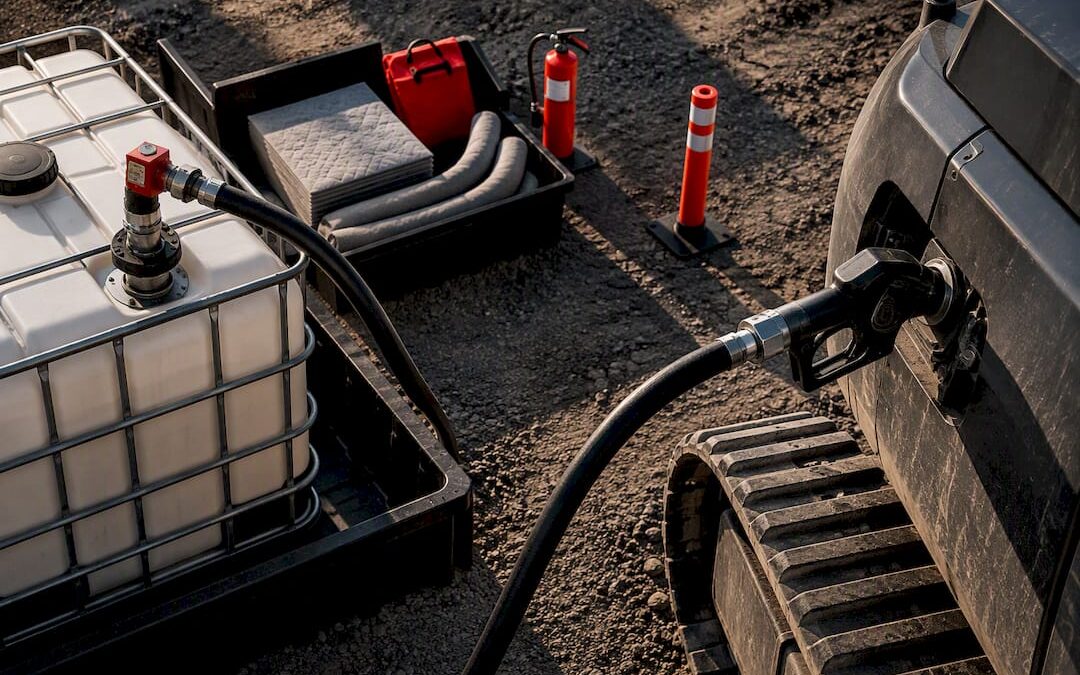
A construction fueling plan must ensure compliant, spill-preventing on-site fueling through documented procedures, designated fueling locations and personnel, and verified delivery and inventory controls. Three actions get you started today: total your aggregate fuel capacity, designate a fueling zone and attendant, and set delivery and reorder triggers. Every piece should trace back to EPA, NFPA, and OSHA requirements, and the template below shows exactly how.
TL;DR:
- Confirm that equipment tanks over 55 gallons are included in the total fuel capacity calculation to accurately assess SPCC compliance thresholds.
- Draft and implement a site diagram, spill containment measures, and personnel training records aligned with EPA, NFPA, and OSHA requirements before starting fueling operations.
- Use metered tank-truck deliveries with digital confirmation, and set reorder triggers based on burn rate plus lead time to prevent running out of fuel.
- Ensure secondary containment and spill kits are staged at every transfer point, with trained attendants executing pre-transfer checks and emergency procedures.
- Require vendors to provide proof of insurance, metered receipts, and safety data sheets to maintain thorough documentation and support ongoing compliance.
Table of Contents
- Executive checklist: the fueling-plan essentials every site must document
- Regulatory requirements that shape your plan: SPCC, NFPA mobile fueling, and OSHA
- On-site fueling methods and safe workflows for every delivery type
- Fuel logistics and inventory monitoring that prevent runouts and shrinkage
- Spill prevention, containment, and emergency response procedures
- Personnel, training, and documentation that prove compliance
- Practical fueling-plan template and sample site diagram
- Implementing the plan and procuring fueling services
- How Anytime Fuel Pros can operationalize your construction fueling plan
- Sources
- FAQ
Executive checklist: the fueling-plan essentials every site must document
A workable plan is only as good as what it forces you to check. Before you sign off on any fueling procedure, confirm the site has covered these five areas in writing, not just in someone’s memory.
- Inventory accounting: total aggregate capacity across bulk tanks, portable containers, and equipment fuel tanks, since equipment tanks over 55 gallons count toward regulatory thresholds.
- Designated fueling spots: fixed locations with defined clearances from ignition sources, drainage paths, and occupied structures, plus basic traffic controls during transfers.
- Transfer hardware and procedures: automatic-closing nozzles, drip pans, and a written step-by-step sequence for every delivery type.
- Containment controls: secondary containment under tanks and transfer points, with spill kits staged within reach of every fueling location.
- Recordkeeping: permits, delivery tickets, meter readings, and inspection logs filed where an auditor or AHJ can find them fast.
Miss any one of these and the rest of the plan loses credibility fast, because inspectors and insurers read a fueling plan as a single connected system, not five separate boxes to check.
Regulatory requirements that shape your plan: SPCC, NFPA mobile fueling, and OSHA
Three federal frameworks govern most construction fueling operations, and your plan needs to answer to all three, not just the one that seems most obvious.
The EPA’s Tier I qualified facility SPCC plan template applies once a site’s aggregate aboveground oil storage crosses the thresholds set under 40 CFR Part 112. The catch that trips up most site managers: fuel sitting in mobile equipment tanks over 55 gallons counts toward that aggregate total, even though it never touches a bulk storage tank. A site that looks well under the SPCC threshold on paper can cross it the moment you add up excavator, dozer, and generator tanks. The EPA’s archived construction industry guidance walks through the applicability test and spells out what a compliant plan needs: a site diagram, containment description, transfer procedures, an inspection schedule, and in some cases a professional engineer’s certification.
One frequently missed compliance gap: omitting equipment tank capacity from aggregate storage math is common enough that it deserves its own line item on every plan review, because it silently pushes sites over the SPCC line without anyone noticing until an audit.
NFPA 30A adds mobile fueling provisions on top of SPCC: a written safety and emergency response plan, a site diagram, minimum distancing rules, and limits on nozzle types and simultaneous vehicle fills. OSHA 1917.156 governs the fueling event itself: designated personnel, engines off during transfer, no smoking, hose length limits, and automatic-closing nozzle requirements.
- Confirm aggregate capacity against SPCC thresholds, equipment tanks included.
- Draft the NFPA 30A written safety plan and site diagram before mobile fueling starts.
- Route the plan through your PE or AHJ when capacity or site conditions call for it.
On-site fueling methods and safe workflows for every delivery type
Most construction sites use some mix of four fueling methods, and each one carries its own rulebook.
- Metered tank-truck delivery: require a meter reading and digital delivery confirmation on every fill. This is the method that produces the cleanest paper trail for inventory reconciliation and invoice disputes.
- Bulk temporary tanks: place tanks on level ground away from drainage paths, with overfill protection and secondary containment sized to the tank’s full capacity plus a buffer.
- Wet hosing: fueling equipment directly from a tank truck without decanting. Your plan should cap simultaneous fills, set maximum hose length, and specify automatic-closing nozzles consistent with OSHA 1917.156.
- Portable fuel containers: limit container size and material to code-approved types, store them away from ignition sources, and require the same attendant sign-off used for larger transfers.
Wet hosing in particular deserves its own line in the plan, since it moves the fueling event to wherever the equipment sits rather than a fixed pump location. That flexibility is exactly why NFPA 30A and OSHA both specify distancing and nozzle requirements for it. Anytime Fuel Pros’ overview of bulk fuel delivery and storage on job sites breaks down temporary tank placement and containment options in more detail if your site is weighing bulk storage against on-demand delivery.
Fuel logistics and inventory monitoring that prevent runouts and shrinkage
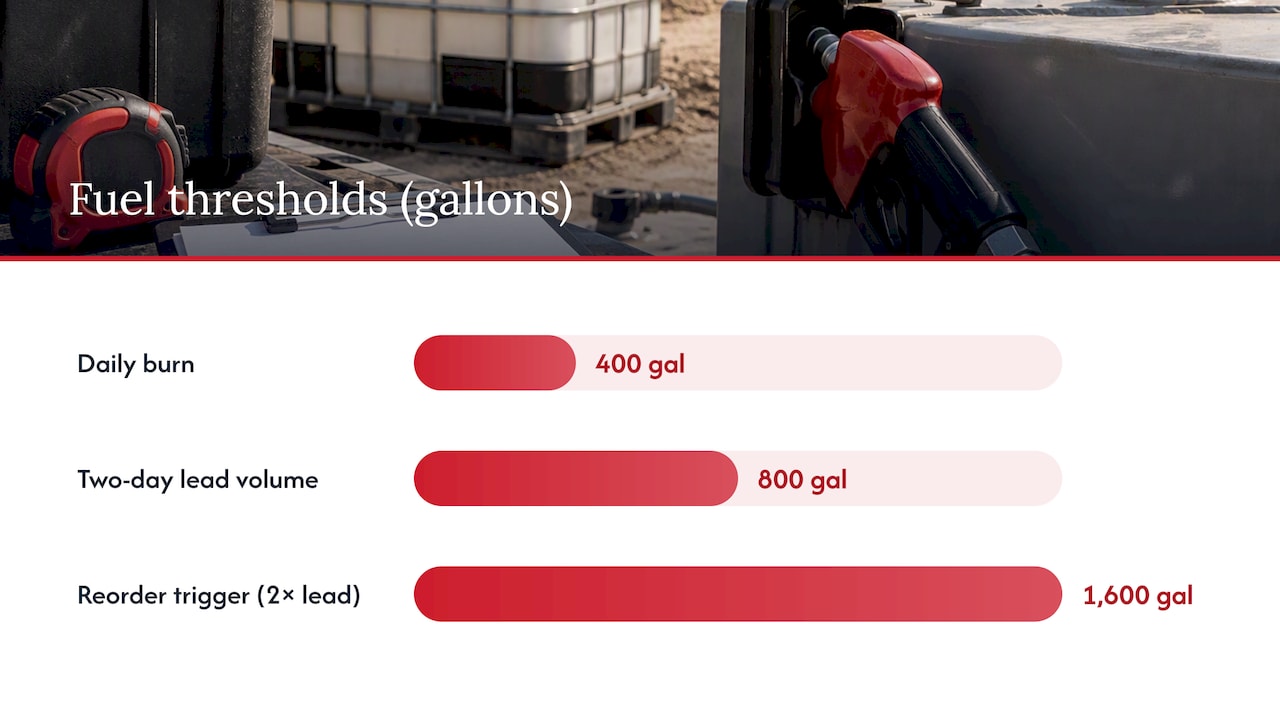
A fueling plan that never runs dry starts with a burn rate calculation, not a delivery schedule pulled from habit. Track daily consumption across your equipment fleet, then set a reorder trigger that accounts for your vendor’s delivery lead time plus a buffer for weather or supply delays. A site burning 400 gallons a day with a two-day lead time needs to reorder well before the tank hits empty, not after.
- Calculate burn rate per equipment class, then set a reorder threshold with lead time built in.
- Use tank telemetry and integrated dispatch where available to trigger fills automatically instead of relying on manual checks.
- Schedule recurring top-offs during low-traffic windows, night deliveries where the site allows it, to keep transfer areas clear.
- Reconcile delivery tickets against tank readings weekly to catch theft, miscounts, or meter drift early.
Telemetry and remote monitoring, the kind described in telematics-driven fleet management, do more than prevent runouts. They give you a documented trail that supports the reconciliation step your SPCC and NFPA paperwork already requires.
Pro Tip: Set your reorder trigger at the point where remaining fuel covers your delivery lead time twice over, since a single missed delivery window should never stop equipment.
Scheduling best practices that fold delivery timing into your broader fleet coordination are covered in Anytime Fuel Pros’ heavy equipment fueling schedule best practices.
Spill prevention, containment, and emergency response procedures
Every transfer point on the site needs secondary containment sized for the volume being moved, whether it’s a bulk tank sitting in place for weeks or a tank truck stopped for a ten-minute wet-hose fill. Temporary containment during deliveries, drip pans and portable berms, closes the gap for transfers that don’t have a permanent containment structure underneath.
Before any transfer starts, the attendant should walk through a short pre-transfer check: absorbent pads staged, drip pan under the connection point, traffic controlled away from the fueling zone, and the nozzle confirmed as automatic-closing with no-drive-off interlocks engaged.
- Stage a spill kit within immediate reach of every designated fueling location.
- Confirm secondary containment is in place before the first drop of fuel moves.
- Assign one attendant per transfer who is trained to stop the fill and initiate cleanup without waiting for approval.
A written plan should specify exact notification steps for a spill, covering who gets called internally, what triggers a regulatory report under the EPA’s SPCC framework, and how the incident gets logged for later review. Inspection frequency should increase whenever the site changes: new equipment added, a tank relocated, or a new fueling zone opened.
Personnel, training, and documentation that prove compliance
A fueling plan is a document until someone is trained to execute it, and that training needs its own paper trail.
- Designated fueling attendants need training in PPE use, emergency shutdown, spill kit deployment, and how to read and record meter receipts on every transfer.
- Inspection logs, delivery tickets, and meter readings should be retained on a schedule that matches your SPCC and NFPA recordkeeping obligations, not just filed until someone asks.
- Toolbox talks and refresher training need a set frequency, with signed attendance records that show who was trained and when.
- Vendor contracts should require digital delivery confirmations, proof of insurance, and safety data sheets as standard deliverables, not optional extras negotiated after a problem occurs.
That last point matters more than site managers usually credit. A vendor who cannot produce a metered receipt or an SDS on request is a documentation gap in your own compliance file, and it becomes obvious the moment an AHJ asks for it.
Practical fueling-plan template and sample site diagram
A usable plan fits on a handful of pages a superintendent can pull up on a tablet mid-shift. Structure it around four blocks.
- Header and approvals: site owner, plan author, PE review status (if triggered), and AHJ notes or approval date.
- Site diagram checklist: mark every fueling point, storm drain, property line, emergency access route, and spill kit location.
- Transfer procedure and inspection checklist: pre-transfer prep, during-transfer monitoring, post-transfer inspection, each with a sign-off line.
- Records section: training logs, vendor scope-of-work checklist, and an incident reporting form ready to fill in.
| Plan section | What it must contain | Who signs off |
|---|---|---|
| Header and approvals | Owner, PE status, AHJ notes | Site manager |
| Site diagram | Fueling points, drains, property lines, spill kit locations | Site manager or PE |
| Transfer procedure | Pre-check, during-fill monitoring, post-check | Fueling attendant |
| Records | Training logs, vendor SOW, incident forms | Safety officer |
This structure lines up directly with the plan contents described in EPA’s construction guidance, so a reviewer can move through your document the same way they’d move through the regulation. Anytime Fuel Pros’ on-site diesel delivery setup guide walks through a similar checklist from the vendor coordination side, useful if you’re handing this template to a delivery partner rather than building it entirely in-house.
Implementing the plan and procuring fueling services
Run a pilot before rolling the plan across the whole site: pick one zone, confirm telemetry is reporting correctly, and complete one full transfer drill with every checklist item documented. Review what worked and what didn’t before scaling.
- Require insurance certificates, compliance statements, and metered delivery receipts in every vendor scope of work.
- Set explicit spill-response obligations in the contract, including response time and inspection cooperation.
- Score vendors on response time, telemetry capability, transparent invoicing, and a documented safety program.
- Loop in a PE or your AHJ early when capacity or site layout puts you near a compliance threshold, and bring the diagram and written procedures to that review, not just a verbal summary.
How Anytime Fuel Pros can operationalize your construction fueling plan
Anytime Fuel Pros supplies the pieces this plan calls for directly: on-site diesel and gasoline delivery, bulk fuel delivery and tank rental, DEF delivery, mobile fleet fueling and wet hosing, plus scheduled and emergency response.
- Metered receipts and digital delivery confirmations for every transfer, ready for your inventory reconciliation.
- Documented safety procedures and insurance information to include in your vendor SOW.
- Scheduled recurring fills or emergency response when a site runs ahead of plan.
Visit the fuel services page to start a pilot or bring a procurement conversation to a partner who already builds delivery around plans like this one.
Sources
- EPA — Tier I qualified facility SPCC plan template
- OSHA — Fuel handling and storage (1917.156)
- Managing Your Environmental Responsibilities: Oil spill requirements for construction activities (EPA archive)
FAQ
What is a construction fueling plan?
A construction fueling plan is a written procedure covering where and how fuel is stored and transferred on-site, who is authorized to conduct transfers, and how spills and inventory are tracked. It ties directly to SPCC, NFPA 30A, and OSHA 1917.156 requirements rather than standing alone as internal policy.
When does SPCC apply to a construction site?
SPCC applies once a site’s aggregate aboveground oil storage crosses the thresholds set under EPA’s 40 CFR Part 112. Fuel held in equipment tanks over 55 gallons counts toward that total, which is the detail that most often catches site managers by surprise.
Does mobile fueling need its own written safety plan?
Yes. NFPA 30A requires a written safety and emergency response plan and a site diagram for mobile fueling operations, separate from any broader SPCC documentation the site maintains.
Who can perform on-site fueling under OSHA rules?
Only designated, trained personnel should conduct fueling transfers under OSHA 1917.156, which also requires engines off during the fill, no smoking near the transfer point, and automatic-closing nozzles.
What should a vendor provide to support plan compliance?
A vendor should supply metered delivery receipts, digital delivery confirmations, proof of insurance, and safety data sheets as standard parts of the service, not items requested only after a problem comes up. Anytime Fuel Pros builds these into its fuel services as part of scheduled and on-demand delivery.
Recent Comments