
Gallons needed equals usable tank capacity divided by burn rate, and burn rate equals load in kilowatts multiplied by specific fuel consumption in gallons per kilowatt-hour. Run that math backward and you get runtime: usable gallons divided by burn rate. Without an OEM fuel curve, planning defaults are roughly 0.08 to 0.12 gal/kWh for diesel, 0.10 to 0.15 for gasoline, and 0.12 to 0.18 for propane, according to a generator fuel runtime planning guide. Measured burn rate always beats a default.
TL;DR:
- Using measured burn rates from testing provides more accurate runtime estimates than default figures, especially when conditions deviate from standard assumptions.
- Running generators at 40 to 60 percent load typically extends fuel efficiency, making partial loads more economical than higher or peak capacity operation.
- Fuel consumption varies significantly with environmental factors like altitude, cold temperatures, and engine maintenance, often pushing actual use above default estimates.
- For longer outages, sizing tanks based on desired runtime and load in kilowatts ensures sufficient fuel supply, with safety considerations guiding refueling procedures during extended periods.
- Outsourcing fuel delivery and refueling services can prevent logistical issues during crises, especially for critical infrastructure or operations with limited storage capacity.
Table of Contents
- How to calculate load, burn rate, and runtime
- Worked examples: what runtime looks like at different loads
- How fuel type and conditions change your burn rate
- Sizing tanks and building a refill cadence
- Keeping stored fuel usable between refills
- Tools and checks that confirm your numbers
- When outsourcing your fuel plan makes more sense
- Sources
- FAQ
How to calculate load, burn rate, and runtime
Start with continuous load, not the number on the nameplate. Multiply amps by volts by power factor, or read continuous draw directly from a clamp meter or a Kill A Watt style monitor on smaller circuits. Nameplate kW reflects peak capacity, including the surge needed for motor starts, so using it as your steady load will overstate burn rate and understate runtime.
Once you have load in kW, pick specific consumption in this order:
- OEM fuel curve for your exact model and load point.
- Measured burn rate from a timed test at your typical load.
- Planning defaults by fuel type when neither is available, per the runtime formula guidance.
Multiply load by specific consumption to get burn rate in gallons per hour, then divide usable tank gallons (not total tank capacity, since suction lines and unusable bottom volume cut into what you can actually draw) by burn rate to get hours of runtime.
A few conditions push burn rate higher than the default suggests:
- High altitude thins the air and can force richer fueling.
- Cold starts and cold ambient temperatures increase warm-up consumption.
- A dirty air filter or an engine overdue for service burns more fuel per kWh.
- Frequent motor-start surges raise average load even when steady-state load looks modest.
Our generator fuel consumption breakdown walks through additional load-factor charts if you want to cross-check your numbers.
Worked examples: what runtime looks like at different loads
Numbers make this concrete. Each example uses the runtime formula and planning defaults from the TestTalkHQ runtime guide.
- 7 kW gasoline inverter, 5-gallon tank. At 50% load (3.5 kW) with a default of 0.12 gal/kWh, burn rate is about 0.42 gal/hr, giving roughly 11.9 hours. At 100% load (7 kW), burn rate climbs to about 0.84 gal/hr, cutting runtime to about 6 hours. Doubling the load less than halves the runtime, but the drop is still steep.
- 20 kW standby diesel, 100-gallon tank, 40% load (8 kW). Using a diesel default of 0.10 gal/kWh, burn rate is 0.8 gal/hr, for roughly 125 hours, more than five days on a single fill.
- 22 kW propane standby, cylinder-fed. At 50% load (11 kW) and a propane default of 0.15 gal/kWh, burn rate is 1.65 gal/hr. A bank of cylinders totaling 100 liquid gallons equivalent yields about 60 hours.
The pattern across all three: partial loading is disproportionately efficient, so sizing a generator with headroom, then running it at 40 to 60% load, often stretch fuel further than the nameplate math implies.
How fuel type and conditions change your burn rate
Specific consumption is not a fixed number. It shifts with fuel type and load percentage, and planning defaults should be treated as a range rather than a single figure.
| Fuel type | ~50% load (gal/kWh) | ~100% load (gal/kWh) |
|---|---|---|
| Gasoline | 0.10 | 0.15 |
| Diesel | 0.08 | 0.12 |
| Propane | 0.12 | 0.18 |
| Natural gas | measured in therms, not gallons | measured in therms, not gallons |
These figures come from the TestTalkHQ planning defaults, and they assume a reasonably well-maintained engine at sea level. Altitude, cold intake air, a clogged filter, and a poor tune all push actual consumption toward the high end of the range or beyond it. Modern inverter generators and Tier 4 diesel engines frequently beat these defaults at partial load because they modulate engine speed instead of running a fixed RPM. When a manufacturer fuel curve exists for your exact model, such as the load-point tables Caterpillar publishes for its genets, use it instead of a default. It reflects your specific engine, not an industry average.
Sizing tanks and building a refill cadence
Once you know gallons per hour, sizing storage is arithmetic: gallons needed equals load in kW multiplied by gal/kWh multiplied by hours of desired runtime.
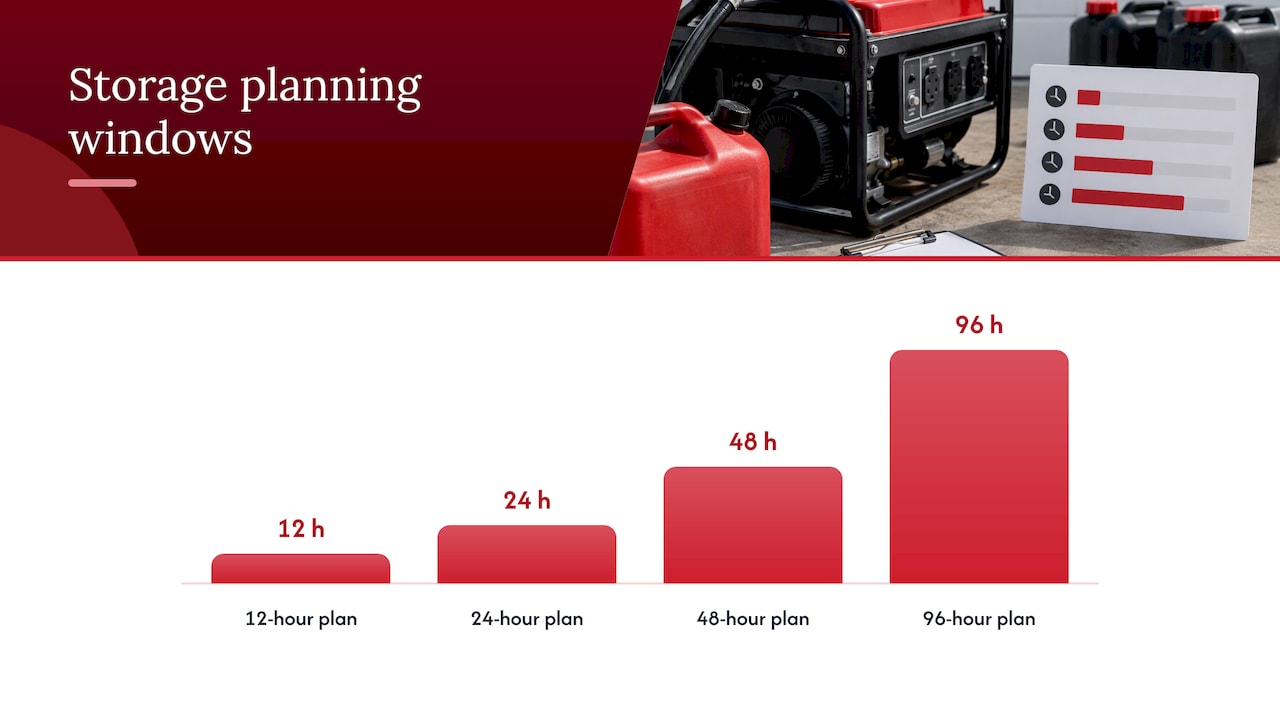
Common planning windows and what they mean for storage:
- 12-hour plan: covers a short outage or a bridge until a scheduled delivery arrives.
- 24-hour plan: the standard baseline for most commercial standby setups.
- 48-hour plan: appropriate when roads, storms, or demand surges could delay a refill.
- 96-hour plan: reserved for mission-critical sites where downtime is not an option.
Convert each window into gallons using the formula above, then match it to tank size or, for propane, cylinder count. A common refill convention is to schedule delivery when the tank reaches about 20% remaining, which is also the assumption built into the TRN / PNNL generator runtime calculator when it models recurring deliveries.
Pro Tip: Build your refill trigger around delivery lead time, not tank percentage alone: a 20% reserve means nothing if your supplier needs 36 hours to arrive.
Refueling safety matters as much as the math. Keep three rules in mind: shut the generator off, let it cool, and refuel outdoors or in a ventilated space away from ignition sources. Some large facilities refuel while a unit carries load, and field guidance shows a 400-gallon portable tank delivering about 4.5 hours of runtime on a large set, but that practice requires trained crews and documented procedures. For most operators, a shutdown refuel or a contracted delivery service is the safer route.
Keeping stored fuel usable between refills
A gallon of fuel is only worth what the formula says if it still burns clean when you need it. NFPA guidance recommends exercising generator sets at least monthly under sufficient load and keeping tanks cool, dry, and with minimal ullage to limit condensation.
- Start a fuel-testing program from the first fill, not months later, so you have a clean baseline.
- Schedule fuel polishing on a recurring basis rather than waiting for a filter to plug.
- Watch for water at the tank bottom, cloudy samples, or microbial growth, all early signs of degradation.
- Avoid extended idle running on diesel units, since low-load idling promotes wet stacking and unburned fuel buildup.
A generator that has not been exercised under load per NFPA-informed schedules risks both a fuel supply and an engine that will not perform when called on. (NFPA)
Keep a fuel log sheet recording exercise dates, hours run, load percentage, fuel added, and test results. That record turns your runtime formula from a one-time estimate into a plan you can defend.
Tools and checks that confirm your numbers
The TRN / PNNL runtime calculator accepts either daily kWh consumption or generator size in kW, applies fuel BTU content and efficiency, and estimates days of runtime while assuming refueling at 20% remaining. It is a fast way to sanity-check hand calculations, though it still runs on assumptions rather than your engine’s actual curve.
- Compare hour-meter readings against your estimate after a scheduled exercise run.
- Dip the tank before and after a timed test to measure actual gallons burned per hour.
- Use a fuel-flow meter where available for a more precise gal/hr reading than a tank dip.
- Reconcile any gap between measured and estimated burn by checking load percentage, filter condition, and ambient temperature during the test.
Our fuel consumption calculator lets you plug in your own load and fuel type to cross-check the numbers from this guide.
When outsourcing your fuel plan makes more sense
Running the calculations is only half the job. Executing a refill cadence under real-world pressure, especially during a multi-day outage, is where many plans break down. Some fuel delivery providers handle that execution directly, bringing diesel, gasoline, and DEF to generators on-site instead of leaving your team to manage tank runs during an outage.

- Scheduled bulk fills keep standby tanks topped off ahead of forecasted weather or peak demand.
- Emergency after-hours delivery covers the gap when a refill trigger hits faster than expected.
- Wet hosing services fuel equipment and generators directly without moving them off-site.
- Fuel tank rentals add temporary storage capacity for extended or unplanned outages.
Contracted delivery makes the most sense for data centers, hospitals, and other sites where downtime carries a real cost, or for any operation with limited on-site storage and a short delivery lead-time requirement. Visit our fuel services page to see current offerings, or request a quote built around your specific outage scenario and generator load.
Sources
- Generator fuel runtime planning guide (TestTalkHQ)
- NFPA guidance (annex and statements) – fuel storage and EPS exercise
- TRN / PNNL generator runtime calculator
- Diesel generator operation and refueling procedures (WIPP supplemental info)
FAQ
What is the 20/20/20 rule for generators?
Definitions vary across the industry, and no single source in this guide defines a standardized 20/20/20 rule. A closely related convention does appear in runtime planning: the TRN / PNNL calculator assumes refueling occurs once a tank reaches 20% remaining, which is a useful trigger point to build into your own plan.
How long will a 5,000-watt generator run on 5 gallons of gas?
Runtime depends on load percentage and specific consumption, not just tank size. Using gasoline planning defaults of about 0.10 to 0.15 gal/kWh from the runtime planning guide, a 5 kW unit at half load would burn roughly 0.25 gal/hr, giving around 20 hours on 5 gallons.
How long will a 22 kW generator run on 250 gallons of propane?
Actual runtime shifts with load percentage and ambient conditions, so a manufacturer fuel curve will narrow the estimate.
How many hours will a generator run on 1 gallon of gas?
Divide 1 gallon by your burn rate in gal/hr to get hours, and burn rate itself equals load in kW multiplied by specific consumption. Using a gasoline default around 0.10 to 0.15 gal/kWh, a lightly loaded small generator might stretch 1 gallon over roughly one to two hours, while a heavily loaded unit will burn through it faster, according to the runtime formula guidance.
Recent Comments