
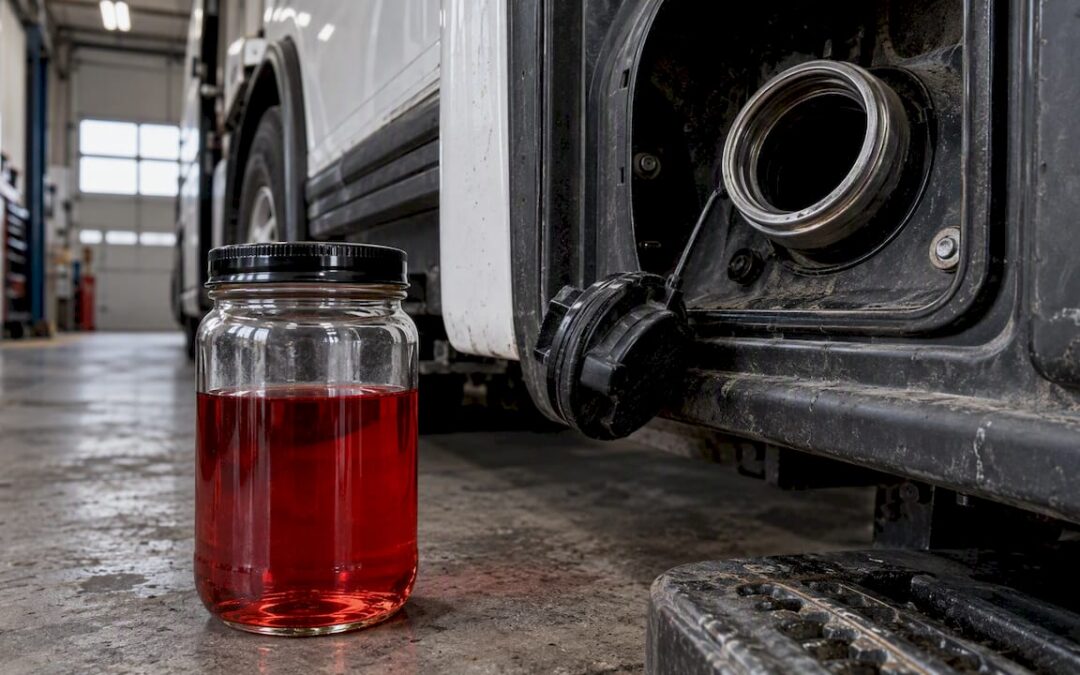
The federal penalty for using dyed diesel fuel on the highway is the greater of $1,000 or $10 per gallon under IRC §6715, and that figure stacks on top of any unpaid excise tax, not in place of it. Officers and employees who knowingly take part can be held personally liable alongside the business, and states often layer on their own fines and procedures.
TL;DR:
- The federal penalty is the greater of $1,000 or $10 per gallon, and its base rises by $1,000 for each prior assessed penalty.
- The penalty does not replace the backup excise tax: taxable highway use can trigger both federal charges, while states may impose separate fines.
- Businesses remain liable for violations during operations, and officers, employees, or agents who knowingly participate can be held personally liable alongside the company.
- After inspection, the IRS generally presumes dyed fuel in a vehicle was held for taxable use; dated records and supplier notices can rebut that presumption.
- Stop using the vehicle, document the fuel and tank labels before draining it, and preserve invoices and delivery tickets; third violations sharply restrict appeals.
Table of Contents
- Federal penalty explained: how the $1,000 or $10-per-gallon rule works
- Who is liable: operators, companies, and shared responsibility
- Inspection, sampling, and enforcement procedures to expect
- State variations and what they add to federal exposure
- Immediate steps and defenses if dyed diesel is found
- Compliance checklist for fleets and equipment owners
- How we help you keep dyed diesel compliant and documented
- FAQ
- Sources
Federal penalty explained: how the $1,000 or $10-per-gallon rule works
The statute is straightforward once you see the mechanics. IRC §6715(b)(1) and (b)(2) set the base penalty at $1,000 per violation, or $10 per gallon of dyed fuel involved, whichever number is bigger. A single pickup truck caught with a half-tank of dyed diesel, maybe 15 gallons, still triggers the $1,000 floor because $150 falls short of it. A bulk tank transfer involving 500 gallons flips that math: $10 times 500 is $5,000, well above the floor.
The penalty compounds with history. The $1,000 base amount increases by $1,000 for each prior penalty already assessed, so a third violation starts its calculation from a higher floor before the per-gallon comparison even runs.
- First violation: greater of $1,000 or $10 per gallon
- Second violation: base effectively doubles before the per-gallon comparison
- Third and later violations: base keeps climbing, and administrative appeal rights narrow sharply
This penalty does not replace the IRC §4041 backup excise tax that applies when dyed fuel is used for a taxable, on-highway purpose. The tax covers the revenue loss; the §6715 penalty punishes the dyeing violation itself. Both can land on the same invoice.
Who is liable: operators, companies, and shared responsibility
Liability under this penalty scheme does not stop at the fuel tank. The person who holds the dyed fuel for a taxable use, often the vehicle operator or the position holder at a terminal, is the primary target of an assessment. But the business that owns the truck or the equipment yard carries liability too, independent of whether a specific employee gets named.
- The operator or position holder faces direct liability for the act itself
- The employer or business entity faces liability when the violation happens in the course of its operations
- Any officer, employee, or agent who willfully participated can be held jointly and severally liable alongside the company
Willful participation is the hinge. A dispatcher who orders a driver to top off from the off-road tank to save money, knowing the truck runs on public roads, fits the standard. IRS memoranda and state administrative determinations have applied this joint liability framework in cases where supervisors directed or ignored known misuse, which means a company’s internal fueling instructions can become evidence in an assessment.
Inspection, sampling, and enforcement procedures to expect
Dyed fuel enforcement follows a defined sequence under IRM 4.24.15, and knowing the steps helps you respond without making things worse.
- A Diesel Compliance Officer pulls a fuel sample from the tank, following chain-of-custody steps so the sample holds up as evidence.
- The sample goes to a lab for dye concentration confirmation before any penalty gets proposed.
- Findings become a formal assessment, with notice sent to the operator or responsible business.
- Refusing the inspection carries its own statutory fine, commonly $1,000, and the vehicle can be detained until inspection is completed.
- A confirmed violation gets logged, and that record becomes the “prior penalty” baseline for calculating any future assessment.
Because the IRS generally presumes dyed fuel found in a vehicle is held for taxable use, the burden falls on you to produce evidence that rebuts that presumption at or soon after inspection.
State variations and what they add to federal exposure
Federal law sets the floor, not the ceiling. States run their own enforcement programs on top of the IRS penalty, and the two can apply to the same incident without overlapping. Colorado, Illinois, Montana, and Idaho each illustrate a different approach, from traffic-style infractions to civil penalties that scale with volume, and none of them erase the federal exposure described above.
- State departments of revenue or transportation can issue separate fines, sometimes through a civil penalty schedule rather than a court process
- Some states route enforcement through roadside inspections tied to commercial vehicle stops, which means a single stop can generate both a state ticket and a referral for federal review
- Collection paths differ by state, so a fine from a state agency does not substitute for resolving a federal assessment
Because state rules shift by jurisdiction and change over time, check your state department of revenue or transportation site directly before assuming your exposure matches a neighboring state’s published numbers.
Immediate steps and defenses if dyed diesel is found
What you do in the first hour after dyed fuel turns up often decides how the assessment plays out. IRS guidance recommends stopping use of the vehicle immediately, draining the tank where it’s safe and lawful to do so, and disposing of the fuel through a compliant method rather than dumping it.
Pro Tip: Photograph the fuel color and the tank or pump label before draining anything; the image becomes part of your contemporaneous record if the case goes to appeal.
- Preserve every purchase record tied to the fuel: invoices, bills of lading, and signed delivery tickets
- Request or locate the seller’s required dyed-fuel notice, since its absence shifts the presumption analysis
- Document the specific equipment or vehicle involved and how the fuel reached it
Credible, dated paperwork is the single strongest tool for rebutting the presumption that dyed fuel was held for taxable use, according to IRS Chief Counsel analysis. Administrative appeal exists for first and second violations, but review rights narrow for the third violation and beyond, limited mostly to fraud or lab errors. Once you’re past a second violation, talk to a tax attorney before responding to the notice.
Compliance checklist for fleets and equipment owners
Most dyed fuel violations trace back to a fueling mix-up rather than deliberate evasion, and a few habits close that gap for good.
- Keep every invoice, bill of lading, and supplier dye notice on file for at least the IRS retention period
- Label bulk tanks and pumps clearly by fuel type, and keep red-dye and clear diesel on separate hoses
- Require a supervisor or designated fueler to sign off on bulk tank fills, especially on mixed on-road and off-road fleets
- Audit delivery tickets against actual tank levels on a regular schedule rather than only when something looks off
Pro Tip: A documented, scheduled supplier relationship does more to protect you than any single internal policy, because the paper trail originates outside your own operation and carries more weight in a rebuttal.
A detailed fleet recordkeeping guide and a breakdown of the nine records that pass an audit both walk through this in more depth. For freight-heavy operations tracking fuel costs alongside compliance risk, this fuel surcharge audit checklist from our partners at Packlogica is worth a look too.
How we help you keep dyed diesel compliant and documented
We deliver red-dye diesel directly to job sites, equipment yards, and bulk tanks with the paperwork built in: signed bills of lading, supplier notices, and delivery records that back you up if a Diesel Compliance Officer ever asks questions. Scheduled, on-site delivery helps reduce accidental misuse caused by drivers or crew members filling from the wrong tank due to convenience.

One documented delivery replaces a dozen guesses about what’s in your tank.
| What you get | Why it matters for compliance |
|---|---|
| Bills of lading on every drop | Rebuts the “held for taxable use” presumption with dated proof |
| Scheduled on-site fueling | Removes the need for drivers to source fuel informally |
| Nationwide partner network | One point of contact across multi-state fleets |
| Separate clear and dyed diesel options | Reduces risk of tank mix-ups on mixed fleets |
Our coverage runs through primary markets in Texas and Utah, with nationwide reach through our partner network for multi-site operations. If your fleet or equipment yard runs both on-road and off-road fuel, start with our fuel services page to see what a documented delivery schedule looks like for your operation.
This article is general information, not a substitute for advice from a qualified lawyer. Consult a qualified legal professional about your own circumstances before acting on anything here.
FAQ
Can I run red dye diesel in my truck?
No. Red dye diesel is tax-exempt fuel meant for off-road equipment, and using it in a vehicle operated on public highways triggers the federal penalty under IRC §6715 along with any unpaid excise tax. The rule applies regardless of whether the use was intentional.
What is the fine for running dyed fuel?
The federal fine is the greater of $1,000 or $10 per gallon of dyed fuel involved, and it increases for repeat violations under IRC §6715. This penalty comes on top of the backup excise tax owed under IRC §4041, and some states add their own separate fines.
Does the US have dyed diesel?
Yes, dyed diesel is a federally recognized category of tax-exempt diesel sold for off-road, agricultural, and heating uses. IRS Publication 510 sets the dye concentration and notice requirements that sellers and terminals must follow.
What happens if you use dyed diesel?
Using dyed diesel for a taxable on-highway purpose triggers the §6715 penalty, the §4041 backup tax, and possible state fines, and a Diesel Compliance Officer may sample your fuel and detain the vehicle to confirm the violation. Repeat violations raise the penalty and sharply limit your administrative appeal rights.
Sources
- 26 U.S. Code § 6715 – Penalty relating to dyed diesel fuel and dyed kerosene
- IRM 4.24.15 – Excise Fuel Compliance Inspection, Sampling, and Shipping
Recent Comments