

Dyed diesel compliance reporting is defined as the documented process of tracking, recording, and filing fuel usage data to prove that tax-exempt dyed diesel was used only for legally permitted, nontaxable purposes. Fleet managers and compliance officers who get this wrong face federal penalties under 26 U.S.C. §§ 4081, 4082, and 6715, with fines starting at $1,000 per violation. The IRS enforces these rules with zero tolerance, and 2026 brought updated guidance on refund claims that every fleet operation needs to understand. Getting your dyed diesel compliance process right from the start is far cheaper than fixing it after an inspection.
What are the key federal regulations and reporting requirements for dyed diesel?
Dyed diesel is defined under 26 U.S.C. § 4082 as diesel fuel that has been mechanically injected with a red dye at a concentration meeting IRS specifications, making it legally identifiable as tax-exempt fuel. The dye itself is the primary legal proof of tax status. Any fuel carrying that red color is presumed nontaxable and restricted to off-road, agricultural, heating, and other approved nontaxable uses.
The core federal framework rests on three code sections. Section 4081 governs the excise tax imposed on taxable fuel removal. Section 4082 creates the exemption for dyed fuel used in nontaxable applications. Section 6715 establishes the penalty structure for misuse. Fleet managers need to know all three, because each one creates a distinct compliance obligation.

One common misconception is that dyed diesel carries zero tax liability. That is not accurate. Dyed diesel remains subject to the 0.1-cent-per-gallon Leaking Underground Storage Tank (LUST) fee even though it is exempt from the main federal excise tax. Missing this fee in your fuel compliance reporting creates a discrepancy that auditors will flag.
Sellers must post a mandatory notice at every pump and delivery point stating “Dyed Diesel Fuel, Nontaxable Use Only, Penalty For Taxable Use.” Missing this signage can trigger penalties equal to those for actual misuse. If you receive dyed diesel deliveries at your yard, confirm your supplier posts or provides this notice with every delivery.
Core recordkeeping requirements
Fleet managers must retain the following records for a minimum of three years:
- Fuel purchase invoices showing dye status, volume, and delivery date
- Equipment logs identifying which vehicles or machines received dyed fuel
- Supplier certifications confirming the fuel meets IRS dye concentration standards
- Internal usage logs showing the nontaxable purpose for each fuel draw
- Any Form 720 filings and supporting schedules for the period
| Requirement | Detail | Deadline or Retention |
|---|---|---|
| Purchase records | Invoices showing dyed fuel volume and dye certification | Retain 3 years |
| Equipment usage logs | Records linking fuel draws to specific nontaxable equipment | Retain 3 years |
| Mandatory signage | “Nontaxable Use Only” notice at all fuel points | Ongoing |
| LUST fee reporting | 0.1 cent per gallon on all dyed diesel volumes | Quarterly with Form 720 |
| Supplier certification | Written confirmation of dye compliance from fuel vendor | Retain per purchase |
Pro Tip: Request a written dye certification from your fuel supplier on every delivery. A single undocumented load can create a gap in your records that looks like intentional misuse during an audit.
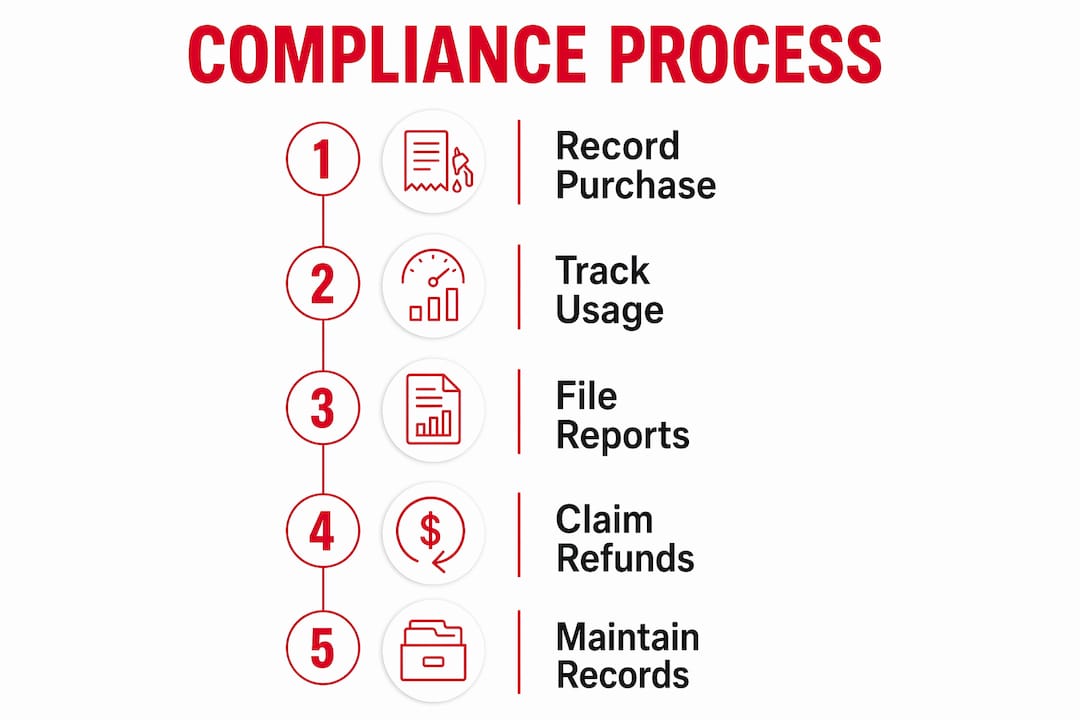
How to accurately file dyed diesel compliance reports and handle excise tax refund claims
Form 720, the Quarterly Federal Excise Tax Return, is the primary filing vehicle for fuel compliance reporting. It covers taxable fuel activity and must be submitted four times per year. The deadlines are april 30, july 31, october 31, and january 31. Missing a deadline triggers late fees on top of any underlying tax liability.
Most fleet managers using dyed diesel exclusively for nontaxable purposes will not owe the main excise tax on Form 720. However, the LUST fee still requires reporting. Any quarter where you take delivery of dyed diesel, you must include that volume on Form 720 and calculate the 0.1-cent-per-gallon fee.
The 2026 IRS update on refund claims
The IRS released updated guidance in may 2026 that changes how excise tax refund claims work for dyed diesel. Under the new rules, Form 8849 and Schedule 5 are now required for refund claims filed by the original taxpayer. The statute of limitations for these claims is three years from the date the fuel was removed from the terminal. This update matters most for operations that redye previously taxed diesel, because Section 6435 prevents double taxation in those situations.
Step-by-step filing process for dyed diesel compliance reporting
- Gather quarterly fuel records. Pull all purchase invoices, delivery receipts, and equipment usage logs for the quarter.
- Calculate total dyed diesel volume. Sum all gallons received and confirm each load carries a valid dye certification.
- Compute the LUST fee. Multiply total dyed diesel gallons by $0.001 to get the fee owed.
- Complete Form 720. Enter the LUST fee amount in the appropriate line. If any taxable fuel activity occurred, report it separately.
- File by the quarterly deadline. Submit electronically through the IRS EFTPS system or by mail, depending on your filing method.
- File Form 8849 with Schedule 5 for refund claims. If you are claiming a refund on previously taxed fuel that was redyed, attach all supporting documentation and file within the three-year window.
- Archive all filings. Store copies of every Form 720 and Form 8849 for at least three years.
Pro Tip: Set calendar reminders 30 days before each Form 720 deadline. Fuel records get harder to reconstruct the longer you wait, and late filings attract IRS scrutiny even when the underlying tax owed is minimal.
What are the common compliance challenges, penalties, and enforcement practices?
The IRS and Department of Transportation conduct roadside inspections that include dye testing of fuel tanks. The test is simple and fast. An inspector draws a fuel sample and checks it for red dye. The enforcement standard is absolute: any trace of red dye in a vehicle operating on public roads triggers a penalty. There is no minimum threshold and no grace period.
“The IRS has no reasonable-cause exemption for dyed diesel misuse. A fleet manager cannot argue that the fuel was accidentally mixed, that a driver made an error, or that the violation was unintentional. The penalty applies regardless of intent. Refusal to allow inspection carries a separate $1,000 penalty per refusal, compounding the financial exposure for any operation that tries to avoid the inspection process.”
The federal penalty structure is direct. The minimum fine is $1,000 or $10 per gallon misused, whichever is greater, plus unpaid federal excise taxes of approximately 24.3 cents per gallon. For a 100-gallon tank, that is $1,000 in penalties plus $24.30 in back taxes at minimum. For a 300-gallon tank, the per-gallon calculation takes over at $3,000 in penalties alone.
Common penalty triggers for fleet operations
- Dyed diesel found in the tractor engine fuel tank during a roadside inspection
- Dyed fuel used in any vehicle licensed for on-road operation
- Missing or incorrect mandatory signage at fuel dispensing points
- Failure to produce records during an IRS or DOT inspection
- Refusal to submit to fuel sampling
One enforcement trap that catches experienced fleet managers is the reefer unit scenario. Reefer units may legally use dyed diesel for their refrigeration engines. However, if an inspector finds dyed fuel in the tractor’s main engine tank during the same stop, the penalty applies to the tractor regardless of the reefer’s legal status. Inspectors check both tanks. Keeping those fuel systems completely separate is not optional.
State penalties add another layer. Several states impose their own fines on top of federal penalties, meaning a single violation can result in compounding costs from two enforcement authorities simultaneously.
Pro Tip: Label every fuel storage tank, nozzle, and hose with color-coded tags indicating dyed or clear diesel. Physical separation and clear labeling are your first defense against cross-contamination claims during an inspection.
What best practices should fleet managers adopt for ongoing dyed diesel compliance?
Consistent dyed fuel compliance starts with physical separation. Store dyed and clear diesel in separate tanks with separate dispensing equipment. Cross-contamination is one of the most common causes of unintentional violations, and it is entirely preventable with proper infrastructure. Review your off-road diesel compliance setup at least once per year to confirm your storage and dispensing systems remain segregated.
Usage logs are your audit defense. Every fuel draw should be recorded with the date, volume, equipment ID, operator name, and the nontaxable purpose. A log that takes 30 seconds to fill out at the pump can save thousands of dollars in penalties if an inspector asks for documentation. Digital fuel management systems make this process faster and reduce the risk of missing entries.
Internal audits catch problems before regulators do. Schedule a quarterly review of your fuel records, equipment logs, and Form 720 filings. Compare purchased volumes against logged usage to identify any gaps. A discrepancy between what you bought and what you recorded using is a red flag that an auditor will pursue.
Compliance tracking methods compared
| Method | Best for | Key limitation |
|---|---|---|
| Paper fuel logs | Small fleets with one or two tanks | Prone to missing entries and hard to audit |
| Spreadsheet tracking | Mid-size fleets with consistent usage patterns | Manual entry errors accumulate over time |
| Digital fuel management software | Large or multi-site fleets | Requires upfront setup and staff training |
| Supplier-provided delivery records | Verifying purchase volumes and dye certification | Does not capture internal usage or equipment allocation |
Staff training is a compliance multiplier. Drivers and equipment operators who understand why dyed diesel rules exist are less likely to make costly mistakes. A 30-minute annual training session covering what dyed diesel is, which vehicles can use it, and what happens during an inspection reduces your exposure significantly. Pair training with written acknowledgment forms so you have documentation that employees received the information.
Proactive supplier communication closes another gap. Confirm with your fuel supplier before every delivery that the product meets IRS dye concentration standards. Ask for written certification with each load. If your supplier cannot provide documentation, that is a signal to find one who can.
Pro Tip: Prepare a compliance binder for each fuel storage location. Include the most recent Form 720 filing, supplier certifications, equipment usage logs, and a copy of the mandatory signage requirements. Hand this binder to any inspector immediately. It demonstrates readiness and often shortens the inspection process considerably.
Key Takeaways
Dyed diesel compliance reporting requires accurate quarterly filings, physical fuel separation, and thorough recordkeeping to avoid federal penalties that start at $1,000 per violation with no reasonable-cause exemptions.
| Point | Details |
|---|---|
| Federal penalty exposure | Misuse penalties reach $10 per gallon or $1,000 minimum, plus 24.3 cents per gallon in back excise taxes. |
| LUST fee applies to dyed diesel | Even tax-exempt dyed diesel carries a 0.1-cent-per-gallon LUST fee that must appear on Form 720. |
| 2026 refund process update | Use Form 8849 with Schedule 5 for refund claims; the filing window is three years from fuel removal. |
| Zero-tolerance enforcement | Any trace of red dye in an on-road vehicle triggers penalties regardless of intent or volume. |
| Recordkeeping is your defense | Retain purchase invoices, usage logs, and Form 720 filings for a minimum of three years. |
Anytimefuelpros keeps your dyed diesel deliveries compliant and documented
Fleet managers who rely on compliant dyed diesel need a supplier who understands the documentation requirements, not just the fuel itself. Anytimefuelpros delivers red dye diesel directly to job sites, equipment yards, mining operations, and agricultural facilities across Texas, Utah, and nationwide through its partner network. Every delivery comes with clear documentation of fuel type, volume, and dye certification, giving your compliance records exactly what an IRS or DOT inspector expects to see.

Anytimefuelpros also supports multi-site operations that need consistent fuel documentation across locations. Transparent invoicing and scheduled delivery records integrate directly into your quarterly Form 720 preparation. If you have questions about fuel delivery logistics or compliance documentation, the team at Anytimefuelpros is ready to help. Visit the fuel delivery questions page to get answers specific to your operation.
FAQ
What is dyed diesel compliance reporting?
Dyed diesel compliance reporting is the process of documenting fuel purchases, usage, and tax filings to prove that tax-exempt red-dyed diesel was used only for legally permitted nontaxable purposes under 26 U.S.C. § 4082.
What forms do fleet managers need to file for dyed diesel?
Fleet managers file Form 720 quarterly to report the LUST fee on dyed diesel volumes. Refund claims on previously taxed fuel require Form 8849 with Schedule 5, filed within three years of fuel removal under 2026 IRS guidance.
What is the penalty for using dyed diesel in an on-road vehicle?
The federal penalty is the greater of $1,000 or $10 per gallon misused, plus approximately 24.3 cents per gallon in unpaid excise taxes. The IRS applies this penalty with no reasonable-cause exemption regardless of intent.
Can reefer units legally use dyed diesel?
Yes, reefer refrigeration engines may legally run on dyed diesel. However, if dyed fuel is found in the tractor’s main engine tank during the same inspection, the tractor penalty applies in full.
How long must fleet managers retain dyed diesel compliance records?
Fleet managers must retain fuel purchase invoices, equipment usage logs, supplier certifications, and Form 720 filings for a minimum of three years to satisfy IRS recordkeeping requirements.
Recent Comments