
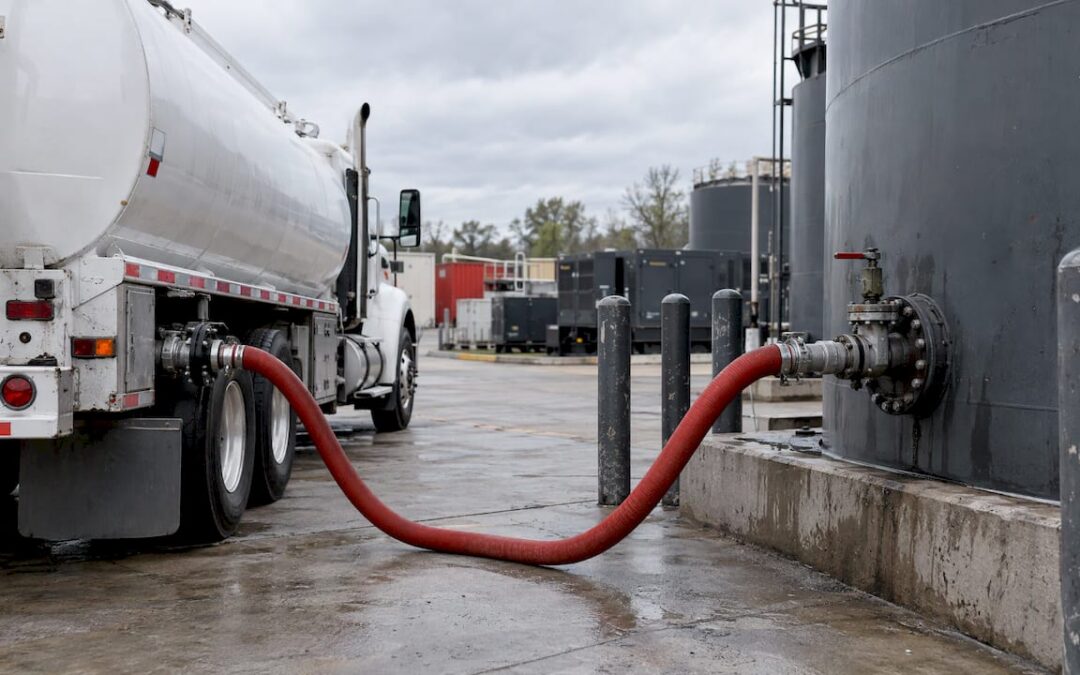
A diesel delivery QA checklist has three jobs: confirm the right product is going into the right tank, confirm the volume you pay for is the volume you receive, and leave a paper trail that holds up if something goes wrong later. The checks below take a trained receiver a few minutes per drop, and they cost far less than a day of equipment down on bad fuel or a disputed invoice.
This guide is written for site superintendents, fleet managers, facilities leads and procurement staff who receive fuel, not for drivers inspecting their own trucks. It walks through the order of operations: prepare the site, inspect before unloading, watch the transfer, reconcile quantity, and document everything.
TL;DR
- Verify product before the hose is connected: match the tanker compartment’s product tag to the tag or label on your tank fill cap or fill pipe.
- Check your own tank first with an automatic tank gauge (ATG) or a manual stick and water-finding paste, so you know what is in there before new fuel goes in.
- After the drop, stick the tank and compare it with the ATG to confirm the volume added matches the volume loaded.
- If readings differ or water shows up, notify site personnel, follow your site procedure and write the finding on the delivery receipt.
- Keep the records. A checklist that is not filed is a checklist you cannot use in a dispute.
Table of Contents
- Why a receiving checklist pays for itself
- Before the delivery: site preparation
- Pre-unloading checks: before any hose is connected
- During the transfer: what the receiver watches
- After the drop: reconcile quantity
- Quality sampling and testing
- What to do when a check fails
- Records: what to keep and for how long
- The one-page checklist
- Where Anytime Fuel Pros fits
- FAQ
- Sources
Why a receiving checklist pays for itself
Most delivery problems are quiet. A wrong-product drop into a tank labeled for something else, a little water that sits under the diesel and feeds microbial growth, a short load that nobody measured. None of these announce themselves at the moment of delivery. They show up days later as clogged filters, a generator that will not carry load, or an invoice that does not match what the tank holds.
Water is the most common offender. Industry delivery guidance describes water as a diesel fuel contaminant and a contributing factor to microbiological growth in storage tanks, which is why it earns its own line on the checklist rather than a vague “inspect fuel” entry.
The checklist also protects the relationship with your supplier. When both sides check the same things in the same order, a discrepancy becomes a short, factual conversation instead of an argument about memory.
Before the delivery: site preparation
The best receiving checks begin the day before. Confirm these items with your supplier when you schedule the drop, whether it is a one-time order or a recurring route.
- Delivery address and gate access. Give the exact address or GPS pin, the gate code, and the hours the gate is staffed. Large rigs cannot turn around on many job sites.
- A named receiver. One person on site is responsible for accepting the load, with a backup if that person is out. Put a phone number on the order.
- Tank location and hose reach. Note the distance from where the truck can park to the fill point. Tell the dispatcher if the hose must cross a road, a trench or a fenced area.
- Product and grade. State clear or dyed diesel, and for fleets with seasonal needs, any fuel grade requirement. If you are unsure which product fits which equipment, our guide to diesel fuel ratings for fleet managers explains the practical differences.
- Expected volume and tank capacity. Know your available ullage (empty space) before the truck arrives. Never order more than the tank can take with room to spare.
- Spill response ownership. Agree who responds to a spill, where the kit is, and who calls whom. Our diesel spill response actions page lays out a five-step approach for facilities and fleets.
- Paperwork expectations. Ask which document you will receive at delivery, such as a meter ticket or delivery record, and what it will show.
If you are setting up recurring service for the first time, the on-site diesel delivery setup guide covers the site layout questions in more depth.
Pre-unloading checks: before any hose is connected
This is the stage that stops mistakes. Do not let the driver connect until every item here is complete.
1. Confirm the product
Compare the product tag on the tanker compartment with the tag or label on your storage tank’s fill cap or fill pipe. The delivery best-practice guidance from the Diesel Fuel Quality Council materials calls for exactly this match to verify the correct product. If your site has both dyed and clear diesel tanks, label every fill point plainly, because a wrong-tank drop is a costly and compliance-sensitive mistake.
2. Check the paperwork against the order
The delivery document should match what you ordered. Verify:
- Product name and type (clear or dyed diesel, DEF, gasoline)
- Ordered volume and the volume loaded on the truck
- Delivery address and your company name
- Driver name, truck or trailer number and date
- Compartment number the product came from, if the truck carries more than one product
For dyed diesel, the paperwork matters beyond your own records, since off-road fuel use is something auditors and government contracts can ask you to substantiate. If you want a repeatable reporting routine, see our seven verification steps for audit-ready fuel consumption reporting.
3. Look at seals and compartment condition
If the truck uses compartment seals, note the seal numbers on the paperwork and confirm they are intact before the driver breaks them. A broken or mismatched seal does not prove tampering, but it is a reason to pause and record it before unloading.
4. Check your tank before adding fuel
Use the ATG, or manually stick the tank with water-finding paste, to check product volume and the presence of water before delivery. Write down the starting level. This number is the baseline for every quantity check that follows, and it is the only way to show later that water was already in the tank before the drop.
5. Inspect the spill bucket
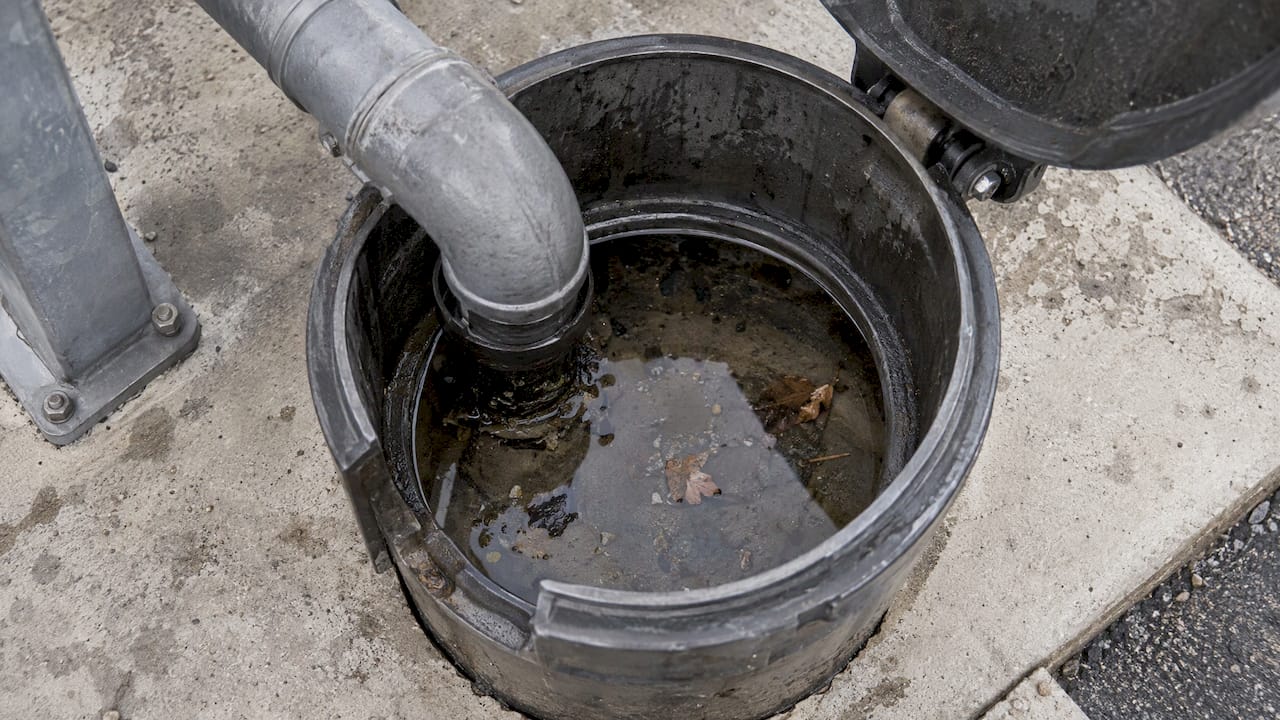
If the spill bucket at the fill point has water in it, dispose of it properly first. The same guidance is explicit that you should not drain it into the tank. Check for debris and visible damage while you are there.
6. Secure the area
Keep non-essential personnel and vehicles back from the transfer zone, confirm the spill kit is within reach, and make sure the receiver and driver agree who can stop the transfer. Our on-site fuel delivery safety protocols guide covers the site-safety side in detail.
During the transfer: what the receiver watches
The receiver does not need to hover, but someone accountable should stay in sight of the fill point for the entire drop.
- Match the hose to the right fill point. Watch the driver connect to the labeled tank you verified, not a similar one next to it.
- Watch the gauge and meter. Note the start and end meter readings and the time. These go on the ticket.
- Keep the stop control in reach. Know where the emergency shutoff is, and confirm both parties know who can use it.
- Respond to leaks immediately. A drip at a coupling gets the transfer paused, not noted for later.
- Do not rely on the color of the fuel. Dyed diesel is red by design, and clear diesel can look fine and still carry water or sediment. When a quality concern arises, the answer is formal sampling and escalation, not a glance at the sight glass.
After the drop: reconcile quantity
Quantity checking is where the earlier baseline pays off. The method is simple and uses equipment most sites already have.
- Stick the storage tank and check the ATG reading after the drop.
- Compare the volume added with the volume loaded into the compartment. The guidance says quantity is verified by comparing the ATG volume with manual tank-stick readings.
- Compare both against the meter ticket from the driver.
- Record all three numbers on the delivery receipt before the truck leaves.
A worked example: your starting ATG reads 2,400 gallons, and the ticket says 3,000 gallons delivered. After the drop, the ATG reads 5,380 gallons. The tank shows 2,980 gallons added against 3,000 on the ticket. A small gap like that may reflect temperature, tank geometry or gauge resolution, so what matters is that your site has a written tolerance it applies the same way every time. If the gap is large, or grows across several deliveries, treat it as a pattern worth raising with your supplier, not a one-off.
The principle comes from custody-transfer standards: in API’s measurement guidance, each party to a custody transfer is responsible within its domain for helping reconcile quantities and seeking explanations for discrepancies. The same document says discrepancies should be recorded and reported, with every effort made to resolve them before the vessel departs. That guidance is written for marine transfers, but the logic carries over to a tanker truck: resolve it before the truck pulls out of the gate, while the evidence is still in front of you.
Quality sampling and testing
Visual and stick checks catch gross problems. When you suspect contamination, or when your operation cannot tolerate a bad batch, a sampling step adds proof.
For reference, the quality manual one major fuel company publishes for its pipeline system requires its technicians to keep testing instruments operating normally and within statistical control, and recommends the same for third-party terminals and stations. You do not need a lab on site, but you do need to know that whatever instrument you use, from a water paste to a sampling kit, is clean, in date and used the same way each time.
Good sampling practice includes:
- Sampling from a clean, labeled container, with the date, time, tank and delivery ticket number written on it
- Taking the sample at the same point in the process each time
- Keeping the sample sealed and stored so it can be tested if a problem emerges
- Recording who took it and who handled it afterward
That last point is chain of custody. The NIST field sampling handbook describes a chain-of-evidence record as one that documents a sample’s collection, movement, storage, custody and conditions until it is accepted and logged for laboratory testing. Our walkthrough on documenting diesel samples with a chain of custody shows how to apply it to a delivery.
What to do when a check fails
A failed check is not a crisis if you have a script for it. Decide in advance who does what.
| Failed check | Immediate action | Record |
|---|---|---|
| Product tag does not match tank label | Do not connect. Stop and contact your supplier and site lead. | Note tag, label, time and who was called |
| Seal broken or number mismatched | Pause before unloading, photograph the seal, call dispatch. | Seal numbers on the ticket |
| Water in the tank or spill bucket | Dispose of bucket water properly, never into the tank. Notify site personnel. | Water level on the delivery receipt |
| ATG and stick readings differ | Notify site personnel and follow site procedure. | Both readings and the ticket volume |
| Suspected contamination | Isolate the affected tank or product, and sample with chain of custody. | Incident report with sample details |
The research behind this table is consistent. When ATG and stick readings differ or water is found, the delivery guidance says to notify site personnel and follow site procedures, and to document water levels on the delivery receipt when fuel has been dropped. For off-spec results or suspected contamination, a pipeline operator’s quality manual directs staff to isolate off-spec product so it does not reach the ultimate consumer, and to document the incident. For a site, the practical translation is to tag the tank out of service until the question is settled, so equipment does not draw suspect fuel in the meantime.
If a spill occurs during the failure, switch to your spill procedure first and paperwork second.
Records: what to keep and for how long
A good delivery file for each drop includes:
- The delivery ticket or receipt, signed by the receiver
- Pre- and post-delivery ATG and stick readings
- Water check results
- Seal numbers, if used
- Any sample details and test results
- Notes on discrepancies and who was notified
On retention, the same pipeline quality manual says to record sample details and test results, retain samples for at least 30 days and follow EPA record-keeping requirements for regulated fuels. That is one company’s rule for its own system, so use it as a sensible floor for your site and check which retention periods apply to your contracts, your state and your insurer. Government and municipal contracts often set their own.
Keep the records in one place that more than one person can find. A shared digital folder organized by tank and month beats a clipboard in a truck cab.
The one-page checklist
Copy this into your site’s receiving procedure and adjust it to your equipment.
Before arrival
- [ ] Order confirms product, volume, address, receiver name and phone
- [ ] Tank has enough ullage for the order
- [ ] Gate access and hose route cleared
- [ ] Spill kit in place and spill response owner named
Before unloading
- [ ] Tanker compartment tag matches tank fill cap or fill pipe label
- [ ] Ticket matches the order (product, volume, site)
- [ ] Seal numbers checked and recorded
- [ ] Starting ATG reading and stick with water paste recorded
- [ ] Spill bucket empty; any water disposed of properly
During unloading
- [ ] Receiver in sight of the fill point
- [ ] Start and end meter readings recorded
- [ ] Emergency shutoff location confirmed
After unloading
- [ ] ATG and stick readings taken and compared with ticket volume
- [ ] Water level documented on the receipt
- [ ] Receiver signs; copy filed
- [ ] Any discrepancy reported before the truck leaves
Where Anytime Fuel Pros fits
We deliver dyed and clear diesel, gasoline and DEF directly to job sites, equipment yards, generators and fleets, with scheduled or on-demand service in San Antonio, Austin, Dallas-Fort Worth and Salt Lake City, and nationwide through our partner network. Our approach is built around itemized invoicing and delivery confirmation, so the paperwork your receiver checks is clear and easy to file.

If you want a supplier that works with your receiving checklist rather than around it, see our clear diesel delivery service, or review all on-site fuel services and tell us how your site receives fuel. Running a backup generator site? Pair this guide with our data center refueling checklist.
FAQ
Who should be the receiver on a diesel delivery?
Name one trained person per shift, with a backup, who has authority to refuse or pause a delivery. They should know your tank labels, how to read the ATG and how to stick the tank. The receiver signs the ticket, so give them the checklist and the time to use it.
Do I need to check the tank before every delivery?
Yes, as a standing rule. Using the ATG or a manual stick with water-finding paste before the drop gives you the baseline for quantity and shows whether water was already present. Skipping it makes any later dispute hard to settle.
What if the ATG and the stick reading do not match?
Notify site personnel and follow your site procedure, and note both readings on the delivery receipt. Resolve it before the truck leaves if you can. If the gap repeats across deliveries, have the gauge checked or calibrated.
How long should delivery and sample records be kept?
There is no single answer for every site. One major pipeline quality manual calls for keeping samples at least 30 days and following EPA record-keeping requirements for regulated fuels. Check your contracts, state rules and insurer for longer periods.
Sources
- Diesel Fuel Loading and Delivery Best Practices (Transportation Energy Partners, DFQC)
- API MPMS Chapter 17.1, Guidelines for Marine Cargo Inspection
- Whiting to Dickson Product Quality Manual (BP)
- Field Sampling Procedures for Fuel and Motor Oil Quality (NIST Handbook 158)
Recent Comments