
Diesel fuel ratings are the standardized labels covering grade (1-D, 2-D, or 4-D), sulfur designation (S15, S500, or S5000), and cetane number that together determine whether a fuel is safe, legal, and efficient for a given engine. For most on-road fleets, the default answer is Grade 2-D S15 (ULSD) with a minimum cetane number of 40. When ambient temperatures drop toward the cloud point of your stored fuel, shift to a winterized blend or Grade 1-D to prevent gelling and filter plugging.
Three standards anchor every procurement decision:
- ASTM D975 defines all seven diesel fuel grades and the required test methods for each.
- The EPA ULSD rule (40 CFR Part 80) mandates 15 ppm sulfur maximum for on-road diesel nationwide.
- Cetane number for standard on-road diesel typically falls in a moderate range, with premium grades often reaching higher levels.
Key Takeaways
Matching grade, sulfur designation, and cetane number to your equipment’s Tier level, duty cycle, and climate is the single most effective way to reduce fuel-related downtime and stay compliant.
| Point | Details |
|---|---|
| Default on-road grade | Grade 2-D S15 (ULSD) is the correct standard for most on-road trucks and modern Tier 4 equipment. |
| Switch to winter blends early | When overnight lows are forecast within 10°F of your fuel’s cloud point, order winterized blends or Grade 1-D before gelling occurs. |
| Specify minimum cetane | For high-compression or stop-start engines, require a minimum cetane number of 47 in your purchase order. |
| Water and sediment is a hard fail | Reject any delivery exceeding 0.05% water and sediment by volume; document COAs for every bulk delivery. |
| Biodiesel max matters in winter | Limit blends to B5 maximum for cold-weather deliveries; B20 gels at warmer temperatures than straight petroleum diesel. |
Table of Contents
- What do diesel fuel ratings actually mean for procurement?
- How does cetane number affect engine performance and startability?
- When should your fleet switch to winterized blends or Diesel #1?
- Which fuel quality parameters should you test at delivery?
- How to choose the right diesel grade for your fleet
- How Anytimefuelpros helps fleets manage fuel grades and cold-weather risk
- Sources
What do diesel fuel ratings actually mean for procurement?
ASTM D975 organizes diesel into seven grades, each defined by a base grade number and an S-designation that specifies sulfur content. Understanding both dimensions is what separates a precise procurement spec from a vague fuel order.
The three base grades
Grade No. 1-D is a lighter, more volatile distillate with a lower cloud point and pour point than Grade 2-D. Its lower energy density means slightly reduced fuel economy, but it resists gelling at temperatures where Grade 2-D begins to solidify. Diesel #1 and #2 compared shows exactly where the tradeoffs land for fleet operators. Grade 1-D is the go-to for cold-climate operations, winter blending, and any application where cold-flow reliability outweighs per-gallon energy output.
Grade No. 2-D is the workhorse of American commercial trucking, construction, and heavy equipment. It carries higher energy content than Grade 1-D, which translates to better fuel economy under normal operating conditions. Industry and trade primers confirm Grade 2-D as the standard for most on-road vehicles and heavy equipment. For fleets running year-round in temperate climates, 2-D S15 is the correct default.
Grade No. 4-D sits in a different category entirely. It is a heavier, higher-viscosity fuel intended for low-speed, constant-load industrial engines such as stationary generators, marine propulsion systems, and large-scale pumping equipment. Grade 4-D is not suitable for on-road vehicles or high-speed diesel engines, and it is not available in S15 form. Its use cases are narrow but important for facilities managers overseeing industrial plant equipment.
The S-designations: sulfur content in plain terms
The S-number tells you the maximum sulfur content in parts per million (ppm):
The ANSI Blog’s breakdown of ASTM D975 notes that the practical choice between Grade 1-D and 2-D balances cold-flow performance against energy content, with Grade 2-D delivering better economy and Grade 1-D (or blends) providing reliable pumpability in cold conditions.
A brief note on global standards: the European equivalent is EN 590, which uses a different classification system based on climate zones rather than numbered grades. U.S. procurement documents should always reference ASTM D975 grade designations explicitly, since EN 590 terminology does not map directly onto U.S. grade numbers.
How does cetane number affect engine performance and startability?
Cetane number is the principal measure of diesel ignition quality. It quantifies ignition delay: the time between fuel injection and the start of combustion. A higher cetane number means a shorter delay, which produces smoother combustion, easier cold starts, and lower white-smoke emissions at startup. Argonne National Laboratory’s diesel primer confirms that cetane number is the primary ignition quality metric and that fuels with higher cetane are commonly marketed as premium diesel to improve startability and combustion quality.
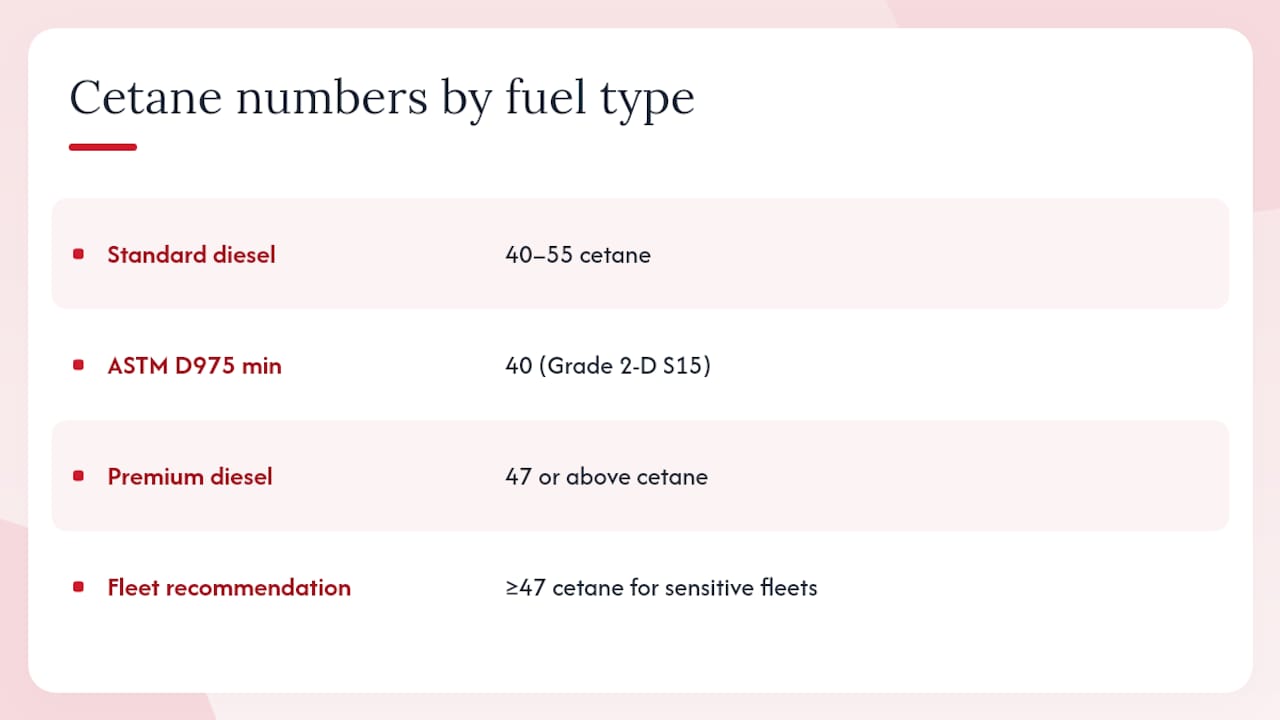
Standard on-road diesel in the U.S. typically carries a cetane number between 40 and 55. Premium diesel products often reach 47 or above. The ASTM D975 minimum for Grade 2-D S15 is 40, which is adequate for most modern engines under normal conditions. High-compression engines, engines operating in cold climates, and vehicles with frequent stop-start duty cycles benefit measurably from cetane numbers at 47 or higher.
Cetane number vs. cetane index: these are not the same measurement. Cetane number is determined by a physical engine test (ASTM D613). Cetane index is a calculated estimate derived from fuel density and distillation characteristics (ASTM D976 or D4737). Cetane index cannot account for cetane-improving additives, so a fuel treated with a cetane improver will show a higher cetane number than its cetane index would predict. When specifying fuel for sensitive equipment, require the measured cetane number, not just the index.
Cetane also interacts directly with emissions control hardware. Engines equipped with diesel particulate filters (DPF) and selective catalytic reduction (SCR) systems perform more reliably with higher-cetane fuel because cleaner, more complete combustion reduces particulate loading on the DPF and stabilizes the exhaust temperature profile that SCR systems depend on.
Pro Tip: For high-compression engines or fleets with frequent stop-start cycles, specify a minimum cetane number of 47 in your fuel purchase order. That single line in your spec can reduce cold-start white smoke, lower injector wear, and extend DPF cleaning intervals.
When should your fleet switch to winterized blends or Diesel #1?
Cold-flow failure is one of the most operationally disruptive fuel problems a fleet can face. Understanding three properties tells you when it becomes a real risk.
Cloud point is the temperature at which wax crystals begin to form in diesel fuel, making it appear cloudy. At this point, the fuel can still flow, but wax crystals will start plugging fuel filters. Pour point is the temperature at which the fuel loses its ability to flow at all. Gelling describes the advanced stage where wax formation is severe enough to completely block fuel lines, filters, and injectors, requiring heated recovery before the equipment can restart.
For Grade 2-D S15, cloud point typically falls in the range of 10°F to 20°F (-12°C to -7°C), though this varies by refinery and season. As a practical rule of thumb: when forecast overnight lows are within 10°F of your fuel’s cloud point, it is time to act. Winterized blend guidance recommends mixing Grade 1-D and Grade 2-D to lower the effective cloud point of the blend and maintain pumpability in cold conditions.
Fleet winterization workflow
- Monitor forecasts weekly starting in October. Track overnight lows against your stored fuel’s cloud point, which your supplier can provide on the Certificate of Analysis (COA).
- Order winterized blends or switch to 1-D when overnight lows are forecast within 10°F of your fuel’s cloud point. Do not wait for the first cold snap.
- Rotate tank inventory before the transition. Running stored 2-D down to a low level before filling with a winter blend prevents a large volume of high-cloud-point fuel from sitting in your tank through the cold months.
- Add EPA-registered anti-gel additives if blending is not available from your supplier. Follow the dosage rate on the product label; overdosing does not improve performance and can affect lubricity.
- Change fuel filters at the start of winter season. Wax crystals that accumulated during early cold events will have partially plugged filter media, reducing flow even after temperatures recover.
- Inspect tank sumps and water separators monthly. Water that enters storage tanks through condensation freezes before diesel gels, compounding filter plugging.
Pro Tip: Request the cloud point and pour point values on every fuel COA during winter months. Store that data alongside your delivery records. If a batch arrives with a cloud point higher than your spec, you have documented grounds to reject it before it goes into your tanks.
Which fuel quality parameters should you test at delivery?
Sulfur content, lubricity, viscosity, water and sediment, and flash point all appear on ASTM D975 test requirement lists. Each one affects a different failure mode.
Sulfur: the regulatory baseline
The EPA’s phased ULSD program brought on-road diesel sulfur from as high as 5,000 ppm down to 15 ppm between 2006 and 2010, then extended the S15 requirement to most nonroad, locomotive, and marine applications. S15 (ULSD) is now the standard for any modern Tier 4 engine. Misfueling a Tier 4 engine with S500 or S5000 fuel damages the DPF and SCR systems quickly and voids most equipment warranties. For on-road vs. off-road diesel compliance, the sulfur designation is the single most consequential specification to verify at delivery.
Lubricity, viscosity, and flash point
Lubricity measures how well the fuel lubricates injection system components. ULSD’s sulfur removal process also strips some natural lubricity, which is why ASTM D975 includes a lubricity test (HFRR wear scar diameter). Biodiesel blends improve lubricity, which is one practical reason B5 blends are common in commercial diesel. Viscosity affects atomization and injector spray pattern; fuel that is too viscous (common in cold conditions) or too thin (common with contamination) degrades combustion efficiency. Flash point is a safety parameter for storage and transport, not a performance metric, but it must meet the ASTM D975 minimum to comply with hazmat regulations.
Water and sediment: a hard fail
Water and sediment content above the ASTM D975 limit of 0.05% by volume is a hard rejection criterion. Water accelerates microbial growth in storage tanks, corrodes injectors, and causes injector tip erosion. A delivery that fails the water and sediment test should be refused before it enters your storage system.
Lubricity and cetane index deviations are performance concerns worth documenting and discussing with your supplier. Water and sediment is not negotiable.
Biodiesel blends: B5 and B20
Biodiesel blends improve lubricity and reduce particulate emissions slightly. Storage handling for B20 requires shorter tank turnover cycles, and procurement specs should explicitly state the maximum biodiesel percentage allowed, especially for winter deliveries.
Pro Tip: Include a maximum biodiesel percentage in every fuel purchase order, especially for winter deliveries. “Grade 2-D S15, maximum B5 blend, per ASTM D975” is a one-line addition that prevents a supplier from delivering B20 into a tank that will sit through a cold weekend.
How to choose the right diesel grade for your fleet
Fleet selection is less about finding the single “best” diesel and more about matching grade, cetane, and sulfur designation to duty cycle, climate, and equipment Tier level. That triplet should be the core of every procurement spec.
Procurement checklist
- Engine spec and Tier level: Tier 4 Final engines require S15 (ULSD). Older Tier 2 or Tier 3 nonroad equipment may accept S500, but verify with the OEM manual before ordering.
- Duty cycle: Frequent cold starts, high-load cycles, or stop-start urban routes benefit from cetane 47 or higher. Steady-state generators or constant-load industrial engines are less sensitive to cetane.
- Climate and storage location: If your tanks are outdoors in a region with winter lows below 20°F, plan for winterized blends from November through March. Indoor or heated storage extends the window for Grade 2-D.
- Fuel turnover rate: High-volume sites that cycle through fuel quickly can carry standard 2-D longer into the season. Low-turnover sites (backup generators, seasonal equipment) need winter blends earlier because fuel sits longer.
- Regulatory requirements: On-road vehicles require S15. Off-road equipment may use dyed diesel; review dyed diesel use cases to confirm which equipment qualifies.
- Biodiesel maximum: State your maximum blend percentage explicitly (typically B5 for year-round, B0 for winter in cold climates).
Minimum spec language for purchase orders
A complete fuel order line might read: *"Grade No.
For winter orders: “Grade No. 1-D S15 per ASTM D975, or winterized blend with cloud point no higher than -20°F, COA required.”
Cost tradeoff: fuel economy vs. cold-weather reliability
Grade 1-D carries lower energy density than Grade 2-D, which means a measurable reduction in miles per gallon or hours per tank. For most fleets, that cost is smaller than the cost of a single gelling event: a plugged fuel system on a job site means equipment downtime, technician labor, and potentially a service call for heated fuel line recovery. Tracking filter change frequency and downtime events over one winter season gives you the data to quantify the tradeoff for your specific operation.
Pro Tip: Require a COA (Certificate of Analysis) and a water and sediment test result with every bulk delivery. File them by delivery date. If an engine problem develops, that paper trail tells you immediately whether the fuel is a contributing factor.
How Anytimefuelpros helps fleets manage fuel grades and cold-weather risk
Getting the fuel specification right on paper is only half the job. The other half is making sure the correct grade arrives on time, in the right condition, with documentation you can actually use. That is where a commercial fuel partner changes the operational equation.
Anytimefuelpros delivers on-site diesel and bulk fuel to construction sites, data centers, mining operations, municipal fleets, and event venues across Texas, Utah, and nationwide through a partner network. The service model is built around the exact pain points that fuel grade decisions create.
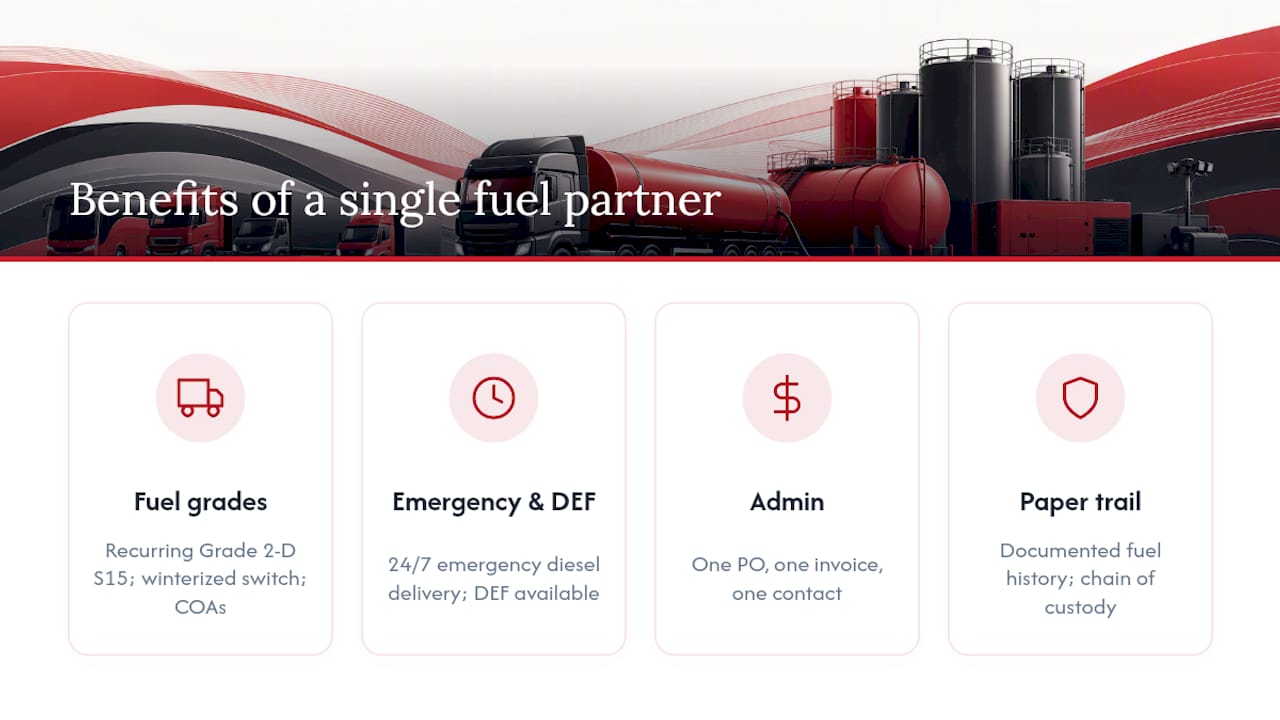
For a construction site running a mixed fleet of excavators, dozers, and light-duty trucks, Anytimefuelpros can schedule recurring deliveries of Grade 2-D S15 through the warm months and transition automatically to a winterized blend as temperatures drop, with COAs provided at each delivery. For a data center running backup generators on Grade 2-D S15, the emergency fuel delivery service provides 24/7 response when a storm or grid event triggers extended generator runtime. DEF delivery is available alongside diesel, so a single call covers both fluids for Tier 4 SCR-equipped equipment.
The operational value of a single fuel partner is not just convenience. It is a documented fuel history, consistent spec compliance, and a single point of accountability when something goes wrong. That paper trail matters when an equipment warranty claim or a regulatory audit comes up.
For a long-haul fleet manager winterizing a multi-state operation, the nationwide partner network means one purchase order, one invoice format, and one contact for delivery confirmation across every yard. The benefits of on-site fuel delivery extend beyond logistics: eliminating crew trips to retail stations, reducing fuel theft exposure, and maintaining documented chain of custody from delivery to tank.
Ready to lock in the right grade and a delivery schedule before the next cold snap? Order now or contact Anytimefuelpros to discuss a fuel spec and delivery plan for your operation.
Sources
The sources below are the primary references for writing procurement specs, validating supplier COAs, and staying current on regulatory requirements.
- D975 Standard Specification for Diesel Fuel
- Diesel Fuel Standards and Rulemakings | US EPA
- ASTM Diesel Fuel Standard Specification – The ANSI Blog
- 7 things you might not know about diesel | Argonne National Laboratory
- Diesel Fuel Grades: What Do the Different Types Mean? | Cadence
- Types of Diesel Fuel: What You Need To Know
For procurement documents and regulatory submissions, cite ASTM D975 and the EPA rulemaking page as primary sources. Industry primers and trade guides are useful for internal training and operational planning, but they do not carry the same authority as the standard or the federal rule in a compliance context.
The ASTM D975 specification is updated periodically. Always verify you are referencing the current edition when writing acceptance test protocols or supplier contracts.
Recent Comments