

Remote fueling service agreements are contractual models that define pricing structures, delivery terms, and risk management approaches for supplying fuel directly to job sites, equipment yards, and remote operations. For facilities and operations managers overseeing multiple locations, the types of remote fueling service agreements you select determine your cost predictability, delivery reliability, and exposure to market volatility. The wrong contract structure can quietly drain your budget or leave equipment idle at the worst possible moment. Getting this decision right starts with understanding what each agreement type actually does.
1. Types of remote fueling service agreements: the three core pricing models
Fuel service agreements fall into three primary pricing structures: fixed-price, indexed pricing, and trigger pricing. Each model manages price volatility differently and requires a different level of supplier capability to execute well. Choosing among them is not just a pricing decision. It is a risk management decision that affects every site in your portfolio.

Fixed pricing periods typically run 1–18 months, jobber agreements run 1–3 years, and branded contracts extend 3–10 years. That range matters because it tells you how long you are locked into a given cost structure, and how much flexibility you give up in exchange for certainty.
2. Fixed-price fueling agreements: budget certainty with a trade-off
Fixed-price contracts lock your fuel cost per gallon for a defined term, regardless of what the market does. This model is the most straightforward of all fuel service agreement types, and it is the right choice when budget predictability outweighs the opportunity to capture market dips.
The core benefits of a fixed-price structure include:
- Predictable monthly fuel costs across all job sites, which simplifies capital planning
- Protection against price spikes during supply disruptions, extreme weather, or geopolitical events
- Simplified invoicing with no need to monitor daily index movements
- Easier contract administration for procurement teams managing multiple vendors
The trade-off is real. Fixed pricing locks your rate regardless of market changes, which means you pay above market when prices fall sharply. A construction firm running heavy equipment fleets through a mild-demand quarter could overpay significantly if diesel prices drop after the contract is signed.
Pro Tip: Negotiate a contract exit clause or a price review window at the 6-month mark. This gives you a limited opportunity to renegotiate if the market moves more than a defined threshold below your locked rate.
3. Indexed pricing agreements: linking costs to market benchmarks
Indexed pricing ties your cost per gallon to a public market index, most commonly the OPIS (Oil Price Information Service) daily average. Your price moves with the market, which means you capture savings when prices fall and absorb increases when they rise.
Indexed pricing requires sophisticated market monitoring and quick execution from your supplier. Without those capabilities, the transparency of the index becomes meaningless because delays in purchasing or delivery can erase any pricing advantage.
Key features of indexed pricing agreements include:
- Market-linked pricing based on OPIS or a comparable public benchmark
- Differential negotiation where you agree on a fixed markup or discount over the index (for example, OPIS daily average minus 1.5 cents per gallon)
- Dynamic cost exposure that reflects real supply and demand conditions
- Requires active monitoring of index movements to time purchases effectively
The differential is where the real negotiation happens. A vague supplier formula gives the vendor room to manipulate your effective cost. A fixed differential over a named index removes that ambiguity entirely.
Pro Tip: Always negotiate a fixed differential expressed in cents per gallon over a named index. Avoid any contract language that references “supplier cost plus margin” without defining the index and the exact differential amount.
4. Trigger pricing agreements and their operational nuances
Trigger pricing is the most sophisticated of the three core models. Trigger pricing activates fuel purchases automatically when market prices hit predefined thresholds, combining elements of indexed pricing with automated execution.
“Trigger pricing depends on volume-based triggers, seasonal structures, and requires financial tools and operational readiness. Without these capabilities in place, the model creates more risk than it eliminates.”
This model works best for operations with large, predictable fuel volumes and a supplier with the infrastructure to execute purchases at the moment a trigger fires. Mining operations and large construction fleets are natural candidates because their volume justifies the complexity.
The risks are real for organizations that lack the right service layer:
- Missed triggers if the supplier lacks real-time market monitoring
- Volume mismatches if trigger quantities do not align with actual site consumption
- Execution delays that result in purchasing above the intended price point
- Seasonal misalignment if trigger structures do not account for demand cycles
Trigger pricing is not a set-and-forget model. It requires an active partnership with a supplier who treats fuel pricing as an integrated service, not just a number on an invoice.
5. Other remote fueling contract types and variations to consider
Beyond the three core pricing models, facilities managers need to understand several additional fuel service agreement types that affect flexibility, exclusivity, and multi-site management.
| Contract Type | Key Feature | Typical Term | Best For |
|---|---|---|---|
| Take-or-pay | Minimum volume commitment regardless of use | 1–3 years | High-volume, predictable sites |
| Spot supply | No commitment; market rate at time of delivery | Per delivery | Low-volume or emergency needs |
| Branded fuel contract | Exclusivity required; equipment loans possible | 3–10 years | Retail or high-visibility operations |
| Unbranded fuel contract | Flexible sourcing; more negotiation room | 1–5 years | Multi-site commercial operations |
| Portfolio/multi-site agreement | Volume pooled across locations for better terms | 1–3 years | Facilities managers with 3+ sites |
Branded contracts typically run 3–10 years and often require exclusivity, meaning you cannot source from other suppliers during the term. They may include equipment loan provisions, which can be valuable for remote sites that need storage tanks or dispensing equipment. Unbranded contracts run 1–5 years and offer more flexibility to shop the market or switch suppliers.
Multi-site portfolio agreements pool volume across all your locations to negotiate better pricing and terms. For a facilities manager running five job sites across two states, consolidating under one agreement often produces better per-gallon rates than negotiating each site separately. Anytimefuelpros structures multi-site fueling contracts to give operations managers a single point of contact and consistent pricing across all locations.
6. Key criteria for evaluating remote fuel delivery contracts
Selecting the right fuel service agreement requires more than comparing price per gallon. Fuel pricing is a service, and the supplier’s execution capabilities matter as much as the contract structure itself.
Evaluate every remote fuel delivery contract against these criteria:
- Pricing transparency: Does the contract reference a named public index like OPIS, and is the differential fixed in writing? Vague formulas favor the supplier.
- Contract length and renewal terms: Shorter terms give you flexibility. Longer terms may offer better pricing but reduce your ability to respond to market changes.
- Supplier execution capability: Can the supplier monitor markets in real time, execute purchases at trigger points, and deliver to remote or hard-to-reach sites on schedule?
- Volume flexibility: Does the contract penalize you for consuming less than projected? Take-or-pay clauses can create significant cost exposure during slow periods.
- Service layer depth: Does the agreement include scheduled deliveries, emergency response, and DEF supply? A contract that covers only fuel leaves gaps that cost you during critical moments.
- Multi-site logistics: Can the supplier coordinate deliveries across multiple locations under one agreement, or will you manage separate vendor relationships for each site?
Pro Tip: Request a sample invoice before signing any agreement. The invoice format reveals how the supplier calculates your price. If you cannot trace the final cost back to a named index plus a fixed differential, the pricing structure lacks transparency.
Aligning your contract structure with your site’s operational profile is the most important step in the selection process. A data center with 24/7 uptime requirements needs different terms than a seasonal construction project. The vendor SLA standards you negotiate should reflect the actual consequences of a missed delivery at each specific site.
Negotiating a fixed differential from rack price rather than accepting a vague supplier formula is the single most effective way to protect your organization from pricing manipulation. Sophisticated facilities managers specify the exact index, the exact differential in cents per gallon, and the exact publication time used to set the daily price.
Anytimefuelpros: custom fuel supply contracts for multi-site operations
Anytimefuelpros builds fuel delivery agreements around the specific needs of facilities and operations managers running multiple job sites, equipment yards, and mission-critical infrastructure. Whether you need a fixed-price contract for budget certainty or an indexed agreement tied to OPIS for market transparency, Anytimefuelpros structures the terms to match your operational risk profile.
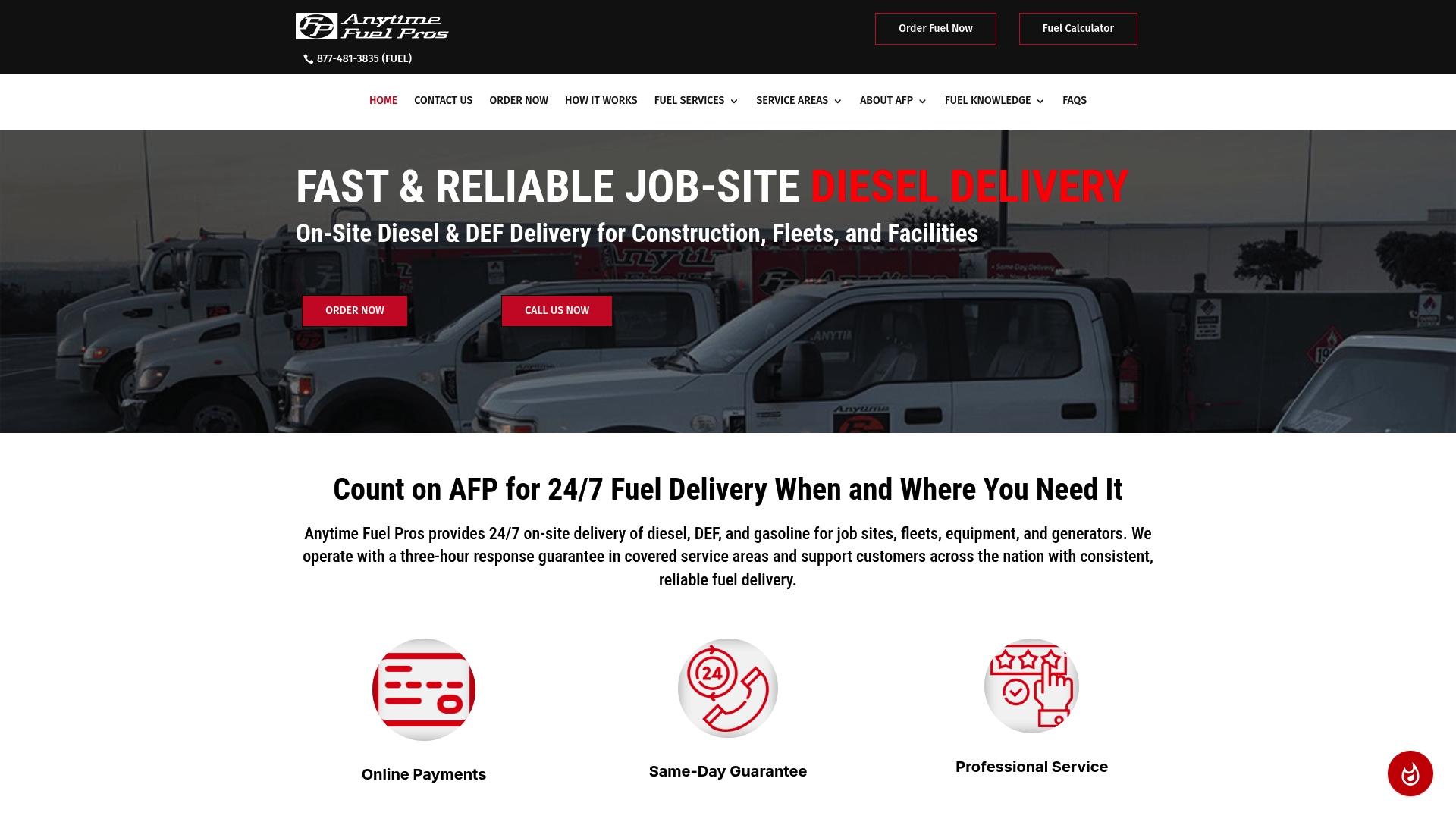
Anytimefuelpros covers primary markets in San Antonio, Austin, Dallas-Fort Worth, and Salt Lake City, with nationwide reach through a trusted partner network. That means one vendor, one invoice, and one point of contact across all your locations. For on-demand diesel delivery or a fully structured multi-site agreement, Anytimefuelpros delivers the fuel and the contract terms your operation requires. Contact Anytimefuelpros to discuss a custom fuel supply contract built around your sites, your volumes, and your uptime requirements.
FAQ
What are the main types of remote fueling service agreements?
The three core types are fixed-price, indexed pricing, and trigger pricing agreements. Additional variations include take-or-pay, spot supply, branded, unbranded, and multi-site portfolio contracts.
How does indexed pricing differ from fixed-price fuel contracts?
Fixed-price contracts lock your cost per gallon for a set term, while indexed pricing ties your cost to a public benchmark like OPIS and changes with the market. Indexed pricing offers more transparency but requires active market monitoring.
What is a fixed differential in a fuel service agreement?
A fixed differential is a set amount in cents per gallon added to or subtracted from a named market index, such as “OPIS daily average minus 1.5 cpg.” It replaces vague supplier formulas and reduces pricing manipulation risk.
When does trigger pricing make sense for remote fueling?
Trigger pricing works best for high-volume operations with predictable fuel demand, such as mining or large construction fleets. It requires a supplier with real-time market monitoring and the operational readiness to execute purchases the moment a price threshold is reached.
How do multi-site portfolio agreements benefit facilities managers?
Multi-site agreements pool fuel volume across all locations to negotiate better per-gallon pricing and simplify vendor management. They replace multiple regional vendor relationships with a single contract, single invoice, and consistent delivery standards across every site.
Key Takeaways
The most effective remote fueling service agreement matches your pricing structure, contract length, and supplier capabilities to the specific risk profile and uptime requirements of each job site.
| Point | Details |
|---|---|
| Fixed-price agreements offer certainty | Lock your per-gallon rate for 1–18 months to protect against price spikes and simplify budgeting. |
| Indexed pricing requires a named benchmark | Always specify OPIS or a comparable public index with a fixed differential in writing to prevent pricing manipulation. |
| Trigger pricing demands supplier readiness | This model only works when your supplier has real-time monitoring and the operational capacity to execute purchases at defined price thresholds. |
| Multi-site portfolios improve cost efficiency | Pooling volume across locations under one agreement produces better terms than negotiating each site separately. |
| Pricing transparency is non-negotiable | Request a sample invoice before signing; if you cannot trace the final cost to a named index plus a fixed differential, the contract lacks clarity. |
Recent Comments