
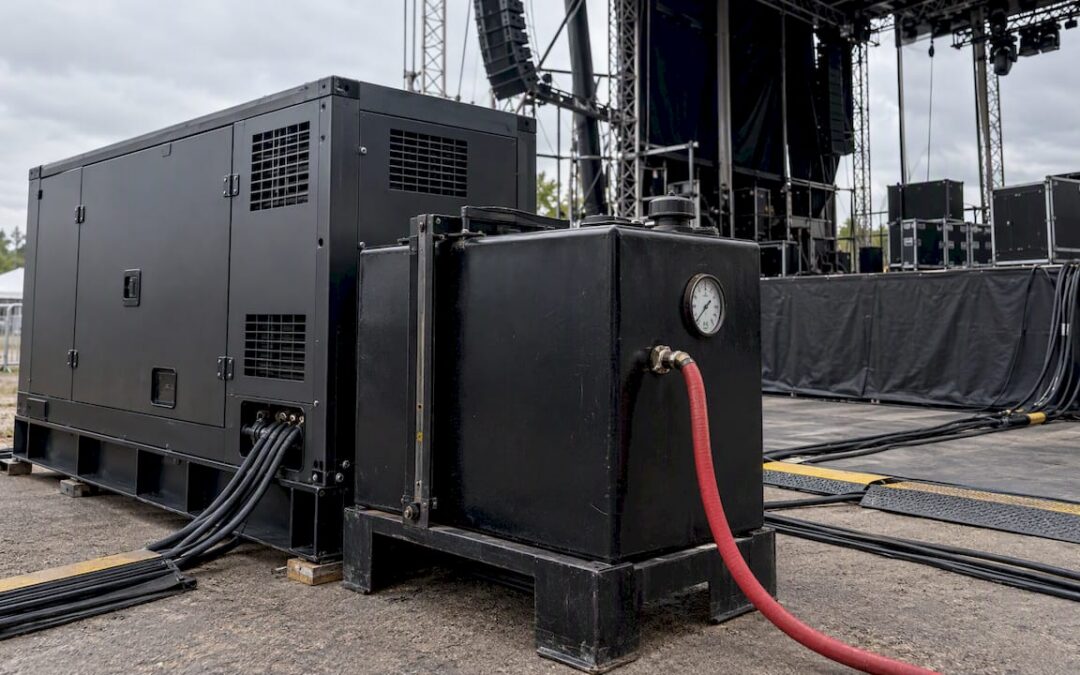
The fastest way to get an accurate fuel number is the inventory method: start fuel minus end fuel, plus deliveries, minus removals. Once you have that figure, the two levers that cut it fastest are metering and allocation (knowing exactly where every gallon goes) and right-sizing equipment so generators run at efficient load points instead of idling under their capacity. The sections below walk through the math, the technical drivers, and the operational moves that turn these numbers into real savings.
TL;DR:
- Oversized generators operating below 30% load burn more fuel per kilowatt hour than correctly matched units running near 70% to 80% load.
- In the festival example, 320 gallons over 40 operating hours equals 8 gallons per hour, while 1,600 kilowatt hours yields 5 kilowatt hours per gallon.
- Track fuel and runtime separately during setup, the show, and teardown; shared venue power requires submeters or a documented allocation rule.
- Use supplier measured fuel carbon content when available; otherwise, apply EPA default emission factors to estimate greenhouse gas emissions.
- Hybrid systems suit intermittent loads, but a single day event with steady demand is usually simpler and cheaper with a correctly sized generator alone.
Table of Contents
- How to calculate event fuel consumption: formulas and a worked example
- Generator fuel consumption and efficiency: BSFC, load points, and what to measure
- Operational tactics to cut fuel use and costs before, during, and after the event
- Measurement, allocation, and emissions accounting for events
- Practical technology options: batteries, solar assist, and hybrid generator systems
- Planner’s checklist and minimal fuel-log template for event teams
- How a commercial on-site fuel partner supports event operations
- Get reliable fuel delivery for your next event
- FAQ
- Sources
How to calculate event fuel consumption: formulas and a worked example
Two methods cover most event scenarios, and you likely already have the inputs for one of them.
- Inventory method. Fuel burned equals starting fuel minus ending fuel, plus any fuel delivered during the event, minus any fuel removed. This works well when tanks are dipped or weighed at defined checkpoints, a practice detailed in the DOE onboard generator test procedure.
- Runtime-rate method. Divide total gallons consumed by total operating hours to get a gallons-per-hour rate, which you can then multiply against planned runtime for future events.
When a generator is metered, you can go a step further and calculate kWh per gallon: divide the metered energy output by the fuel consumed. The DOE generator test procedure records start and end fuel weight, converts that weight to gallons using fuel density, and pairs it with kWh readings to produce this efficiency figure, which is the clearest way to compare one generator setup against another on the same site.
Here is how it works on a small festival stage generator. Say the tank holds 500 gallons at bump-in and 180 gallons at bump-out, with no deliveries or removals during the three-day run. Fuel burned is 500 minus 180, or 320 gallons. If the generator logged 40 hours of runtime across those three days, the rate is 320 divided by 40, or 8 gallons per hour. If the metered output was 1,600 kWh for the weekend, efficiency comes out to 1,600 divided by 320, or 5 kWh per gallon. That single number lets you compare this generator against a different model or a different load profile at your next event, without needing to repeat the full inventory count each time.
For a deeper look at how these rates shift with generator size and load, our generator fuel consumption rate charts break down typical burn figures across common unit sizes.
Generator fuel consumption and efficiency: BSFC, load points, and what to measure
A generator’s nameplate kW rating tells you its maximum output, not how much fuel it burns doing real work. That gap is where most event budgets quietly leak.
- Duty type matters. Prime power (continuous, variable load), standby power (backup only), and variable-load event power each carry different fuel profiles, even on identical hardware.
- Brake-specific fuel consumption (BSFC) measures fuel mass per unit of useful work, typically grams per kWh, and it is the right way to compare engines because it accounts for actual output rather than rated capacity, as explained in this overview of brake-specific fuel consumption.
- Collect these fields on site: start and end fuel weight, metered kWh, runtime hours, and ambient temperature, since heat and altitude both shift efficiency.
- Low-load operation drives up fuel per kWh. A generator sized for peak lighting and sound that spends most of the event running a handful of phone chargers and a coffee maker is burning fuel inefficiently the entire time.
One widely cited test example reports a brake-specific fuel consumption figure near 317 grams per kWh for a comparable engine at a matched load point, a useful benchmark for spotting a generator that is running far outside its efficient range. The fix is matching generator size to actual expected load, not peak theoretical load, and we cover exactly how to do that in the next section.
Operational tactics to cut fuel use and costs before, during, and after the event
Fuel costs at events rarely come from one bad decision. They build up from small inefficiencies repeated across every stage, every day, and every supply run.
- Right-size generators and stage equipment. Oversized units running under 30% load burn more fuel per kWh delivered than a correctly matched unit running near 70 to 80% load.
- Stagger equipment starts. Bringing up lighting, sound, and climate control in sequence rather than all at once avoids a demand spike that forces oversized generator selection in the first place.
- Schedule noncritical loads for lower-demand windows. Running water chillers or charging stations overnight, when stage power demand drops, smooths the load curve and lets the generator settle into an efficient operating point.
- Consolidate fuel logistics. Scheduled top-ups beat emergency runs on cost and on reliability, since a planned delivery window avoids the premium pricing and scrambling that come with a dry tank mid-show. Our guide to generator fueling schedules walks through how to set those windows.
- Plan routes to cut supply vehicle miles and idling. Local staging areas reduce the distance fuel trucks and crew vehicles travel between the yard and the site, and practical transport planning frameworks built for multi-stop event logistics apply directly to fuel and equipment runs as well as people movement.
Pro Tip: Walk the site power plan against actual equipment specs before the event, not during load-in, so right-sizing decisions happen on paper instead of under time pressure.
Avoiding emergency fuel runs is worth particular attention. Our breakdown of power outage fuel logistics covers how last-minute fueling compounds cost and risk, lessons that translate directly to multi-day festival and production schedules.
Measurement, allocation, and emissions accounting for events
Credible fuel numbers come from tracking phases, not totals. A single end-of-event gallon count hides exactly where consumption happened and makes next year’s planning a guess.
- Log fuel and runtime separately for bump-in, show, and bump-out. Each phase has a different load profile, and lumping them together masks which one is driving cost.
- Use submetering or a documented allocation rule when power is shared with a venue’s own systems, a practice the Net Zero Carbon Events venue energy guidance recommends specifically to prevent event energy use from disappearing into a building’s overall bill.
- Prefer supplier-measured fuel carbon content when it is available. When it is not, EPA default emission factors are the appropriate fallback for converting gallons burned into CO2 and other greenhouse gases, per the EPA GHG emission factors hub.
- Keep delivery invoices, meter readings, and phase logs together so the numbers hold up if a sponsor, venue, or regulator asks for documentation after the fact.
Submetering and interval data give organizers a way to catch abnormal runtime, such as equipment left running overnight during an unoccupied period, which the venue energy guidance identifies as a common and avoidable source of wasted fuel. Catching that pattern once usually prevents it from repeating at the next event on the same site.
Practical technology options: batteries, solar assist, and hybrid generator systems
Batteries and solar assist do not replace generators at most events, but they change how long a generator has to run and at what load.
- Battery buffers absorb low-power periods, letting the generator shut down or idle less during quiet stretches like overnight security lighting or early load-in, then ramp back up for peak demand.
- Solar assist reduces daytime draw on sunny sites, which stretches fuel reserves without adding generator runtime.
- Trade-offs are real: hybrid setups need extra space, controls commissioning time, and weather-appropriate enclosures, and someone on site needs to understand how the system behaves if the battery depletes faster than expected.
- Hybrid gear earns its cost when loads are intermittent, such as lighting, AV, and communications gear that cycle on and off, since that is exactly the pattern that hybrid generator systems are built to smooth out.
For a single-day event with a steady load, a well-sized generator alone is usually simpler and more cost-effective than adding hybrid components.
Planner’s checklist and minimal fuel-log template for event teams
Start tracking before the first truck arrives, not after the first tank runs low.
- Pre-event: confirm capacity planning against real load estimates, lock in fuel contract delivery windows, set up meters or submeters where power is shared, and build a contingency plan for at least one unplanned top-up.
- On-site log fields: timestamp, tank ID, start fuel, end fuel, deliveries received, runtime hours, kWh produced or drawn, and a notes field for anomalies like an unexpected shutdown or a load spike.
- Post-event reconciliation: total fuel burned against planned estimates, then convert to cost per hour of runtime or emissions per attendee for reporting back to sponsors or venue partners.
Our fuel vendor checklist with model burn charts gives planners a ready template to adapt for their own site layout and equipment list.
How a commercial on-site fuel partner supports event operations
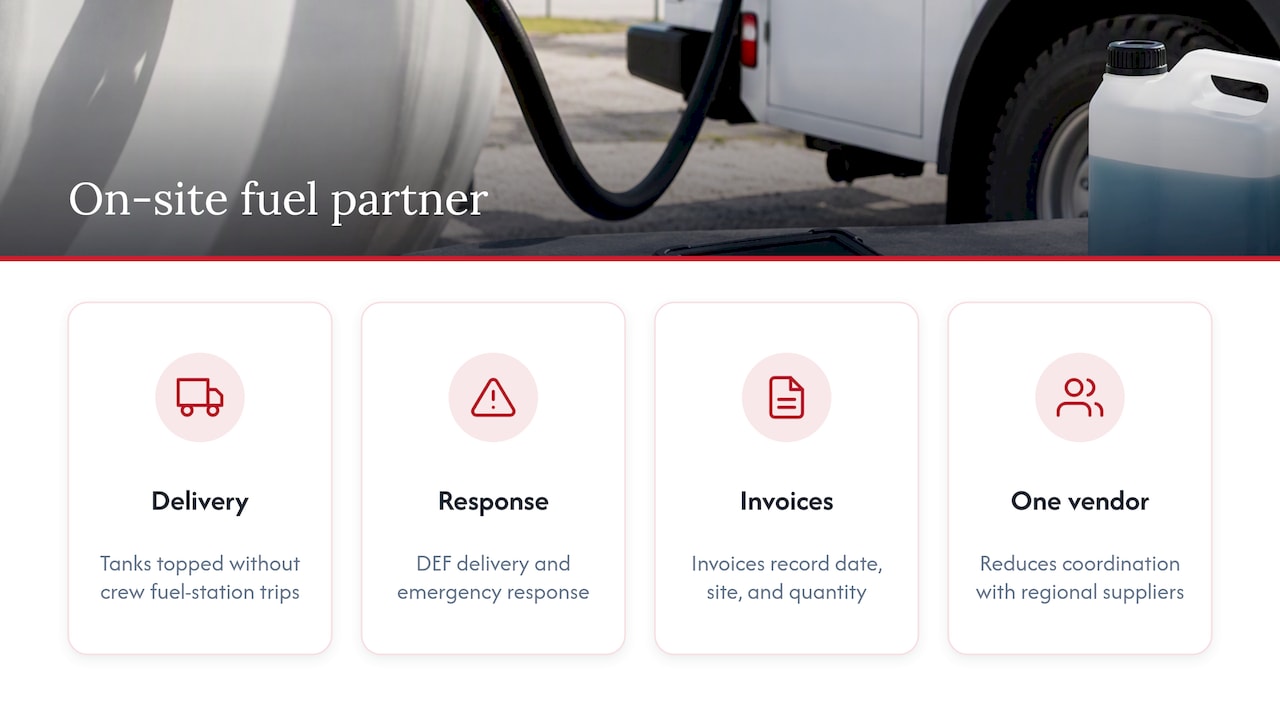
Multi-day festivals, remote sites, and productions with hard uptime requirements rarely run efficiently on ad hoc fuel runs. Scheduled fuel delivery directly to generators, staging areas, and equipment yards can keep tanks topped without pulling crew off their actual jobs to make a fuel station trip. Fuel delivery services also handle DEF delivery and emergency response when a generator runs hotter than planned.
Deliveries typically include an invoice tied to the date, site, and quantity delivered, which provides production accounting with the documentation needed for phase-level reconciliation described earlier. For organizers coordinating fuel across multiple stages or venues at once, working with a single vendor can reduce the coordination overhead of managing several regional suppliers during an already compressed event timeline. Our on-site diesel delivery setup guide covers tank placement and access planning for production teams working through this for the first time.
Get reliable fuel delivery for your next event
We built our event fueling service around the exact problem this guide addresses: generators that run dry mid-show, crews pulled off setup to chase a fuel station, and invoices that do not match what actually got delivered.

- Scheduled deliveries timed to your bump-in, show, and bump-out phases
- Documented, itemized invoicing for every drop, ready for post-event reconciliation
- Emergency response when a generator runs hotter than planned
Whether you are powering a single stage or a multi-day festival footprint, our fuel services page covers diesel, gasoline, DEF, and bulk delivery options for event production teams.
FAQ
How much fuel is burned per day?
Daily fuel burn depends entirely on generator size, load, and runtime hours, so there is no fixed figure across events. The most reliable way to get your own number is the inventory method: start fuel minus end fuel, plus deliveries, minus removals, tracked separately for each day.
What is the formula for calculating the consumption rate?
The consumption rate is gallons consumed divided by operating hours, which gives you a gallons-per-hour figure you can apply to future runtime estimates. This runtime-rate method, outlined in the DOE generator test procedure, works alongside the inventory method for cross-checking your numbers.
How much fuel will a vehicle consume per kilometer?
Vehicle fuel consumption per kilometer depends on engine size, load, and driving conditions, and figures vary too widely by make and model to state a single rate. For event logistics vehicles specifically, tracking actual trip fuel against odometer readings gives a far more useful number than a generic estimate.
What is specific fuel consumption?
Specific fuel consumption, often called brake-specific fuel consumption or BSFC, measures fuel mass used per unit of useful engine work, typically expressed in grams per kWh. Comparing BSFC at matched load points, rather than by engine size alone, is the correct way to judge which generator setup is actually more efficient, as described in this overview of brake-specific fuel consumption.
Sources
- ETA-HTP13 Onboard generator energy efficiency test (DOE)
- Venue energy guidance (Net Zero Carbon Events community)
- EPA GHG emission factors hub (2025)
Recent Comments