
A 100 kW diesel generator burns roughly 7 gallons per hour at full load — that single figure, drawn from the industry-standard 0.07 gal/kWh rule of thumb, is the fastest way to anchor any fuel plan. Scale it up: a 500 kW unit needs about 35 gal/hr at full load, and a 1,000 kW unit approaches 70 gal/hr. Generator fuel consumption rates vary most with load percentage, so the charts and calculation method below are where the real planning work happens.
Key Takeaways
| Point | Details |
|---|---|
| Use actual load, not nameplate | A 100 kW generator at 50% load burns ~4.1 gal/hr, not the 7.4 gal/hr full-load figure. |
| 70–80% load is the efficiency sweet spot | Running below 40% load raises fuel burn per kWh and risks wet-stacking in diesel engines. |
| Size tanks with usable gallons and a margin | Apply a 5% draw-down reserve plus a 15% planning buffer for transient loads and delivery delays. |
| Add a 10% real-world buffer | Engine wear, fuel quality variation, and transient loads typically push consumption 10% above spec-sheet values. |
| Anytimefuelpros delivers on-site | Scheduled and emergency diesel delivery to generators, day tanks, and bulk storage — single-vendor, nationwide. |
Table of Contents
- What are the generator fuel consumption rates for diesel by kW and load?
- How much fuel does a portable gasoline generator use per hour?
- How do you calculate fuel use and runtime for any generator?
- What factors change your real-world fuel consumption?
- How do you size a fuel tank and plan refueling cadence?
- How do you estimate operating cost per hour and per day?
- Diesel, gasoline, or natural gas: which fuel type fits your situation?
- How to reduce fuel consumption and get more runtime per gallon
- Methodology and assumptions behind the charts
- Planning extended runtime: on-site refueling and delivery options
- Anytimefuelpros keeps your generator running when it matters most
- Sources
What are the generator fuel consumption rates for diesel by kW and load?
The table below maps common diesel generator sizes to gallons per hour at four standard load levels. Industry vendor charts present these values as planning estimates, not guaranteed OEM specs — actual burn depends on engine family, ambient conditions, and maintenance state.
How to read this table: Use your generator’s actual operating load, not its nameplate rating. For generators rated in kVA rather than kW, multiply kVA by the power factor (commonly 0.8 for commercial standby units) to get kW before looking up the row.
Chart assumptions: Values are calculated at sea level using a specific fuel consumption (SFC) reference of approximately 0.07 gal/kWh for diesel, consistent with typical modern diesel SFC of 0.22–0.25 L/kWh at or near optimal load. Standard ambient temperature (77°F) is assumed. Field conditions will shift these numbers — see the Methodology section for adjustment guidance.
- Values represent planning estimates with a typical real-world variability of ±10%.
- Light-load rows (25%) often show disproportionately high fuel-per-kWh because diesel engines lose thermal efficiency below roughly 40% load.
- Always cross-check against your OEM spec sheet for the specific engine model and rating.
Pro Tip: Download this table as a CSV for your own spreadsheet by copying the rows above — or use the Anytimefuelpros fuel consumption calculator to enter your exact kW and load percentage and get an instant estimate.
How much fuel does a portable gasoline generator use per hour?
Gasoline generators follow the same load-percentage logic as diesel, but the absolute burn rates are lower because the units are smaller. The table below covers common portable and inverter-generator sizes.
| Generator Size | 25% Load (gal/hr) | 50% Load (gal/hr) | 75% Load (gal/hr) |
|---|---|---|---|
| 2 kW (inverter) | 0.10 | 0.14 | 0.20 |
| 3 kW | 0.14 | 0.20 | 0.29 |
| 5 kW | 0.21 | 0.35 | 0.52 |
| 7 kW | 0.29 | 0.48 | 0.71 |
| 10 kW | 0.40 | 0.67 | 0.98 |
Figures derived from portable generator consumption references and are estimates for planning.
Runtime = 4.5 ÷ 0.35 ≈ 12.9 hours
Plan for a refill at the 12-hour mark to stay clear of the reserve.
Pro Tip: *Inverter generators (like Honda EU series or Yamaha EF series) throttle engine speed to match actual load.
Key practical notes for portable units:
- Tank capacity on most 5–7 kW portables is 4–6 gallons; confirm the usable volume in your owner’s manual.
- Running at 75% load or above for extended periods raises both fuel burn and engine temperature — budget for more frequent refills and allow cool-down intervals.
- Ethanol content in pump gasoline (E10 or E15) slightly reduces energy density versus pure gasoline, which can nudge actual consumption 3–5% above these estimates.
How do you calculate fuel use and runtime for any generator?
The core formula is straightforward:
Fuel/hr (gal) = kW output × SFC (gal/kWh)
Where kW output = rated kW × load percentage, and SFC is the specific fuel consumption reference for your fuel type. For diesel, use 0.07 gal/kWh as a planning figure. For gasoline portables, SFC typically runs 0.10–0.14 gal/kWh depending on engine design.
To extend this to cost and runtime:
- Cost/hr ($) = Fuel/hr × fuel price per gallon
- Runtime (hr) = Usable tank volume (gal) ÷ Fuel/hr
The interpolation method — storing SFC reference points at 25%, 50%, 75%, and 100% load and interpolating for intermediate values — gives the most accurate planning estimate across the load range.
-
kW output = 250 × 0.50 = 125 kW
-
Fuel/hr = 125 × 0.07 = 8.75 gal/hr (chart value: ~10.2 gal/hr; the chart accounts for real-world engine losses, so use 10.2 for planning)
-
At $3.80/gal diesel: Cost/hr = 10.2 × $3.80 = $38.76/hr
-
With a 500-gallon day tank (475 usable): Runtime = 475 ÷ 10.2 = 46.6 hours
-
kW output = 5 × 0.50 = 2.5 kW
-
Fuel/hr = 2.5 × 0.12 = 0.30 gal/hr (use 0.35 from the chart for planning margin)
-
At $3.50/gal gasoline: Cost/hr = 0.35 × $3.50 = $1.23/hr
-
With a 5-gallon tank (4.5 usable): Runtime = 4.5 ÷ 0.35 = 12.9 hours
Inputs to gather before you calculate:
- Nameplate rated kW (or kVA × power factor)
- Expected percent load (measure with a clamp meter or check connected load list)
- Fuel type and local price per gallon
- Tank capacity and usable volume (subtract 5–10% for draw-down reserve)
- Planned runtime window and any contingency hours required
What factors change your real-world fuel consumption?
Chart values assume ideal conditions. In the field, several variables push consumption above or below those estimates — sometimes significantly.
- Load percentage is the single biggest lever. Running a diesel below 30–40% load raises fuel burn per kWh and risks wet-stacking (unburned fuel accumulating in the exhaust system). The efficiency sweet spot sits at 70–80% load, where thermal efficiency peaks.
- Altitude and ambient temperature both derate engine output. Spec-sheet values are measured at sea level and 77°F; at 5,000 feet elevation, expect a 10–15% power derate and a corresponding increase in fuel burn per kWh produced. High ambient temperatures compound the effect.
- Engine age and maintenance state affect injector spray patterns, compression ratios, and air-filter restriction — all of which shift SFC upward as the engine wears. A well-maintained modern diesel holds closer to 0.22 L/kWh; a neglected older unit can drift toward 0.35 L/kWh or higher.
- Fuel quality matters more than most operators expect. Water contamination, microbial growth in stored diesel, or high biodiesel blends (B20+) can reduce energy content and clog injectors, raising consumption and increasing maintenance intervals.
- Alternator coupling losses add 3–8% to the engine’s fuel demand beyond what a pure kW-output calculation suggests. The charts already embed a typical alternator efficiency assumption, but high-resistance connections or aging windings push losses above that baseline.
- Duty cycle and start-stop patterns affect average consumption differently than steady-state operation. Frequent cold starts and short run cycles prevent the engine from reaching optimal operating temperature, raising average fuel burn per kWh over a shift.
Generac’s standby guidance specifically flags load, ambient temperature, and elevation as the primary influences on both power output and fuel consumption for standby gensets — a useful cross-check against the chart values here.
How do you size a fuel tank and plan refueling cadence?
Tank sizing starts with one number: gal/hr at your expected operating load. Multiply by planned runtime, add a safety margin, and you have your minimum usable tank volume.

| Tank Size (gal) | Runtime at 2 gal/hr | Runtime at 5 gal/hr | Runtime at 10 gal/hr | Runtime at 20 gal/hr |
|---|---|---|---|---|
| 100 | 47.5 hr | 19 hr | — hr | 4.75 hr |
| 250 | 118.75 hr | 47.5 hr | 23.75 hr | 11.9 hr |
| 500 | 237.5 hr | 95 hr | 47.5 hr | 23.75 hr |
| 1,000 | 475 hr | 190 hr | 95 hr | 47.5 hr |
For multi-day operations, bulk tank sizing and delivery cadence should account for more than just steady-state burn. Add contingency hours for load spikes, delayed deliveries, and weather events.
Planning checklist:
- Calculate minimum usable volume: (gal/hr × planned runtime hours) × 1.15 safety buffer
- Confirm tank draw-down limit with your equipment supplier — most above-ground tanks leave 5–10% unusable at the bottom
- Schedule top-offs before the tank drops below 25% to avoid sediment disturbance and air ingestion
- Rotate stored diesel every 6–12 months and use fuel polishing if storage exceeds 90 days
- Check local and state regulations for above-ground storage tank (AST) permitting thresholds — many jurisdictions require secondary containment above 660 gallons
- For critical facilities, maintain a generator fuel maintenance program that includes scheduled testing, fuel sampling, and polishing
Pro Tip: Staged refueling — topping off the day tank from a larger on-site bulk tank rather than waiting for a delivery truck during an active outage — cuts the risk of a dry-run shutdown. Pair the bulk tank with a scheduled delivery contract so the bulk supply stays full without manual tracking.
How do you estimate operating cost per hour and per day?
The formula is direct: Cost/hr = gal/hr × fuel price per gallon. Extend it to daily cost by multiplying by hours of operation per day.
-
Fuel burn: 0.35 gal/hr
-
Fuel price: $3.50/gal
-
Cost/hr: $1.23
-
Cost for 24-hour run: $29.40
-
Fuel burn: 1.4 gal/hr
-
Fuel price: $3.80/gal
-
Cost/hr: $5.32
-
Cost for 72-hour outage: $383.04
-
Fuel burn: 14.4 gal/hr
-
Fuel price: $3.60/gal (commercial bulk rate)
-
Cost/hr: $51.84
-
Cost for 7-day continuous run (168 hr): $8,709.12
A few cost variables that the simple formula misses:
- Commercial bulk diesel pricing typically runs $0.20–$0.50/gal below retail pump prices for contracted volumes — factor this in for large operations.
- DEF (diesel exhaust fluid) consumption on Tier 4 Final engines runs roughly 2–3% of diesel volume, adding a secondary cost line.
- Fuel additives for cold-weather operation or long-term storage add $0.02–$0.08/gal depending on product and dosage rate.
Use the Anytimefuelpros fuel consumption calculator to model multi-day scenarios with your local fuel price before committing to a tank size or delivery contract.
Diesel, gasoline, or natural gas: which fuel type fits your situation?
Each fuel type carries a different SFC profile, cost structure, and set of handling requirements. The right choice depends on generator size, site infrastructure, and runtime expectations.
Diesel:
- SFC range: 0.22–0.30 L/kWh (≈0.058–0.079 gal/kWh) at typical loads
- Lowest cost-per-kWh among liquid fuels at commercial bulk pricing
- Best for: continuous standby, commercial and industrial sites, data centers, construction, and any application requiring 24+ hour runtime from stored fuel
- Storage: requires secondary containment above regulatory thresholds; fuel quality degrades after 6–12 months without treatment
- Dyed (off-road) vs. clear (on-road) diesel matters for tax compliance — generators typically use dyed diesel for off-road applications
Gasoline:
- SFC range: 0.30–0.45 L/kWh at typical loads — less efficient than diesel per kWh produced
- Higher retail price per gallon than diesel in most markets; no bulk commercial pricing advantage
- Best for: small portables under 10 kW, short-duration residential backup, remote recreational use
- Storage: degrades faster than diesel (60–90 days without stabilizer); ethanol blends accelerate phase separation in stored tanks
Propane/LP:
- Burns cleaner than diesel or gasoline; SFC slightly higher than diesel on an energy-equivalent basis
- Best for: residential standby where a fixed propane tank is already installed; sites with no diesel delivery access
- Storage: indefinite shelf life in sealed tanks; requires licensed installation and pressure-rated equipment
Pipeline natural gas:
- Eliminates on-site fuel storage entirely — the generator draws from the utility line
- Best for: permanently installed standby at sites with reliable gas infrastructure; eliminates refueling logistics
- Limitation: utility gas pressure can drop during widespread outages or peak demand events, which is the exact scenario a standby generator is meant to cover
For a deeper look at diesel fuel grades and commercial applications, including additive packages and seasonal blends, the grade selection matters as much as the fuel type itself.
How to reduce fuel consumption and get more runtime per gallon
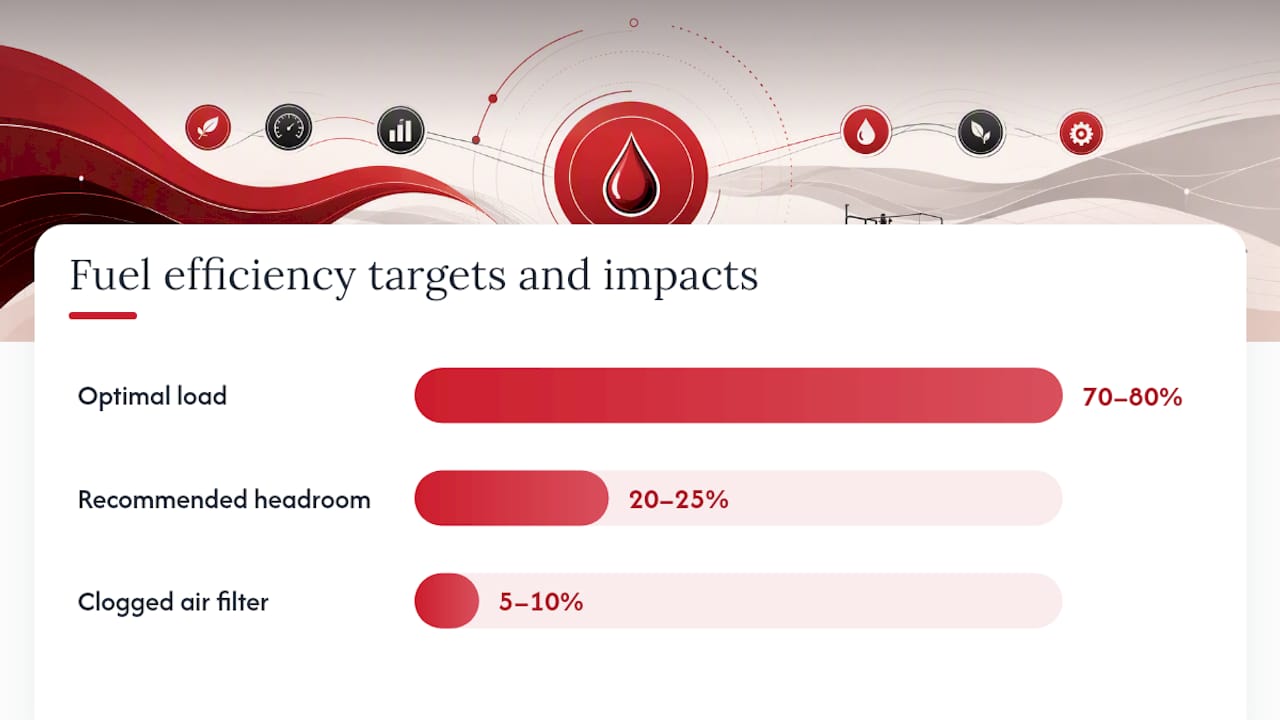
The biggest gains come from load management and right-sizing — not from fuel additives or minor maintenance tweaks. Modern diesel gensets are most fuel-efficient at 70–80% load, and that efficiency curve is steep on both ends.
Priority actions:
- Right-size the generator. A 500 kW unit running a 100 kW load burns fuel at its worst efficiency point. Match rated capacity to expected peak load plus a 20–25% headroom margin, not a 400% margin.
- Keep loads in the 70–80% band. Stagger noncritical loads (HVAC, lighting circuits, non-essential equipment) to maintain the engine in its efficiency window during extended runs.
- Use load banks for exercise runs. Running a generator under no-load or very light load for weekly testing causes wet-stacking and inflates average fuel consumption. A load bank brings the engine to operating temperature under realistic conditions.
- Implement a preventive maintenance schedule. Fuel filter replacement, injector service, air intake cleaning, and coolant checks directly affect SFC. A clogged air filter alone can raise fuel burn by 5–10%.
- Check alternator coupling and connections. Loose or corroded connections increase resistive losses, which the engine compensates for by burning more fuel.
For fleet operators managing multiple diesel assets, diesel engine efficiency practices that apply to trucks translate directly to generator sets — injector condition, compression health, and turbocharger performance all govern SFC.
Pro Tip: Soft-start devices on large motor loads (HVAC compressors, pumps, air compressors) reduce inrush current spikes that force the generator to momentarily over-fuel. Eliminating those spikes keeps the engine closer to its steady-state efficiency point and reduces mechanical wear.
Maintenance checklist for fuel economy:
- Replace fuel filters per OEM interval (typically every 250–500 hours)
- Service injectors every 1,000–2,000 hours or per manufacturer spec
- Inspect and clean air intake and turbocharger annually
- Check alternator coupling alignment and terminal torque at each scheduled service
- Sample and test stored fuel every 90 days for water content and microbial growth
Methodology and assumptions behind the charts
The diesel chart values use a planning SFC of approximately 0.07 gal/kWh, consistent with the 0.22–0.25 L/kWh range for modern diesel gensets at or near optimal load. All figures assume ISO/sea-level baseline conditions and a standard ambient temperature of 77°F, matching the conditions under which OEM spec sheets are typically measured.
Core assumptions:
- Power factor of 0.8 applied for kVA-to-kW conversions unless otherwise noted
- Alternator efficiency of approximately 92–95% embedded in chart values
- Gasoline SFC reference of 0.12 gal/kWh used for portable unit estimates
- 5% draw-down reserve applied to all runtime calculations
Add a 10% planning buffer for engine wear, fuel quality variation, and transient load spikes, as practical guidance recommends.
Field fuel-burn measurement test: To verify actual consumption for your specific unit, fill the tank to a known level, run the generator at a measured load (use a clamp meter or panel display) for a timed interval of at least 30 minutes, then measure the fuel drop. Divide fuel consumed (gallons) by hours elapsed to get your actual gal/hr. Compare against the chart value for your kW and load percentage to calibrate your planning numbers.
Statistic callout: Rental and equipment charts consistently note that published consumption figures are approximations — OEM spec sheets for the specific engine model and rating are the final authority for any individual genset.
Planning extended runtime: on-site refueling and delivery options
For operations running generators beyond 24 hours, the logistics of fuel replenishment become as critical as the consumption math. Delivery options fall into three practical categories:
Scheduled bulk fills: A contracted delivery on a fixed cadence (daily, every 48 hours, weekly) keeps the bulk tank above a set minimum without manual tracking. This works well for data centers, construction sites, and events with predictable load profiles.
Emergency on-call delivery: For unplanned outages, a 24/7 emergency delivery contract guarantees fuel arrival within a defined response window. The key variable is response time SLA — confirm it in writing before an outage, not during one.
Staged day-tank replenishment: Large facilities often run a bulk storage tank feeding a smaller day tank adjacent to the generator. The delivery truck fills the bulk tank; the day tank feeds the genset. This decouples delivery scheduling from generator runtime and eliminates the risk of a dry-run shutdown during a delayed delivery.
Coordinate DEF delivery with diesel fills to avoid a separate logistics track.
Contracting checklist for a fuel delivery partner:
- Confirmed response time SLA for emergency deliveries (4-hour, 8-hour, or next-business-day)
- Delivery metering with printed or electronic tickets for every fill
- Insured drivers and DOT-compliant delivery vehicles
- Clear segregation of dyed (off-road) and clear (on-road) diesel to avoid compliance issues
- Transparent invoicing with per-gallon pricing tied to a published index, not spot-rate surprises
Safety and compliance bullets:
- Above-ground storage tanks above 660 gallons typically require secondary containment under EPA Spill Prevention, Control, and Countermeasure (SPCC) rules
- Dyed diesel is tax-exempt for off-road use but carries significant penalties if found in on-road vehicles
- Fuel polishing (filtration and water removal) is recommended for any stored diesel held more than 90 days
- Conduct a generator fuel delivery site assessment before the first fill to confirm access, tank compatibility, and containment compliance
Anytimefuelpros keeps your generator running when it matters most

Multi-day generator operations expose one unavoidable risk: running out of fuel at the worst possible moment. Anytimefuelpros removes that risk with on-site diesel delivery direct to your generator, day tank, or bulk storage — scheduled or on-call, anywhere in Texas, Utah, and nationwide through our partner network.
Where other options require you to manage multiple regional vendors, coordinate truck access, and chase invoices, Anytimefuelpros gives you a single point of contact, transparent per-gallon pricing, and 24/7 emergency response. Whether you are fueling a data center in Dallas through a 72-hour outage, topping off a construction site generator in San Antonio, or supporting a multi-day event in Austin, the delivery comes to you — metered, documented, and on time.
Ready to take fuel logistics off your plate? Schedule a diesel delivery or get answers to common delivery questions before your next planned run.
Sources
Use these resources to validate chart values, download calculators, and access manufacturer guidance for your specific genset:
- Diesel Generator Fuel Consumption Chart (GPH) | PGE
- Diesel Generator Fuel Consumption Chart 2026: L/hr at 25-100% Load
- Generator Fuel Cost Calculator: Complete Guide
- Diesel Generator Fuel Consumption Chart by kW | Gallons/Hour
- Diesel Generator Efficiency & Fuel Consumption
OEM spec sheets for your specific engine model and rating are the final authority — use these resources for planning, then confirm against the manufacturer’s published data for your genset.
Recent Comments