
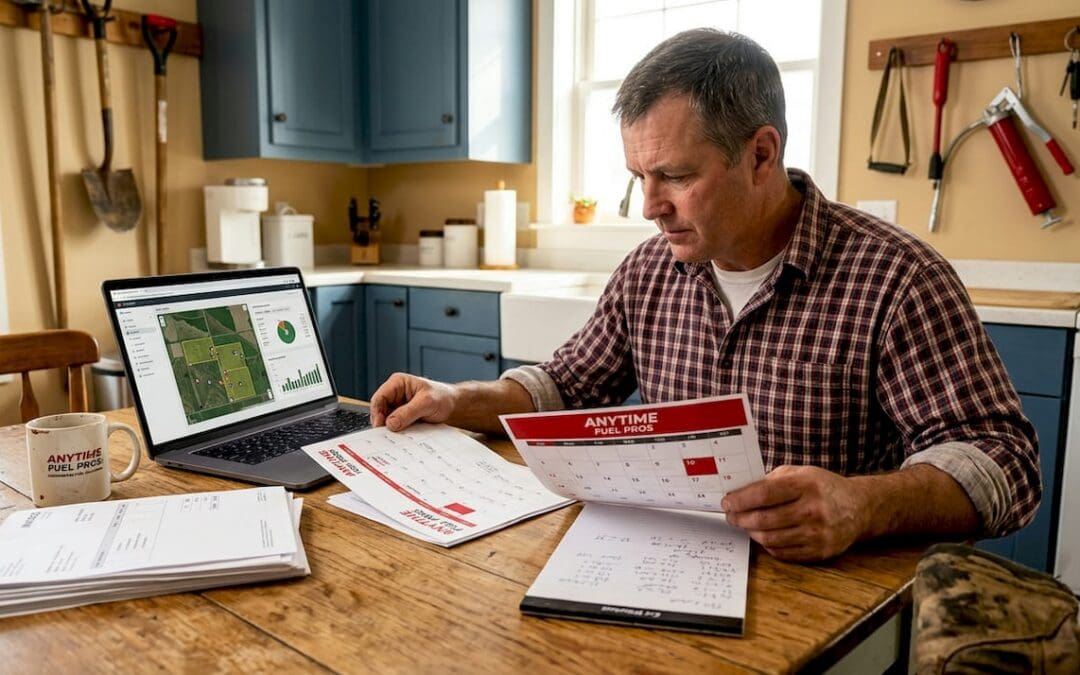
Running out of diesel during planting or harvest isn’t just inconvenient. It’s a productivity collapse that can cost thousands of dollars per idle hour when tractors, combines, and irrigation pumps go dark. Farm diesel delivery scheduling, known in the industry as agricultural fuel supply planning, is the difference between operations that run on time and operations that scramble for emergency deliveries at premium prices. This guide walks farm operators and agricultural managers through exactly how to build a proactive, season-proof delivery system that keeps equipment running when every hour counts.
Table of Contents
- Key takeaways
- What to plan before scheduling farm diesel delivery
- Setting up a proactive delivery schedule
- Managing common scheduling challenges
- Comparing scheduling approaches
- My take on scheduling diesel for farm operations
- How Anytimefuelpros supports your farm fuel schedule
- FAQ
Key takeaways
| Point | Details |
|---|---|
| Assess before you schedule | Know your tank capacity, seasonal draw rates, and site access conditions before setting any delivery cadence. |
| Move from reactive to predictive | Remote tank monitoring cuts emergency deliveries by 30% and removes guesswork from replenishment. |
| Match cadence to season | Increase delivery frequency during planting and harvest; reduce it during slower periods to avoid overfill and cost waste. |
| Solve access problems early | Spring mud and rutted lanes are the real bottleneck in farm fuel logistics. Plan access routes before the season starts. |
| Layer scheduling with procurement | Combine frequent usage-triggered deliveries with forward volume contracts to protect against price spikes. |
What to plan before scheduling farm diesel delivery
Before you call a supplier and set up a recurring schedule, you need a clear picture of what your operation actually requires. Skipping this step is the single biggest reason farms end up with mismatched delivery volumes and unexpected shortages.
Start with your storage infrastructure. Measure your tank capacities precisely and confirm that secondary containment, spill kits, and overfill protection are in place. Staff presence during delivery is not optional. It minimizes spill risk and keeps deliveries compliant with environmental standards. A delivery that arrives when no one is on site creates liability exposure you do not want.
Next, map your seasonal consumption patterns. A 500-acre row crop operation burns dramatically more diesel during a two-week corn planting window than it does in January. Pull your fuel receipts from the last two to three years and calculate average daily burn rates by month. This gives you a real baseline rather than a rough guess.
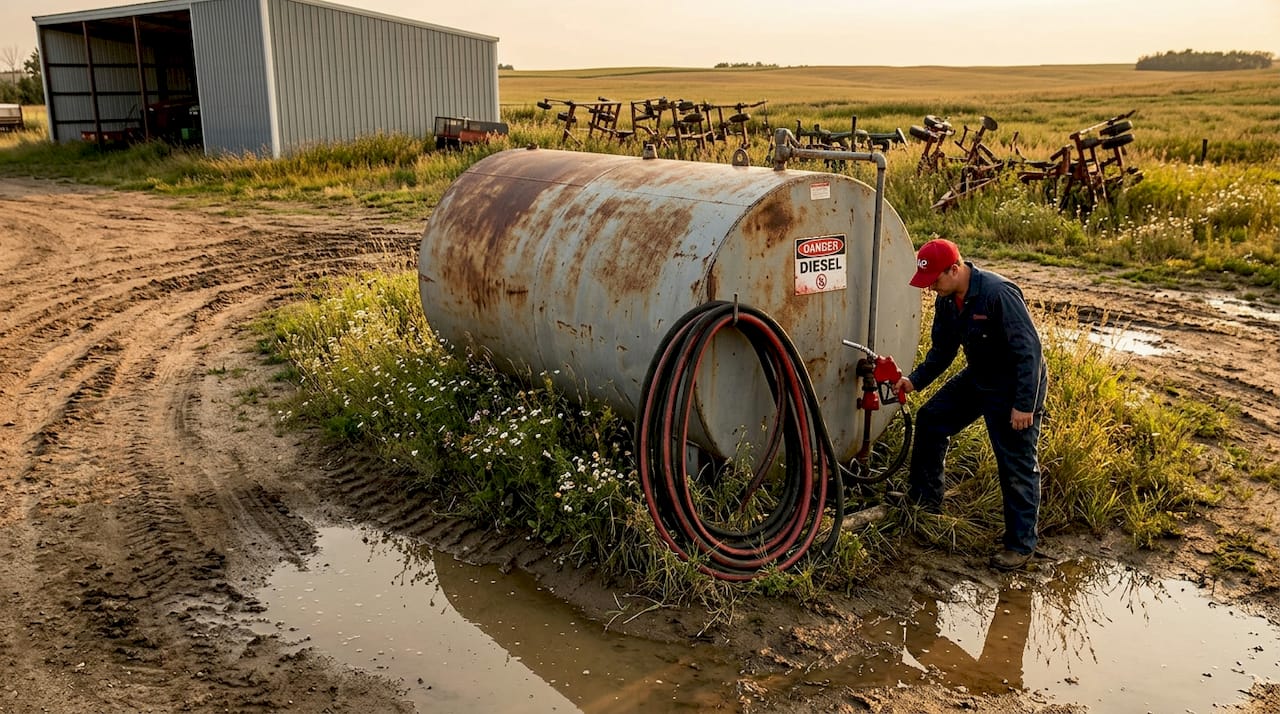
Then assess your site access honestly. Truck access and fill-point conditions are often the real bottleneck in agricultural fuel delivery, especially during spring mud seasons. Walk your delivery lanes after a rain event. If a loaded tanker truck would get stuck, you have a problem that needs solving before the season starts, not during it.
Here is a practical pre-scheduling checklist:
- Confirm total above-ground tank capacity and usable fill volume
- Document daily and weekly diesel burn rates by equipment type and season
- Identify fill-point locations and check overhead clearance for tanker access
- Verify secondary containment integrity and spill kit availability
- Note any seasonal access restrictions such as soft ground, low bridges, or locked gates
- Confirm who on your team will be present during each scheduled delivery
Pro Tip: If your access lanes are marginal in spring, consider a temporary above-ground portable tank positioned closer to a hard-surface road. Your supplier can fill that tank, and you transfer fuel to field equipment from there. It adds a step but eliminates the risk of a stuck delivery truck during peak planting days.
Setting up a proactive delivery schedule
Once your prerequisites are documented, building a schedule that actually prevents shortages is straightforward. The goal is to shift from “call when you’re almost empty” to a system where fuel arrives before you need it.
-
Install remote tank monitoring. Level sensors with automated alerts give you and your supplier real-time visibility into fuel levels. Sensor-triggered deliveries outperform fixed calendar schedules because they respond to actual usage rather than assumptions. When a threshold is crossed, dispatch gets notified automatically.
-
Set a reorder threshold, not a runout threshold. Most operations set alerts at 20 to 25 percent of tank capacity. That gives you a delivery window of two to four days before you hit operational risk. Never set your alert at 10 percent. That is a runout threshold, not a reorder threshold.
-
Establish a recurring delivery cadence with your supplier. Recurring delivery cadences such as weekly or bi-weekly routes during high-demand seasons give your supplier the ability to plan routes efficiently and give you priority access during peak periods when other farms are also competing for delivery slots.
-
Build seasonal adjustments into the agreement. Your contract or service agreement should explicitly allow for frequency changes. During planting and harvest, you may need weekly bulk fuel delivery for agriculture. During winter, bi-monthly may be more than enough.
-
Coordinate delivery timing with your field work schedule. A delivery that arrives mid-harvest when your entire crew is in the field creates safety and logistics problems. Schedule deliveries for early mornings or days when field activity is lower.
Here is a reference table showing how delivery frequency should shift across the farm calendar:
| Season | Typical daily diesel use | Recommended delivery frequency |
|---|---|---|
| Spring planting | High (peak) | Weekly or as triggered by sensor |
| Summer growing | Low to moderate | Bi-weekly to monthly |
| Fall harvest | High (peak) | Weekly or as triggered by sensor |
| Winter off-season | Low | Monthly or on-demand |
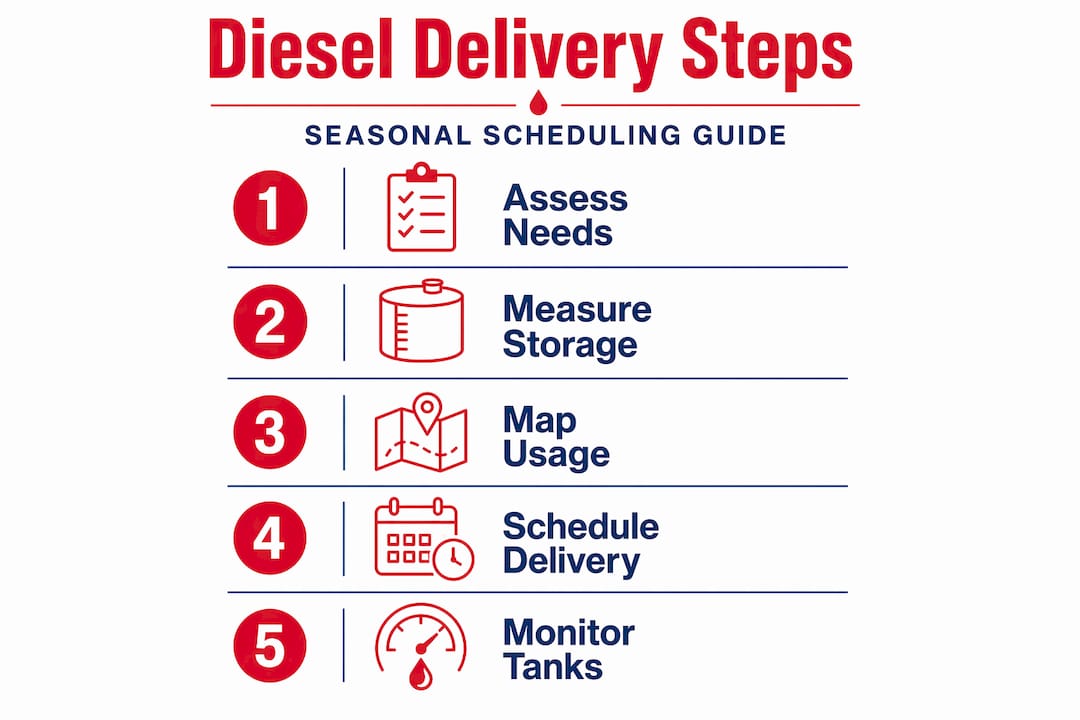
Pro Tip: Share your planting and harvest calendar dates with your fuel supplier at the start of each year. Suppliers who know your peak windows in advance can pre-position inventory and prioritize your deliveries. Suppliers who find out the day you need fuel are working against their own route logistics.
Managing common scheduling challenges
Even well-designed schedules run into problems. Knowing what to expect and how to respond keeps those problems from becoming shutdowns.
The most common issue is the emergency delivery. Emergency calls almost always trace back to the same root cause: an information gap about actual tank levels. Closing that gap with telemetry is the most direct fix. Without sensors, farms rely on manual dipstick checks that happen irregularly, especially during busy seasons when the person responsible for checking the tank is running equipment from sunup to sundown.
Weather and terrain disruptions are the second major challenge. Spring mud seasons can make scheduled delivery impossible for days at a time. Scheduling should account for the earliest likely delivery window and include contingency plans such as larger pre-season fills or temporary staging tanks. If your lanes are typically passable by March 15, schedule your last pre-season top-off for March 10.
Price volatility is a third pressure point that scheduling alone cannot solve. This is where procurement planning intersects with delivery logistics. Booking 90% of next year’s diesel needs by January 1 through pre-buy volume contracts reduces budget exposure significantly. The delivery schedule handles when fuel arrives. The procurement contract handles what you pay for it. These are two separate decisions that work best when made together.
Clear communication with your supplier is the thread that holds all of this together. Consider these practices:
- Provide your supplier with a seasonal operations calendar each year
- Designate a single point of contact on your farm for all fuel delivery coordination
- Confirm delivery appointments 24 to 48 hours in advance during peak seasons
- Report any access changes, such as new gates or road repairs, before they affect a delivery
“The farms that never run out of fuel are not lucky. They treat fuel inventory the same way they treat seed inventory. They know exactly what they have, what they need, and when the next order is coming.”
Comparing scheduling approaches
Not every farm needs the same system. Understanding the tradeoffs helps you pick the right fit for your scale and complexity.
| Approach | Best for | Key limitation |
|---|---|---|
| Reactive (call when low) | Very small operations with low diesel use | High risk of emergency deliveries and premium pricing |
| Fixed calendar schedule | Predictable, low-variance operations | Ignores actual usage; can over-deliver or under-deliver |
| Sensor-triggered schedule | Mid-to-large farms with variable seasonal use | Requires upfront monitoring investment |
| Hybrid (sensor plus contract) | Large operations with significant price exposure | Most complex to set up; highest long-term value |
The hybrid model is where most serious farm operators land. Farms applying sophisticated fuel scheduling combine high-frequency deliveries triggered by usage with forward purchasing contracts to reduce exposure to fluctuating diesel prices. The delivery cadence handles operational continuity. The contract handles financial risk. Neither one alone is as effective as both together.
A few additional points worth considering when evaluating approaches:
- On-demand diesel delivery works well as a backup layer but should not be your primary strategy during peak seasons
- Manual monitoring is better than nothing but degrades in reliability exactly when you need it most, during busy harvest periods when checks get skipped
- Efficient diesel scheduling through a trusted supplier relationship gives you access to priority routing that ad-hoc customers rarely receive
- Review your approach annually. A farm that added 200 acres or a new grain dryer last year has different fuel needs than it did before
For more on matching logistics to seasonal demand peaks, the Anytimefuelpros article on holiday season fuel logistics covers similar demand-surge principles that translate directly to planting and harvest planning.
My take on scheduling diesel for farm operations
I’ve seen a lot of farm operators approach diesel the same way they approach weather: something you react to rather than something you plan for. That mindset is expensive.
What I’ve learned from working with agricultural operations is that the farms with the fewest fuel problems are not the ones with the biggest tanks. They are the ones who treat diesel inventory as a rolling minimum safe stock system. They are never asking “how much do we have?” They already know, because a sensor tells them, and a supplier is already scheduled.
The seasonal site access issue is one that catches people off guard every single spring. You can have a perfect delivery schedule on paper and still lose two critical planting days because a tanker truck cannot get down your lane after a wet week. I’ve seen this happen to experienced operators who simply did not walk their access routes before the season. That is a five-minute walk that saves a two-day delay.
The other thing I would push back on is the idea that proactive scheduling is only for large operations. A 200-acre farm burning 800 gallons a week during harvest has just as much to lose from a two-day fuel gap as a 2,000-acre operation. The scale is different. The consequence of running dry is the same: equipment stops, and the clock keeps running.
Technology and communication are the two levers that matter most. Sensors close the information gap. A good supplier relationship turns that information into reliable deliveries. Neither one is complicated to set up. The cost of not doing it shows up in emergency delivery fees and idle equipment hours.
— Justin
How Anytimefuelpros supports your farm fuel schedule
Anytimefuelpros provides scheduled agricultural diesel delivery built around the realities of farm operations, including seasonal demand spikes, remote access challenges, and the need for reliable supply during planting and harvest windows. AFP offers recurring delivery routes, proactive dispatch coordination, and bulk fuel delivery for agriculture across Texas, Utah, and nationwide through its partner network.
For farm operators looking to move beyond reactive ordering, AFP’s bulk delivery and contract options support both scheduled replenishment and pre-buy volume programs that protect against price volatility. Whether you need weekly harvest-season fills or a customized farm fuel management plan, the team at Anytimefuelpros is ready to build a schedule that fits your operation. Visit the fuel delivery questions page to get started.
FAQ
What is farm diesel delivery scheduling?
Farm diesel delivery scheduling is the process of planning and coordinating recurring diesel fuel deliveries to agricultural operations based on seasonal usage patterns, tank capacity, and equipment demands. It replaces reactive ordering with predictive replenishment to prevent fuel shortages during critical seasons.
How often should a farm schedule diesel deliveries?
Delivery frequency should match your seasonal burn rate. During planting and harvest, weekly deliveries are common for mid-to-large operations. During slower periods, bi-weekly or monthly fills are typically sufficient. Sensor-based monitoring allows frequency to adjust automatically based on actual tank levels.
How do I prevent emergency diesel deliveries on my farm?
The most effective prevention is installing remote tank level sensors that trigger automated reorder alerts before you reach critical levels. Proactive scheduling combined with a recurring supplier agreement eliminates most emergency situations by keeping fuel levels consistently above operational minimums.
What should I do if my delivery site is inaccessible during spring planting?
Plan ahead by walking your delivery lanes before the season and identifying access risks. Use a temporary staging tank near a hard-surface road if your primary fill point becomes unreachable. Communicate access changes to your supplier at least one week before a scheduled delivery to allow rerouting or rescheduling.
Can I lock in diesel prices while keeping a flexible delivery schedule?
Yes. Separating procurement from delivery cadence is the recommended approach. Use a pre-buy volume contract to secure pricing for the season, then manage delivery frequency independently based on actual usage. This gives you price stability without sacrificing scheduling flexibility.
Recommended
- Bulk Fuel Delivery | On-Site Diesel and DEF
- Fueling Up for Holiday Season Logistics: Strategies to Meet Increased Demands - Anytime Fuel Pros
- Fuel Delivery at the Heart of Winter Operations: How On-Site Services Keep Businesses Running - Anytime Fuel Pros
- Fuel Consumption Calculator - Anytime Fuel Pros
Recent Comments