

Effective frac site fuel logistics planning follows six steps: forecast consumption, size reserves, stage storage on pad, sequence dispatch, instrument telemetry and inventory, and activate a 24/7 contingency response. When those steps are owned by named people with clear handoffs, fuel stops being a variable and becomes a controlled input. Procurement engineers, operations leads, and a single accountable fueling dispatcher each carry a defined piece of this chain. Vendors like Anytimefuelpros, operating under DOT and EPA compliance requirements, execute the physical delivery side. The plan only holds when every link is explicit.
Six-step frac fueling checklist:
- Forecast consumption — calculate gallons per stage per pump set, plus ancillary loads (lighting, support equipment, DEF)
- Size reserves — set a minimum on-site buffer of multiple hours of runtime before a refill trigger fires
- Stage storage — position bulk tanks or drop trailers at pad-accessible points before pumping begins
- Sequence dispatch — schedule tanker runs against stage timing, not calendar days; build in lead time for oversize/overweight routing
- Instrument telemetry — require real-time tank-level reporting with defined refill trigger thresholds
- Activate contingency — confirm 24/7 emergency response SLA with your fueling partner before the first stage pumps
Pro Tip: Assign one named contact at your fueling partner who owns every delivery, every escalation, and every emergency call. Multi-board dispatching under basin demand stress is one of the most common failure modes in frac fleet management — a single accountable contact eliminates the gap.
Table of Contents
- What does frac fueling actually cover on site?
- What delivery methods and equipment will you plan around?
- How do you build a step-by-step frac fueling plan?
- What safety and compliance requirements apply to frac fueling?
- How do you vet and select a frac fueling partner?
- How does telemetry change the way you manage pad-side fuel?
- Key Takeaways
- Anytimefuelpros supports your frac fueling program
- Useful sources for permits, compliance, and transport rules
What does frac fueling actually cover on site?
Frac fueling is not just diesel delivery. It covers every fuel-related task from the moment a tanker enters the pad gate to the final post-stage reconciliation: on-site storage management, pump-by-pump wet-hose fueling, DEF top-offs, lubricant supply, telemetry monitoring, and emergency refills during active pumping windows. Sand logistics, water hauling, and chemical blending are adjacent operations, but they are not fueling tasks. Keeping that boundary clear prevents scope creep and accountability gaps.
Fuel is a critical path item. A frac pump that runs dry mid-stage does not pause the job — it breaks the stage. Completion windows are tight, and recovery from a fuel-related stoppage costs time that cannot be bought back cheaply.
Fuel types and ancillary fluids to plan for:
- Clear diesel (on-road) — for licensed vehicles and support trucks operating on public roads
- Dyed/off-road diesel — for frac pumps, blenders, hydration units, and other non-road equipment
- DEF (diesel exhaust fluid) — required for Tier 4 engines; often overlooked until a pump derate event forces the issue
- Lubricants — transmission fluid, hydraulic oil, and gear lube for pump maintenance
- Ancillary fluids — coolant top-offs and generator fuel for lighting and instrumentation trailers
What delivery methods and equipment will you plan around?
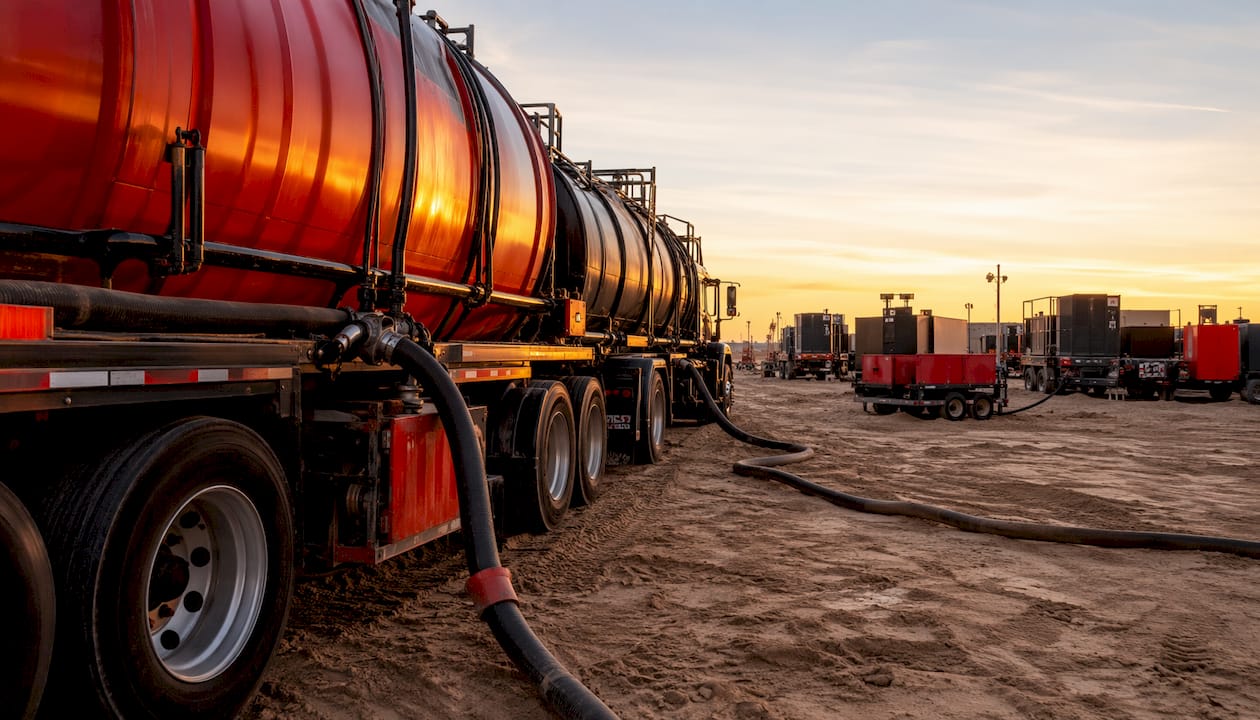
The right delivery mix depends on pad scale, basin road conditions, and how many stages you’re running per week. Most multi-well frac programs use a combination of methods rather than a single approach.
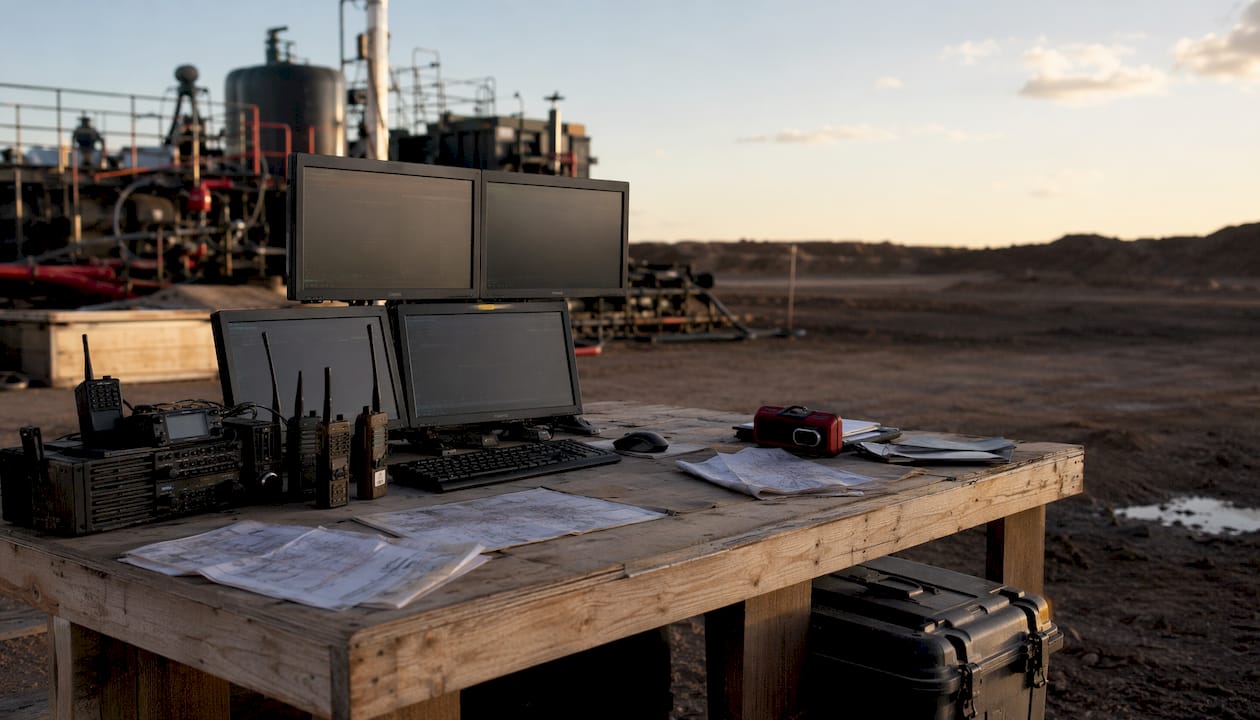
| Method | Typical Capacity | Refill Speed | Staffing | Best For |
|---|---|---|---|---|
| Semi-tanker direct drop | — | Fast | 1 driver | High-volume pads, frequent cycling |
| Mobile tank fleet | — | Moderate | 1 operator | Remote or access-restricted locations |
| Drop trailer (leave-behind) | — | Passive | Minimal | Buffer storage between tanker runs |
| On-site bulk pad tank | — | Passive | Minimal | Multi-week programs, large pump counts |
| Wet-hose fueling | Varies | Fast | 1 operator | Direct pump-to-pump refueling on pad |
| Automated fueling station | Varies | Fastest | Remote only | Hot-zone elimination, multi-pump pads |

Bulk tank delivery and storage on the pad reduces trucking touchpoints and gives your team a physical buffer when a tanker run is delayed by road conditions or permit routing.
Ancillary equipment to spec in your plan:
- DEF trailer or tote with pump for Tier 4 engine service
- Lubrication cart for scheduled pump maintenance
- Telemetry probes for tank level sensing
- Spill containment berms and drip pans under all storage tanks
Pro Tip: On a multi-well pad running four or more pumps simultaneously, a single drop trailer is rarely enough. Plan for at least one dedicated bulk pad tank plus a drop trailer as a rolling buffer — the tank covers baseline consumption, the trailer covers surge demand between tanker cycles.
How do you build a step-by-step frac fueling plan?
Sequencing matters as much as volume. A plan that gets the gallons right but misses the timing still causes stage delays.
- Consumption forecast (pre-job, 2–3 weeks out) — calculate gallons per hour per pump at expected load, multiply by stage duration and pump count, add 15–20% for ancillary loads and inefficiency
- Reserve sizing policy — set a hard minimum: never let on-site inventory drop below 24 hours of runtime; 48 hours is the safer standard for remote pads
- Staging and pre-position — bulk tanks and drop trailers must be on location before the first stage pumps; confirm placement with the site supervisor 72 hours ahead
- Dispatch sequencing — schedule tanker runs against stage timing, not fixed clock intervals; the procurement engineer owns this calendar and updates it daily based on actual consumption rates
- Daily confirmation protocol — the site supervisor confirms tank levels each morning; the fueling dispatcher confirms next delivery ETA; both log the exchange
- POD and invoicing — require timestamped proof of delivery on every run; reconcile against telemetry data before approving invoices
- Contingency activation threshold — define the gallon level or percentage that triggers an emergency call; pre-authorize the dispatcher to act without waiting for approval
Procurement engineers must maintain daily communications with haulers and logistics coordinators, integrating fuel planning with sand, water, and chemical logistics to avoid stage delays. Treating fuel as a stage-timing tool rather than a freight cost item is what separates programs that recover quickly from stage slips and those that don’t.
Timeline for a typical multi-stage pad:
- 2–3 weeks pre-job: consumption forecast, vendor contract finalized, tank pre-order placed
- 72 hours pre-stage: tanks staged on location, telemetry probes active, dispatch calendar set
- 24 hours pre-stage: site supervisor confirms inventory levels; dispatcher confirms delivery ETA
- Day of stage: real-time telemetry monitored; refill trigger reviewed every shift change
- Post-stage: POD reconciliation, invoice review, consumption data logged for next stage forecast
Cost and uptime trade-offs to keep in mind:
- Larger on-site reserves reduce emergency delivery costs but increase tank rental and fuel carrying costs
- Tighter dispatch sequencing lowers inventory carrying costs but raises the risk of a missed window
- Telemetry investment pays back quickly when it prevents a single stage miss
What safety and compliance requirements apply to frac fueling?
Hot-zone protocol is the first line of defense. During active pumping, fueling personnel should not be in the hot zone unless the operation uses automated or remote fueling equipment. When human presence is required, it must follow site-specific SOPs with documented training records. Require your fueling vendor to provide both before the first delivery.
Compliance checklist to require from every fueling vendor:
- DOT/FMCSA-compliant manifests and licensed hazmat drivers for fuel transport
- EPA spill-prevention plan (SPCC) covering on-site storage tanks
- State oversize/overweight permits for tank moves and heavy equipment transport, including pre-approved routes and escort requirements where applicable
- Secondary containment under all storage tanks (berms or double-wall tanks)
- Spill kits staged at each fueling point
- Current insurance certificates (general liability, pollution liability, cargo)
- Driver training records and hazmat endorsement verification
- Digital documentation and electronic logs for compliance verification and roadside inspections
Pro Tip: Put 24/7 emergency response in the contract as a measured SLA, not a marketing claim. Require your vendor to state a specific response time in hours for after-hours emergency refills, and verify it with a test call during onboarding. A vendor who can’t answer that question precisely is not ready for a frac program.
How do you vet and select a frac fueling partner?
Vendor selection for frac fueling is a procurement decision with operational consequences. A partner who can’t meet stage timing is more expensive than a higher-priced vendor who can.
Selection criteria for your RFP or vendor scorecard:
- Basin-specific fleet posture: does the vendor have trucks and tanks pre-positioned in your operating basin, or are they routing from a distant terminal?
- 24/7 emergency response with a stated SLA (hours, not “as soon as possible”)
- Telemetry and reporting capability: real-time tank levels, consumption data, and delivery confirmation
- DOT/FMCSA compliance, hazmat endorsements, and current insurance certificates
- Single named accountable contact for all deliveries and escalations
- Proof of experience with multi-pump frac programs, not just general commercial delivery
Contract clauses to insist on:
- Named fleet capacity committed to your program
- Minimum on-call truck guarantee during active pumping windows
- Fuel quality testing and certification on delivery
- Timestamped POD on every run
- Defined penalties or remedies for missed delivery windows
Operational checks during vendor onboarding:
- Live telemetry test before first stage
- Emergency response drill (call the after-hours line; time the response)
- Driver training verification and hazmat endorsement review
- Sample POD review for format and timestamp accuracy
Pro Tip: Negotiate a basin-specific fleet posture clause into your master service agreement. Under peak demand, a vendor without pre-positioned assets in your basin will deprioritize your program in favor of closer customers. A contractual commitment to local fleet capacity is the only protection against that.
How does telemetry change the way you manage pad-side fuel?
Telemetry converts fuel management from a reactive task into a monitored system. Instead of waiting for a pump operator to report a low tank, the system alerts the dispatcher automatically when inventory crosses a defined threshold.
Telemetry features to require in your vendor spec:
- Real-time tank level reporting (5–15 minute data refresh minimum)
- Consumption rate by pump or equipment group
- Automated refill alerts at defined gallon or percentage thresholds
- SCADA or API connectivity for integration with your dispatch board
- Automatic spill-prevention fail-safes (shutoff on overfill or leak detection)
Automated fueling stations, like the Fuel Automation Stations described by Atlas Oil, can fuel multiple pumps simultaneously, remove personnel from hot zones entirely, and include guided-wave radar tank sensing with SCADA connectivity. The operational impact is significant: simultaneous multi-pump fueling shortens refill cycles and reduces the staffing required in active hot zones.
Automated frac fueling systems can support many pumps at once, include telemetry-based inventory control, and incorporate automatic spill-prevention features — removing personnel from hot zones while maintaining continuous fuel supply to active pump sets. (Atlas Oil, Automated Frac Fueling Services)
Haulage dispatch software that integrates with telemetry data can further reduce non-productive time by aligning tanker dispatch with actual consumption rates rather than fixed schedules. Real-time fleet orchestration platforms that combine GPS, engine-hour monitoring, and predictive queue management have shown meaningful reductions in idle time across frac fleets.
Pro Tip: Telemetry systems go offline. Cellular dead zones, power interruptions, and sensor failures happen on remote pads. Always maintain a manual tank-dip protocol as a fallback, and require your vendor to confirm local inventory levels by voice if telemetry data is more than two hours stale.
Key Takeaways
Effective frac fueling logistics treats fuel as a stage-timing critical path item, not a commodity, requiring named ownership, telemetry, and a 24/7 emergency SLA before the first pump turns.
| Point | Details |
|---|---|
| Forecast before you commit | Calculate gallons per stage per pump, add 15–20% buffer, and finalize vendor contracts 2–3 weeks before the first stage. |
| Reserve policy prevents stage misses | Hold a minimum 24–48 hours of on-site runtime inventory; set a hard telemetry trigger before that floor is breached. |
| Single contact, faster recovery | Assign one named dispatcher at your fueling partner; multi-board dispatching is a documented failure mode under basin demand stress. |
| Telemetry with a manual fallback | Require 5–15 minute data refresh and automated refill alerts, but maintain a manual dip protocol for when connectivity fails. |
| Anytimefuelpros for frac programs | Anytimefuelpros provides bulk diesel, DEF, 24/7 emergency response, and telemetry-enabled reporting for frac and oilfield operations nationwide. |
Anytimefuelpros supports your frac fueling program
When a stage is running and your on-site tank is dropping faster than the forecast, you need a fueling partner who already has a truck in the basin, not one routing from three states away.
Anytimefuelpros delivers on-site diesel and DEF for frac programs, including scheduled bulk drops, drop trailer staging, wet-hose fueling, and 24/7 emergency response. Telemetry-enabled reporting and timestamped POD documentation come standard, so your procurement team has the delivery confirmation and consumption data they need for daily reconciliation. For large programs, bulk tank delivery and storage reduces trucking touchpoints and keeps a physical buffer on location between tanker cycles. Coverage runs through primary markets in Texas and Utah, with nationwide reach through AFP’s partner network.
Pro Tip: On your first scoping call with Anytimefuelpros, ask two questions: what is the after-hours emergency response time for your specific basin, and can they run a live telemetry integration test before your first stage? The answers tell you whether the operation is ready for frac work.
Request a service quote before your next program kicks off, and give your procurement team a fueling partner who treats stage timing as seriously as you do.
Useful sources for permits, compliance, and transport rules
Field teams and procurement engineers should verify current requirements directly with the relevant agencies. Rules change by state, season, and load classification.
- DOT/FMCSA — Federal Motor Carrier Safety Administration rules for hazmat transport, driver licensing (CDL/hazmat endorsement), hours of service, and vehicle inspection requirements. Search fmcsa.dot.gov for current regulations.
- EPA SPCC Program — Spill Prevention, Control, and Countermeasure rules for on-site fuel storage tanks above threshold volumes. Check epa.gov for current SPCC plan requirements and inspection schedules.
- State oversize/overweight permit offices — Each state issues its own permits for heavy haul moves, including pre-approved routes, escort requirements, and seasonal load restrictions. Contact the state DOT in each operating state before moving bulk tanks or frac equipment on public roads.
- State oil and gas regulatory commissions — Texas Railroad Commission, Utah Division of Oil, Gas and Mining, and equivalent bodies in other states set pad-level environmental and operational requirements that affect fueling and storage.
- FracFocus — The national chemical disclosure registry for hydraulic fracturing; useful for understanding fluid and chemical handling requirements adjacent to fueling operations.
- U.S. Department of Energy — DOE resources on idle reduction and fuel efficiency apply to frac support fleets and can inform consumption forecasting assumptions.
Recent Comments