

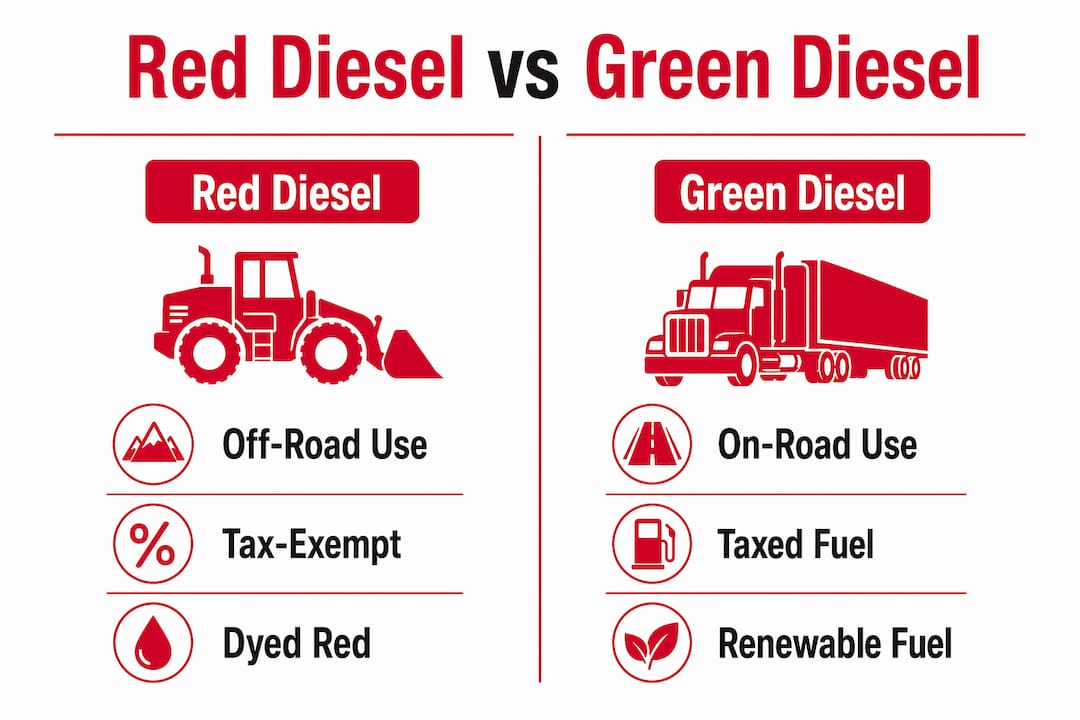
Red diesel is dyed, tax-exempt petroleum diesel restricted to off-road and non-road equipment. Green diesel is a renewable, chemically distinct hydrocarbon fuel that is taxed like conventional on-road diesel and serves as a drop-in replacement for fleets pursuing lower emissions. The difference between red diesel and green diesel is not just color — it is a legal, tax, and compliance distinction that carries real enforcement consequences under IRS rules and state motor fuel regulations. Do not interchange them. Using dyed diesel in on-road equipment exposes your operation to civil fines, tax assessments, and potential vehicle seizure. Green diesel, which meets ASTM D975 in the U.S., is a fully legal on-road fuel with no such restriction.
Table of Contents
- What is red diesel and who is legally allowed to use it?
- What is green diesel and how does it differ from biodiesel?
- Red diesel vs green diesel: side-by-side comparison
- Can you mix red diesel and green diesel, and what are the risks?
- U.S. legal framework and penalties for dyed diesel misuse
- How to identify red vs clear diesel on site and at the pump
- Practical compliance checklist for fleet and site managers
- Engine performance, emissions, and warranty implications
- Key Takeaways
- Anytimefuelpros keeps your fuel compliant and your operation running
- Authoritative sources and further reading
What is red diesel and who is legally allowed to use it?
Red diesel is standard petroleum diesel that has been dyed — typically with Solvent Red 26 or Solvent Red 164 — to signal that it is intended for off-road or tax-exempt use. The dye itself has no meaningful effect on combustion performance or fuel chemistry. It is purely an enforcement tool, allowing IRS agents and state motor fuel inspectors to identify taxable fuel that has been diverted to on-road use.

In the U.S., dyed diesel is sold without federal highway excise taxes, which makes it cheaper at the pump than clear, taxed diesel. That price advantage is the reason misuse happens. The law is specific about who qualifies.
Permitted uses of red (dyed) diesel in the U.S.:
- Agricultural equipment: tractors, combines, irrigation pumps, and other farm machinery operated off public roads
- Construction and excavation equipment: excavators, bulldozers, skid steers, and loaders that never travel on public highways under their own power
- Stationary generators and heating systems at non-road sites
- Railroad locomotives (under specific IRS provisions)
- Marine vessels in certain commercial and recreational categories
- Off-road mining equipment
Sellers of dyed diesel are required to document buyer eligibility at the point of sale. As a buyer, you are responsible for keeping purchase invoices, tank logs, and fuel use records that tie consumption to eligible equipment. State requirements vary — Washington State’s Department of Revenue and Oregon’s Department of Transportation, for example, each publish their own motor fuel tax rate schedules and eligibility rules, so operators working across state lines need to check both federal and state guidance.
Storage matters too. Dyed diesel should be kept in dedicated, clearly labeled tanks, separate from any clear diesel used for on-road vehicles. Commingling at the tank level is one of the most common compliance failures on mixed-use job sites.
What is green diesel and how does it differ from biodiesel?
Green diesel — also called renewable diesel or HVO (hydrotreated vegetable oil) — is a hydrocarbon fuel produced by hydrotreating fats and oils such as soybean oil, tallow, or used cooking oil. The hydrotreating process strips oxygen from the feedstock and produces paraffinic hydrocarbons that are chemically very similar to petroleum diesel. The result is a drop-in renewable fuel that meets ASTM D975 in the U.S. and can be used in existing diesel engines and infrastructure without hardware modifications.

That “drop-in” designation is what separates renewable diesel from biodiesel (FAME — fatty acid methyl esters). Biodiesel is an oxygenated ester, not a hydrocarbon. At higher blend ratios, FAME biodiesel can degrade certain rubber seals and fuel system components, absorbs water more readily, and has inferior cold-flow properties compared with petroleum diesel. Renewable diesel avoids those issues entirely — it is non-oxygenated, stable in storage, and performs well in cold climates without the cloud-point concerns associated with FAME blends.
Green diesel is taxed like conventional on-road diesel. There is no tax exemption tied to it. What it offers instead is an emissions and regulatory advantage: lower lifecycle carbon intensity, which matters for fleets operating in states with Low Carbon Fuel Standard programs, and compatibility with decarbonization commitments without requiring new equipment. It is a sustainability upgrade, not a cost-management tool in the way dyed diesel is.
Red diesel vs green diesel: side-by-side comparison
| Dimension | Red (Dyed) Diesel | Green (Renewable) Diesel |
|---|---|---|
| Intended use | Off-road, non-road equipment, heating, agriculture | On-road vehicles, fleet decarbonization, any diesel application |
| Tax status | Tax-exempt (no federal highway excise tax) | Fully taxed like conventional on-road diesel |
| Identification | Red/pink dye (Solvent Red 26 or 164); labeled at pump and invoice | Clear to slightly yellow; labeled as renewable diesel or HVO on invoice |
| Chemical source | Petroleum diesel base; dye added post-refining | Hydrotreated fats and oils; paraffinic hydrocarbons |
| Engine compatibility | Compatible with diesel engines; illegal in on-road use | Drop-in compatible; meets ASTM D975; no hardware changes needed |
| Emissions profile | Depends on petroleum base fuel; dye does not affect emissions | Lower lifecycle carbon intensity; reduced particulate in many applications |
| Enforcement risk | High if used on-road; detectable at trace concentrations | No misuse risk when used as intended; standard on-road fuel |
| Penalties for misuse | Civil fines, back taxes, vehicle seizure, criminal charges in severe cases | N/A for standard use; tax fraud risk only if mislabeled |
Tax status is governed by IRS regulations and applicable state motor fuel tax codes. Emissions data reflects lifecycle carbon intensity under programs such as California’s Low Carbon Fuel Standard. ASTM D975 is the U.S. standard specification for diesel fuel oils.
Can you mix red diesel and green diesel, and what are the risks?
The short answer: mixing dyed diesel with clear or renewable diesel does not eliminate your legal exposure. It makes it worse.
Enforcement labs use high-sensitivity detection methods that can confirm dye markers at extremely low concentrations. Dilution attempts are detectable — the IRS and state motor fuel agencies have confirmed this in enforcement guidance. Someone who adds clear diesel to a tank of dyed fuel hoping to mask the color will still test positive, and the attempt to conceal misuse can escalate a civil matter to a criminal one.
Mechanical and operational risks of mixing fuel types:
- Renewable diesel is a true drop-in and is chemically compatible with petroleum diesel — blending the two carries no significant mechanical risk when both are clear, on-road fuels
- Mixing FAME biodiesel with petroleum diesel at high ratios can affect fuel-water separation, increase microbial growth risk in storage tanks, and degrade certain elastomers
- Commingling dyed and clear diesel in the same tank creates a compliance problem regardless of the ratio — the dye marker is the issue, not the volume
Warranty and OEM considerations:
Most OEM engine manufacturers accept fuels that meet ASTM D975 or equivalent specifications. Renewable diesel generally qualifies. Using dyed off-road diesel in an on-road engine does not void the engine warranty on its own, but it does create a tax violation — and if an insurer or fleet auditor discovers the misuse, it can trigger scrutiny of maintenance records and warranty claims.
Pro Tip: If you suspect a tank has been contaminated with dyed fuel, isolate it immediately. Pull a sample for lab confirmation before using any of that fuel in on-road equipment. Document the incident, notify your fuel supplier, and retain the lab report. Voluntary disclosure to the relevant state revenue agency, before an audit, typically results in better outcomes than discovered violations.
U.S. legal framework and penalties for dyed diesel misuse
The federal framework for dyed diesel enforcement sits primarily with the IRS under 26 U.S.C. § 4082, which authorizes the dyeing requirement and defines the penalty structure for misuse. The IRS Publication 4941 covers dyed fuel penalties in detail. State revenue agencies layer additional penalties on top of federal ones, and the amounts and procedures differ significantly by jurisdiction.
How enforcement works:
- Field inspectors use dipstick tests or portable spectrometers to detect dye in fuel tanks of on-road vehicles at roadside checks or facility inspections
- Positive field results trigger lab confirmation, which can identify dye at concentrations well below what the human eye can see
- The EPA’s fuel sulfur standards and the Electronic Code of Federal Regulations, 26 CFR § 48.4082-1 together define the technical and legal standards that enforcement agencies apply
Typical penalties:
- Civil penalty per gallon of dyed fuel found in an on-road vehicle’s tank (federal minimum applies; state penalties are additional)
- Back taxes assessed on the full volume of dyed fuel determined to have been used on-road
- Vehicle seizure in cases of repeated or large-scale violations
- Criminal prosecution in flagrant cases involving intentional tax evasion
Regulatory change risk: Jurisdictions can and do revise dyed fuel rules. A UK policy change in 2022 removed the red diesel exemption for most industrial users — a reminder that operators in any market should monitor state revenue agency bulletins and federal rulemaking for changes that affect their eligibility.
Audit-readiness checklist:
- Retain all dyed diesel purchase invoices with supplier name, date, volume, and product code
- Maintain a tank log showing opening inventory, deliveries received, and fuel drawn per piece of equipment
- Keep fuel use records tied to specific non-road equipment by serial number or asset tag
- Label all dyed diesel storage tanks and dispensers clearly and permanently
- Document any fuel testing or sampling events with date, results, and lab name
- Store records for a minimum of three years (check state requirements — some require longer retention)
For detailed dyed diesel compliance reporting requirements by fleet type, the guidance varies enough by state that a single federal reference is not sufficient.
How to identify red vs clear diesel on site and at the pump
Visual inspection is a starting point, not a final answer. Dyed diesel is red or pink in a clear container. Clear diesel — whether petroleum or renewable — ranges from water-clear to a very light amber. But color alone cannot confirm tax status, fuel grade, or whether a tank has been contaminated.
Reliable identification methods:
- Pump and dispenser labels: Dyed diesel dispensers must be labeled “Dyed Diesel — Nontaxable Use Only” or equivalent language under federal regulations. On-road diesel pumps carry no such restriction label. Renewable diesel may be labeled as “R99,” “renewable diesel,” or “HVO” depending on the supplier.
- Purchase documentation: Every delivery ticket and invoice should state the product name, tax status (taxed or tax-exempt), volume, and the supplier’s name and license number. If a delivery ticket does not specify tax status, request clarification before accepting the load.
- Field testing: A portable colorimeter or dip-and-read test kit can confirm the presence of red dye in a sample. These are the same tools field inspectors use. For definitive results, send a sample to a certified fuel testing laboratory.
- Lab confirmation: Pull a sample when accepting a large delivery of dyed diesel, when you suspect contamination, or when a tank’s history is unclear. Log the sample date, tank ID, and lab results in your compliance file.
Pro Tip: Label every tank inlet, not just the dispenser. A color-coded cap system (red cap for dyed diesel, green or black for clear) costs almost nothing and prevents the most common on-site mix-up: a driver fueling the wrong piece of equipment from the wrong tank during a night shift or a busy harvest.
Practical compliance checklist for fleet and site managers
Running both dyed and clear diesel on the same site is common in construction, agriculture, and mining. The compliance risk is real, but it is manageable with the right controls in place.
Tank and dispenser controls:
- Dedicate separate physical tanks to dyed and clear diesel — never share a tank between fuel types
- Install locked dispensers or fuel cards with equipment-level restrictions to prevent unauthorized draws
- Label every tank, dispenser, and inlet permanently with fuel type and tax status
- Use sealed delivery tickets that record the tank filled, volume delivered, and fuel type for every delivery
Record-keeping:
- Log every fuel draw against a specific asset (equipment serial number or fleet unit number)
- Reconcile tank inventory monthly against purchase records and equipment logs
- Retain all supplier invoices, delivery tickets, and tank logs for at least three years
- For bulk diesel storage compliance, follow EPA Spill Prevention, Control, and Countermeasure (SPCC) requirements for tanks above the applicable threshold
Training and SOPs:
- Train all fueling staff on the difference between dyed and clear diesel, permitted uses, and what to do if they suspect a mix-up
- Conduct refresher training at least annually and whenever new staff join the fueling team
- Write a one-page incident response procedure: isolate the tank, pull a sample, notify the supervisor, document everything
Pro Tip: A compliant fuel delivery partner can eliminate most of the documentation burden. When Anytimefuelpros delivers dyed or clear diesel, each delivery comes with a documented ticket that specifies fuel type, volume, tax status, and delivery time — exactly what you need for an audit file. Segregated routing means dyed and clear diesel never share a delivery hose or a tank.
Engine performance, emissions, and warranty implications
Renewable diesel’s technical profile is genuinely strong. It has low sulfur content below 10 ppm, high cetane numbers, and good cold-flow characteristics — properties that translate to cleaner combustion and lower particulate emissions compared with conventional petroleum diesel in many applications. The high cetane number means faster ignition and more complete combustion, which reduces unburned hydrocarbons in the exhaust.
The dye in red diesel does not change any of this. Fuel dye is an identifier, not a combustion additive. The emissions profile of dyed diesel is determined entirely by the base petroleum fuel and its sulfur content, not by the dye itself.
| Fuel Property | Renewable (Green) Diesel | Petroleum Diesel (Clear) | FAME Biodiesel |
|---|---|---|---|
| Sulfur content | <10 ppm | <15 ppm (ULSD) | <10 ppm (B100) |
| Cetane number | High (typically 70–90) | 40–55 | 46–65 |
| Oxygen content | None (paraffinic) | None | ~11% (oxygenated ester) |
| Cold-flow performance | Good; comparable to ULSD | Good | Poor at high blends |
| Drop-in compatible | Yes (ASTM D975) | Yes | Blend-limited (B20 typical) |
| Lifecycle carbon intensity | Substantially lower under LCFS programs | Baseline | Moderate reduction |
Sources: AFDC Renewable Diesel; ScienceDirect Green Diesel topic; EPA fuel sulfur standards. LCFS = Low Carbon Fuel Standard (California). Cetane and sulfur values are representative ranges from published technical literature.
Most OEM engine manufacturers accept fuels that meet ASTM D975 or EN15940 specifications. Renewable diesel qualifies under both. Using dyed off-road diesel in an on-road engine does not mechanically damage the engine, but it is a tax violation — and that distinction matters when an insurer or fleet auditor reviews your maintenance and compliance records. For fleet managers weighing the diesel fuel types available for their operations, renewable diesel offers the clearest path to both OEM compliance and emissions reduction without equipment changes.
Fleet maintenance programs also benefit from the cleaner combustion profile of renewable diesel. Operations running renewable diesel alongside a bulk oil change program for their fleet vehicles often report extended oil change intervals and reduced filter loading — a secondary cost benefit worth tracking.
Key Takeaways
Red diesel is legally restricted to off-road and non-road equipment in the U.S.; green (renewable) diesel is a taxed, drop-in hydrocarbon fuel that meets ASTM D975 and can be used in any diesel application without engine modifications.
| Point | Details |
|---|---|
| Red diesel = off-road only | Dyed diesel is tax-exempt but legally restricted; using it in on-road vehicles triggers IRS penalties and back taxes. |
| Green diesel is a drop-in fuel | Renewable diesel meets ASTM D975, has sulfur below 10 ppm, and requires no hardware changes for existing diesel engines. |
| Dilution does not hide dye | Enforcement labs detect dye markers at trace concentrations; mixing dyed and clear fuel does not reduce legal exposure. |
| Segregation and documentation | Separate tanks, labeled dispensers, and complete purchase and usage records are the core of a defensible compliance program. |
| Anytimefuelpros delivers both | Anytimefuelpros supplies dyed and clear diesel with documented delivery tickets, segregated routing, and audit-ready records for multi-site operations. |
Anytimefuelpros keeps your fuel compliant and your operation running
Fuel compliance is not just a paperwork problem — it is an operational risk that shows up at the worst possible time: during an audit, after an equipment failure, or when a state inspector pulls up to your job site. Anytimefuelpros delivers both dyed red diesel and clear on-road diesel to job sites, equipment yards, data centers, mining operations, and agricultural sites across Texas, Utah, and nationwide through our partner network.

Every delivery comes with a documented ticket that specifies fuel type, volume, tax status, and delivery time — the exact records your compliance file needs. Segregated routing means dyed and clear diesel never share a hose or a tank in transit. For multi-site operations managing both off-road equipment and on-road fleets, that separation is built into the delivery process, not left to chance on site. Scheduled recurring deliveries, 24/7 emergency response, and a single point of contact for multi-state accounts make it straightforward to stay stocked and audit-ready at the same time. Request a diesel delivery and get your fuel program on a compliant footing today.
Authoritative sources and further reading
The following primary government, standards, and research sources informed this article. Consult your OEM’s fuel specification guide and your state revenue agency for jurisdiction-specific rules.
- Alternative Fuels Data Center: Renewable Diesel — U.S. Department of Energy resource on renewable diesel chemistry, ASTM D975 compatibility, and LCFS program economics
- IRS Publication 4941 — IRS guidance on dyed fuel penalties, enforcement procedures, and taxpayer obligations
- 26 CFR § 48.4082-1 (eCFR) — Federal regulation governing dyed diesel requirements and exemptions
- EPA Fuel Sulfur Standards — EPA reference for ultra-low sulfur diesel (ULSD) requirements applicable to on-road and nonroad diesel
- ScienceDirect: Green Diesel — Technical overview of renewable diesel properties including sulfur content, cetane, and combustion performance
- Green Diesel as a Drop-in Renewable Diesel Alternative to FAME (DOI) — Peer-reviewed comparison of renewable diesel and FAME biodiesel chemistry, stability, and engine compatibility
- Green Diesel: Biomass Feedstocks, Production Technologies, and Engine Performance (IDEAS/RepEc) — Comprehensive review of green diesel production pathways and compression ignition engine effects
- Washington State DOR Motor Vehicle Fuel Tax Rates and Oregon DOT Current Fuel Tax Rates — State-level motor fuel tax schedules; check your state revenue agency for current rates and dyed fuel eligibility rules
This article is general information, not legal or tax advice. Confirm current federal and state dyed fuel rules with the IRS, your state revenue agency, or a qualified tax professional before making compliance decisions for your operation.
Recent Comments