

Most facility managers know their backup generators need fuel. What far fewer recognize is that a fueling schedule for generators is not simply a calendar reminder to top off a tank. Generator fueling schedules explained properly reveal a structured, compliance-driven framework that ties fuel volume, fuel quality, testing intervals, and emergency readiness into a single operational system. Get it wrong and you risk failed load tests, compliance violations, and generators that run dry during the exact emergencies they exist to cover. This article gives you the foundational knowledge and practical steps to build a schedule that holds up under pressure and scrutiny.
Table of Contents
- Key Takeaways
- Generator fueling schedules explained: the compliance foundation
- Fuel quality: the part most schedules miss
- Building the schedule: thresholds, triggers, and scenarios
- Technology and record-keeping that make schedules stick
- Common pitfalls that undermine fueling schedules
- My take on what most facility teams get wrong
- How Anytimefuelpros supports your fueling schedule
- FAQ
Key Takeaways
| Point | Details |
|---|---|
| Compliance drives scheduling | NFPA 110 sets minimum fuel storage at 133% of required runtime volume, making it the foundation of any fueling schedule. |
| Fuel quality matters as much as quantity | Annual testing and daily visual checks for water and sediment must be built into your schedule, not treated as separate tasks. |
| Test fuel and outage fuel are not the same | Monthly exercise runs consume fuel that must be accounted for separately to protect emergency reserves. |
| Storm readiness requires advance action | Pre-event top-offs should be triggered at 60 to 70% capacity and scheduled 48 to 72 hours before anticipated impact. |
| Documentation is non-negotiable | Auditable fuel records are as important to regulators and insurers as the physical fuel level itself. |
Generator fueling schedules explained: the compliance foundation
The industry term for what most people call a “fueling schedule” is a fuel management plan, and it sits inside the broader framework of emergency power supply system (EPSS) maintenance. The governing standard in the United States is NFPA 110, the Standard for Emergency and Standby Power Systems, and it sets the floor for everything you do with generator fuel.
NFPA 110 requires on-site fuel storage equal to 133% of the fuel needed to run the generator for its full operating class duration. That 33% buffer is not optional. It exists to account for delivery delays, fuel degradation, and consumption variance under load. If your Level 1 system requires 8 hours of runtime at a given load, your minimum storage target must cover 10.6 hours at that same consumption rate.
The standard also creates a testing cadence that directly shapes fueling events:
- Weekly visual inspections confirm fuel level, check for leaks, and verify tank condition. These are checkpoints where top-off decisions get made.
- Monthly 30-minute exercise tests run the generator under load. Weekly and monthly intervals become the operational cadence for fuel level verification and scheduling refills.
- Annual load bank tests for Level 1 systems (and biennial for Level 2) consume significant fuel and require pre-test top-offs.
Level 1 systems, which cover life-safety applications like hospitals and emergency lighting, carry stricter documentation and response time requirements than Level 2 systems. That distinction affects how tight your fueling triggers need to be. A hospital generator running on a Level 1 classification cannot afford the same margin for error as a warehouse backup system.
Pro Tip: Build your NFPA 110 operating class duration and fuel consumption rate into a written formula. Minimum fuel inventory = class duration × consumption rate × 1.33. Post that number visibly in your generator room and use it as the hard floor for every refill decision.
Regulators and insurers treat documented readiness and verifiable fuel condition as equally important as having the equipment itself. A generator with a full tank and no inspection records is a liability, not an asset.
Fuel quality: the part most schedules miss
Volume gets the attention. Quality gets the failures. Diesel fuel stored in a stationary tank does not stay stable indefinitely. Microbial growth, water intrusion, and oxidation can render a full tank of fuel useless within 12 to 18 months without proper management.
Annual fuel quality testing using recognized methods checks for microbial contamination, water and sediment content, and fuel degradation parameters. If your stored diesel fails that test, you have a compliance problem and a reliability problem simultaneously. The test result also tells you whether fuel polishing or a full tank replacement is needed before the next scheduled delivery.
Here is how to integrate quality checks into your fueling schedule:
- Daily visual checks during occupied periods should include a look at the tank sight glass or gauge for water accumulation at the bottom and visible sediment. Daily visual checks for water and sediment can trigger more frequent deliveries or supplementary polishing if contamination is noted.
- Monthly fuel filter inspections coincide with your exercise test. A clogged filter is a leading indicator of fuel quality degradation and signals that polishing may be overdue.
- Annual laboratory testing should be scheduled 30 to 60 days before your annual load bank test, so you have time to address any quality issues before you need the fuel under real load.
- Fuel polishing is a mechanical filtration process that removes water, sediment, and microbial matter from stored fuel. Build it into your schedule every 12 to 24 months depending on storage conditions and tank age.
Pro Tip: If your facility is in a humid climate or your tank is above ground and subject to temperature swings, schedule fuel polishing annually rather than every two years. Condensation accelerates water accumulation faster than most operators expect.
Maintaining fuel clean and dry reduces failure risk significantly. A fueling schedule that tracks volume but ignores condition is half a schedule.

Building the schedule: thresholds, triggers, and scenarios
This is where generator fuel management moves from policy to operations. A well-built schedule does not just say “refill monthly.” It defines specific numeric triggers, accounts for different consumption scenarios, and coordinates delivery logistics with enough lead time to actually work.
Setting your low-fuel threshold
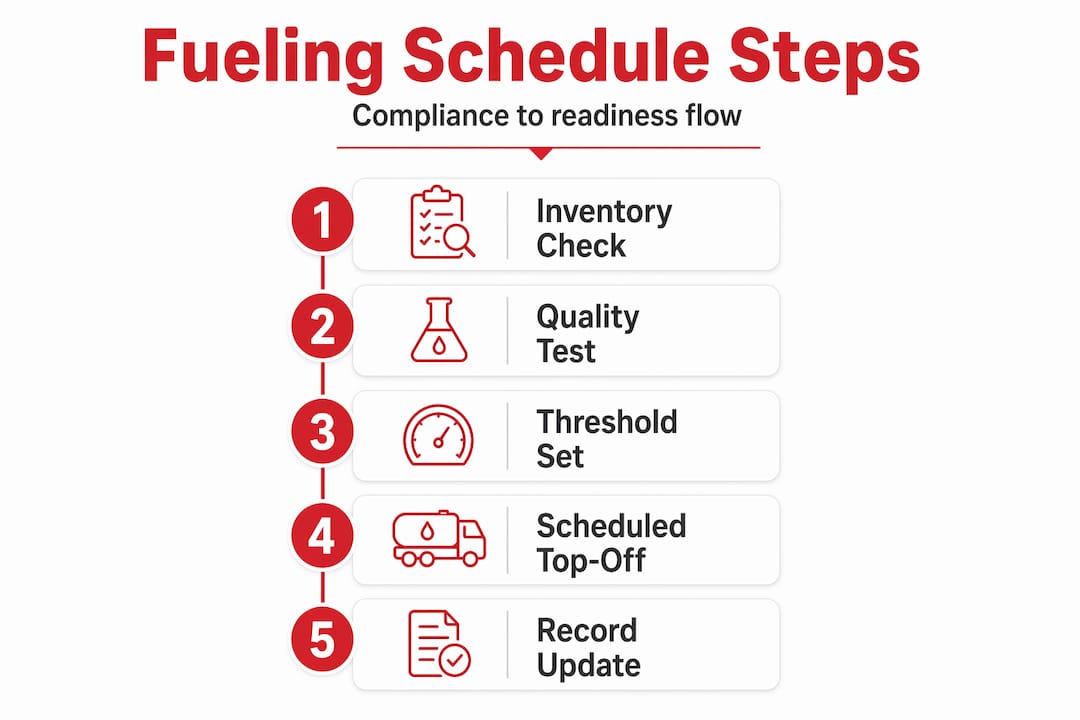
Your low-fuel alarm should be set at 100% of your minimum runtime volume, which is the NFPA 110 floor. Calculating minimum fuel inventory as class duration × fuel consumption rate × 1.33 converts a vague policy into an auditable alarm threshold. When the tank hits that level, a delivery order goes out. No judgment call required.
Separating test fuel from outage fuel
This is one of the most overlooked details in generator fuel management. Separating test fuel consumption from outage fuel prevents wet stacking and protects your emergency reserve. Your monthly 30-minute exercise run consumes real fuel. If you do not account for that consumption in your scheduling, you may believe your tank is at 90% capacity when it is actually at a level that falls short of your NFPA 110 minimum after the test.
The fix is straightforward. Calculate how much fuel your monthly test consumes at rated load and treat that as a scheduled draw against your inventory. Schedule a top-off after every monthly test, not before, so your post-test level returns to full capacity.
Storm and event readiness
Storm top-off triggers at 60 to 70% capacity with deliveries scheduled 48 to 72 hours before anticipated storm impact is the operational standard. Waiting until a storm warning is issued to call your fuel supplier puts you in line behind every other facility manager in your region doing the same thing.
| Scenario | Trigger Level | Lead Time Required |
|---|---|---|
| Routine top-off | Low-fuel alarm (NFPA 110 floor) | 24 to 48 hours |
| Storm readiness | 60 to 70% tank capacity | 48 to 72 hours before impact |
| Annual load bank test | Full tank required | 7 days before test date |
| Post-exercise refill | After every monthly test | Within 24 hours of test |
Scenario-based fueling triggers allow facilities to prepare for storms and after-hours needs, improving reliability even when delivery logistics get complicated. You can use a fuel consumption calculator to build these scenario numbers precisely for your specific generator model and load profile.
Technology and record-keeping that make schedules stick
A fueling schedule written in a binder and reviewed once a year is not a schedule. It is a document. The difference between a document and an operational tool is automation and accountability.
Digital fuel management systems and building management system integrations now make it practical to log fuel levels automatically, generate refill alerts, and maintain a timestamped audit trail without manual entry. Here is what a functional digital record-keeping setup looks like for generator fuel management:
- Automated tank level monitoring tied to your low-fuel threshold triggers a work order or supplier notification without human intervention.
- Digital maintenance logs capture every fuel delivery, inspection result, and test outcome with date, time, and technician ID. These records are what auditors and insurers want to see.
- Consumption trend tracking compares actual fuel use against expected consumption. A sudden increase in consumption between tests can indicate a fuel leak, a transfer pump issue, or unauthorized draws from the tank.
- Pre-event checklists built into your maintenance software prompt storm readiness top-offs automatically when a weather alert is triggered for your region.
Bulk fuel storage facilities often require local day tanks and reliable fuel transfer pump systems. Your digital records need to capture the status of those transfer systems alongside tank levels, because a full bulk tank means nothing if the day tank is not receiving fuel correctly.
The generator fuel maintenance program documentation practices supported by Anytimefuelpros align with exactly this kind of auditable record structure, which reduces compliance stress significantly at inspection time.
Common pitfalls that undermine fueling schedules
Even well-intentioned facility teams make predictable mistakes. Recognizing these patterns is the fastest way to close gaps in your current approach.
- Ignoring test fuel consumption. Monthly exercise runs are not free. Monthly tests simulate runtime under load, and failing to account for that draw leaves your post-test reserve lower than your records show.
- Meeting volume targets while ignoring fuel condition. A tank at 95% capacity with degraded, water-contaminated fuel will fail a generator just as surely as an empty tank.
- Delayed refueling after a test or minor outage. Operations teams often defer the refill because the tank is “still pretty full.” That deferred top-off becomes a problem when the next event hits before the delivery is scheduled.
- Misaligning delivery timing with storm forecasts. Calling for fuel when a storm is 24 hours out means competing with every other facility in the region. Suppliers prioritize customers with standing delivery agreements and pre-event protocols already in place.
- Keeping paper-only records. Paper logs get lost, damaged, and are difficult to audit quickly. A single missing inspection record can create compliance exposure during a regulatory review.
My take on what most facility teams get wrong
I’ve worked with a lot of facility teams that have generators, have fuel, and still fail inspections or run short during extended outages. The pattern I see most often is not negligence. It’s a lack of specificity.
Most teams know they need fuel. Very few have sat down and calculated exactly how much fuel their generator consumes per hour at rated load, multiplied that by their operating class duration, applied the 1.33 factor, and turned that number into a hard alarm threshold. That calculation takes about 15 minutes. The absence of it creates months of vague anxiety and occasional near-misses.
The other thing I’ve found is that the test-fuel-versus-outage-fuel distinction is almost never made explicit in written schedules. Teams run their monthly test, see the tank at 85%, and feel fine. They don’t realize that 85% might be below their NFPA 110 minimum once you account for the fuel just consumed. Post-test top-offs should be automatic, not optional.
What I’ve learned is that the best fueling schedules are not built around calendar dates. They are built around specific numeric triggers, scenario protocols, and a delivery partner who can execute on short notice. Technology helps, but the foundation is always the math.
— Justin
How Anytimefuelpros supports your fueling schedule
Developing a solid schedule is one part of the equation. Executing it reliably is the other.
Anytimefuelpros delivers on-site diesel directly to your generator, whether that means a scheduled recurring top-off after your monthly exercise test, a storm readiness fill 48 hours before a weather event, or emergency fuel delivery when an unplanned outage extends beyond your current reserve. AFP operates 24/7 and serves facilities across Texas, Utah, and nationwide through a trusted partner network, giving you a single point of contact regardless of how many sites you manage.
For facility managers who need on-demand diesel delivery tied to specific compliance thresholds and documented with the records your auditors require, Anytimefuelpros brings the operational discipline your schedule demands. Contact AFP to build a delivery program that fits your generator’s runtime class, your testing calendar, and your storm readiness protocols.
FAQ
What is the NFPA 110 minimum fuel storage requirement?
NFPA 110 requires on-site fuel storage equal to 133% of the fuel needed to run the generator for its full operating class duration. This 33% buffer accounts for delivery delays and consumption variance under load.
How often should generator fuel be tested for quality?
Annual laboratory testing is the standard, and it should be scheduled 30 to 60 days before your annual load bank test. Daily visual checks for water and sediment supplement the annual test between formal inspections.
What is the difference between test fuel and outage fuel?
Test fuel is the diesel consumed during monthly exercise runs. Outage fuel is your emergency reserve. Failing to account for test consumption separately can leave your post-test reserve below your NFPA 110 minimum without your records reflecting that shortfall.
When should I schedule a storm readiness top-off?
Trigger a top-off when your tank reaches 60 to 70% capacity and schedule delivery 48 to 72 hours before anticipated storm impact. Waiting until a storm warning is issued puts you in competition with every other facility in your area for the same limited supplier capacity.
How do I calculate my minimum fuel inventory threshold?
Multiply your generator’s operating class duration by its fuel consumption rate at rated load, then multiply by 1.33. That result is your NFPA 110 minimum storage floor and the number your low-fuel alarm should be set to trigger on.
Recent Comments