

Off-road fuel compliance is defined as adherence to federal and state regulations governing the use, storage, and documentation of tax-exempt dyed diesel fuel reserved exclusively for non-highway equipment and operations. For site superintendents, fleet managers, and procurement officers in construction, mining, logistics, and the public sector, understanding these rules is not optional. The IRS enforces off-road fuel regulations under 26 U.S.C. § 4082 and § 6715, and violations carry penalties starting at $1,000 per incident. Getting this wrong does not just cost money. It can trigger federal audits, criminal referrals, and operational shutdowns.
What is off-road fuel compliance and why does it matter?
Off-road fuel compliance refers to the full set of legal obligations that govern how dyed diesel fuel is purchased, stored, used, and documented in non-highway operations. The industry standard term for this fuel is dyed diesel or off-road diesel, and it carries a distinct legal status because it is exempt from federal and state road-use excise taxes. That tax exemption is the reason the rules exist. The government needs a reliable way to confirm that tax-exempt fuel stays off public roads.
The industries most affected include construction, mining, agriculture, logistics yard operations, and municipal fleets. Each of these sectors runs diesel-powered equipment that never touches a public highway, from excavators and dozers to generators and irrigation pumps. For these operations, understanding off-road diesel is a core part of managing financial and legal risk.
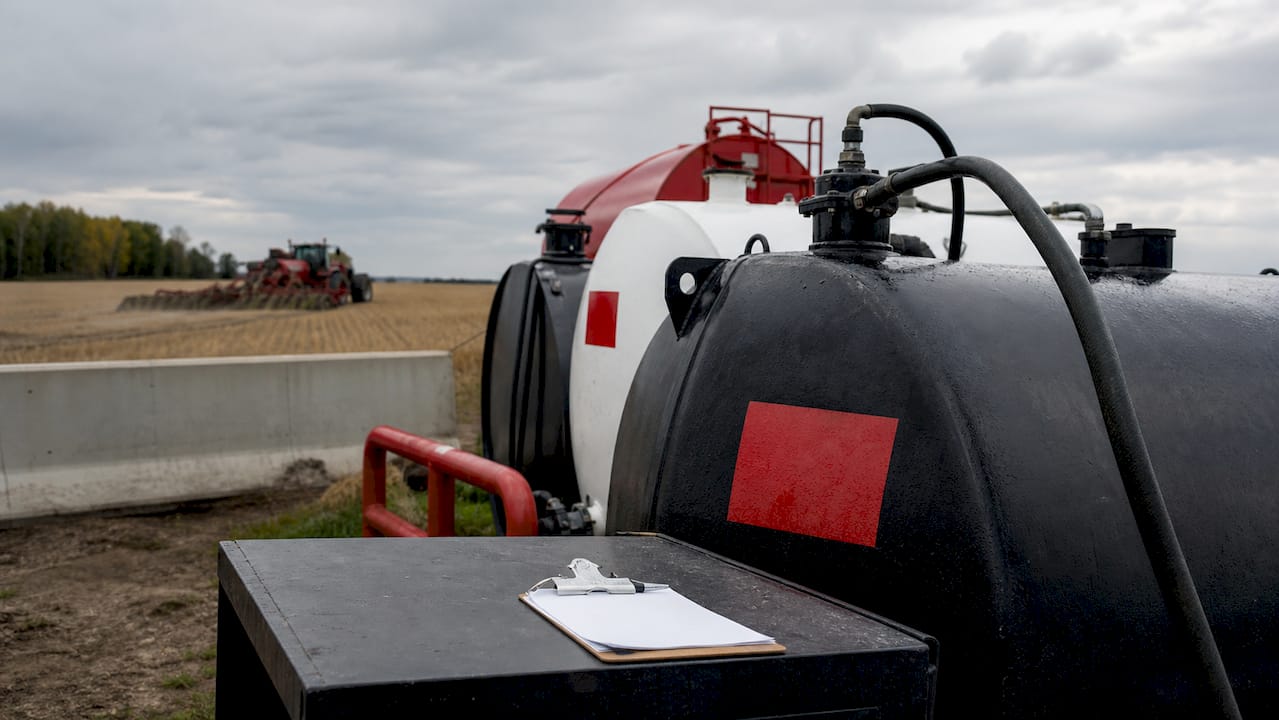
The consequences of non-compliance are not theoretical. Using off-road diesel in highway vehicles is treated as tax evasion under IRS codes, and repeat violations can trigger escalating fines and potential criminal referrals. That classification alone should reframe how operations teams think about fuel procurement and tracking.
What federal and state regulations govern off-road fuel use?
The federal framework for off-road fuel compliance is built around two primary statutes. 26 U.S.C. § 4082 establishes the conditions under which diesel fuel qualifies for tax exemption, and 26 U.S.C. § 6715 sets the penalty structure for misuse. These statutes give the IRS direct authority to inspect, sample, and penalize any business that uses dyed diesel in taxable applications.
The IRS Fuel Compliance Program operates through field-based Fuel Compliance Officers who hold broad inspection authority. IRS Fuel Compliance Officers can inspect any site with fuel storage, sample fuel from tanks and vehicles, and review fuel invoices and delivery tickets. That authority extends to job sites, equipment yards, and bulk storage facilities without advance notice.
State-level regulations add another layer. Most states mirror federal dyed diesel rules but apply their own excise tax structures and enforcement protocols. Some states require additional fuel use reporting, separate licensing for bulk fuel storage, and specific labeling formats on storage tanks. The EPA also sets storage requirements under underground and aboveground storage tank regulations, and local fire codes govern tank placement and containment.
Key federal and state compliance requirements include:
- Fuel labeling: All storage tanks holding dyed diesel must be clearly labeled to distinguish them from on-road fuel systems.
- Tank isolation: Dyed diesel tanks must be physically separated from taxed fuel systems to prevent cross-contamination.
- Invoice retention: Fuel purchase records and delivery tickets must be retained to support audits.
- Inspection readiness: Sites must be prepared for unannounced IRS sampling visits at any time.
Pro Tip: Store fuel invoices, delivery tickets, and tank inspection records in a single organized file, either physical or digital. IRS Fuel Compliance Officers can arrive without notice, and having records immediately accessible prevents delays that can look like obstruction.
Treating off-road diesel compliance as operational risk management, rather than a paperwork burden, is the mindset that separates companies that pass inspections from those that face penalties.
How does off-road diesel differ from on-road diesel?
The chemical composition of off-road and on-road diesel is nearly identical. The critical difference is a red dye added at the distribution point to signify tax-exempt status. Off-road diesel is dyed red at distribution, and the dye is chemically detectable at very low concentrations. Diluting dyed diesel with clear diesel does not remove the dye. IRS testing methods are sensitive enough to detect trace amounts, which means blending fuels to avoid detection is not a viable strategy and compounds the legal exposure.
A common misconception is that off-road diesel is lower quality than on-road diesel. Off-road diesel carries the same fuel quality as on-road diesel. The difference is entirely regulatory: additional labeling requirements, documentation obligations, and restrictions on where the fuel can be used.
The table below outlines the key distinctions between allowed and disallowed applications:
| Application | Off-Road Diesel Allowed? | Notes |
|---|---|---|
| Excavators, bulldozers, loaders | Yes | Standard off-road equipment use |
| Stationary generators | Yes | Non-highway power generation |
| Agricultural machinery | Yes | Tractors, irrigation pumps, harvesters |
| Mining equipment | Yes | Drills, haul trucks, crushers on private land |
| Licensed highway trucks | No | Federal violation under § 6715 |
| Municipal road vehicles | No | Taxable use; clear diesel required |
| Construction vehicles on public roads | No | Even temporary road use triggers liability |
Legal dyed diesel use cases are broader than many operators realize, but the line between legal and illegal use is absolute. A piece of equipment that operates both on private land and on public roads requires on-road clear diesel, not dyed diesel.
What are the common compliance challenges and how do you avoid penalties?
The most expensive compliance failures in off-road fuel management are often unintentional. Accidental contamination, poor documentation, and inadequate tank labeling account for a significant share of enforcement actions. Understanding where these failures occur is the first step toward preventing them.
The top compliance risks, ranked by frequency and financial impact:
- Residual dye contamination: Residual red dye can remain in fuel lines and tanks after switching from off-road to on-road diesel, potentially triggering a false positive during an IRS inspection. Thorough fuel system flushing and documented cleaning procedures are the only reliable defense.
- Missing or incomplete records: Failure to maintain proper fuel purchase records and delivery documentation increases penalty risk during audits. Records should be retained for a minimum of three years and organized by site, date, and fuel type.
- Unlabeled or mislabeled tanks: Tanks that lack proper labeling create ambiguity during inspections and can result in penalties even when the fuel use itself was legal.
- Mixed-use equipment: Equipment that transitions between job site and public road use is a high-risk category. Operators must track fuel type by vehicle and document the transition.
- Supplier documentation gaps: Purchasing dyed diesel from a supplier who does not provide compliant invoices leaves the buyer without the paper trail needed to prove lawful purchase.
The federal penalty for misuse is direct and severe. The penalty for using dyed diesel in highway vehicles is at least $1,000 or $10 per gallon found, whichever is greater, with no reasonable cause exceptions. That means a 100-gallon tank of dyed diesel found in a highway truck generates a minimum $1,000 fine on the spot, before any back taxes or escalating penalties apply.
Pro Tip: When switching a piece of equipment from off-road to on-road use, document the fuel system flush in writing, including the date, technician name, and fuel type used after the flush. Keep that record with the vehicle’s compliance file.
How to maintain compliant fuel records and management practices
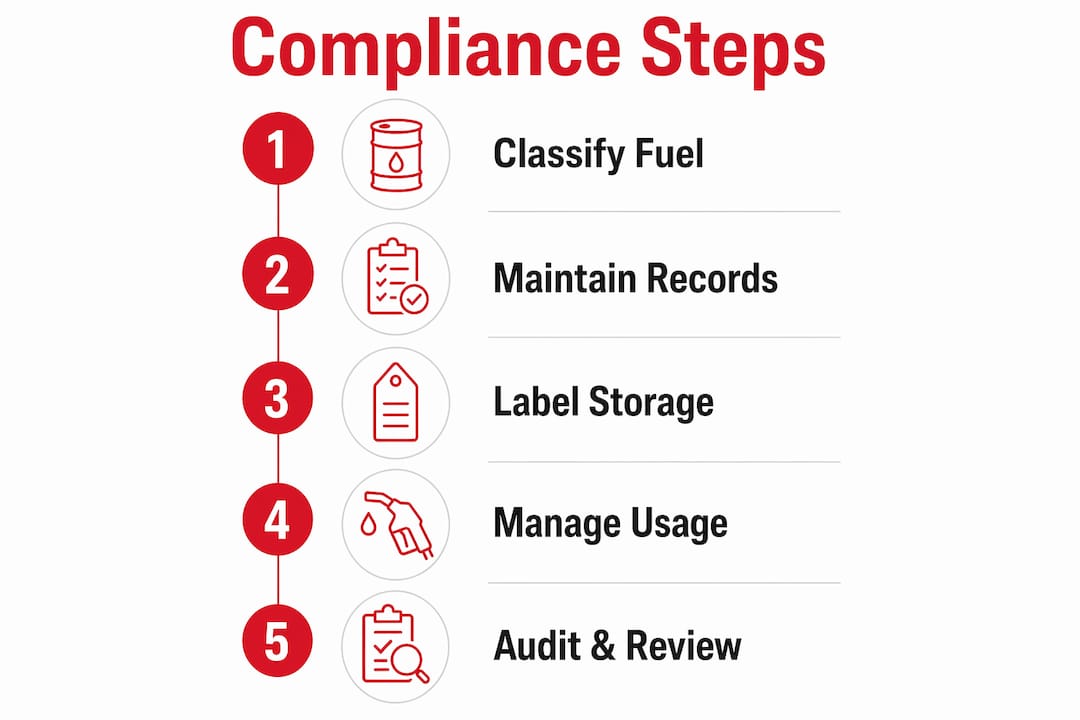
Systematic record-keeping is the foundation of any compliant off-road fuel operation. The goal is to create a paper trail that answers three questions at any moment: what fuel was purchased, where it was delivered, and what equipment consumed it.
A compliant fuel management system includes these core components:
- Purchase documentation: Every dyed diesel delivery should generate a supplier invoice that identifies the fuel type, volume, delivery date, and site location.
- Delivery tickets: On-site delivery tickets signed by the receiving party confirm that the fuel arrived at the correct location and in the correct quantity.
- Equipment fuel logs: Each piece of off-road equipment should have a log tracking fuel consumption by date and volume. This supports both compliance audits and operational cost tracking.
- Tank inspection records: Document tank labeling, capacity, and any maintenance or cleaning events. Include dates and the names of personnel involved.
- Supplier compliance verification: Confirm that your fuel supplier provides invoices that meet IRS documentation standards. A supplier who cannot produce compliant paperwork creates liability for your operation.
Working with a knowledgeable fuel supplier simplifies this process considerably. Suppliers who specialize in commercial off-road diesel delivery understand the documentation requirements and build compliant invoicing into their standard process. For logistics operations, the 2026 fuel delivery operations guide outlines specific record-keeping procedures relevant to yard and fleet environments.
The table below outlines a basic compliant fuel management framework:
| Document Type | Retention Period | Purpose |
|---|---|---|
| Supplier invoices | 3 years minimum | Proves lawful purchase of dyed diesel |
| Delivery tickets | 3 years minimum | Confirms site-specific fuel receipt |
| Equipment fuel logs | 3 years minimum | Documents non-highway use |
| Tank inspection records | Duration of tank use | Supports labeling and storage compliance |
| Fuel system flush records | 3 years minimum | Defends against residual dye findings |
What environmental and regional rules affect off-road fuel compliance?
Environmental compliance adds a second layer of obligations that operates alongside tax compliance. These two systems are separate but intersecting, and failing one does not excuse the other.
California requires reporting of off-road equipment and adherence to idling limits as part of its environmental compliance program. The state’s DOORS (Diesel Off-Road Online Reporting System) portal tracks engine tiers and emissions data for off-road fleets operating within California. Fleet operators in the state must comply with both IRS tax rules and California Air Resources Board (CARB) emissions standards simultaneously.
Key environmental and regional compliance factors to monitor:
- Idling restrictions: Many states and municipalities limit engine idling time for off-road diesel equipment, with fines for violations separate from fuel tax penalties.
- Engine tier reporting: States with emissions programs may require operators to report the engine tier classification of each piece of off-road equipment.
- Fuel sulfur content: Some regions restrict the sulfur content of off-road diesel beyond federal minimums, affecting which fuel products are legally usable.
- Spill containment: EPA secondary containment requirements apply to bulk fuel storage, and violations carry independent penalties.
- Regulatory update monitoring: Off-road fuel standards change at both the federal and state level. Subscribing to IRS and state environmental agency updates is the most reliable way to stay current.
For operations running equipment across multiple states, the compliance picture becomes more complex. A mining operation with sites in Texas, Utah, and California faces three distinct regulatory environments on top of federal requirements. Building a compliance calendar that tracks state-specific reporting deadlines is a practical way to manage that complexity.
Key takeaways
Off-road fuel compliance requires accurate fuel classification, documented record-keeping, proper storage labeling, and awareness of both federal IRS rules and state environmental standards to avoid penalties.
| Point | Details |
|---|---|
| Federal penalties are immediate | Misusing dyed diesel in highway vehicles triggers fines of at least $1,000 per incident with no exceptions. |
| Dye detection is highly sensitive | Diluting dyed diesel does not remove the dye; IRS testing detects trace amounts reliably. |
| Records must span three years | Invoices, delivery tickets, and equipment fuel logs should be retained for a minimum of three years. |
| Environmental rules run parallel | States like California require emissions reporting and idling compliance on top of federal tax rules. |
| Supplier choice affects your liability | A supplier who cannot produce compliant invoices creates a documentation gap that falls on the buyer. |
How Anytimefuelpros supports your off-road fuel compliance
Managing off-road fuel compliance is easier when your fuel supplier understands the regulatory environment as well as you do. Anytimefuelpros delivers compliant dyed diesel directly to construction sites, mining operations, logistics yards, and municipal fleets across Texas, Utah, and nationwide through its partner network. Every delivery comes with documentation that meets IRS invoicing standards, giving your team the paper trail it needs before an inspection ever happens.
From bulk tank fills to scheduled recurring deliveries, Anytimefuelpros builds compliance support into its standard service. You get transparent invoicing, site-specific delivery records, and a single point of contact for multi-site fuel needs. Whether you manage a fleet of excavators in San Antonio or a mining operation in Salt Lake City, explore on-site diesel delivery to see how Anytimefuelpros keeps your operation fueled and audit-ready.
FAQ
What is off-road fuel compliance in simple terms?
Off-road fuel compliance means following federal and state rules that govern the use of tax-exempt dyed diesel fuel, ensuring it is only used in non-highway equipment and properly documented to satisfy IRS and environmental requirements.
What happens if dyed diesel is found in a highway vehicle?
The federal penalty is at least $1,000 or $10 per gallon found, whichever is greater, with no reasonable cause exceptions under 26 U.S.C. § 6715. Repeat violations can escalate to criminal referrals.
How long should fuel records be kept for compliance purposes?
IRS guidance recommends retaining fuel purchase records, delivery tickets, and equipment fuel logs for a minimum of three years to support audits and inspections.
Does off-road diesel perform differently than on-road diesel?
No. Off-road diesel carries the same fuel quality as on-road diesel. The difference is regulatory: it is dyed red to indicate tax-exempt status and is restricted to non-highway use only.
Do environmental rules apply separately from fuel tax compliance?
Yes. States like California require off-road fleet operators to comply with emissions reporting programs such as DOORS and idling restrictions, which operate independently of IRS fuel tax rules.
Recent Comments