
A quarry fueling plan is a written diesel fuel-delivery and storage program that covers SPCC applicability, secondary containment sizing, designated fueling-area design, transfer procedures, emergency spill response, and daily inventory controls. We put this guide together because most sites treat these as separate problems when regulators and insurers expect them as one plan. We also deliver on-site diesel for quarry operators who need that plan backed by a reliable supply.
TL;DR:
- SPCC applies when combined aboveground oil capacity exceeds 1,320 gallons; count each container’s full shell capacity, but exclude containers under 55 gallons.
- Fuel outside the pit whenever equipment can leave; unavoidable transfers inside the pit need temporary containment, drip pans at every connection, and an attendant throughout.
- Build fueling zones on impervious concrete sloped toward a drain or sump, with a cover, overflow controls, clear boundaries, and nearby spill kits.
- Before each delivery, inspect hoses, confirm tank capacity, chock the vehicle, and assign an attendant; monitor the transfer, then close valves and log completion.
- Inspect piping, valves, and containment monthly, keep training and delivery records, and review the SPCC plan every five years; larger sites may need engineer certification.
Table of Contents
- One-Page Checklist: Immediate Actions to Put a Fueling Plan in Place
- Fueling Area Design and Containment Requirements
- Fuel Transfer Procedures and Loading/Unloading Checklist
- Fueling Inside the Pit vs. Fueling Outside: Controls and When Each Is Acceptable
- Fuel Storage, Tank Selection, and Overfill Prevention
- Inventory, Purchasing, and Delivery Strategy for Volatile Fuel Markets
- Emergency Response, Spill Kits, and Training Requirements
- Recordkeeping, Inspections, and Regulatory Tasks to Keep Your Plan Audit-Ready
- Implementation: A Short, Prioritized 8-Step Template for a Quarry Fueling Plan
- Environmental Permitting and Reporting Requirements Specific to Quarry Fueling Operations
- Fuel Quality Control and Contamination Prevention Methods
- Personnel Training and Certification Requirements for Fueling Operations in Quarries
- Health and Safety Risks Specific to Fueling Heavy Equipment in Quarry Environments and Mitigation Strategies
- Integration of Fuel Management Technology: Monitoring and Delivery Tracking
- Coordination With Quarry Operational Schedules and Minimizing Operational Disruptions During Fueling
- How Anytime Fuel Pros Supports Quarry Fueling Plans
- FAQ
- Sources
One-Page Checklist: Immediate Actions to Put a Fueling Plan in Place
Before anything else, add up your total aboveground oil storage capacity. The SPCC rule kicks in once a facility crosses 1,320 gallons of combined storage, and quarries with multiple tanks, generators, and mobile equipment tanks cross that line faster than most site leads expect.
Once you know where you stand, move through these steps in order:
- Calculate total aboveground oil storage and compare it against the 1,320-gallon SPCC threshold.
- Mark off designated fueling zones and install containment plus spill kits before the next delivery.
- Build pre-transfer, during-transfer, and post-transfer checklists, assign a trained attendant to every delivery, and log each one.
Momentum on site drops fast when a surprise inspection catches a tank with no containment under it. Getting these three items done first buys time to build out the rest of the plan properly.
Fueling Area Design and Containment Requirements
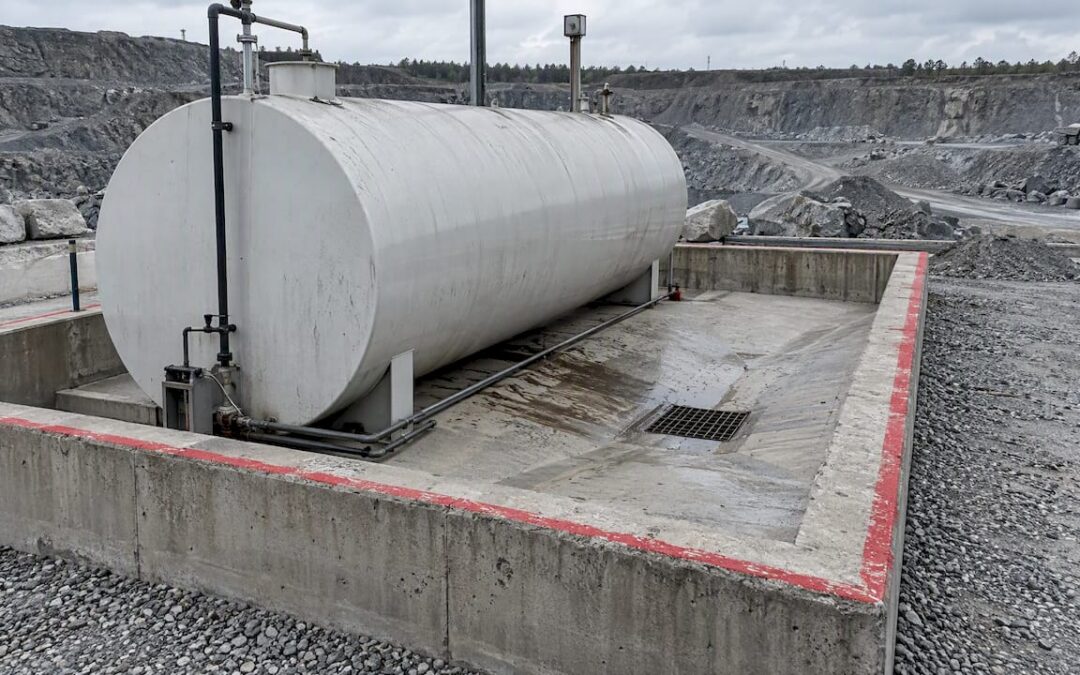
The surface under your tanks matters as much as the tanks themselves. TCEQ’s quarry best-practice guidance calls for impervious surfaces, meaning concrete rather than asphalt, sloped so fuel and runoff move toward a drain or sump instead of pooling near equipment.
Pit locations and other high-risk spots warrant particular attention.
Beyond the pad itself, a complete fueling area includes a cover over the dispensing point, oil-control devices or perimeter drains to catch overflow, and a visible, marked boundary that separates fueling from crushing, loading, and other site operations. Treat this zone as its own controlled area, not a corner of the equipment yard, and inspection day gets a lot simpler.
Fuel Transfer Procedures and Loading/Unloading Checklist
Every transfer, whether it is a tanker filling your bulk tank or a technician topping off a haul truck, follows the same three-phase rhythm: prepare, monitor, close out.
- Pre-transfer: Inspect hoses and couplings for wear, confirm the receiving tank has enough ullage for the delivery, chock the delivery vehicle’s wheels, and confirm a trained attendant is present for the entire transfer.
- During transfer: The driver or attendant stays with the vehicle the whole time, watches flow rate and tank level, keeps a drip pan under every connection point, and slows the flow as the tank nears capacity.
- Post-transfer: Drain and cap the hose, close all valves, complete the delivery log, and walk the area to check for visible leaks or staining before releasing the vehicle.
Pro Tip: Keep a laminated copy of this checklist at the fueling station itself. Attendants who have to walk to an office to find the procedure skip steps.
A documented quarry SPCC plan from Mid-Continent shows this exact structure in practice: posted procedures at the transfer point, drip pans as standard equipment, and suppliers who are supervised rather than left to self-manage the delivery.
Fueling Inside the Pit vs. Fueling Outside: Controls and When Each Is Acceptable
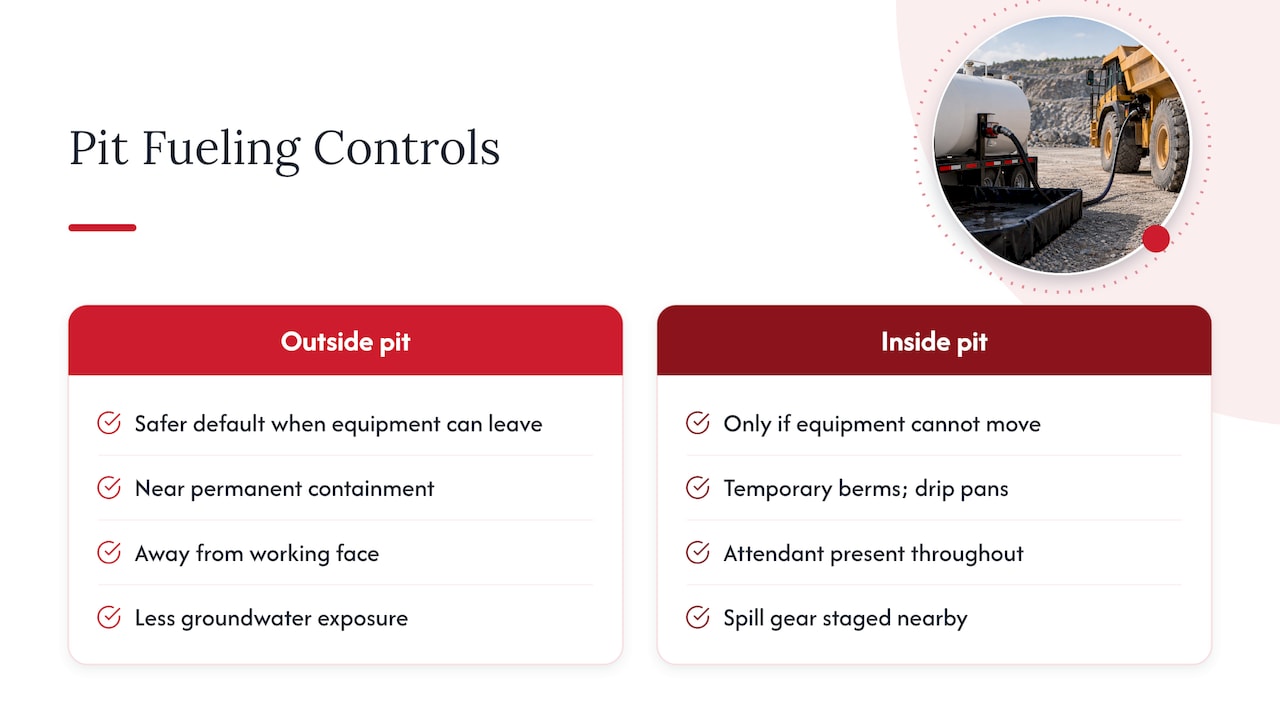
Fueling outside the pit is the safer default whenever equipment can be driven out. It keeps fuel handling away from the working face, away from groundwater exposure, and closer to your permanent containment.
Some equipment cannot leave the pit floor during active production, so in-pit fueling becomes unavoidable. When that happens, the controls tighten: temporary containment berms under the tank or vehicle, drip pans at every hose connection, and an attendant present for the full transfer, no exceptions.
For larger tanks staged in the pit, state guidance recommends containment sized to 150% of tank volume rather than the standard 110%, given the proximity to the water table and the difficulty of fast cleanup on an active pit floor. Limit in-pit transfers strictly to equipment that genuinely cannot be moved, and treat each one as a higher-monitoring event with spill response gear staged nearby, not back at the yard.
Fuel Storage, Tank Selection, and Overfill Prevention
Your SPCC applicability calculation depends on shell capacity, not the amount of fuel actually in the tank. EPA guidance counts the full container capacity toward your 1,320-gallon threshold, though containers under 55 gallons are excluded from that count.
Tank selection affects both compliance and risk. Double-walled tanks provide built-in secondary containment and reduce the footprint needed for a bermed containment area, which matters on tight quarry sites. Check with your state or local authority on tank registration requirements, since some jurisdictions require registration above certain capacities regardless of SPCC status.
Overfill prevention devices and tank-level alarms are cheap insurance against the most common cause of spills: a tank that kept filling after someone walked away. Document that your fuel vendor’s drivers follow your site’s transfer procedures every time, not just during the first delivery.
Inventory, Purchasing, and Delivery Strategy for Volatile Fuel Markets
A fueling plan is also a purchasing plan. Industry guidance recommends treating fuel buys as daily tactical decisions rather than a single annual contract: compare spot pricing against your contract rate each day, and keep an updated run-out window for every tank so you know exactly how many days of supply you have before you are forced into a rushed, higher-cost delivery.
Carrier flexibility is the other half of that strategy. Contracts that allow off-peak lifts, access to multiple carriers, and guaranteed volumes for priority or emergency service give you room to chase savings without putting continuity at risk.
The same guidance points to structured processes, including software, that normalize pricing across suppliers and flag short-term savings windows automatically. A buyer who checks prices manually once a week will miss most of those windows. The goal is capturing the savings while still honoring your contract’s ratability terms, not abandoning the contract altogether.
Emergency Response, Spill Kits, and Training Requirements
Spill kits only help if they are sized for the job and placed where the spill will actually happen: at the fueling station itself and near every bulk tank, not centralized in a maintenance shed across the site. Require suppliers to follow your posted transfer procedures on every delivery, since a discharge during a tanker drop is a potential failure point.
Training needs a rhythm, not a one-time session. Discharge prevention briefings at onboarding, followed by routine refresher training, keep procedures fresh for crews who handle fuel daily and for seasonal staff who do not. Document every session. SPCC rules also require a full plan review every five years, so build that into your calendar now rather than discovering it during an inspection.
For a discharge that reaches navigable water or exceeds reportable quantities, your plan needs a clear escalation path: who calls the regulatory hotline, who documents the incident, and who notifies site leadership, in that order.
Recordkeeping, Inspections, and Regulatory Tasks to Keep Your Plan Audit-Ready
An inspector’s first question is usually “can you show me,” so your paperwork needs to be ready before the question gets asked. Keep facility diagrams, delivery logs, inspection checklists, training records, and management sign-off on the plan itself in one accessible file, digital or physical.
Routine inspections of piping, valves, and fittings can catch slow leaks that visual checks miss. Confirm containment capacity and sump drainage function during these inspections rather than waiting for a review. Larger facilities should prepare for professional engineer certification of the SPCC plan and the mandatory five-year review where the rule requires it.
Implementation: A Short, Prioritized 8-Step Template for a Quarry Fueling Plan
Turning the sections above into a working plan takes structure, not more reading. Here is a sequence to help a site work toward audit readiness.
- Assess total storage against the 1,320-gallon SPCC threshold. Verification: a written capacity worksheet listing every tank and container.
- Walk the site and designate fueling zones away from active production. Verification: a marked site map.
- Size and install containment, 110% baseline or 150% for pit locations. Verification: containment volume calculations on file.
- Procure spill kits and overfill devices sized to each station. Verification: purchase records and placement photos.
- Write transfer procedures covering pre, during, and post-transfer steps. Verification: posted checklist at each station.
- Train staff and brief suppliers on the written procedures. Verification: signed training logs.
- Schedule deliveries against run-out windows with carrier flexibility built in. Verification: delivery calendar and contract terms.
- Set an inspection and review cadence for equipment and the full plan. Verification: inspection log with assigned owners.
Pro Tip: Assign one site lead, one safety officer, and one procurement contact to these eight steps by name. Plans without an owner for each line item stall at step three.
Environmental Permitting and Reporting Requirements Specific to Quarry Fueling Operations
Quarry fueling sits inside a broader web of environmental permitting that goes beyond SPCC alone. Stormwater permits for quarry operations typically require a pollution prevention team and written measures to keep fueling, maintenance, and equipment washing from contaminating runoff, since a fueling area with poor drainage control can turn a routine rainstorm into a reportable discharge.
Permitting requirements vary by state and by the specific discharge pathway at your site, so the exact forms and thresholds depend on your location and the regulator with jurisdiction over your operation. What stays consistent across most programs is the expectation that fueling areas are designed to prevent runoff from leaving the site uncontrolled, and that any significant discharge gets reported promptly rather than discovered during a routine inspection.
Reporting obligations layer on top of permitting. A discharge that reaches water or exceeds a reportable quantity may trigger notification requirements. Check the applicable reporting rules and act promptly. Keep contact information for your state environmental agency and the relevant regulatory hotline posted alongside your spill response procedures, not buried in a binder in a site office. The facilities that handle an inspection calmly are usually the ones that treat permitting and reporting as part of daily operations rather than a once-a-year compliance exercise handled separately from the fueling plan itself.
Fuel Quality Control and Contamination Prevention Methods
Water and particulate contamination degrade diesel quietly, and quarry equipment running on dirty fuel shows it through clogged filters, injector wear, and unplanned downtime long before anyone traces the problem back to the tank. Contamination usually enters through one of three paths: condensation inside a partially empty tank, dirt introduced during transfer, or sediment that settles at the bottom of long-term storage.
Keeping tanks closer to full reduces the airspace where condensation forms, which is one reason run-out window tracking matters for quality as much as for cost. Filtration at the point of transfer, both on the delivery side and at the dispensing nozzle, catches particulate before it reaches equipment tanks. Routine fuel testing for water content and particulate levels gives you an early warning before a contaminated batch works its way through your fleet.
Fuel polishing, which filters and reconditions stored diesel, addresses contamination that has already settled into a tank rather than preventing it at the source. It is a practical recovery step for bulk tanks that sit for extended periods, particularly for backup or reserve supply that is not cycled through quickly. Pairing routine quality checks with the containment and transfer procedures already built into your plan closes the loop: clean fuel in, controlled transfer, no contamination introduced along the way.
Personnel Training and Certification Requirements for Fueling Operations in Quarries
The people handling fuel transfers need training that covers both the mechanics of a safe transfer and the regulatory expectations behind it. MSHA best-practice guidance for surface mobile equipment calls for hazard assessments and documented safety controls, and fueling attendants fall squarely inside that scope since they work around moving equipment, pressurized hoses, and flammable material daily.
Training should cover the transfer checklist itself, spill response procedures, and the specific hazards of your site’s fueling zones, whether that is proximity to the pit edge or traffic patterns on haul roads near the fueling station. New hires need this before their first unsupervised transfer, and refresher sessions keep the procedures from going stale for experienced staff who may start cutting corners once a routine feels familiar.
Documentation matters here as much as the training itself. A training log that shows who was trained, on what, and when is often the difference between a smooth inspection and a cited deficiency, since SPCC rules explicitly require personnel training as part of a compliant plan. Suppliers and delivery drivers should receive a briefing on your site’s specific procedures as well, not just their own company’s standard protocol, since the posted checklist at your fueling station takes precedence during any transfer on your property.
Health and Safety Risks Specific to Fueling Heavy Equipment in Quarry Environments and Mitigation Strategies
Fueling heavy equipment in a quarry carries risks that do not show up at a typical fleet yard. Uneven ground near the pit edge, active haul truck traffic, and the proximity of ignition sources from nearby crushing or blasting operations all raise the stakes of a routine transfer.
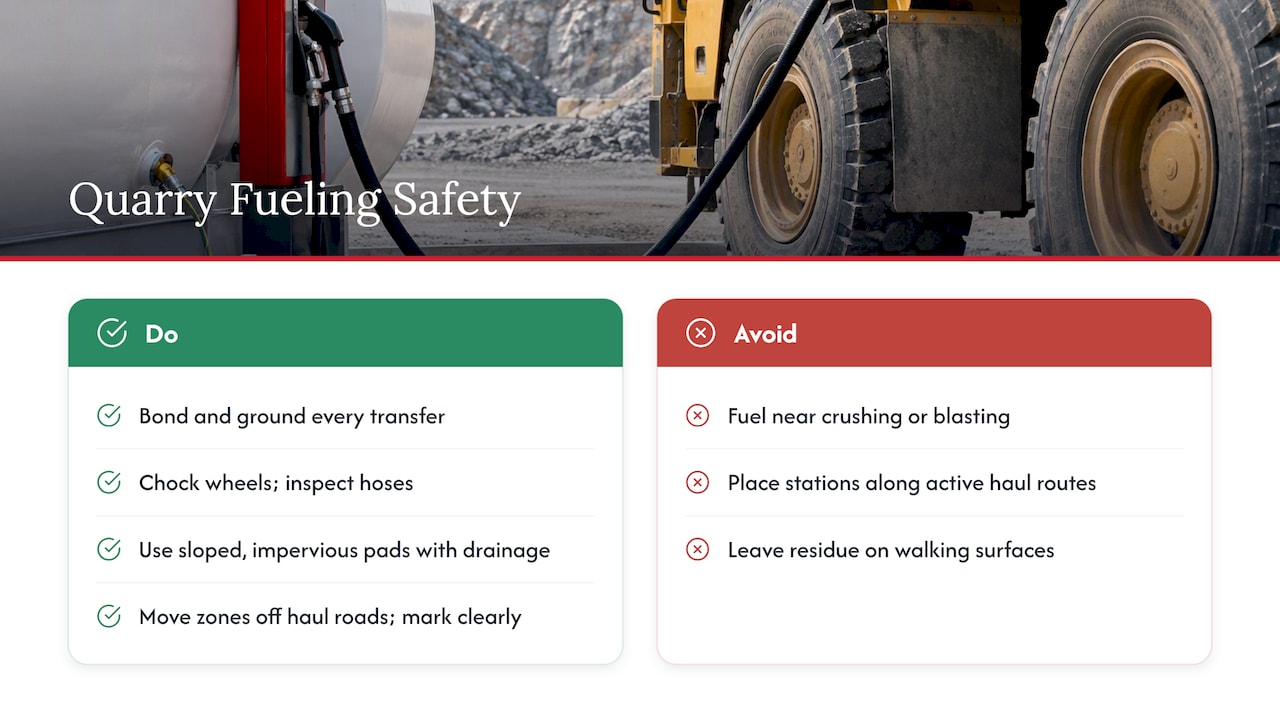
Static discharge during fuel transfer is a recognized ignition risk, which is why bonding and grounding procedures belong in every transfer checklist alongside the basic steps of chocking wheels and inspecting hoses. Slips and falls around fueling stations rank among the more common injuries on quarry sites, often tied to fuel or oil residue on walking surfaces, which is exactly why a sloped, impervious pad with proper drainage protects people as well as the environment.
Traffic management deserves its own line in the plan. MSHA guidance on haulage roads and mobile equipment emphasizes clear right-of-way rules and visibility standards, and a fueling station positioned along an active haul route multiplies the chance of a collision during a transfer when an attendant’s attention is split between the hose and the tank gauge. Positioning fueling zones away from primary haul roads, marking them clearly, and requiring high-visibility gear for anyone working a transfer are low-cost mitigations that address a real and recurring hazard rather than a theoretical one.
Integration of Fuel Management Technology: Monitoring and Delivery Tracking
Manual tank checks and paper delivery logs work for small sites, but they start to break down once a quarry runs multiple tanks across a spread-out footprint. Fuel monitoring systems that track tank levels remotely give site leads real-time visibility into run-out windows without someone physically checking a gauge, which ties directly back to the purchasing strategy covered earlier in this plan.
Automated delivery tracking closes the loop from the supply side. Knowing exactly when a tanker left the terminal and when it is expected on site reduces the guesswork that leads to rushed, premium-priced emergency orders. A 2026 digital modeling study found that optimizing equipment selection and reducing idle trips can cut fuel consumption by up to 31% and lower cost per unit of output by about 26% in quarry transport scenarios, a result that depends on having accurate consumption data to work from in the first place.
None of this technology replaces the written procedures and training covered earlier. It gives the people running those procedures better information, faster, which matters most on sites juggling multiple fueling zones, rotating crews, and a purchasing strategy that depends on knowing exactly how many days of fuel remain in each tank at any given moment.
Coordination With Quarry Operational Schedules and Minimizing Operational Disruptions During Fueling
A fueling plan that ignores production schedules creates its own downtime. Equipment pulled off the pit floor to fuel outside, as recommended earlier in this guide, needs a scheduled window that does not collide with blasting, loading, or shift changes, or the plan becomes the thing crews route around rather than follow.
Scheduling recurring deliveries around known low-activity windows, early shift starts or shift-change lulls, keeps tanker traffic away from the busiest hours on haul roads. Coordinating with your fuel supplier on delivery timing, rather than treating every delivery as whenever the truck happens to arrive, reduces the chance that a transfer overlaps with the exact window when equipment needs to move through that same area.
The sites that handle this well treat the fueling schedule as part of the daily production plan, not a separate logistics problem handled by a different team. A quick morning check of run-out windows against the day’s planned equipment movements, paired with a supplier that can adjust delivery timing on short notice, prevents the two most common disruptions: equipment idling while it waits to fuel, and a tanker sitting in a haul route during peak production hours.
How Anytime Fuel Pros Supports Quarry Fueling Plans
We built our service around the exact gaps that slow down a fueling plan like the one above. We handle on-site diesel delivery directly to your fueling zones, so equipment stays out of the pit and off the haul road during a transfer, and we offer bulk fuel delivery and tank rentals for sites still sizing their storage and containment.
Our scheduled recurring deliveries plug straight into the run-out window tracking covered in your purchasing strategy, and our emergency response covers the moments a run-out window closes faster than planned. We also deliver DEF alongside diesel, so one call covers both. Request a quote to see where we fit your implementation timeline.
FAQ
What triggers the SPCC requirement for a quarry?
A quarry needs a written SPCC plan once total aboveground oil storage capacity exceeds 1,320 gallons, counting full shell capacity rather than the amount actually stored. Containers under 55 gallons do not count toward that total.
How much secondary containment does a quarry fuel tank need?
State guidance recommends increasing the containment level to 150% for tanks in pit locations or other high-risk areas near water resources.
Is it safe to fuel equipment inside an active quarry pit?
Fueling outside the pit is the safer default and should be used whenever equipment can be driven out. When in-pit fueling is unavoidable, it requires temporary containment, drip pans at every connection, and a trained attendant present for the entire transfer.
How often does a quarry SPCC plan need to be reviewed?
SPCC rules require a full plan review at least once every five years, alongside monthly inspections of piping, valves, and containment integrity. Larger facilities may also need professional engineer certification of the plan.
Sources
- Ehs
- Best Management Practices for Quarry Operations
- Mid-Continent Quarry SPCC Plan
- Smarter fill-ups | Pit & Quarry
- Digital Modeling of Quarry Transport to Reduce Fuel and Environmental Costs
Recent Comments