
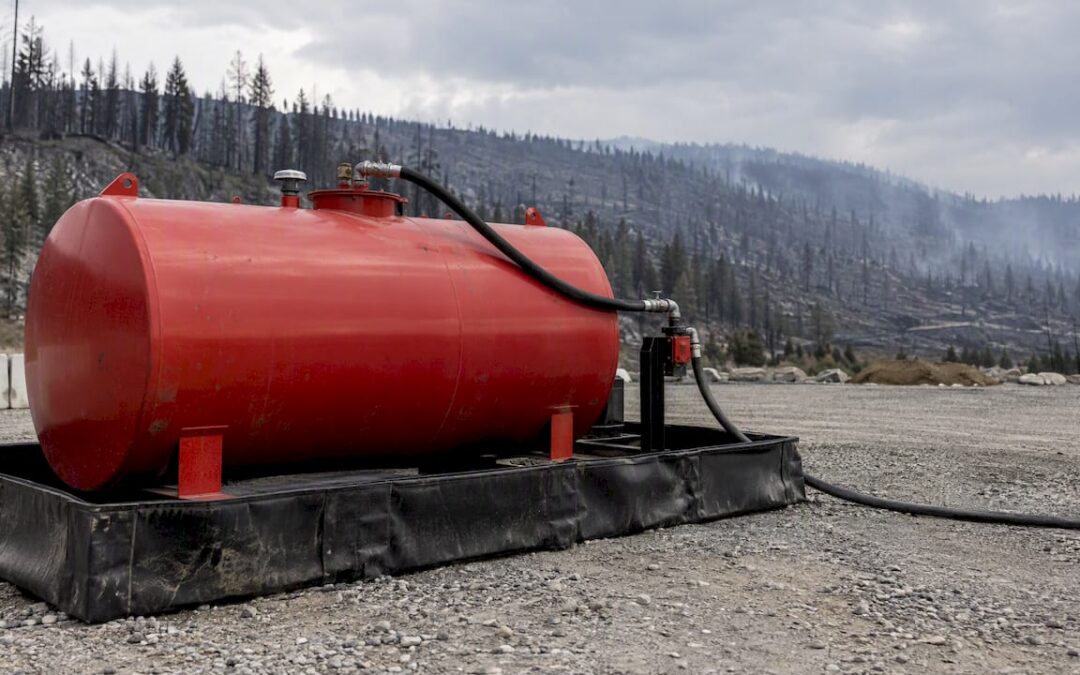
A wildfire fueling plan must guarantee continuous, compliant on-site fuel for response equipment, generators, and support vehicles, and it starts with three anchors: OSHA 29 CFR 1926.152 for portable tank storage, NFPA 30 for tank venting and placement, and NIFC fuel tender typing for ordering the right equipment. We supply scheduled and emergency diesel, gasoline, and DEF delivery to incident operations across Texas, Utah, and nationwide through our partner network, so this guide shows you exactly what to put in the plan before you order.
TL;DR:
- For immediate orders, specify product, gallons, dyed or clear diesel, delivery window, and GPS or landmark access notes; incomplete fields can produce mismatched deliveries.
- Type 1 tenders carry at least 3,501 gallons for sustained supply, while Type 3 tenders carry 500 to 2,500 gallons for mobile refueling.
- Outdoor portable tanks holding more than 660 gallons need fire apparatus access and clear surrounding space; OSHA guidance places extinguishers 25 to 75 feet away.
- For sustained base camp demand, use bulk delivery into a portable tank sized for peak daily draw, because average consumption can leave it empty during spikes.
- Before assigning a driver, verify the required commercial driver’s license and current medical certification; hazmat endorsement and incident safety orientation may also apply.
Table of Contents
- Core components every wildfire fueling plan needs
- How to order fuel resources during an active wildfire response
- Matching fuel tenders, bulk delivery, and portable tanks to the job
- Safety, storage, and regulatory requirements you cannot skip
- Integrating fuel logistics with ground support and site traffic
- Tracking, invoicing, and demobilization once fuel starts flowing
- Environmental protection and spill prevention during fuel deliveries
- Communication protocols between fuel teams and firefighting command
- Safety procedures specific to fueling operations in wildfire-affected areas
- Training and certifications for personnel handling incident fuel
- How Anytime Fuel Pros supports your wildfire fueling plan
- FAQ
- Sources
Core components every wildfire fueling plan needs
A procurement-ready plan is a checklist, not a narrative. Before the first tender rolls, confirm every line below is assigned to a name and a phone number, not a job title sitting empty in a binder.
- Roles: a Ground Support Unit Leader or logistics lead, a fueling specialist on shift, and a buying or contracting point of contact who can authorize orders beyond the tender’s capacity.
- Equipment authorizations: fuel tender type and count, bulk truck availability, portable tank specifications, secondary containment, and compatible pumps and hoses.
- Documentation fields: IROC/DPL resource codes, tender type, gallons by product, dyed versus clear diesel designation, and special access notes.
- Admin trail: invoicing format, receipt requirements, and a point of contact for payment disputes.
- Site logistics: staging location, approach and egress lanes, a communication plan with dispatch, and security coverage for parked fuel assets overnight.
Every one of these items feeds into how fast dispatch can fill an order once the incident escalates. A plan missing even one, like a blank buying-team contact, turns a routine resupply into a delay measured in hours, not minutes.
Pro Tip: Build your fueling plan as a fillable form, not a memo. Dispatch works faster from structured fields than from paragraphs.
How to order fuel resources during an active wildfire response
Ordering fuel during an incident splits into two tracks: what you need in the next few hours, and what you need to sustain operations for days. Treat them differently from the start.
- Define the immediate need first. Specify product type, gallons, whether off-road (dyed) diesel is acceptable, delivery window, and exact GPS or landmark access notes before calling dispatch.
- Submit through IROC/DPL with complete fields. Resource type, tender class, gallons requested, and any approach restrictions (narrow roads, locked gates, steep grades) all belong in the order; incomplete fields are the most common cause of mismatched deliveries.
- Watch for the tender capacity ceiling. Interagency dispatch guides note that immediate-need orders follow different approval rules than planned orders, so flag which track you’re on when you call it in.
- Escalate to a buying team or fuel contract once volume exceeds tender scope. Base camps running multiple generators and a fleet of heavy equipment typically outgrow single-tender support within the first operational period.
- Confirm operator credentials before the truck arrives. The NWCG Fueling Specialist position description requires a commercial driver’s license and current medical certification for anyone delivering to fireline, camp, or helibase locations.
Our emergency fuel delivery team fields exactly these calls, so having the gallon count and access notes ready when you dial in saves a callback cycle.
Matching fuel tenders, bulk delivery, and portable tanks to the job
Resource typing exists so dispatch can match the right truck to the right need without guessing. The 2026 National IBPA Guide sets four tender classes by capacity.
- Type 1 tenders carry 3,501 gallons or more and work best for base-camp supply or sustained front-line rotation.
- Type 2 tenders hold 2,501 to 3,500 gallons, a middle ground for mid-size camps or secondary staging areas.
- Type 3 tenders range from 500 to 2,500 gallons, suited to mobile refueling of scattered equipment.
- Type 4 tenders run 600 to 999 gallons, useful for tight access points where larger trucks can’t maneuver.
Tenders excel at mobile refueling but strain under sustained base-camp demand. For that, bulk truck-to-tank delivery into a staged portable tank keeps inventory centralized and cuts the number of tender hours logged on site, which matters for contract billing and vehicle wear alike. Size the portable tank to your camp’s peak daily draw, then build in margin, since a tank sized to average consumption runs dry on the one-day equipment use spikes.
Safety, storage, and regulatory requirements you cannot skip
Fuel storage compliance isn’t optional paperwork, it’s what keeps a staging area from becoming the next incident. Outdoor portable tank storage over 660 gallons must allow clear access for fire-suppression apparatus and stay free of combustible debris under 29 CFR 1926.152.
A 1,000-gallon diesel tank placed on an incident site falls under these same access and venting requirements, according to an OSHA standard interpretation letter, which also specifies that fire extinguishers should sit 25 to 75 feet from outdoor storage areas. That distance range is the kind of detail that gets missed when a staging plan is drawn up quickly under incident pressure.
Beyond extinguisher placement, confirm these before fuel touches the ground:
- Secondary containment under every tank and dispensing point to catch drips and small spills.
- An exclusion zone around active fueling operations, clear of open flame, smoking, and unrelated vehicle traffic.
- Contracted tenders meeting DOT and EPA vehicle compliance, with current registration and inspection records on hand.
- Operators holding the credentials their role requires, verified before the first delivery, not after.
Integrating fuel logistics with ground support and site traffic
Fuel delivery fails quietly when it’s treated as a separate errand instead of part of the incident transportation plan. The Ground Support Unit Leader carries direct responsibility for fuel supply planning and for folding fuel delivery into the incident’s transportation and traffic plans, not bolting it on afterward.
That means coordinating these pieces before the first truck shows up:
- A designated staging location with marked approach and egress lanes, communicated to dispatch and every contracted vendor in advance.
- Scheduling windows for tender rotations that avoid stacking multiple deliveries against the same access road at once.
- A direct line to the camp manager for base-camp fuel needs and to aviation operations when helibase fuel competes for the same road network.
- Coordination with local public works when incident traffic shares roads with community evacuation routes.
Large staging areas sometimes need crew and equipment movement planned alongside fuel delivery lanes; incident teams coordinating multi-vehicle camp logistics can apply the same scheduling discipline used in corporate event transportation planning to keep access roads from bottlenecking during shift changes.
Tracking, invoicing, and demobilization once fuel starts flowing
Every delivery needs a paper trail that survives an after-action review and a reimbursement audit.
- Capture the delivery record: location, gallons by product, operator name, timestamp, and signed receipt or manifest.
- Tag dyed versus clear diesel at the point of entry, since municipal or grant reimbursement often hinges on documented off-road fuel use.
- Review invoices against delivery records within the agreed window, flagging discrepancies immediately rather than at closeout.
- Reconcile final totals during demobilization, including tank removal, site inspection, and environmental handoff before the staging area closes.
Pro Tip: Keep delivery receipts and manifests in one running file from day one. Reconstructing them during demobilization costs far more time than logging them in real time.
Environmental protection and spill prevention during fuel deliveries
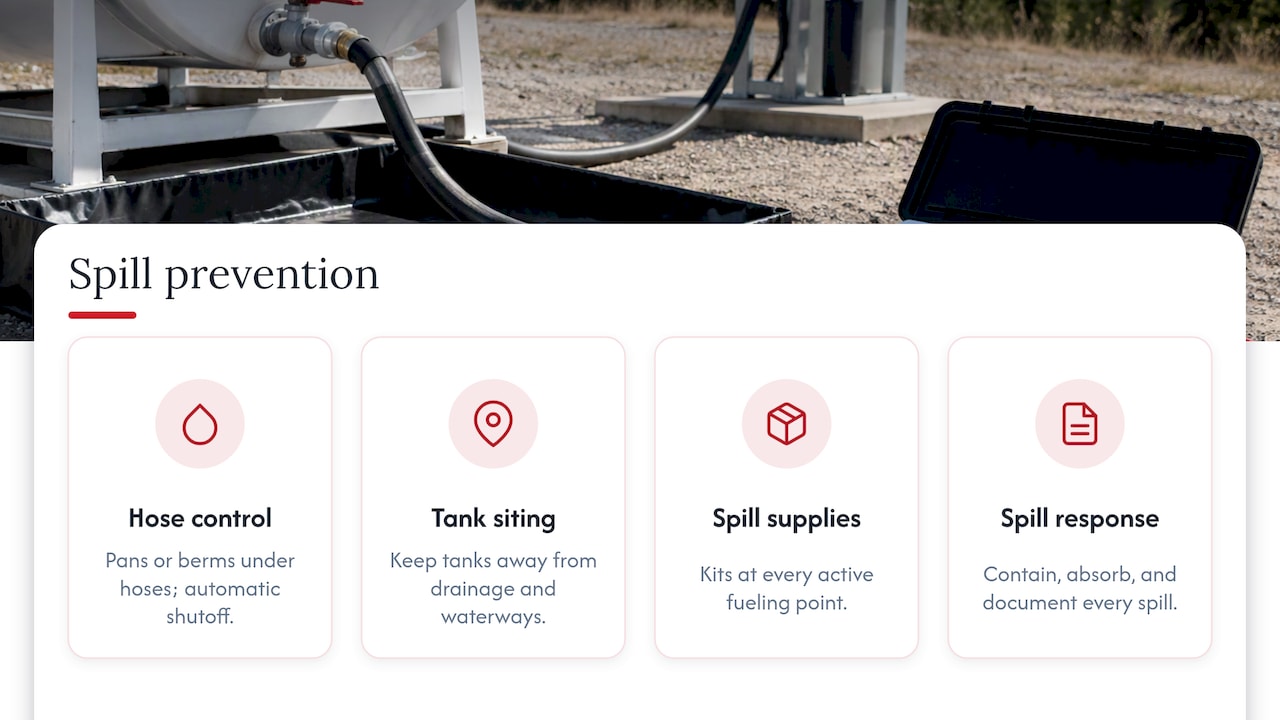
Spill prevention on a wildfire incident carries extra weight because the surrounding terrain is already stressed by fire, drought, and disturbed soil. Every delivery point needs drip pans or containment berms under hose connections, and dispensing nozzles should include automatic shutoff to prevent overfill during transfer.
Stage portable tanks away from drainage paths, waterways, and any area where runoff could reach a creek bed or containment pond. Keep spill kits, absorbent pads, and containment booms at every active fueling point, not just at the main staging area, since mobile refueling by tender happens away from the base camp’s supplies.
Train the on-site fueling specialist to respond to a small spill immediately: contain it, absorb it, and document it before it spreads or soaks into exposed ground. Our guide on diesel spill response actions covers the containment and cleanup sequence in more detail and works as a quick reference for crews unfamiliar with incident-specific protocols. Document every spill, however small, in the same log used for delivery records, since that documentation often matters for environmental handoff at demobilization.
Communication protocols between fuel teams and firefighting command
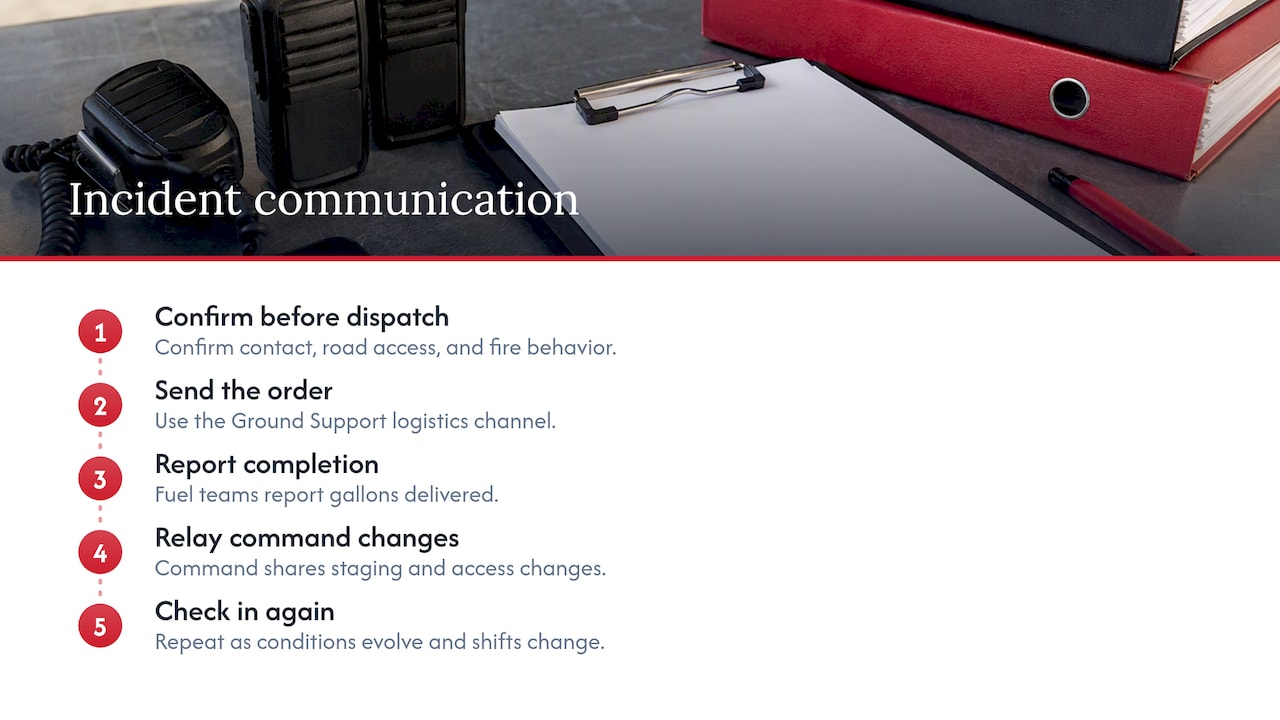
Fuel delivery crews operate inside the incident command structure, not alongside it. Every order, change, or delay needs to move through the same channel the Ground Support Unit Leader uses for other logistics requests, so dispatch and command see the same picture.
Before a tender or bulk truck enters an active area, the driver needs a confirmed radio channel or phone contact for the camp manager or staging area manager, current road and access conditions, and any changes to fire behavior that could affect the approach route. A delivery scheduled an hour earlier can become unsafe if containment lines shift, so confirming status immediately before dispatch saves a wasted trip or worse.
Status updates run both ways: fuel teams report when a delivery is complete and gallons delivered, and command relays any changes to staging locations or access restrictions as conditions evolve. Treat this as a standing check-in, not a one-time call, especially during multi-day operations when shift changes mean the person receiving the update isn’t the person who placed the order.
Safety procedures specific to fueling operations in wildfire-affected areas
Fueling near an active wildfire carries risks that don’t exist on a typical job site: ash and embers in the air, unstable ground from firefighting activity, and reduced visibility from smoke. Every fueling point needs a cleared buffer from standing vegetation, not just the containment measures required under normal storage rules.
Operators should inspect the ground around a staging site for hot spots or smoldering debris before setting up, since a tank placed too close to a reignited area turns a storage decision into an emergency. Keep engines running during transfer only when required for pump operation, and shut down unnecessary equipment nearby to reduce ignition sources.
PPE matters more in these conditions: respiratory protection for smoke exposure, flame-resistant clothing for personnel working near active fuel transfer, and eye protection against ash and debris. Exclusion zones around fueling operations should account for ember fallout distance, not just the standard extinguisher placement distances that apply under ordinary storage conditions.
Training and certifications for personnel handling incident fuel
Anyone handling fuel on a wildfire incident needs credentials that match the job, not general familiarity with fuel equipment. The NWCG Fueling Specialist position description requires a commercial driver’s license and current medical certification for personnel delivering fuel to fireline, helibase, airport, base, or spike camp locations.
Beyond the CDL, operators handling bulk diesel transfer typically need hazmat endorsement where state or federal rules apply to the volumes being moved, along with basic spill response training so a small leak gets contained before it spreads. Crews working inside an active incident perimeter also need wildfire-specific safety orientation covering fire behavior awareness, evacuation triggers, and communication protocols with command, since standard fuel delivery training doesn’t cover those conditions.
Verify every operator’s credentials before they’re assigned to a wildfire incident, not after a delivery is already scheduled. A tender capable of showing up with the right gallons is only useful if the person driving it is cleared to work inside the incident perimeter.
How Anytime Fuel Pros supports your wildfire fueling plan
We deliver diesel, gasoline, DEF, and bulk fuel on-site for incident operations, providing emergency response and access to a partner network for extended coverage across multiple states. This single-point-of-contact approach helps simplify logistics by coordinating through one vendor relationship during an active response instead of multiple regional contractors.
We fit into tender rotations for front-line refueling and into base-camp bulk replenishment through scheduled bulk fuel delivery, so your plan can lean on one supplier for both tracks. When you request service, include:
- Gallons needed by product.
- Delivery window and whether the need is immediate or scheduled.
- Site access notes, including road conditions and any locked or restricted entry points.
- Operator credential requirements if site access demands specific clearances.
Request support through our emergency fuel delivery page or review full service details on our fuel services page before your next incident briefing.
FAQ
What is a wildfire fueling plan?
A wildfire fueling plan is the fuel supply and delivery strategy an incident team puts in place to keep response equipment, generators, and vehicles running without interruption. It covers resource typing, ordering procedures, safety compliance, and documentation for every fuel delivery during the response.
What are the fuel tender types used in wildfire response?
Fuel tenders are classified into four types by capacity under the National IBPA Guide: Type 1 carries 3,501 gallons or more, Type 2 holds 2,501 to 3,500 gallons, Type 3 ranges from 500 to 2,500 gallons, and Type 4 runs 600 to 999 gallons. Dispatch matches tender type to the site’s access and demand before ordering.
Who is responsible for fuel supply planning on an incident?
The Ground Support Unit Leader holds responsibility for fuel supply planning and for integrating fuel delivery into the incident’s transportation and traffic plans. This role also oversees vehicle maintenance and coordinates fueling schedules with other ground support functions.
What credentials does a fuel delivery operator need on a wildfire incident?
Fuel delivery personnel typically need a commercial driver’s license and current medical certification, as outlined in the NWCG Fueling Specialist position description. Depending on volume and product, hazmat endorsement and incident-specific safety orientation may also apply.
Does Anytime Fuel Pros handle emergency fuel delivery for wildfire response?
Yes, we provide emergency fuel delivery along with scheduled bulk fuel, diesel, gasoline, and DEF service for incident operations. Coverage extends across our primary Texas and Utah markets and nationwide through our partner network, with requests handled through our emergency fuel delivery page.
Sources
- OSHA 29 CFR 1926.152 — Flammable and Combustible Liquids
- 2026 National IBPA Guide — Fuel Tender typing and requirements
- Fueling Specialist — NWCG position description
- Ground Support Unit Leader — FEMA NIMS guidance
Recent Comments