
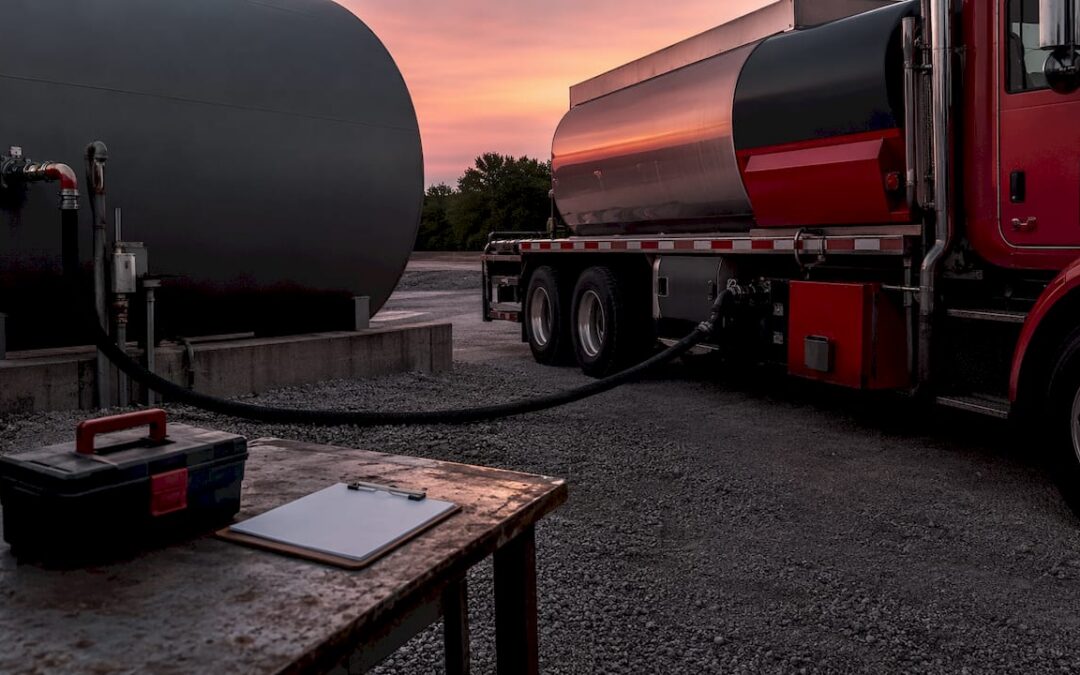
A fuel top-off service is an on-site refueling visit where a licensed delivery driver brings fuel directly to your vehicles, generators, or equipment tanks and fills them to a target level, without your crew leaving the site. For fleet managers and facilities directors, that distinction matters operationally: no detours, no dry tanks, no condensation building in half-empty storage.
Think of it as preventive maintenance for your fuel supply. Keeping tanks fuller reduces the headspace where temperature swings drive condensation, which in turn lowers water accumulation and microbial contamination risk in stored diesel. For backup generators at data centers or long-idle equipment on job sites, that fuel quality protection is as important as the convenience.
Quick reference:
- Who uses it: Fleet yards, construction sites, data centers, event operators, mining operations, municipal agencies
- Delivery types: Scheduled recurring, one-off scheduled, and emergency on-demand
- Fuels delivered: Clear diesel, red-dyed diesel, gasoline, DEF
- Readiness triggers: Low tank level, pre-season fill, post-event recovery, generator test cycle
Anytimefuelpros provides all three delivery models across Texas, Utah, and the continental United States, through its national partner network.
Table of Contents
- What does a fuel top-off service actually include?
- How does the fuel top-off process work, start to finish?
- Which operations benefit most from scheduled top-offs?
- What safety and compliance items must you verify before contracting?
- How is a fuel top-off service priced?
- Procurement checklist: questions to ask every provider
- How to prepare your site for a top-off delivery
- Key Takeaways
- Anytimefuelpros delivers when your operation cannot afford to wait
- Useful sources and further reading
What does a fuel top-off service actually include?
A standard top-off delivery covers more than just gallons. Here is what procurement should expect in a typical scope of service:
- Fuel types: Clear (on-road) diesel, red-dyed (off-road) diesel, unleaded gasoline, and DEF. Some providers also carry premium blends or winter-additive treated diesel.
- Pump and wet-hose options: Metered pump trucks for direct wet-hosing into vehicle tanks, or bulk fill into storage tanks and day tanks on site.
- Per-visit volume limits: Industry practice for a preventive maintenance top-off is a typical preventive maintenance top-off volume per visit. That ceiling fits most day tanks and light equipment; bulk storage tanks require a separate bulk delivery contract.
- Metering and flow rates: Calibrated meters on the delivery truck record exact gallons dispensed. Flow rates vary by pump configuration, typically 30–100 gallons per minute for commercial units.
- Containment equipment: Reputable providers carry spill kits and drip pans on every truck. Secondary containment at the fill point is the site’s responsibility, but the driver should not proceed without it in place.
- Scheduling options: Recurring scheduled visits (daily, weekly, or monthly), one-off scheduled top-offs, and emergency on-demand calls.
- Verification: Delivery ticket, meter reading, driver photo log, and digital confirmation sent to the account contact.
For bulk fuel storage needs that exceed per-visit limits, a separate bulk delivery agreement with tank rental is the right structure.
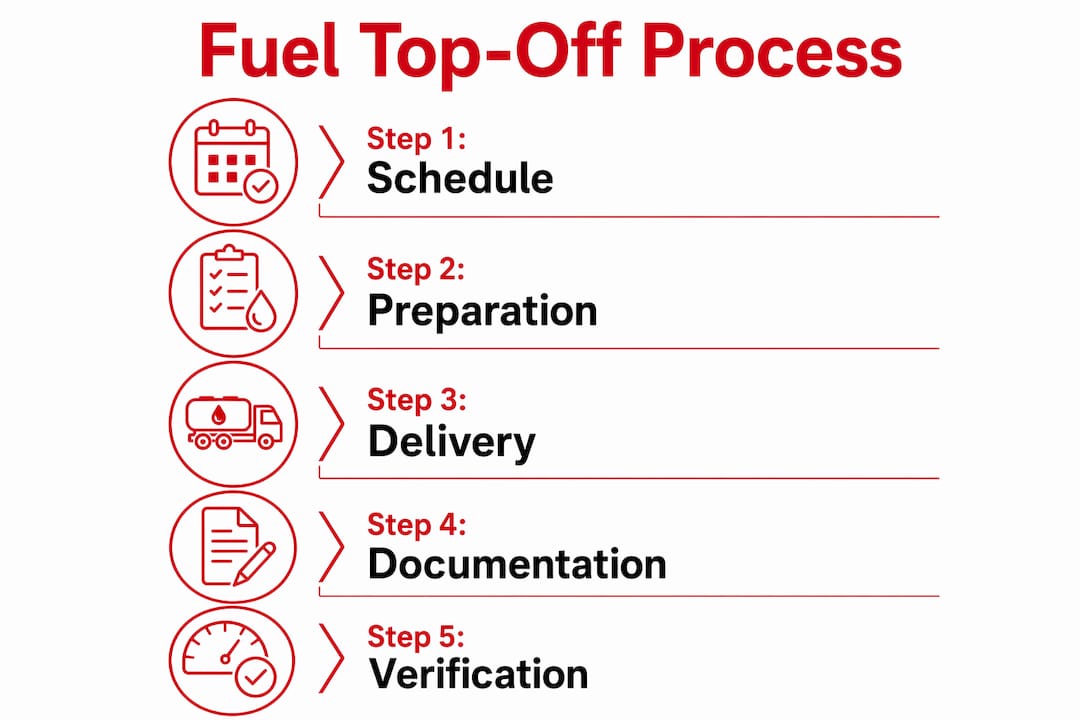
How does the fuel top-off process work, start to finish?
The sequence below applies to both scheduled and emergency deliveries, with timing differences noted.
- Request and scheduling. Submit via phone, app, or account portal. Scheduled visits are confirmed 24–48 hours in advance; emergency requests trigger same-day or after-hours dispatch. Mobile fuel services commonly offer app-based scheduling with real-time ETA tracking.
- Pre-delivery notification. The driver sends an ETA alert (text or email) before arrival. Use this window to confirm gate access, clear the approach path, and notify your site safety lead.
- On-site delivery. The driver presents DOT paperwork, positions the truck per your site’s fueling SOP, zeros the meter, and begins the fill. Wet-hosing goes directly into vehicle tanks; bulk fills go into storage tanks. The driver monitors the fill and stops at the agreed target level.
- Verification and acceptance. At completion, the driver produces a printed or digital delivery ticket showing gallons dispensed, meter start/end readings, and a photo of the tank gauge before and after. You or your designee signs off. Digital confirmations are sent automatically to the account contact.
- Invoicing and reconciliation. Billing is per-gallon plus any delivery fee or minimum, processed automatically or on your billing cycle. Match the delivery ticket to the invoice line by line before approving payment.
Pro Tip: Zero the meter in front of the driver before the fill starts, and photograph the tank gauge yourself. That 30-second step eliminates the most common billing disputes before they start.

Which operations benefit most from scheduled top-offs?
The use case determines the delivery model. Here is how the most common scenarios map out:
- Backup generators at data centers and critical facilities. Generators sitting at 50% or below are a liability during a grid event. Scheduled top-offs keep tanks at 90%+ and prevent condensation that degrades standby fuel over time.
- Fleet yards and trucking operations. Wet-hosing directly into vehicle tanks overnight means drivers start every shift with a full tank. No pump queues, no off-site fuel runs, no lost dispatch time.
- Construction and excavation sites. Excavators, dozers, and telehandlers burn through diesel fast. On-site fueling for construction eliminates the dead time of sending equipment or a fuel runner to a retail station mid-shift.
- Events and entertainment. Generator-dependent festivals and film productions need fuel on a predictable schedule. Emergency top-offs cover unexpected load spikes.
- Seasonal pre-fills. Pre-winter fills reduce condensation risk and ensure treated diesel is in the tank before temperatures drop. Pre-holiday fills protect logistics operations during peak demand.
- Multi-site accounts. Subscription and fleet plans with consolidated invoicing reduce administrative overhead across locations. Fleet subscriber models allow recurring fills and single-account billing, which procurement teams prefer over managing multiple regional vendors.
The industries that benefit most from on-site delivery share one trait: downtime costs more than the fuel.
What safety and compliance items must you verify before contracting?
This is where procurement earns its keep. A provider without the right credentials creates liability exposure for your operation.
Insurance certificates to request:
- General liability (ask for limits, not just proof)
- Pollution liability, specifically for fuel spills
- Workers’ compensation
- Commercial auto coverage for all delivery vehicles
Regulatory identifiers to confirm:
- USDOT number and MC number for interstate carriers
- HazMat endorsement on the driver’s CDL
- Written fueling SOPs and driver training records
Environmental controls to verify on-site:
- Spill kits carried on every delivery truck
- Secondary containment at all fill points
- Winterization procedures to prevent condensation and microbial growth in stored fuel
Contract language to demand:
- Written response-time SLAs for emergency deliveries
- Incident reporting procedures and escalation contacts
- Indemnity and environmental remediation responsibility clauses
Providers who hesitate on any of these items are a risk. Require documented proof of insurance and DOT credentials before the first delivery.
How is a fuel top-off service priced?
Pricing has several moving parts. Understanding each one lets you compare quotes accurately.
| Pricing factor | What drives the cost |
|---|---|
| Fuel unit cost | Spot price plus supplier margin; fluctuates daily |
| Delivery fee | Distance from depot, route density, and truck type |
| Emergency surcharge | After-hours or same-day dispatch premium |
| Minimum order | Minimum gallons per visit; below-minimum calls carry a flat fee |
| Equipment rental | Portable tank or pump rental for sites without storage |
Contract models to consider:
- Pay-per-delivery: Best for irregular or low-frequency needs. Full flexibility, higher per-gallon cost.
- Recurring subscription: Fixed schedule with volume commitments. Lower per-gallon rate, predictable budgeting.
- Prepaid credit line: Lock in a volume at a negotiated price. Useful when prices are rising.
- Emergency retainer: Guaranteed response window (e.g., 4-hour SLA) for a monthly fee. Standard for data centers and critical facilities.
Red-dyed diesel typically prices differently from clear diesel due to tax treatment. Access difficulty, required certifications, and on-site hazards all add to the delivery fee. Mobile fuel delivery cost savings often offset the delivery fee when you factor in crew time and equipment idle costs.
Procurement checklist: questions to ask every provider
Use this list in your RFP or initial vendor call.
Must-have verifications:
- [ ] Certificate of insurance (GL, pollution liability, workers’ comp, commercial auto)
- [ ] USDOT and MC numbers
- [ ] HazMat endorsement on driver CDLs
- [ ] Written fueling SOPs and driver training records
- [ ] Sample delivery ticket showing metered gallons and photo log
- [ ] Written emergency response SLA with defined response window
- [ ] National partner network or confirmed coverage for all your sites
Questions to ask during bid:
- What is your average emergency response time in our area?
- Can you provide a sample delivery ticket and digital confirmation?
- Do you offer contactless delivery for unattended sites?
- What is your billing cycle and dispute resolution process?
- Can you provide references from similar industries (data centers, construction, fleet yards)?
Contract clauses to include:
- Performance SLAs with defined penalties for missed windows
- Minimum volume commitments and termination for non-performance
- Environmental remediation responsibility in the event of a spill
- Indemnity language covering third-party claims
How to prepare your site for a top-off delivery
Preparation prevents delays and safety incidents. Run through this before every scheduled or emergency delivery.
Access and logistics:
- Clear the approach path for a tanker truck (minimum 14-foot clearance height, adequate turning radius)
- Provide gate codes or a contact person who will be on-site during the delivery window
- Designate a staging area away from ignition sources
Tank and containment prep:
- Confirm fill points are accessible and caps are operable
- Verify secondary containment is in place and unobstructed
- Mark hazard zones with cones or barriers before the driver arrives
Communications:
- Pre-notify your site safety lead and any subcontractors working near the fueling area
- Confirm PPE requirements (safety glasses, gloves) for anyone near the fill point
- Know where your spill-response kit is located and confirm it is stocked
Timing expectations:
- Scheduled top-offs: 24–48 hour lead time for confirmation; on-site fill time depends on gallons and flow rate (a moderate fill at typical flow rates takes approximately 1-2 minutes at the pump, plus setup and verification time)
- Emergency deliveries: response windows vary by provider and SLA; confirm yours in writing before you need it
Pro Tip: For unattended deliveries, set up a contactless delivery protocol with pre-authorized access instructions and automatic post-delivery notifications. It reduces site disruption and keeps your team focused on the job.
Key Takeaways
A fuel top-off service is the most direct way to protect uptime, fuel quality, and operational continuity for fleets and critical facilities.
| Point | Details |
|---|---|
| Preventive maintenance framing | Regular top-offs reduce condensation and microbial contamination risk in stored diesel. |
| Scheduled vs. emergency models | Use recurring subscriptions for predictable demand; retain an emergency SLA for critical facilities. |
| Three procurement must-haves | Require proof of insurance (GL and pollution liability), USDOT/MC numbers, and a written response-time SLA. |
| Site prep reduces risk | Clear access, verified containment, and pre-notified safety leads prevent delays and incidents. |
| Anytimefuelpros | Provides scheduled, emergency, and bulk top-offs with metered delivery, DEF, and nationwide coverage. |
Anytimefuelpros delivers when your operation cannot afford to wait
Running a fleet, a job site, or a critical facility on a tight schedule means fuel gaps are not an inconvenience — they are a production stop. Anytimefuelpros handles scheduled recurring top-offs, emergency same-day dispatch, bulk tank fills, DEF delivery, and multi-site account management across Texas, Utah, and the continental United States. Every delivery comes with metered tickets, photo verification, and transparent per-gallon invoicing. Proof of insurance, USDOT registration, HazMat-endorsed drivers, and documented SOPs are standard, not optional extras.
Whether you need a diesel fuel delivery SLA for a data center generator or a recurring wet-hose schedule for a 50-truck yard, Anytimefuelpros builds the contract around your operation. Request a site-specific quote or set up your emergency response account today.
Useful sources and further reading
- How On-Site Fuel Delivery Can Elevate Your Business — AFP’s capabilities, markets served, and E-E-A-T proof points including insurance and DOT credentials.
- On-Site Diesel Delivery Setup: A Guide for Operations Managers — Step-by-step setup guidance for access, containment, and scheduling.
- Bulk Fuel Delivery and Storage on Job Sites — Tank rental options and bulk delivery requirements for sites exceeding per-visit limits.
- Top Industries That Benefit Most from On-Site Diesel Delivery — Industry-by-industry breakdown of use cases and operational benefits.
- Fuel Knowledge Hub — Operational tips, compliance guidance, and best practices from the AFP team.
“Keeping tanks fuller reduces the headspace where temperature swings drive condensation — lowering water accumulation and microbial contamination risk in stored diesel. For backup generators and long-idle equipment, that fuel quality protection is as operationally critical as the delivery itself.” — Anytimefuelpros operational guidance
Recommended
- How Fuel Delivery Reduces Fleet Downtime for Managers
- Mobile Fuel Delivery Explained: How This Can Save Your Business Money – Anytime Fuel Pros
- Fuel Delivery at the Heart of Winter Operations: How On-Site Services Keep Businesses Running – Anytime Fuel Pros
- From Refineries to Your Fleet: How Diesel Fuel Gets Delivered – Anytime Fuel Pros
Recent Comments