

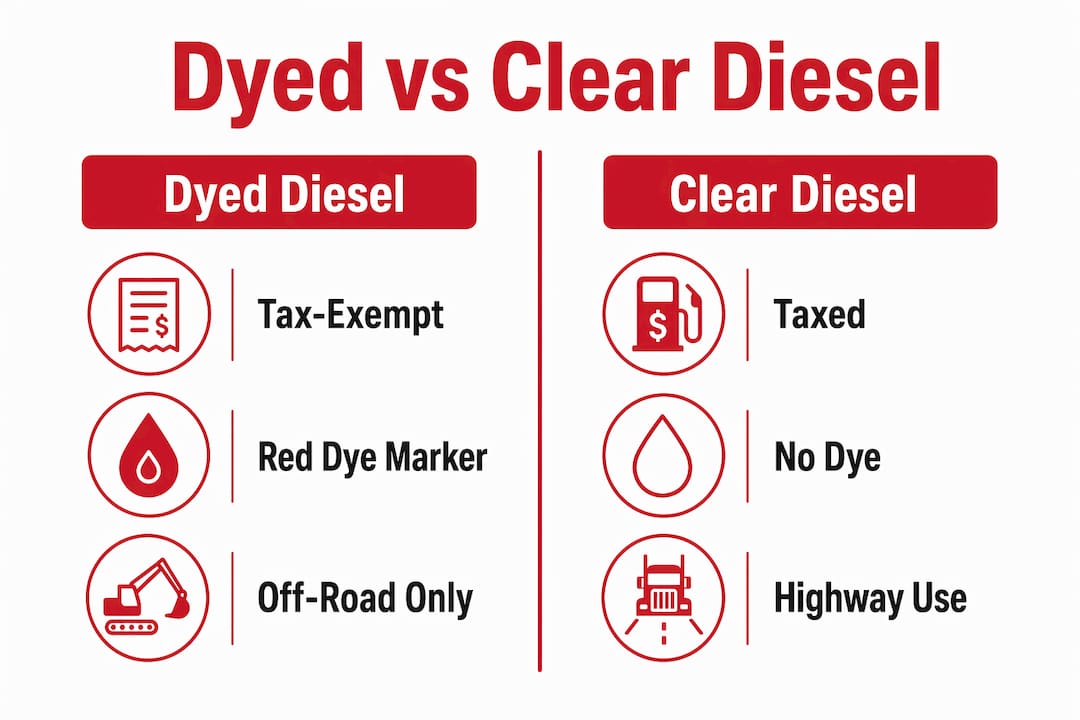
Dyed diesel fuel is diesel marked with red dye to indicate it is tax-exempt and restricted to off-road, non-highway use. The dye itself is a regulatory marker, not a performance additive. Chemically, dyed diesel is identical to the clear diesel that runs highway trucks and fleet vehicles. The distinction matters enormously for operations managers, fleet supervisors, and procurement officers because using the wrong fuel in the wrong equipment carries federal penalties that start at $1,000 per incident. Understanding what is dyed diesel fuel, who can legally use it, and how to manage it is a compliance requirement, not optional knowledge.
What is dyed diesel fuel used for?
Dyed diesel is restricted to non-highway use in equipment that does not operate on public roads. That restriction is the foundation of the entire regulatory framework. The tax exemption exists because the federal excise tax on clear diesel funds highway infrastructure. Equipment that never touches a public road has no obligation to fund that infrastructure, so it qualifies for tax-exempt fuel.
Authorized uses of dyed diesel fuel span a wide range of industries:
- Farm tractors and agricultural equipment. Combines, planters, irrigation pumps, and other farm machinery qualify. Agriculture is one of the largest consumers of dyed diesel in the United States.
- Construction and excavation equipment. Excavators, bulldozers, loaders, compactors, and skid steers running on job sites are all eligible.
- Stationary engines and generators. Backup generators at data centers, hospitals, and industrial facilities run on dyed diesel legally.
- Marine vessels. Commercial fishing boats, barges, and other watercraft qualify under federal rules.
- Mining equipment. Haul trucks, drills, and loaders operating within mine boundaries are authorized users.
- Government and municipal exceptions. School buses, fire trucks, and highway maintenance vehicles operated by government entities may use dyed diesel on public roads under specific licensing conditions.
The government exception is worth noting for municipal fleet managers. A licensed government agency can fuel certain on-road vehicles with dyed diesel, but the licensing requirement is strict and the documentation burden is real. Operating outside that license is treated the same as any other misuse.
How is dyed diesel fuel identified and regulated?
The dyeing process is not optional and not informal. Federal law requires red dye to be mechanically injected at IRS-registered terminals before the fuel ever reaches a buyer. The specific dye used is Solvent Red 164, and its concentration must meet the spectral equivalence standard defined under 26 CFR §48.4082-1. That standard is precise enough that diluting dyed diesel with clear diesel does not remove the dye or eliminate legal liability.
Compliance enforcement follows a straightforward sequence:
- Visual inspection at the point of use. Inspectors check fuel tanks in on-road vehicles for red coloring. A red-tinted tank in a highway truck is immediate evidence of a violation.
- Terminal audit. Regulators verify that licensed terminals are injecting dye at the correct concentration and maintaining proper records.
- Fuel sampling. State and federal inspectors can pull fuel samples from storage tanks, equipment, and delivery vehicles to confirm dye presence or absence.
- Record review. Buyers of dyed diesel must maintain purchase records that document the fuel’s intended use. Missing records compound the penalty exposure.
- Cross-state enforcement. Federal rules apply nationwide, but states layer additional requirements on top. Texas, Utah, Idaho, and Washington each maintain their own dyed diesel enforcement programs.
The dye concentration standard under 26 CFR §48.4082-1 is spectrally defined, meaning lab analysis can detect it even in heavily diluted samples. This is why the common misconception that you can “clear out” dyed diesel by mixing it with regular diesel is both wrong and dangerous.
Pro Tip: Never attempt to dilute or filter red dye from diesel. The dye concentration standard is spectrally defined, meaning even trace amounts are detectable. Attempting removal signals intent to evade tax, which escalates the penalty exposure significantly.
What are the penalties and risks of misusing dyed diesel fuel?
The penalty structure for dyed diesel misuse is one of the most unforgiving in federal excise tax law. Federal penalties start at $1,000 per tank or $10 per gallon, whichever is greater. These penalties stack on top of any unpaid excise taxes owed. There are no reasonable cause exceptions. Intent does not matter.
“Decision-makers must treat dyed diesel compliance as a zero-tolerance operation. Accidental misuse carries the same penalty as intentional misuse under federal law.”
The most common violation scenarios in commercial operations include:
- Accidental fueling from job-site tanks. A driver fills a registered work truck from the same tank used for excavators on site. This is the most common source of violations in construction and excavation operations.
- Mixed fleet management errors. A fleet manager fails to segregate on-road and off-road fuel supplies, and a highway vehicle gets dyed diesel during a routine fill.
- Inherited equipment violations. A company purchases used equipment with residual dyed diesel in the tank and operates it on public roads before draining and refueling.
- Inadequate staff training. Fueling crews without clear protocols make errors that expose the entire operation to audit and penalty.
State penalties add another layer. Washington State, for example, imposes fines starting around $250 per violation on top of federal exposure. A single fueling error on a multi-truck job site can generate multiple violations simultaneously, one per vehicle. The financial multiplier effect is significant and fast.
How does dyed diesel compare with regular (clear) diesel?
Dyed diesel and clear diesel are chemically identical ASTM D975 Grade 2-D S15 fuel. The red dye is a compliance marker with no effect on engine performance, fuel economy, or emissions. A generator running on dyed diesel performs exactly the same as one running on clear diesel. The difference is entirely legal and financial.
| Factor | Dyed diesel | Clear diesel |
|---|---|---|
| Chemical composition | ASTM D975 Grade 2-D S15 | ASTM D975 Grade 2-D S15 |
| Color | Red (Solvent Red 164) | Clear to light amber |
| Federal excise tax | Exempt (saves 24.3 cents per gallon) | Taxed at 24.3 cents per gallon |
| Authorized use | Off-road equipment, generators, marine | On-road highway vehicles |
| Engine performance | Identical to clear diesel | Identical to dyed diesel |
| Penalty for misuse | $1,000 per tank or $10 per gallon | No penalty for standard use |
The tax exemption of 24.3 cents per gallon adds up fast for high-volume operations. A construction site burning 10,000 gallons per month saves $2,430 monthly compared to buying taxed clear diesel. That savings is the economic engine behind dyed diesel adoption in agriculture, mining, and construction.
Cross-contamination is the operational risk that the cost savings can obscure. Fuel storage areas that hold both dyed and clear diesel require physical separation, clear labeling, and enforced fueling protocols. A single mislabeled tank or inattentive fueling crew can erase months of tax savings in a single penalty event.
Pro Tip: Color-code your fuel storage infrastructure. Use red caps, red hoses, and red labels exclusively for dyed diesel storage. Visual differentiation at the point of fueling is the single most effective way to prevent accidental cross-contamination on busy job sites.
For a deeper breakdown of how these fuels interact with fleet fuel management, the operational distinctions go beyond color.
What best practices should professionals follow for dyed diesel compliance?
Compliance with dyed diesel regulations is an operational discipline, not a one-time checkbox. The following practices protect operations from penalty exposure and keep fuel costs predictable.
- Physically segregate fuel supplies. Store dyed diesel and clear diesel in separate, clearly labeled tanks. Never share hoses, nozzles, or pumps between the two fuel types without a full purge and documentation.
- Establish written fueling protocols. Every fueling crew member needs a written procedure that specifies which fuel goes into which equipment. Verbal instructions are not sufficient when a federal inspector is reviewing your records.
- Train staff at onboarding and annually. Fueling errors spike when new crew members join a site without proper orientation. Annual refreshers keep compliance awareness active across the team.
- Maintain purchase and usage records. Document every dyed diesel purchase with the supplier invoice, the intended use, and the equipment fueled. Keep records for a minimum of three years to cover standard audit windows.
- Conduct internal fuel audits quarterly. Walk your storage area, check labels, inspect hoses, and verify that on-road vehicles are not drawing from dyed diesel tanks. Catching a protocol breakdown internally costs nothing. Catching it during a federal inspection costs at minimum $1,000 per vehicle.
- Work with a compliant fuel delivery partner. A delivery provider that manages on-site diesel delivery with proper documentation reduces your administrative burden and creates a defensible paper trail.
The risk of accidental fueling from shared job-site tanks is the most preventable compliance failure in the industry. Physical separation and written protocols eliminate the vast majority of accidental violations before they happen.
Pro Tip: Assign one person per site as the designated fuel compliance lead. That person owns the records, conducts the quarterly audit, and is the single point of contact for any fuel-related questions. Diffused responsibility is the root cause of most compliance failures.
How Anytimefuelpros delivers dyed diesel with compliance built in
Anytimefuelpros delivers on-site dyed diesel directly to job sites, equipment yards, mining operations, and generator facilities across Texas, Utah, and nationwide through its partner network. Every delivery comes with proper documentation, clear invoicing, and the fuel segregation your compliance records require.

Operations that rely on dyed diesel for excavators, generators, agricultural equipment, or marine vessels cannot afford fueling errors. Anytimefuelpros eliminates the trip to the pump, reduces the risk of cross-contamination, and gives your compliance team a clean paper trail on every delivery. The benefits of professional fuel delivery extend well beyond convenience. They directly reduce your penalty exposure. Whether you manage a single construction site or a multi-state fleet, Anytimefuelpros provides the fuel and the documentation your operation needs to stay compliant and keep moving.
Key takeaways
Dyed diesel fuel is legally identical to clear diesel in performance but carries strict tax-exempt status that restricts its use to off-road equipment, with federal penalties of at least $1,000 per violation for misuse.
| Point | Details |
|---|---|
| Definition and purpose | Dyed diesel is tax-exempt diesel marked with Solvent Red 164 for off-road use only. |
| Chemical identity | Dyed and clear diesel are the same ASTM D975 Grade 2-D S15 fuel; the dye has no effect on performance. |
| Tax savings | The federal excise tax exemption saves 24.3 cents per gallon compared to taxed clear diesel. |
| Penalty exposure | Federal fines start at $1,000 per tank or $10 per gallon with no exceptions for accidental misuse. |
| Compliance priority | Physical fuel segregation, written protocols, and documented records are the core of dyed diesel compliance. |
FAQ
What is red dyed diesel fuel?
Red dyed diesel fuel is standard diesel marked with Solvent Red 164 to indicate it is tax-exempt and approved only for off-road equipment. The red color is a federal compliance marker, not a performance distinction.
Can you use dyed diesel in a regular truck?
No. Using dyed diesel in a highway-registered vehicle is a federal violation carrying fines of at least $1,000 per tank or $10 per gallon, with no exceptions for accidental use.
Is dyed diesel the same quality as clear diesel?
Yes. Dyed and clear diesel are chemically identical ASTM D975 Grade 2-D S15 fuel. Engine performance, fuel economy, and emissions are the same regardless of dye.
Can you remove red dye from diesel fuel?
No effective or legal method exists to remove red dye from diesel. The dye concentration standard is spectrally defined, meaning lab analysis detects it even in diluted samples. Attempting removal is treated as tax evasion.
Who can legally use dyed diesel on public roads?
Licensed government entities operating vehicles like fire trucks, school buses, and highway maintenance equipment may use dyed diesel on public roads under specific state and federal licensing conditions.
Recent Comments